Third Annual Zeitgeist Media Festival Aug. 3-4, 2013: LA and Global! Avalon, Hollywood3:00 pm-10:00 pm (doors at 2:00) with sympathetic global events: 8/2/13 to 8/4/13.
“Changing the World Through Socially Conscious Art”
It was a festival of full-spectrum conviction, overflowing with compelling emotions that reflect the real [troubles] pressing in upon our emerging global society with accelerating force. In this sense this now-annual festival is a natural outgrowth of a growing, terrestrial upheaval that is going to
leave no part of the human collective being untouched. - Hollywood Today
A swarm of suspected genetically manipulated "Africanized"killer bees attacked Kristen Beauregard and her boyfriend in Pantego, North Texas, as they were exercising miniature horses.— Science World Report
Sighting of the figure, which appears covered in thick black hair and is seen lumbering across the mountain top, has sparked plenty of excitement among Bigfoot fans.— News.com.au
A newly discovered way to determine the spin of monster black holes could help shed light on the evolution of these bizarre objects and the galaxies they anchor.— Space.com
Honey bees are being fitted with tiny radar antennae to find how disease and pesticides are effecting the insects as they hunt for food.— The Telegraph
The humanoid robot, developed and built by mechatronics engineer Ben Schaefer, mixes drinks for guests at the Robots Bar and Lounge in Ilmenau, eastern Germany.— Mail Online
The NSA is now building a facility that will make it more than seven times the size of the Pentagon, making the secretive compounds the biggest in the country.— Mail Online
Brightly colored little patches that stick on clothing or backpacks could represent an effective new way to fight mosquitoes and the deadly illnesses they spread.— Discovery News
Two security experts in the US have demonstrated taking control of two popular models of car, while someone else was driving them, using a laptop.— BBC News
Eyewitnesses report hearing howls, whoops, growls, screams, mumbles, whistles and other strange vocalizations in the wild, and attribute these to Bigfoot.— Scientific American
Fatty Nobuckle (edited by Ashley Wells and Seven), Wisdom Quarterly
"If you don't move, you get fat." But howcan you move when you're exhausted and your brain and heart are telling you they're starving and when plastics and chemicals are making you obese even as you diet? Meanwhile, the diet industry, food corporations, and cancer centers grow rich.
Okay, I give up. I look like Java the Hut. I wear sweats without ever dreaming of going to the gym in them. I wear them because they're comfy. And I'm sloppy. It wasn't always this way.
I used to have hope and a routine. I ate well and I jogged. But I could never get over the hump, never beat the Battle of the Bulge. My spare tire became a saggy, over inflated mess.
It's not easy looking in the mirror now. I used to like what I saw, in general, but even then I would nitpick. I was trying to criticize myself to thin.
Tony Tiganis, lead author of a study published in the journal Cell Metabolism, says our bodies produce leptin in response to increasing fat. [That makes us fatter.]
What works is accepting, loving, and doing. But what I found was holding me back are chemicals in foods. First, there are the excitotoxins that practically force me to overeat. It's true. Why are these allowed? MSG is well known, but flavorants, dough conditioners, "natural" flavors that are anything but natural, sugars, empty calories, salt, acrylamides (from frying and "browning"), cancer-causing substances that we run to because someone somewhere is tricking our biology.
How I feel when I eat not to be empty
We are drawn to sweets, fats, and salts. Without leptin, or having become insensitive to it, we don't know we've had enough. The brain is starving as we're fattening up.
Craving sweets, fats, and salts is an evolutionary adaptation, because they were once scarce in the environment. Now they are abundant. So now it is maladaptive. The brain hasn't changed to compensate for the world the food corporations have created. And we'll be deceased due to obesity long before our brains catch up.
There is no reason to eat carbs at all. We can live without them. Yet they are 40 percent of our diet. They make and keep us fat. Once we get caught in the loop of fast, guilt-producing fake food.
We need (unadulterated) fats. We need clean protein. We need vitamins and minerals (like GTC Chromium) and the great things in greens.
You don't "need" grass seeds and their germ reserve. That is what grains are. That is where flour comes from. Wheat and corn, like milk and cheese, are FATTENING and unnecessary. I now avoid them completely. Beer is decomposing grain sugar with lots of toxins. (I know I'm breaking the fifth precept, but I only do it to make TV shows better).
Where is the bulk of our starch coming from? And why do we need sugar to get all that starch down? No one eats cake for the flour; we eat it for the sugar, a more highly processed toxin than white dead bleached flour.
We don't need anything highly processed. Punching with a rock and tossing into a fire was all our cave forbears needed to stay in shape, to be vital, and strong. They did not spend their time staring at their bellies wondering how to trim down. I want to get back to that. I want to rip off these sweat and go sweat.
But I'm exhausted. The processed foods depleted my essential minerals, like food-chromium. In place of real vitamins, I buy the cheapest "multiple" that is mostly chemical with "natural" flavors and toxins like magnesium stearate and stearic acid and talc. Try to find anything without them. But there are a few good companies like innateresponse.com, and notadoc.org is a great resource to find more.
There are two other carcinogens that should never have been allowed to touch food, but they were. And it was probably more or less accidental. Obesogens and BPA-type plastics that are xenoestrogens. I love fancy words.
But fancy words hide the truth. There are chemicals in the environment, in our food, that mimic hormones in our body. Xeno means foreign. Foreign estrogens (estrogenic substances) compound my own estrogens. The fatter one is, the more lipid deposits, the more of this cancerous hormone one is already producing. I'm fat. I have too much estrogen, and my voice shows it.
Laugh if you want, but you know I'd look good in a halter top and Daisy Dukes.
Hormone imbalances are telling my body to HOLD ON to calories.
LET GO is what I am telling it. And when I was exercising, I was trying to force it to burn up calories while craving and eating more to make up for what my body thought it was losing. Being deprived leaves one feeling depraved.
It's like an iatrogenic disease, something caught in a hospital one goes to to recover from something else. Self-starving leads the body to get fat.
The Social Factors that make us Fat Starts at Minute 10:30. Why do I overeat, or why do I pack on and hold onto the pounds? "It's genetic"? No. That is a dreadful piece of propaganda that keeps us fat and relying on poison pharmaceuticals with terrible side effects. What I do, how I live, why I eat has much more to do with getting to a healthy state. Why, why, why? Why did I get fat? Stress in childhood still affects me. My traumas have had long lasting effects. I take drugs, usually pharmaceuticals to deal with it. And they have yet to invent one without side effects. And I take stronger drugs like alcohol, all to deal with that trauma. Dr. Gabor Mate spells it all out, and more people are listening.
Imagine how much worse it feels to now find out there were "obesogens" in my food. I'll remove them, eat green, eat unprocessed, and take high quality food grade supplements, get outside and move, and watch my mood lift.
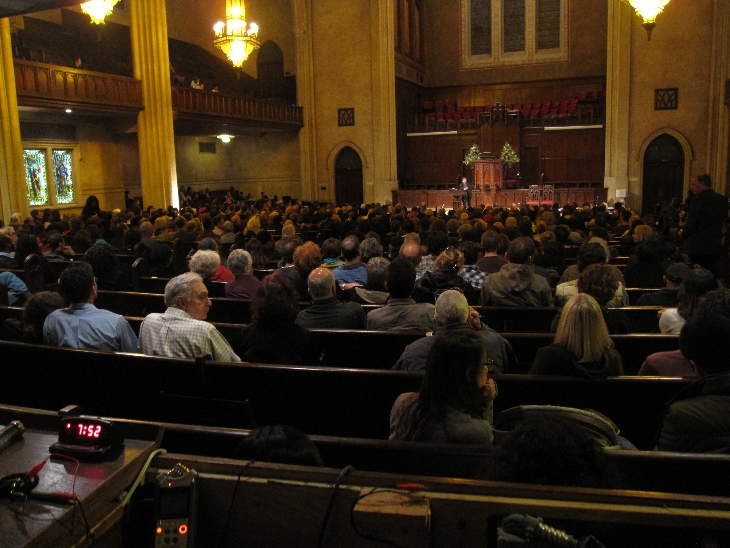
PHOTO REPORT: Gabor Mate Fall 2011: On Nov. 30th over 1,000 people gathered at IP Church in Los Angeles to hear a Pacifica-sponsored speech by the acclaimed Canadian addiction specialist, physician, and bestselling author Gabor Mate. The speech was the first of Uprising Media’s Speaker Series. This is a report of the event.
Christianity has little to do with Rabbi Jesus Wisdom Quarterly (INVESTIGATION) Why do Christians preach the Dharma?Why do Jews love Tibetan Buddhism, yoga?
Why does Wisdom Quarterly delve into "Christian" ideas, myths, and traditions? The reason is that Christianity is an amalgam of faiths from ancient India and the Near East. Therefore, the amazing thing we aim to communicate is that what passes as Christianity isn't really "Christian."
There are entire bodies of Vedic, Sumerian, Egyptian, and Ethno-mycological literature -- which Catholicism in particular has shamelessly appropriated and reinterpreted -- that explain the odd artifacts of a religion attributed a gentle rabbi who was merely used as a cover story. (See video).
The Christian religion is not about Christ's life. It should be, it would be nice if it were (with his Zen parables and Tibetan Buddhist training), but it is not.
The earliest Christian forefathers were keeping alive psychedelic references and trans-shamanic lore of much older traditions -- like Moses and his tribe surviving on manna in the desert.
Buddhism, particularly messianic Mahayana (waiting for the return of the Maitreya / Messiah) and Vajrayana in northern India-Ladakh-Tibet, apparently fed Jewish spiritual thinking long before Christianity was composed and forced on the world through Roman and European conquest (hegemony).
The wisdom of the East is referred to time and again as, for example, in the story of the Three Wise Men. There were, according to the Bible, Three Wise Men from the East who came to give gifts to the star-child (devaputra or "son of god," lowercase because "god" here simply indicates deva). This is astrotheology, not history.
Holger Kersten (Jesus Lived in India, Chp. 4, Penguin Books India) explains that the "wise men" were Buddhist monks. This is not to say that the story is of a single human event. It is clearly an astrotheological reference to annual celestial cycles. But the human version echoes the theme of Tibetan Buddhist monks searching for a Tulku in the West among the Essenes.
The Essenes of Judea, yogis and eaters of manna, were an ancient Buddhistic-monastic community among Jews. Their spiritual and hygienic practices were unprecedented in the history of Judaism but were common in India.
It's remarkable where one finds confirmation for so many disparate ideas covered in the pages of Wisdom Quarterly!
For here we have a story of entheogenic mushrooms (Amanita muscaria), the gateway to shaman visions used by countless spiritual traditions, revealing the real history behind the construction of Judeo-Christian symbolism and mythology. (In this case, not naming the mushroom but anthropomorphizing it with stories of a religious teacher is mythologizing).
Buddhists and Muslims seem more in touch with the original human Jesus, St. Issa (Isa in Arabic) than the Jewish-Roman Paul. Why?
Paul was encoding a psychedelic religion and its practices in a syncretic amalgam or collection of faiths that would sweep the world. Originally, it had more to do with mushrooms than messiahs.
People were simply re-fed a pot of gumbo their indigenous beliefs all contributed to. This explains why the Vatican grounds contain such an inexplicable mishmash of exotic artifacts and symbols. There are Greek and Greco-Indian as well as Theravada-Therapeutae and Gnostic mystic elements for a start. The Vatican itself was built over on an enormous temple-complex dedicated to Mithra. Most of what is said about Jesus today was first said about Mithra.
Mithraism was Roman astrotheology (the stars forming the basis of religion) before renaming and reinterpreting things in "Christian" terms. The word "catholic," after all, simply means "universal." And the plan worked, making this Roman mishmash the largest religion in the world. Catholicism was the Roman Empire's way of conquering the world after failing to conquer it by war.
So the religions of the world have a lot to talk about with one another, a great deal to share, and a much to be friends about.
For instance, Wisdom Quarterly's research strongly indicates that Sakka, King of the [Tavatimsa world and Catumaharajika] Devas, is none other than archangel St. Michael (who cast demons/asuras out of lower celestial world).
Jesus (and Mithra) may be the ideal "savior" (bodhisattva) for Christians. But ancient Jews knew he was not the "messiah" they were awaiting, from stories of Maitreya they picked up from the East. Moreover, he is certainly not the Buddha "Maitreya."

Jesus as Messiah? Rabbi Simmons (ask.com) Q: Why did the majority of the Jewish world reject Jesus as the Messiah, and why did the first Christians accept Jesus as the Messiah? A: It is important to understand why Jews don't believe in Jesus. The purpose is not to disparage other religions, but rather to clarify the Jewish position. The more data that's available, the better informed choices people can make about their spiritual path. Jews do not accept Jesus as the messiah because: More>>

PHOTOS: Rabbi Jesus (forward.com), the Buddha and Christ (consciouslivingfoundation.org), Maitreya Buddha statue from Gandhara (Norton Simon Museum of Art), Mithra stone relief (wikipedia.org)
InflationUS — The emperor has no clothes -- the beginning of a U.S. (and global) currency crisis and hyperinflation. Become a member of NIA free at inflation.us
Near-death.com Ancient Roman carvings of Mithra – dated between 300-400 CE. Note similarity of this and ancient Vedic/Hindu representations of these deities/devas (hitxp.com).
Jesus as a Reincarnation of Mithra
The Vatican (the seat of Roman Catholicism that is the Church of the Holy Roman Empire) was built on the grounds previously devoted to the worship of Mithra (600 B.C.). The Eastern Orthodox Christian hierarchy is nearly identical to the Mithraic version. Virtually all of the elements of Orthodox Christian rituals, from miter, wafer, water baptism, alter, and doxology, were adopted from Mithra and earlier Pagan mystery religions.
The religion of Mithra preceded Christianity by roughly six hundred years. Mithraic worship at one time covered a large portion of the ancient world. It flourished as late as the second century. The Messianic idea originated in ancient Persia, and this is where the Jewish and Christian concepts of a savior originated.
It must have been a very old idea since traces of it are found in Buddhism and Vedic Hinduism. The Bodhisattva (buddha-to-be) is said to have descended from Tusita heaven to turn the wheel of the Dharma. And the future buddha, Maitreya, is said to reside there now waiting until such time as the Dharma is lost, leading to messianic expectations by many Mahayana Buddhists. The concept runs more deeply with frequent stories of Sakka -- the lord of lords and king of kings (namely, the chief of the Tavatimsadevas and the king of the Four Great Kings of Catumaharajikadeva world) stepping down from "The Heaven of the Thirty-Three" (Tavatimsa) to intervene in human affairs, particularly to uphold its sense of morality.
More shocking is the history of Sakka who -- as the "son of god" (devaputra), which is simply an expression that means "born among devas" (demigods, deities, "gods," extraterrestrials who are more like angels in JudeoChristian conception) -- is said to have cast out the "fallen angels" (Asuras) from Tavatimsa heaven. But an avatar ("incarnation of God" reborn on Earth in human form to help humans) is an age-old Hindu concept in Brahmanism and Indian philosophy.
Mithra, as the "Sun god" of ancient Persia [called Surya by Buddhists and Hindus], had the following karmic similarities with Jesus:
Identical Life Experiences (1) Mithra was born on December 25th as an offspring of the Sun. Next to the gods Ormuzd and Ahrimanes, Mithra held the highest rank among the gods [devas] of ancient Persia. He was represented as a beautiful youth and a mediator. Reverend J. W. Lake states: "Mithras is spiritual light contending with spiritual darkness, and through his labors the kingdom of darkness shall be lit with heaven's own light; the Eternal will receive all things back into his favor, the world will be redeemed to God. The impure are to be purified, and the evil made good, through the mediation of Mithras, the reconciler of Ormuzd and Ahriman. Mithras is the Good, his name is Love. In relation to the Eternal he is the source of grace, in relation to man he is the life-giver and mediator" (Plato, Philo, and Paul, p. 15).
(2) He was considered a great traveling teacher and master. He had 12 companions just as Jesus is said to have had 12 disciples. Mithras also performed miracles.
(3) Mithra was called "the good shepherd," "the way, the truth, and the light," "redeemer," "savior," and "Messiah." He was identified with both the lion and the lamb.
(4) TheInternational Encyclopedia states: "Mithras seems to have owed his prominence to the belief that he was the source of life [just as the Sun is], and could also redeem the souls of the dead into the better world... The ceremonies included a sort of baptism to remove sins [a common Indian practice, particularly in holy rivers such as the Ganges, which the Buddha called a superstitious ritual], anointing [also common particularly in knighting rulers in warrior caste clans], and a sacred meal of bread and water [called prasadam in Hinduism], while a consecrated wine [soma or amrita, nectar of the gods/devas], believed to possess wonderful power, played a prominent part."
(5) Chambers Encyclopedia says: "The most important of his many festivals was his birthday, celebrated on the 25th of December, the day subsequently fixed -- against all evidence -- as the birthday of Christ. The worship of Mithras early found its way into Rome, and the mysteries of Mithras, which fell in the spring equinox, were famous even among the many Roman festivals. The ceremonies observed in the initiation to these mysteries -- symbolical of the struggle between Ahriman and Ormuzd (the Good and the Evil) -- were of the most extraordinary and to a certain degree even dangerous character. Baptism and the partaking of a mystical liquid, consisting of flour and water [sura, a kind of beer or brew the Asuras were fond of prior to being cast out of the Tavatimsa deva world], to be drunk with the utterance of sacred formulas [mantras, japa, or prayers], were among the inauguration acts."
(6) Prof. Franz Cumont, of the University of Ghent, writes the following concerning the religion of Mithra and the religion of Christ: "The sectaries of the Persian god, like the Christians', purified themselves by baptism, received by a species of confirmation the power necessary to combat the spirit of evil; and expected from a Lord's supper salvation of body and soul. Like the latter, they also held Sunday sacred, and celebrated the birth of the Sun on the 25th of December....They both preached a categorical system of ethics, regarded asceticism as meritorious, and counted among their principal virtues abstinence and continence, renunciation and self-control. Their conceptions of the world and of the destiny of Man were similar. They both admitted the existence of a Heaven inhabited by beatified ones [devas, literally, "shining ones"], situated in the upper regions [two spheres of spaece just above the Earth], and of a Hell, peopled by demons, situated in the bowels of the Earth. They both placed a flood at the beginning of history; they both assigned as the source of their condition, a primitive revelation; they both, finally, believed in the immortality of the soul [the ancient Indian concept of reincarnation], in a last judgment, and in a resurrection of the dead, consequent upon a final conflagration of the universe" (The Mysteries of Mithras, pp. 190, 191).
(7) Reverend Charles Biggs stated: "The disciples of Mithra formed an organized church, with a developed hierarchy. They possessed the ideas of Mediation, Atonement, and a Savior, who is human and yet divine [a deva or extraterrestrial on Earth], and not only the idea, but a doctrine of the future life. They had a Eucharist, and a Baptism, and other curious analogies might be pointed out between their system and the church of Christ (The Christian Platonists, p. 240).
(8) In the catacombs at Rome was preserved a relic of the old Mithraic worship. It was a picture of the infant Mithra seated in the lap of his virgin mother, while on their knees before him were Persian Magi [a.k.a., the Three Wise Men] adoring him and offering gifts.
(9) He was buried in a tomb, and after three days he rose again [all astrological details hinting at the origin of the myth, namely, that the real reference is to the alignment of celestial bodies and the planet Earth cyclically returning to life every spring, as explained in the original Zeitgeist movie]. His resurrection was celebrated every year.
(10) McClintock and Strong wrote: "In modern times Christian writers have been induced to look favorably upon the assertion that some of our ecclesiastical usages (e.g., the institution of the Christmas festival) originated in the cultus of Mithraism. Some writers who refuse to accept the Christian religion as of supernatural origin, have even gone so far as to institute a close comparison with the founder of Christianity; and Dupuis and others, going even beyond this, have not hesitated to pronounce the Gospel simply a branch of Mithraism" (Art. "Mithra").
(11) Mithra had his principal festival on what was later to become Easter, at which time he was resurrected [all recurring celestial, not historical, events]. His sacred day was Sunday, "the Lord's Day." The Mithra religion had a Eucharist or "Lord's Supper."
(12) The Christian Father Manes, founder of the heretical sect known as Manicheans, believed that Christ and Mithra were one. His teaching, according to Mosheim, was as follows: "Christ is that glorious intelligence which the Persians called Mithras...His residence is in the sun" (Ecclesiastical History, 3rd century, Pt. 2, Chp. 5).
"I am a star which goes with thee and shines out of the depths." - Mithraic saying "I am the root and the offspring of David, and the bright morning star." - Jesus (Rev. 22:16)
(HitXP.com) There is ample archaeological, historical, and textual evidence that Mithraism was practiced by the ancient Romans. In fact, Ernest Renan says in his book The Origins of Christianity that if the growth of Christianity had been arrested, the world would have been Mithraic.
There are three types of religions in the world today: ones that do not care to convert others and treat all religions equally (like Hinduism); ones that promote themselves without demoting other religions (like Buddhism); and ones that promote themselves by demoting others (like the Christianity spread by evangelists and missionaries).
Mithraism and Christianity Franz Cumont was the first scholar to observe the similarity between Christianity with Mithraism. He pointed out that Christianity borrowed iconographic themes from Mithraism...between the third and fifth centuries, not before that.
According to Cumont, the Christian story of Moses striking Mount Horeb (Sinai) with his staff to release drinking water was inspired by the earlier Mithraic reference to Mithras shooting arrows at rocks causing fountains to spring up. This again is a common event in the stories of Vedic deities in the ancient Indian texts. Read details about ancient Mithraism here.
[NOTE: Good advice for earthquake preparedness and fake ET invasions, Amero conversions, martial law declarations, Drug Cartel takeovers, and so on.]
The status quo (things as they are now) will be held up at all costs.
I think people will still go to their jobs, even if they are paid nothing at all. I picture it like an ant colony with a dead queen ant. They will continue doing their jobs. Slowly but surely things will have to change from the inside.
I also see a rise in crime and a split between supporters of the government and non-supporters. Those with a lot invested in the system are likely to support that system. Those not as invested may resort to other methods of survival.
For those, I will introduce the Rule of Three. A human being can go:
3 minutes without air
3 hours without shelter in poor conditions
3 days without water (brain damage after 24 hours)
3 weeks without food and (some say)
3 months without love.
We NEED these to survive, at least the first four.
I do not see society totally stopping. It's habit-energy for people to go to their day jobs. And I have the feeling that unless it's an extremely fast change, I think there will be a place for physicists, doctors, accountants, and the like to do their jobs. But I doubt that they will be paid very well, if at all.
Some people might not get paid in money. For example, a farm worker might instead get paid in accommodation/food. Another example would be a factory worker making beds might get paid in beds. The foreman might say, "Go sell it." Of course, s/he mean barter or trade it.
In such a situation, there are many beds being pushed in a local area. That means competition with fellow employees, so be prepared.
There will come a time: There will be more than one form of currency. Even without a complete economic collapse, new currencies are beginning to pop up already. So it won't be surprising to find pockets of people paying each other in, say,
bottle caps
gold
Monopoly money
You name it
It's already happening and has been for some time. (See the Ithaca Hour for a neat example of it in New York).
This does not mean that one can sell a bed for bottle caps and use them to buy chemicals at McDonalds. There's a chance that the government will still exist and "legal tender" will be the normal currency. There are many, MANY forks in the path ahead of us -- like the branches of a fractal pattern.
Survival Tips I think most cities have a three day supply of food. Large cities require food to be shipped daily to maintain their populations. This means if food stops being shipped in, people are likely to raid grocery stores and hoard.
This will not mean raiding with guns but rather raiding with shopping carts and cash. Guns are a last resort, after the sales. But I don't see that happening. If it does, then the following method of food storing applies: Can Cloning.
If rice and pasta and similar staples are stored up, there's one thing to bear in mind. These things require water, electricity, fuel to cook,. Water may be dirty and unsupported in a crisis. So it's better to get canned food with water inside the can, like ravioli or noodle soup.
Buy a can of soup. Start a can cloning list. When that soup is eaten, write it on the list. Then buy two at the grocery store. Then when that can of soup is eaten, it goes on the list again. Now there is one left in the pantry, and TWO more are purchased. There are a total of three. Eat another; mark it on the list. This time, however, buy one can of one soup and one can of another.
In this way food is stored, food one is in the habit of eating. There is no crowding the grocery store raiders being gouged at the market. One lessens the burden on everyone else by being someone who planned ahead.
Label cans to know which ones are older and need to be eaten first.
Water The water supply may be contaminated or the system may be siphoned off to the city's drains.
The basement is a good place to store 40 gallons of clean water. It's already there inside the water heater. Of course, it was supposed to be cleaned out once a year by flushing from the small valve on the bottom.
It's estimated that one needs one gallon per person, per day to survive.
Does that cover everything? Of course not. There is a ton of information out there. Search for it.
Today is Rosh Hashanah, Judaism's New Year's -- the anniversary of the day Jews mark as the "creation of the world." Did YHWH (Maha Brahma, the Buddhist creator-god) in fact "create" the world as the commencement of the High Holidays ending in Yom Kippur (ten days later) suggests? No.
While few American care or know much about Jews, only interesting themselves with the state of Israel as a place to send Jews or as the equivalent of "ten CIAs" (as a former head famously admitted in a rare moment of candor), the majority-religion is inextricably tied to Judaic beliefs. Americans' view of Jews is perhaps best revealed (somewhat offensively) in massively popular cartoon portrayals, such as Family Guy ("When You Wish Upon a Weinstein" episode), which today represent the single best way of tapping into the nation's zeitgeist.
The Greek God "Thor," the Indian version of "Indra" (home.planet.nl)
The human world (manussa-loka) has existed, cyclically, for a duration better measured in geologic-time than in terms of calendars and great events. The Buddha and Hindu texts such as the Vedas describe time in terms of epochs and aeons (kalpas) and beyond that great-aeons (maha-kalpas), indeterminate periods on a staggering scale. Furthermore, the evolution and devolution of world systems, or "world periods," is sometimes reckoned as a unit of time. When asked for a definition of an aeon, the Buddha responds that it is not easy to reckon in terms of this many or that many years but must resort to analogies that oppress the mind that attempts to conceive them and sicken the spirit that understands that they may as well be called "eternities."
As a Wikipedia author announces: Since the time of the Buddha, the refutation of the existence of a creator has been seen as a key point in distinguishing Buddhist from non-Buddhist views.[1] While Buddhism is called a religion, it might better be described as a "spiritual philosophy" due to the absence of an absolute creator god. Rather, Buddhism teaches that through persistent meditation practices and efforts to perfect morality, practitioners (and, by extension, all sentient beings) can dispel ignorance and relieve suffering. As taught in the earliest Pali texts, practitioners may through these practices become inheritors of the Dharma, and thus embody the Buddha's word (Buddha vacanam) as his hearers (savaka).
All that having been said, the rank of Buddhist creator god is a title more than a personal name -- Maha Brahma (the great supremo). Buddhist cosmology states that the various planes of existence correspond to the karma (consequential actions of moral significance) of individuals. Some of the most positively weighty karma are the Eight Jhanas ("meditative absorptions") -- four material, four immaterial -- and their degrees of refinement. This correspondence is explained in detail in a free ebook 31 Planes of Existence (Ven. Suvanno Mahathera).
Hindu God Rama (indianchild.com) often a trinity of Brahma-Vishnu-Shiva
BUDDHISM & THE GOD IDEA
Ven. Nyanaponika
Quite contradictory views have been expressed in Western literature on the attitude of Buddhism toward the concept of God and gods. From a study of the discourses of the Buddha preserved in the Pali canon, it will be seen that the idea of a personal deity, a creator god conceived to be eternal and omnipotent, is incompatible with the Buddha's teachings. On the other hand, conceptions of an impersonal godhead of any description, such as world-soul, etcetera, are [ultimately] excluded by the Buddha's teachings on [the basis of the Buddhist principle known as] Anatta, "non-self" or "unsubstantiality."
In Buddhist literature, the belief in a creator god (issara-nimmana-vada) is frequently mentioned and rejected, along with other causes wrongly adduced to explain the origin of the world. The same is true, for instance, about a world-soul, time, nature, and so on. God-belief, however, is placed in the same category as those morally destructive wrong views which deny the karmic results of action, assume a fortuitous origin of man and nature, or teach absolute determinism. These views are said to be altogether pernicious, having definite bad results due to their effect on ethical conduct.
[Editor's note: There are gods, devas as well as brahmas, but they do not have the abilities people presume. The mistake is attributing to them some special status beyond karma or Samsara. Some of the monotheistic notions, particularly Christian, are very misleading, while others approximate the claims made by superior beings, such as claims of immortality, omnipotence, omniscience, and the like. These should be understood as extreme longevity, great puissance, knowledge or even wisdom, and so on. The hyperbole that honors them misleads many followers who then fail to notice, or at least acknowledge, any limitations to their deities.]
Theism, however, is regarded as a kind of karma-teaching in so far as it upholds the moral efficacy of actions. Hence a theist who leads a moral life may, like anyone else doing so, expect a favorable rebirth. He may possibly even be reborn in a heavenly world that resembles his own conception of it, though it will not be of eternal duration as he may have expected. If, however, fanaticism induces him to persecute those who do not share his beliefs, this will have grave consequences for his future destiny. For fanatical attitudes, intolerance, and violence against others create unwholesome karma leading to moral degeneration and to an unhappy rebirth.
Although belief in God does not exclude a favorable rebirth, it is a variety of eternalism, a false affirmation of permanence rooted in the craving for existence, and as such an obstacle to final deliverance.
Among the fetters (samyojana) that bind to existence, theism is particularly subject to those of personality-belief, attachment to rites and rituals, and desire for fine-material existence or for a "heaven of the sense sphere," as the case may be.
As an attempt at explaining the universe, its origin, and man's situation in his world, the God-idea was found entirely unconvincing by the Buddhist thinkers of old. Through the centuries, Buddhist philosophers have formulated detailed arguments refuting the doctrine of a creator god. It should be of interest to compare these with the ways in which Western philosophers have refuted the theological proofs of the existence of God. More>>
Aion and Gaia (Earth) with four children, perhaps the personified seasons, mosaic from a Roman villa in Sentinum, first half of the 3rd century BCE, Munich Glyptothek, Inv. W504 (Wiki).
THE GREEK GOD-IDEA
The Greek Pantheon better approaches the Indian and Buddhist version, replete with Titans (Asuras) and monsters (Nagas, etc.).
Answer: The Christian God Jehovah exists but is neither sole creator, nor almighty, nor all-knowing. On a Buddhist cosmological scale, it is possible to place Jehovah at Level 10. That realm is called "Devas Delighting in Creation" (nimmanarati). If that is the correct placement (others may argue for a different placement; see 31 Planes of Existence), the God of the West still deals with desire, anger, and delusion.
The arch-opponent of Christian lore, "Satan" (in Buddhism "Mara") might be placed at Level 11: "Devas Wielding Power over the Creation of Others" (paranimmita-vasavatti). But like the Christian devil, Mara does not refer to a single being. Mara-Devaputra is a deva (a kind of "Lucifer"); another Mara is a personification of Death, which rules the Sensual World in its entirety (because all being are of a nature to eventually die and be reborn). Other beings on earth are called "Maras," and these may be thought of as "demons" or spiritual soldiers dedicated to the cause of Death, corruption, anger, revenge, and spoilage. Lucifer, Satan, demons, and "unclean spirits" -- just like God, godlings, angels, light-beings -- all still deal with varying degrees of lust, hatred, and ignorance. Mara/Satan may have developed a particularly polluted mind (as for example the story of Mara Dusi, MN 50).
Buddhas and Arhats are beyond and above deities, gods, and other beings, since they irreversibly have eliminated all greed, all hate, and all delusion! They have transcended existence and continued wandering in Samsara by attaining nirvana. Nirvana is the deathless absolute peace, the supreme bliss, the highest bliss. No trace of craving, anger, or confusion remains.
All materials on this site are submitted by editors and readers. All images, unless otherwise noted, were taken from the Internet and are assumed to be in the public domain.
In the event that there is still a problem, issue, or error with copyrighted material, the break of the copyright is unintentional and noncommercial, and the material will be removed immediately upon presented proof.
Contact us by submitting a comment marked "private."
Do not follow this journal if you are under vinaya or parental restrictions. Secure protection by Sucuri.
Wisdom Quarterly: American Buddhist Journal is licensed under a Creative Commons Attribution-Noncommercial-Share Alike 3.0 United States License. Permissions beyond the scope of this license may be available at creativecommons.org/about/licenses.