Ashley Wells, Dhr. Seven, Amber Larson, Wisdom Quarterly (ASK MAYA)
 |
| Quench your mind/heart because dispassion is the key to enlightenment and liberation. Not by passion or anger or delusion can one find happiness and freedom. Clinging and hating are tangled up in ignorance. Untangle. |
- QUESTION: Anonymous asks, "We
aren't supposed to want love? Should I live alone for the rest of my
life? I am new to this blog. Please forgive me if you have answered this
question."
This
is a great question. Thank you. The conundrum arises from our assumptions. What do we
(you and us) mean by "love"? Do we mean universal altruism, loving-kindness (
metta), compassion (
karuna), unselfish joy (
mudita), and impartiality (
upekkha)? We don't think so. These are five expressions of love that ancient Indians (Pali/Sanskrit) and Greeks (
agape = "unconditional love," etc.) had a better grasp of than we do in English because of all
of their words for love like friendliness (
metta) vs. sensuality (
kama), equanimity (
upekkha)
vs.
indifference,
agape vs.
eros,
arete vs. bad and so on. What does Wisdom Quarterly mean when we say "love"?
 |
I'm supposed to be alone and not in love?
|
We mean
affection (
pema),
attachment manifesting as
clinging (
upadana),
selfish-desire (
tanha),
not wanting (
a-karuna) or
being unwilling to sit with someone's suffering (rather than being with them in their need,
con+passion= "with suffering"),
not deriving joy from others' joy (
a-mudita) but wanting instead our own joy even at the cost of others' happiness,
partiality rather than equanimity (
upekkha). And what will happen as a result?
"Karma" means that fruits (
phala) and mental resultants (
vipaka)
follow in line with
intentional-actions, whether those actions/deeds
are mental, verbal, or physical. Whatever is rooted in greed, aversion,
or delusion will produce a miserable, unpleasant, unwelcome result.
 |
| You can see what buddhas see (DM). |
This
is the way it is; we don't see it because it is spread out over time
between planting a karmic seed and its fruit, which comes to fruition
fortuitously when it gets the chance, which can be aeons later. So we
confuse what we just did with what just happened and come to believe,
"Oh my actions must not be harmful because nothing happened as a
result!" We do not know that and are only laboring under the assumption
that intentions and results must be linked closely in time when we can
all see that that is in no way the case. We haven't even developed the
"
divine eye" (
dibba cakkhu) to see karma coming to fruition for ourselves and others, yet we make the claim. Or we say, "There's no such
thing as karma!" and give our proofs: "I did such and such, and nothing
happened; therefore, nothing is wrong with doing as I did; nothing will
come of it."
What is our karma, and what will happen to us as a result? Anonymous, when you ask, "We
aren't supposed to want love? Should I live alone for the rest of my
life?" what do you mean by "love"?
(Bauhaus) "All We Ever Wanted Was Everything" with the young actor David Bowie. Oh we can live together and be happy forever! Yes, love, we'll live happily ever after!
Surely you don't think we are saying that people in general, or Buddhists in particular, should NOT cultivate altruism, loving-kindness, compassion, unselfish joy, impartiality (unbiased equanimity). We think you should love, but
love is not "love" the way we normally mean it. You know how we as Westerners normally mean it. These are the
Four Divine Abidings (
Brahma Viharas), excellent (Greek,
arete) forms of "love," excellent sources of merit (
puñña),
excellent karma!
The Love Addiction Series
 |
| I want to meditate, but my compulsions (OB) |
What we have been suggesting in a
recent series of articles is that the normal, common kind of "love" that we as
Americans hold up as ideal and cultivate unthinkingly (some of us more than others) is quite
harmful.
No person wishing for his/her own good, the good of others, or the good of both would continue in this way. But we do. Why do we? It is because we are not being mindful, not thinking, not engaging in wise action, not being compassionate, not living up to our actual and professed ideals.
What should YOU do, Anonymous? Would you like us to tell you? Your question implies that you want us to tell you what to do as if we can know what's best for you. You know what you want.
But let us guess: You want to
suffer (to be disappointed, dissatisfied, unfulfilled). That's real passion! We can tell you're very passionate (in the throes of suffering). And so, naturally, you want
painful progress (
dukkha-patipadā). Maybe Suffering is your teacher,
as Eckhart Tolle points out, Suffering being most people's only teacher.
("Like Crazy") Love rules! Love is the best! Love rocks! We have nothing higher to live for!
Of course, this is possible, but we think the opposite: You want relief, freedom from pain and disappointment. You want joy, peace, pleasure, and fulfillment. Then what is the Way to it -- selfish, unthinking, clinging "love"? An American marriage, which is a business contract (ask a lawyer if you don't believe us), a mortgage, sexual thrills, a bunch of dependents, emotional attachments, desperate clinginess? Is that what you want, Anonymous, is that who you are? That's what they're tempting us with, that's what they're offering us, that's why we date, isn't it?
And that's what we've been taught and conditioned to want -- told that that's the way to fulfillment and a happy life. Yet, spirituality teaches us something better. But we don't want to give up our pleasure even for a better (more sublime) pleasure.
 HONEY TRAP? Tie a jar or coconut to a tree where monkeys can see. Carve out a hole just big enough for a hand to wriggle in. Place honey or a banana or something good in center. Wait for curious monkey. Monkeys are so foolish and greedy that they will reach in to grab the sweet without realizing that their clenched fist will trap them. As long as they cling to the object, their hand can't get free. If they would only let go, their hand would slide out of the trap, and they could run to safety. But they can't let go, they can't, they can't; they're just too greedy and foolish. So the hunter comes up and does as he wishes, slaying them where they stand, cutting them up limb from limb.
You see, Anonymous,
we are monkeys. We have our hand in the honey trap, and
the hunter is coming to kill us. What should we do?
Ahh-ahh, before you say "Let go," have you considered that we want the honey we're grasping that's holding us to the trap? Don't go telling us to "let go" of our little sliver of sweetness in this cold heartless world with your religious mumbo-jumbo!
We're spiritual not religious. We want it ALL! Like
Bauhaus, "All we ever wanted was everything"! Give us enlightenment, AND let us keep our sexy, clingy, hopelessly pathetically attached forms of "love."
 |
| One of many human honey traps. Oh, just look at the poor monkey, doesn't realize what's going to happen when the hunter arrives to claim what the monkey can't let go of internally. Run, monkey, run! |
Lust, paradise, and the Buddha's brother
Anonymous, did you ever hear the story of
Nanda, the Buddha's brother? Most people don't know he had a brother or a sister (same father,
mother the sister of his deceased biological mother who went on to become the world's first Buddhist nun) or a child or a wife or
three mothers or a rich and powerful father.
Why don't you get these, and then that way you won't be alone? We don't want, nor do we advise, you to be alone. That answers your second question. We want you to be with people, preferably noble friends (
kalyana-mittas). The way you're going, you may end up alone. So alter course, and move in the direction of stable relationships. Whether you marry temporarily or do better by sealing permanent relationships with noble friends, there is no going at it alone. The Buddha's attendant, his cousin Ananda, once said to him: "I think half of the supreme-life is having noble friends." The Buddha scolded him, "Do not say so, Ananda, do not say so! Noble friends are the whole of the supreme-life." The Buddha is one's best friend in the supreme-life. Maybe at first that comes from
faith (
saddha), but it grows to the
absolute certainty of an
asekha:
Nanda was getting married to the most beautiful woman in all the realm, the "Belle of the Land," Janapada Kalyani. The Buddha came to visit his home country somewhere west of the Indus river in Afghanistan or beyond, way in the northwest of India. He was eager for the honeymoon with his beautiful fiance. Then the Buddha really got him. In a very superficial way, one could say he tricked him out of his marriage, his royalty, his earthly riches. It's a very amazing story. But for anyone who doesn't penetrate what was really going on and why, what the Buddha already knew and what Nanda was about to find out just before it was too late, was that the Buddha was acting out of compassion, and in many places Nanda had the chance and choice to go back. At first, only respect was holding him back, and then it was his own insight.
In brief, the Buddha finished his family's alms-offering then handed his monastic-bowl to Nanda, who carried it for his half-brother, the former prince and Great Sage of the Shakyas, walked him to the door thinking to hand it back to him there. But the Buddha walked outside. Nanda followed thinking to hand it back at the gate. Beautiful Janapada Kalyani, combing her wonderful washed hair, saw him going from the veranda, and wondered why he was leaving, but just shouted out to him, "Come back to me soon, my love!"
The Buddha walked beyond the gate without turning to collect his bowl. Nanda thought to follow him back to the monastery (probably a cave in Bamiyan or Mes Aynak or any of the ancient Afghan Buddhist sites) and return it to him there then get back to his wedding plans honeymoon preparations. When they arrived, the Buddha turned and seeing that Nanda had followed him all the way to the monastery, naturally asked, "Oh did you want to become a monk?" In other words, Oh did you, like your wiser, more spiritual, possibly older (see below) brother and so many of your royal cousins you loved in childhood, want to join us in renouncing that dusty, burdensome homelife and live here with us in our left-home life?
 |
| What am I doing sitting here when I could be having sex and getting high on love?! |
 |
| JP: "Come back to me soon, Nanda!" |
Without thinking, or not wanting to imply that they had made a poor choice in choosing to live like beggars when they were all born fabulously rich and privileged, Nanda answered YES. The Buddha called for someone to ordain him then gave him a meditation subject.
Before he could say, "Wait, no, I meant no; I'm getting married to this hot woman tomorrow!" or explain what had happened, he was clean shaven, in robes, and meditating in his
kuti (hut, cave, room, cell). But he couldn't concentrate or achieve the absorption (
jhanas) like other wandering ascetics (
shramans), spiritual recluses (
bhikkhus), mendicant meditation masters (
theras). All he could do was think about sex.
 |
| All my family and belongings! (motifake.com) |
Before long, oppressed by thoughts of sexy Janapada Kalyani, he came to the Buddha to quit and get back to the palace. The Buddha surprised him by saying that that was fine, but he wanted to show him something first. Look. Taking hold of the Buddha's robe, Nanda was whisked away on an astral travel journey,
a trip to paradise.
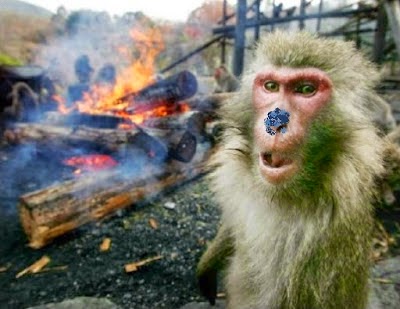
They traveled through the sky, over the Earth, over a burnt field, and there was a she-monkey there sitting on a stump with a burnt nose. They ascended to pleasant celestial plane in space where there was a brilliant, sparkling, white granite mansion being washed by a large number of pink footed celestial nymphs.
And Nanda asked the least beautiful of these delightful and alluring beings what they were doing. She answered that they were preparing the platform/palace/mansion of Nanda for his arrival.
"But Nanda lives on Earth," Nanda said. "Yes, but thereafter he will come here, and we will serve him." (They would be his wives, his harem, the celestial nymphs people mock Islam for talking about). Nanda stepped back to the Buddha and said, "She says this is for me?" The Buddha asked, "What do you think of these nymphs, Nanda?/Isn't Janapada Kalyani beautiful?" "Jana-pada-who?" exclaimed Nanda. "Your beautiful fiance, the one you're leaving us to go back to, the 'Belle of the Land'!"
"Venerable sir, Janapada Kalyani, my former fiance, can't compare to these nymphs. Even the ugliest one. She doesn't even possess one-sixteenth part the beauty of any of these; she doesn't even come into the count! Why compared to these nymphs, Janapada Kalyani resembles that monkey we saw on the way here with its nose and tail burned off."
"Let's go, Nanda," the Buddha said. On the way down to Earth, they took a detour. They descended to a frightful subterranean hell, where frightful beings were stoking a fire for a large iron cauldron of oil. And Nanda asked these scary demonic figures what they were doing. "What the hell's it to you, $#@&!? Not that it's any of your damn business, but we're making preparations for that scumbag Nanda."
"But, sir, I have it on good authority that Nanda will be reborn in a celestial world with a mansion," Nanda explained. "Yeah, but after that, he will be reborn right here, and we'll do as we wish with him, slaying him, flaying him..." Nanda stepped back to the Buddha. "Did you hear that, venerable sir?"
"Let's go, Nanda," the Buddha said gently. "Now you see how things stand; now you see how samsara, this endless round of the playing out of karma, goes." [We're filling in the colorful language in case you hadn't noticed, Anonymous. The is the gist, the sentiment of what was said and meant.]
When they returned to the monastery, Ven. Nanda went quickly to his chambers and resumed his meditation. The other monastics noticed his sudden turnaround and asked him about it. They teased him about missing his sexy wife, which he had formerly talked so much about returning to. But now he was all silent and committed to meditating. He explained to his monastic relatives and friends, the other Shakyas, how wonderful heaven is, full of gorgeous nymphs and shimmering palaces, so that with good karma one can earn that. Seeing his foolishness, they began anew to tease him, but this time they said, "Nanda has been bought for 500 nymphs! Nanda is a hireling! He works [meditates, see kammatthāna] for nymphs!"
-
Kammatthāna: literally, "working-ground," "field of exertion, effort, or striving" (i.e., for meditation), is the term in
the Commentaries for "subjects of meditation"; see bhāvanā.
Even though his fellow monastics gently ribbed and mercilessly teased and taunted him, Ven. Nanda stuck to it, clearing his mind of lust for Janapada Kalyani, of fear of karmic retribution in unfortunate realms, and aspired just for those nymphs. But when he attained the absorptions (jhanas), finding them superior even to the "heavenly lusts" and appetites of the lower celestial planes, he kept going and cultivated liberating-insight, as the Buddha, his trusted brother had instructed him.
- Actually, they would have been age-peers, almost exactly the same age because Nanda's mother, Maha Pajapati Devi, who was the sister of the Buddha's biological mother, Queen Maha Maya Devi, was co-wife of the polygamous king, their father. And when the latter passed away just a week after her son Siddhartha's birth, the former took over nursing, caring for, and raising Prince Siddhartha as her own, turning over the primary care of Nanda to a nurse in the royal palace. Queen Maya, who was considered the "first wife" would have been more beautiful, the more pleasing long time companion of King Suddhodana. Contrary to our modern opinion that this is sexist and patriarchal, her sister would surely have been happy to co-marry the king and thereby live together with her sister as royals from the ruling family of the rich crossroads capital of Kapilavastu (in the vicinity of modern Kabul and Bamiyan according to Dr. Pal), having and raising kids at the same time like virtuous-Kardashians, then taking over the role of Queen Kim with her sister's passing. The Shakyas were a fiercely proud, tough, formerly-nomadic warrior peoples not like the more refined people of Brahminical India, much like hearty Afghans/Central Asians today.
 |
| Novice's devotion in a sacred cave (13som) |
When Ven. Nanda reached enlightenment, he continued to meditate, experiencing the bliss of release from ignorance, karma,
samsara, rebirth, and all further forms of suffering.
But his fellows were dissatisfied and they complained to the Buddha: "Nanda's a hireling! He works for nymphs!" Knowing better the Buddha had Ven. Nanda summoned. "They say you're a hireling, Nanda, that you work for nymphs, that I promised you nymphs if you would meditate." Ven. Nanda was abashed for it having once been true that he worked for such a petty aspiration as superhuman sensual experiences in that lowly heavenly world they visited, having lost the
healthy dread of what they had seen would happen in that subterranean fallen/hellish plane of existence (
niraya).
Ven. Nanda implicitly declared his attainment by stating that he had released the Buddha from his implied promise of heavenly splendor the moment he realized the Truth. His fellow monastics were shocked and abashed, not realizing they were mocking and complaining about an arhat, an enlightened disciple of the Buddha. They quickly returned to their
kutis to meditate and follow the example of the one they had wasted so much time and made such unskillful karma berating.
The end.
Anonymous, does our overkill answer make sense? Does this famous Story of Nanda make sense as applying to your dual question?
Question. Selfish "love," sensual lust, desperate clinging, emotional attachment, pathetic obsession, does it arise in a person for her/his own good, for the good of another, for both? Or does it bring harm?
Love is a snare, a trap, a lie leading us to buy the ways of the world without thinking and only realizing too late what bargain we made? When the
Dhammapada speaks ill of desire, clinging, and passion, we recoil. No, we like those! We want those! "Passion" (which literally means "suffering" in English) is good, it's zesty, it adds spice to life. You're question was very good because people don't want to get caught up in words and thinking, paying attention and actually analyzing anything. We want it spelled out, or we'll learn from experience. But most of us won't learn even then.

What the Buddha said makes sense, a lot of sense. If one stays superficial, it is easy to debunk karma, spirituality, religion, and claims of all kinds. That's nonsense. That's not science. We know everything; the ancients knew nothing! The purpose of an "American Buddhist Journal" is to spell out all the ways that Buddhism does apply, does make sense, does offer a Path to the end of all suffering. And it's beautiful even if it seems to us sexist and full of it. For instance, did you notice a gaping hole in Nanda's story? We know you did.
We know what you're thinking, Anonymous! "Hey, but what about Janapada Kalyani?! The Buddha was wise, exceedingly wise; he thought of that, too. Here is her story:
The Beautiful Princess Janapada Kalyani's spiritual journey