Robert Wright); Ashley Wells, Wisdom Quarterly
 |
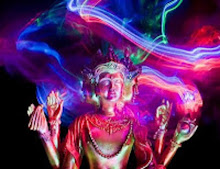
“Golden Buddha, 2005” by Nam June Paik (Fred R. Conrad/The New York Times)
|
.
 |
| Why... (simonandschuster.com) |
Not
long ago I was accused of something I hadn’t realized was a bad thing:
clarity.
Adam Gopnik, reviewing my book Why Buddhism is True, in The
New Yorker in August (2017), wrote:
“He makes Buddhist ideas and their history
clear. Perhaps he makes the ideas too clear.”
Underlying
this allegation (which I vigorously deny!) is a common view: that
Buddhist ideas defy clear articulation — and that in a sense the point of
Buddhist ideas is to defy clear articulation. After all, aren’t those
Zen koans — “What is the sound of one hand clapping?” and so on —
supposed to suggest that language, and the linear thought it embodies,
can’t capture the truth about reality?
Gopnik
seems to think that this drift of Buddhist thought — its apparent
emphasis on the inscrutability of things — largely insulates it from
scrutiny. Buddhist discourse that acknowledges, even embraces, paradox
may “hold profound existential truths,” Gopnik says, but by the same
token it has, as a kind of built-in property, an “all-purpose evasion of
analysis.”
So apparently people like me, who would like to evaluate
Buddhist ideas in the light of modern science and philosophy, should
save our breath.
The question Gopnik
is raising isn’t just an academic one. Every day, millions of people
practice mindfulness meditation — they sit down, focus on their breath,
and calm their minds. But the point of mindfulness meditation isn’t just
to calm you down.
 |
| Light Morning Meditation in Floyd, Virginia 2017 (Lori Marsh/Light Morning Community) |
.
Rather, the idea — as explained in ancient Buddhist
texts — is that a calm, contemplative mind can help you see the world as
it really is.
It would be nice to critically examine this powerful
claim, but if we can’t say clearly what Buddhists mean by “the world as
it really is,” then how can we examine it? How can we figure out — or
even argue about — whether meditation is indeed drawing people closer to
the truth about reality?
The cultural critic Edward Said famously used the term “Orientalism” to refer to a patronizing way Westerners sometimes think of Eastern cultures and ideas — as charmingly exotic, perhaps, but as deficient in various Western virtues, including rationality and rigor.
Said was
talking mainly about Middle Eastern cultures, but much the same could be
said of Buddhism: Western thinkers may cherish its art and its cryptic
aphorisms, and may see meditation as therapeutically useful.
 |
| Why Buddhism is True (Robert Wright) |
This
condescension is unfounded. Not only have Buddhist thinkers for
millenniums been making very much the kinds of claims that Western
philosophers and psychologists make — many of these claims are looking
good in light of modern Western thought.
In fact, in some cases Buddhist
thought anticipated Western thought, grasping things about the human
mind, and its habitual misperception of reality, that modern psychology
is only now coming to appreciate.
Consider a quote that Gopnik employs in suggesting that appraising
Buddhist philosophy may be a fool’s errand. It is from a Zen Buddhist
who, in analyzing a famous text called the Heart Sutra, wrote this:
“Things exist but they are not real.” More