Showing posts with label dunhuang cave. Show all posts

Thursday, October 16, 2025

1,000 hidden Buddhist caves of Tibet


The oldest religious center of Tibet: A hidden world travelers have never seen, still used by monks
Tibet Travel (Tibet Vista) Oct 16, 2025: This is Jamyang from Tibet Vista, the leading Tibetan local travel agency since 1984. This video goes on a journey to three amazing places in Tibet.
Let’s see all three places in detail so viewers can get a true sense of them and plan their future tours of Tibet.

(Living in ChinaDunhuang, Western China, desert Silk Road crossroads

Any questions about Tibet or tours? Do not hesitate to ask. Jamyang is always happy to help. Email: jamyangtour@gmail.com. Website: tibettravel.orgFacebook: tibetvista.

Monday, June 2, 2025

Clean, green China? Leshan with Lizzy


Lizzy likes to travel, so she heads for China, behind the red wall, to magical Leshan to see the Giant Buddha in Sichuan Province. The size of the caves before arriving are boggling. China is enormous and very advanced, which we rarely here about by a critical U.S. media, although a quarter of its land was stolen from Tibet, which it now claims with an eye on Taiwan. Certainly, the Chinese government does much harm, but are there no upsides to its culture and creativity? Could Westerners so love the Chinese that they might even adopt one and give her everything?

Trump's racist plan to try to dominate China?

Saturday, November 30, 2019

Space aliens built Buddhist temples? (video)

Disclose Truth TV (DTTV Docs, 3/19); Dhr. Seven, Pat Macpherson, Wisdom Quarterly


Ellora Caves: The Mind-Boggling Rock-Cut Buddhist Temples of India
Rock-cut Buddha statues in Ajanta cave
There were no caves here to begin with. How are we to comprehend the 100+ artificial Ellora caves and Ajanta caves? How were they built? By space-devas?

Somehow the massive Ellora complex of publicly visible 34 unique structures has been magically cut out of pure rock, into the side of a mountain, without the use of "modern" technology. This construction would be difficult if not impossible to replicate today.


This never-before-seen documentary closely looks at the intricate Buddhist temple and suggests — as have many archaeologists on the ground — that thousands of years ago, ancient cultures were far more advanced and sophisticated than scholars are generally willing to give them credit for. Who handed them that level of technology?

We call them "caves" but they are much more
What baffles experts at Ellora is the incredible precision, not possible by hand, and extensive layout of the design imposed on the rock. It is plausible that whoever or whatever built these caves was using unknown advanced ancient-alien technology.

Cave 16, the magnificent Kailasa Temple, is notable for being the largest monolithic structure in the world! It was carved out of a single rock.

Thursday, June 21, 2018

Voices of Women in Sacred Music (video)

Prof. Anne Harley, Scripps College (voicesofthepearl.org), YouTube, John Schneider ("Global Village," June 21, 2018, KPFK 90.7 FM); Dhr. Seven, Ashley Wells (eds.), Wisdom Quarterly
The Buddhist Therigatha is 2,600 years old.
On today's episode of Global Village, John Schneider hosts some incredible female musicians. The first is Yale-educated Anne Harley talking about ancient Buddhism in Dunhuang (Central Asia as it abuts Western China with its own Research Academy). She talks about Buddhist nuns of the two dominant schools and Abbess Hildegard of Bingen, a Western mystic, poet, composer, and musician. Hildegard opened scholars' minds as to how much women contributed to spirituality through music. Are women capable of enlightenment and mysticism (direct experience of the divine)? These women prove they are. LISTEN (Global Village - Thurs, June 21, 2018, 11:00 AM)

 
Professor of Music Anne Harley (Scripps)
Voices of the Pearl, in newly commissioned song cycles,  traces the tenuous lineage of women who dared to encounter the unmediated divine.

Their efforts span time, religion, nation, and culture. This project commissions, performs, and records musical works from composers across the world, setting text by and about female esoterics from world traditions throughout history, reclaiming these lost voices and the tradition of female spirituality.

By juxtaposing and performing four to five cycles by living composers, a full-length evening of portraits is created of female esoterics, traversing time and geography.
 
Ayya Tathaloka, California Theravada nuns
The performance of several different cycles over the course of an evening focuses audiences' attention on the musical portraits of women negotiating the intersection of heaven and earth, in a variety of world traditions: Christian, Jewish, Muslim, Taoist, Buddhist.
  • [The section on Buddhist nuns is particularly striking as it sets to music rare and ancient Buddhist texts known as the Therigatha or "Verses of the Nuns," which are songs about individual enlightenment experiences of theris or female-elders, an "elder" being anyone with ten or more rains retreats in the robe. Harley gathered these texts from "female monks" in Theravada Thailand, the are fully ordained nuns. But "nun" has another, lower-status meaning of the Maechi or White-Clad Ten Precept Nuns, like Srirasmi Suwadee is treated, who are not fully ordained.]
Goddesses (devis) can teach and sing.
The female esoteric practitioner is twice marginalized in the world’s traditions. First, the mystic’s direct contact with the divine threatens the hierarchical [and patriarchal] structures of organized religion, so they are sometimes labeled heretical.

Second, women are often considered by religious traditions incapable, due to their female bodies, to attain an authentic [enlightenment or] direct mystical contact with the divine.
 
[The Buddha said they could and made them "nuns," wandering female ascetics, but that did not stop sexist societies from doubting them and them doubting themselves.] 

Voices of the Pearl traces the tenuous lineage of women who dared to encounter the divine directly. More


Voices of the Pearl: Vol. 1, Secret Book of Sun Bu'er: Step 5: Cultivating the Elixir (養丹)

Artist Song Title Album Label Played
Joan Huang Along the River During the Gingming Festival (Bustling Market) Festive River, East Meets West Cambria Music 11:01 AM
Anne Harley, Steve Thachuk Voices of the Pearl, excerpts Live In-Studio Live In-Studio 11:15 AM
Anne Harley, Steve Thachuk Voices of the Pearl, excerpts Live In-Studio Live In-Studio 11:

Wednesday, June 6, 2018

Pyramids found in the Grand Canyon (video)

G.E. Kincaid via Jayson, May 5, 2018; Pat Macpherson, Dhr. Seven (eds.), Wisdom Quarterly


Echoes of old Earth (Pyramids in the Grand Canyon)
The Phoenix Gazette in 1909 reported it. Did an ancient civilization live in the caves of the Grand Canyon? In the early 20th century, claims of an amazing discovery were made by two Smithsonian-funded archaeologists.
 
They spoke of a thriving civilization tucked within a series of large caverns carved into the side of a remote portion of the Grand Canyon. What did the archaeologists find? What evidence did they bring back?

Perhaps the most amazing suppression of all is the excavation of an Egyptian tomb by the Smithsonian itself in Arizona. A lengthy front page story of the Phoenix Gazette on April 5, 1909, gave a highly detailed report of the discovery.
 
It also details the excavation of a rock-cut [a hallmark of Buddhist cave temples in India, Afghanistan, China, Indonesia, Cambodia, and elsewhere, which seem to have been made by laser cutting advanced technology of space-faring devas] vault by an expedition led by a Prof. S. A. Jordan of the Smithsonian.

The Smithsonian, which is not one place but a consortium of quasi-governmental facilities, however, claims to have no knowledge of the discovery or its discoverers, namely the explorer G. E. Kincaid.

Kincaid's Cave FOUND!
Sir Joseph Voros, May 14, 2014
Marble Canyon Research: Sipapu, Kincaid's Cave (1909), Lost Civilization in Grand Canyon Found!
 
I have today (April 25th, 2014) located, using Google Earth, a cave and area previously discovered by Mr. G. E. Kincaid in 1909 and written about in The Arizona Gazette. [Phoenix Gazette?] This location holds several anomalies that I have marked in Google Earth. The coordinates are also marked. As of this writing I am still stunned by what I have seen at this location even on software. The discovery I have seen shows a figure, a giant stone (head) statue 100 feet tall. It's partially buried, yet I can see a bust in the likeness of something Egyptian, perhaps Incan.

A very mystical feeling came over me, and the spirit of the statue spoke to me, instructing me to search more closely, and this opened the way to the apparent entrance of the cave. I was also able to see a large cut stone area where many rocks of similar size were gathered. The entrance is seen almost exactly as described by G. E. Kincaid. A large deer carving also marks the area. (Here are my exact notes at the time of my revelation). It is entirely possible that this cave marks an origination of the ancient Mexicans called Toltec peoples, who then at a later date migrated southward to the city of Teotihuacan. Here is the Sipapu... More

Friday, September 9, 2016

Buddhist Cave Temples, Silk Road, China

The Iris (blogs.getty.edu); Crystal Quintero, CC Liu, Wisdom Quarterly
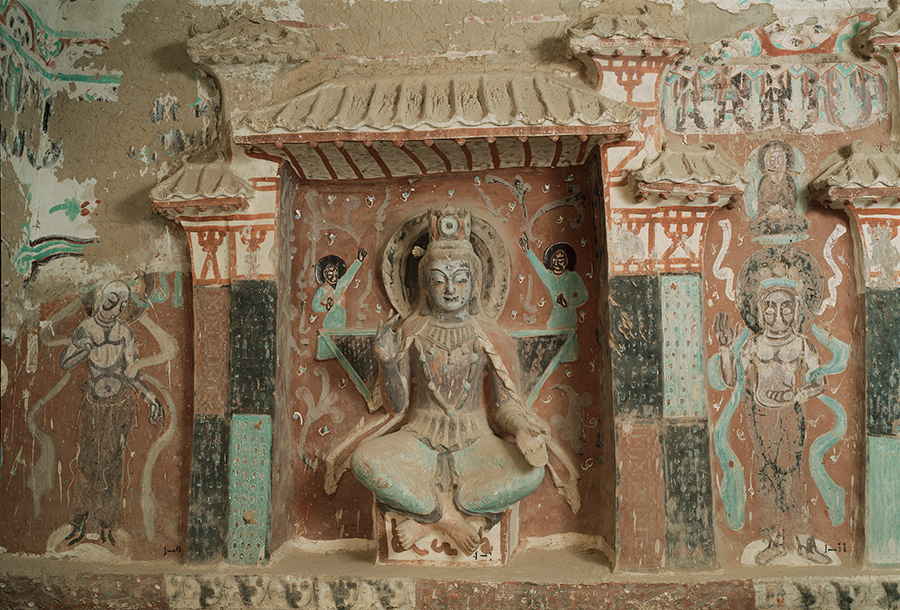
Interior and sculpture of a bodhisattva in Cave 275 (Courtesy of the Dunhuang Academy)
.
Pyramidal interior of cave temple (The Iris)
The exhibition Cave Temples of Dunhuang: Buddhist Art on China’s Silk Road explores the history and art of the Mogao Caves in northwestern China.

The exhibit presents the story of preserving these caves, displays objects originally found there, and offers on the Getty Center plaza life-size, hand-painted replicas of three spectacular Mogao Cave Temples.

Also known as the Mogao Grottoes, this UNESCO World Heritage site is one of the great artistic and religious wonders of the world. Here is an introduction, via a few intriguing facts:

1. Mogao means “peerless.”
Excavated into a mile of cliff face outside Dunhuang, an oasis town at the edge of the Gobi Desert, the site’s Chinese name Mogaoku means “peerless caves.” More

Art, environment, Dunhuang Cave Temples

(Cave Temples of Dunhuang, 8/30); CC Liu, Crystal Quintero, Wisdom Quarterly
Interior of Cave 275 showing the sand and mud walls covered with pigment
The walls of the cave temples were plastered with sand, hemp fiber, and mud then painted. Interior wall of Cave 275, Northern Liang Dynasty (420-429 CE) (Dunhuang Academy).
Art Meets Environment in the Cave Temples of Dunhuang
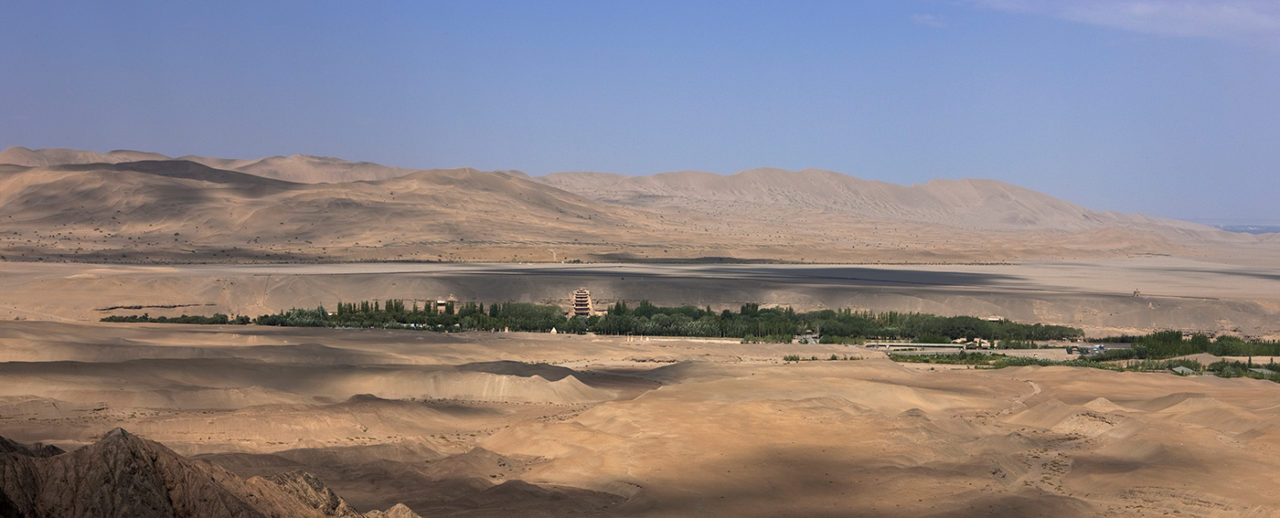
The cave temples of Mogao at Dunhuang, Western China, are carved into the cliff face along the Daquan River and are surrounded by austere desert (Sun Zhijun/Getty Museum).
The Mogao cave temples of Dunhuang have been shaped by more than the Buddhist artists and builders who crafted the site over the course of a thousand years -- the environment itself has played a vital role.

After several decades of research and conservation work carried out by the Dunhuang Academy in collaboration with the Getty Conservation Institute and others, we now have a greater understanding of how the natural setting and local climate -- from the wind and the desert sand to the water sources nearby -- influenced the design of the cave temples and their paintings.
 
Not only is this knowledge critical to developing strategies for preserving and managing the grottoes today, it also prompts art and architectural historians to study the history of the cave temples in connection with their broader ecological environment. What does an earth-centered approach to the art of Dunhuang look like?
 
A Desert Oasis
The overall configuration of the Mogao Grottoes is key to understanding the relationship between its art and environment. Nearly five hundred extant caves are distributed over a half-mile along the same cliff face in the southern tip of the Sanwei Mountains.

The heavy concentration of cave-building activity in this relatively limited area from the fourth to the fourteenth centuries underscores the remarkable allure that the place held for the local community.
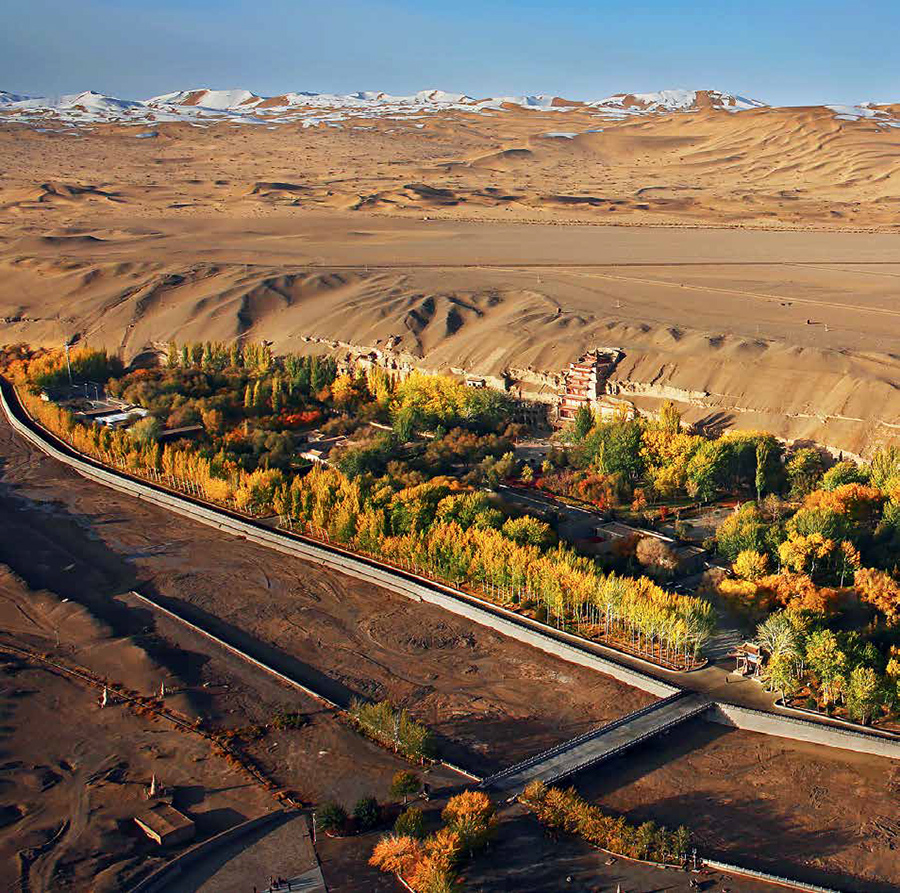
 
Aerial view of the Mogao Grottoes, looking west, showing desert and snow-capped mountains in the far distance
Aerial view of the Mogao Grottoes showing the location of the cave temples in the cliff face. Poplar and conifer trees provide shade for the site. Beyond the sandy expanse above the cliff rise the dunes known as the Mingsha Shan, capped with snow. Courtesy of the Dunhuang Academy (Sun Zhijun).
 
In material terms, the rock structure is the same for most of the temples, and the general climate is consistent throughout the site. Composed of conglomerate, a soft rock, the cliff was easily excavated with hammers and chisels, and the cave temple walls were plastered with sand, hemp fiber, and mud from the nearby Daquan riverbed before being painted.

Despite working in the same location, different generations of builders and painters dealt with these existing environmental conditions in disparate ways.
 
When the site was first established, artisans focused on finding appropriate materials and techniques to create an enduring work of art. Their concerns changed considerably in the ensuing years with the planning of new additions. Largely due to financial and time constraints, these later craftsmen did not reinvent the site but rather adapted new caves to the existing configuration.
 
When all the available cliff surfaces ran out in the tenth century, however, the need to reconfigure the site anew arose. Builders added many monumental cave temples by consolidating older units into one location, and they consulted the work of their predecessors while carrying out this renovation.

Their awareness of Dunhuang’s history of construction and adaptation enabled them to better respond to the immediate environmental pressures.

Flora and Fauna
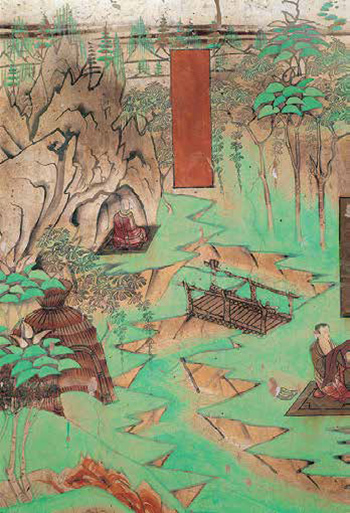
Wall painting from the Mogao caves showing topography and vegetation
Greenery abounds in this landscape illustrating the Maitreya Sutra. Detail, north wall, Yulin Cave 25. Late eighth-early ninth century (Dunhuang Academy).
  
In addition to the physical setting, the mural paintings inside the cave temples at Mogao offer ways to chart the shifting ecology of the area. Take, for example, representations of plants and animals. These paintings could be a source of information regarding environmental changes over time.

Although most of the scenes depicted at Mogao pertain to imaginary realms populated with Buddhist deities of all sorts, local painters often imbued these religious scenes with a touch of reality from their own earthly lives.
 
Indeed, plants and animals were often rendered with such remarkable accuracy that it’s possible to identify the individual species. By tracking when certain flora and fauna became prevalent subjects in Dunhuang paintings or disappeared from the artistic repertoire, researchers can infer whether climate changes contributed to the growth or decline of certain types of ecological life in the region.
 
Over the course of a millennium, environmental factors in this desert oasis shaped the very configuration and appearance of the Dunhuang cave temples, and the discovery and study of these natural influences is now more accessible than ever.

 
This post is part of the series Cave Temples of Dunhuang, featuring stories inspired by the exhibition Cave Temples of Dunhuang: Buddhist Art on China’s Silk Road. See all posts in the series

Saturday, July 23, 2016

Getty Center: Buddhist caves exhibit (video)

Jeff Albrizze, Dhr. Seven, CC Liu, Wisdom Quarterly; CCTV News; Getty.edu


The World in the Year 1000: The View from Dunhuang
Aurel Stein's Ruins of Desert Cathay (1912)
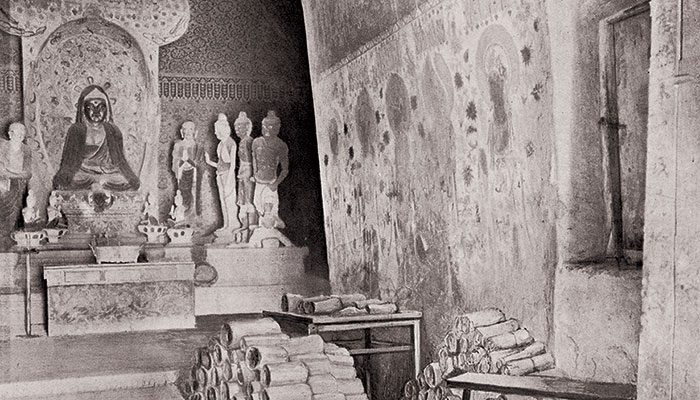
In the year 1000, dramatic cultural and political changes were underway in major regions of the world, including East and Central Asia. At Dunhuang, this was when the Library Cave (Cave 17) was sealed. Hear from Valerie Hansen, professor of history at Yale University, what the contents of this long-sealed cave reveal.
This lecture is made possible by the generous support of Mr. Andrew Cherng and Dr. Peggy Cherng, the Panda Restaurant Group, Inc. and complements the exhibition Cave Temples of Dunhuang: Buddhist Art on China's Silk Road. More

Friday, May 6, 2016

Buddhist Caves of Dunhuang, Getty LA

Getty.edu; CC Liu, Dhr. Seven via Roshi Jeff Albrizze (PasaDharma.org) Wikipedia edit
Cave Temples of Dunhuang at the Getty Museum, Los Angeles, May 7-Sept. 4, 2016
.
Ancient manuscripts, Library Cave
(Wiki) The Western Thousand Buddha Caves refers to a Buddhist cave temple site in Dunhuang, Gansu Province, China.
 
The site is located approximately 21 miles (35 km) southwest of the urban center and about the same distance from the Yangguan Pass.

The area once served as a staging post for travelers on the Silk Road (Xuerong) north of Afghanistan.

It is the western counterpart of the Mogao Caves, also known as the "Caves of the Thousand Buddhas."
Prof. Robert Thurman
For more than 20 years, theater and opera director Peter Sellars has been studying the Vimalakīrti Sutra -- a 1st century AD allegorical text of Buddhist teachings, scenes of which are well-represented in the Dunhuang cave temples -- and is collaborating with artists, composers, and scholars to stage a full-scale production that is anticipated to premiere in 2020.

At the Getty, Sellars will be joined by Robert Thurman, Uma's dad, the Jey Tsong Khapa Professor of Indo-Tibetan Buddhist Studies in the Department of Religion at Colombia University, for a discussion about Dunhuang and the Vimalakīrti Sutra as sources of inspiration for artists and for Sellars' forthcoming production. More
  
They are named after the founding monk Yuezun's vision in 366 of a "golden radiance in the form of a thousand Buddhas" (Whitfield).

The caves were excavated from a cliff that runs along the north bank of the Dang River. Some have been lost to floods and collapse.

Forty are still extant; 22 of the decorated caves house 34 polychrome statues and 800 square meters of wall paintings, dating from the Northern Wei to the late-Yuan and early-Ming Dynasties, sixth to fourteenth centuries (Zhang).

The site was included within the 1961 designation of the Mogao Caves as a Major National Historical and Cultural Site. More
  • Zhang Xuerong, ed. (1998). 敦煌西千佛洞石窟 [Dunhuang Western Thousand Buddha Caves]. 甘肃人民美术出版社. pp. 4-5. 
  • Whitfield, Roderick (et al.) (2000). Cave Temples of Mogao: Art and History on the Silk Road. Getty Conservation Institute. pp. 5, 9.

Tuesday, April 1, 2014

The rock-cut temples of Buddhism

Dhr. Seven, Amber Larson, CC Liu, Wisdom Quarterly
Bezeklik ancient Buddhist rock-cut temple monastery complex (chinatouronline.com)
Tiger's Nest Buddhist Monastery perched on cliff, Bhutan (MichaelFoleyPhotography/flickr)
Rock-cut Buddha, Luoyang Shaolin Temple, taken during the "Kung Fu and Buddhism Tour by Cycle" through China in 2013 (Great-wall-hikers/flickr.com)
 
Kwan Yin, Yungang (G-W-H)
It is characteristic of Buddhism that temples were built by carving them directly into mountains out of bare stone -- a feature known as rock-cut architecture, particularly in ancient India.
 
This was accomplished in some advanced way that cannot be explained today, for it was a time when there were presumably no lasers, power drills, grinders, sanders, or diamond-tipped chisels.
 
Mountain-sized Buddhas, Bamiyan
The first were in Afghanistan beginning at the time of the Buddha. His family was apparently living in the area, the northwestern frontier of greater "India" (Bharat) beyond Gandhara.

There are stunning examples in the spectacular Afghan archeological sites of Bamiyan and Mes Aynak, the jaw-dropping caves of Ellora and Sanchi in Buddhist India, and China's Bezeklik and Yungang grottoes.... Of course, one cannot lose sight of the official "largest" Buddhist sites in Borobudur, Java, Indonesia and the rock-cut marvels of the Cambodian jungles at Angkor Wat and "lost medieval cities" (livescience.com) such as Mahendraparvata discovered in 2013. We are assured by the enlightened and psychic Buddhist master Ven. Jumnien that more such stone sites remain in the jungle to be found.

Giant and Buddhist missionaries Datong, Yungang Grottoes (Great-wall-hikers/flickr.com)
Magnificent rock-cut architectural finds: stupa at Mes Aynak, Afghanistan (ranajitpal.com)
"Copper Well" (Mes Aynak), Afghanistan mineral mine treasures (AP)
 
World's largest Buddhas, Bamiyan, Afghanistan
The real Kapilavastu, the Buddha's hometown, was close to modern Kabul (Kapil). For the ancient country's capital, seat of the Shakyan janapada (the "foothold" of the Shakya clan's territory) may have been Bamiyan, a site famed not only for rock-cut caves and monastic dwellings but also the most massive Buddha statues in the world.

Bojjannakonda cave (Adityamadhav83/AP)
It was rich because it was on the Silk Road between India to the east and Central Asia to the west. Right from its inception Buddhism traveled the route west into ancient Greece and onto China. It is said that one of the first things the newly enlightened Buddha did was send out 60 enlightened missionaries in all directions; they were wandering ascetics spreading the "good news" of liberation from all suffering.
 
Cliffside Bamiyan Valley, Afghanistan, overlooking adobe "pueblos" in the distance (wiki)


Much of desert western China features magnificent rock-cut Buddhist architecture which is little known today. Islam supplanted the Dharma and obscured its Buddhist past. Much of the architecture is now in a part of the Great Walled Empire (China), known as the restive Uighur Autonomous Region. Like Buddhist Tibetans from the Tibetan Autonomous Region, Muslim Uygurs want nothing to do with colonial communist/capitalist Han Buddhist Chinese rule.

Buried treasures at Mes Aynak (Andy Miller)
At 2,600 years, the oldest Buddhist temple complex yet discovered and largest -- with a central area of one square mile -- is at Mes Aynak ("Copper Well"). 

However, most of it is still underground as an archeological site never to be excavated if China (through its Chinese Metallurgy Company) has its way. China will be the next empire to invade Afghanistan, according to Afghans, after the ancient Greeks with Alexander, the British, the Soviets, and the Americans.
  • Scientific research in "forbidden archeology" suggests that technologically advanced tools were in the possession of someone as explained by Micheal Cremo, David Hatcher Childress, and others.
Buddha Grottoes, China (Great-wall-hikers)
While characteristic of Buddhist sites, rock-cut technology did not remain exclusive to the East, having made its way to Petra and widely practiced in Cappadocia, (Anatolia, Asia Minor) Turkey, particularly in the soft stone of Derinkuyu. But no other religious movement did so much to generate and exploit this practice -- we would guess with help from above, namely, the akasha deva loka (space deva world).

https://www.flickr.com/photos/great-wall-hikers/


Buddhism spread from Afghanistan
Dazzling new finds from Mes Aynak and Tepe Naranj near Kabul
Ranajit Pal, Ph.D. (ranajitpal.com)
Mes Aynak vihara, Trapusa (Brent E. Huffman)
"The discoveries cover more than 1,000 hectares and have unearthed [Buddhist] temples, monasteries, and about 1,000 statues, which cannot be compared with finds from any location in Nepal.

Smaller Buddha, Bamiyan
"The site is about 20 km from the Indian border (pre-partition) and was probably within ancient ‘India.’ The RigVeda names many rivers and tribes of Afghanistan, which shows that it was a part of Vedic India.

"The new discoveries unmistakably indicate that Buddhism spread from Afghanistan and northwest India, not eastern India or Nepal. The discoveries at Bamiyan, Mes Aynak, and [Greco-Buddhist] Hadda highlight the primacy of Afghanistan and Gandhara in early Buddhist history."
Gold-covered statues of "Copper Well" (Mes Aynak) archeological site, Afghanistan