Showing posts with label getty. Show all posts

Thursday, April 25, 2024

Getty Museum: Greek, Maya, Moche (LA)

(Plan your visit: getty.edu)

FEATURED EXHIBITION Picture Worlds Greek, Maya, and Moche Pottery (Runs until July 29, 2024)
Art of the Americas and the Old World
GETTY VILLA, Malibu, Los Angeles: Plan a visit to see mighty deities, brave heroes, and fantastic beings adorn the terracotta vessels of the ancient Greeks in the Mediterranean, the Maya in Central America, and the Moche of northern Peru.

This exhibition juxtaposes these three distinct ceramic traditions and explores the ways in which painted pottery served as a dynamic means of storytelling and social engagement.


This exhibition is presented in English and Spanish. Esta exhibición se presenta en inglés y en español. More: getty.edu
Generous support provided by Jeffrey P. Cunard and the Getty Patron Program Additional support from Charles and Ellen Steinmetz in honor of Professor Christopher B. Donnan. SELECTED WORKS Plate with Hunters Shooting a Supernatural Bird, Maya, 600–900 CE. Terracotta. Museo Maya de Cancún, Secretaría de Cultura-Instituto Nacional de Antropología e Historia. Image: © D.R. Secretaría de Cultura-INAH- MEX. Ignacio Guevara Explore the Exhibition Discover more about the dynamic picture worlds of the Greeks, Maya, and Moche
  • Getty.edu; Crystal Q., CC Liu (eds.), Wisdom Quarterly

Sunday, October 29, 2023

The Florentine Codex at Getty Center (11/4)

Adolfo Guzman-Lopez, LAist.com; Crystal Quintero, Dhr. Seven (eds.), Wisdom Quarterly
Older Aztecs were told to describe and draw their culture for a friar aiming to convert them.

To celebrate the launch of the Digital Florentine Codex, join LAist for an outdoor concert debuting an original score by musician Lu Coy (they/them).
The Florentine Codex is a Spanish conquest text
Known for their mastery of woodwinds, electronics, and agile vocals, Coy mines inspiration from ancient texts, stories, and musical traditions, guiding audiences through splendid architectures of ancestral memory.

Musical group Xochi Cuicatl (it/what) and Chris Garcia (he/him) will open the performance.

Introducing the performances is LAist higher education correspondent Adolfo Guzman-Lopez (he/him) and Getty Research Institute researcher Kim Richter (she/her).

They will discuss the historical resonances of the Florentine Codex in Southern California, the ancestral homeland of the Kizh/Gabrieleño/Tongva, Chumash (Malibu), and Tataviam (SFV) people, as well as the Codex’s impact on numerous Indigenous groups throughout the Americas.
ABOUT
  • Lu Coy (they/them) is a Los Angeles-based LGBTQ mixed-media artist and multi-instrumentalist of Mexican and Ashkenazi Jewish heritage. Coy frequently collaborates with other musicians and holds degrees in music performance and composition from the Boston Conservatory of Music and California Institute of the Arts. They have taught for institutions such as the Hammer Museum, California Institute of the Arts, and Plaza de la Raza.
  • Chris Garcia and Xochi Cuicatl are musicians specializing in Indigenous breath, string, and percussion instruments of Mesoamerica and Mexico, including pre- and post-invasion poetry and songs in Nahuatl, Purepecha, Spanish (the language of the colonial invaders), and English.
  • Host Adolfo Guzman-Lopez is an award-winning correspondent on Southern California Public Radio (scpr.org), LAist 89.3 FM, and host of The Forgotten Revolutionary podcast. He has reported on education, politics, arts, and higher education.
  • Kim Richter is senior research specialist at the Getty Research Institute and leads the Florentine Codex Initiative.

Sunday, February 23, 2020

"The Golden Girls" reunion (video)

Golden (Estelle Getty, Betty White, Bea "Maude" Arthur, Rue McClanahan) Girls, Lifetime TV, 2003; Best Clips of the Golden Girls; Ashley Wells, Sheldon S., Seth Auberon, Wisdom Quarterly


Gold girls have no Golden personalities (VS).
Just like the title song says, "Thank you for being a [TV] friend," Golden Girls. Leave it to schmaltzy Lifetime TV way back in 2003 -- 11 years after the final episode originally aired -- to bring us to tears with funny Estelle Getty & Company. HD TV this is not, but real "friends of Dorothy" won't mind, ha ha.

The strangest thing is that Estelle Getty was the youngest person on the cast playing the eldest, and she was the first to go in real life.

Now the world mourns the loss of BoJack.
Look, American TV is not that good, most of the time, but it's all we've got to stitch together a unified "culture."

Now in the Golden Age of TV with binge-watching and Netflix, it's a little better. But with 600 shows to pick from, no one gets general references like they used to. It's the Post-Ironic Age. Then there's Maude, was, and Mary Tyler Moore.

The closest thing to a cultural comedy: DNC cheating for Pete Buttigieg
"Any blue will do unless it's an old socialist Jew." Trump's second term.

Friday, September 9, 2016

Buddhist Cave Temples, Silk Road, China

The Iris (blogs.getty.edu); Crystal Quintero, CC Liu, Wisdom Quarterly
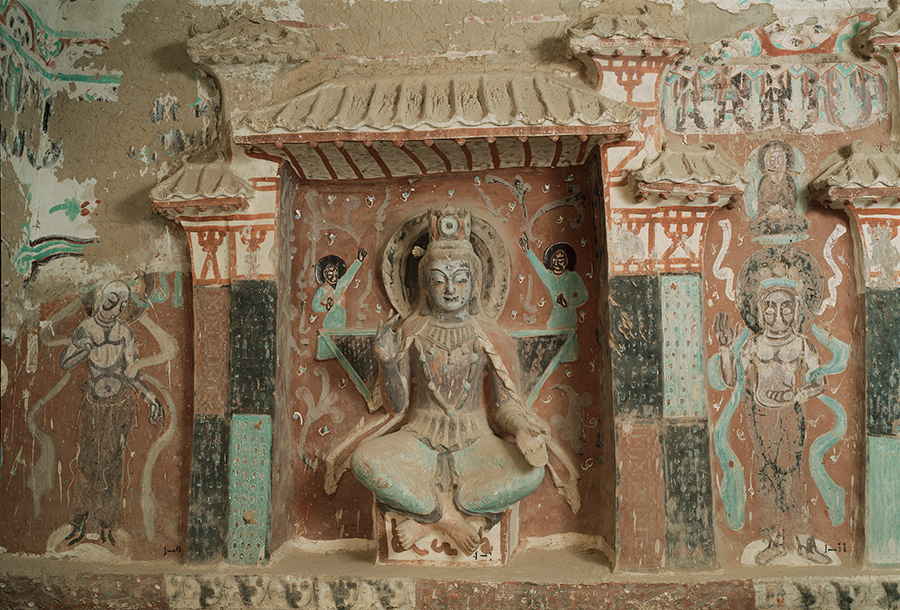
Interior and sculpture of a bodhisattva in Cave 275 (Courtesy of the Dunhuang Academy)
.
Pyramidal interior of cave temple (The Iris)
The exhibition Cave Temples of Dunhuang: Buddhist Art on China’s Silk Road explores the history and art of the Mogao Caves in northwestern China.

The exhibit presents the story of preserving these caves, displays objects originally found there, and offers on the Getty Center plaza life-size, hand-painted replicas of three spectacular Mogao Cave Temples.

Also known as the Mogao Grottoes, this UNESCO World Heritage site is one of the great artistic and religious wonders of the world. Here is an introduction, via a few intriguing facts:

1. Mogao means “peerless.”
Excavated into a mile of cliff face outside Dunhuang, an oasis town at the edge of the Gobi Desert, the site’s Chinese name Mogaoku means “peerless caves.” More

Art, environment, Dunhuang Cave Temples

(Cave Temples of Dunhuang, 8/30); CC Liu, Crystal Quintero, Wisdom Quarterly
Interior of Cave 275 showing the sand and mud walls covered with pigment
The walls of the cave temples were plastered with sand, hemp fiber, and mud then painted. Interior wall of Cave 275, Northern Liang Dynasty (420-429 CE) (Dunhuang Academy).
Art Meets Environment in the Cave Temples of Dunhuang
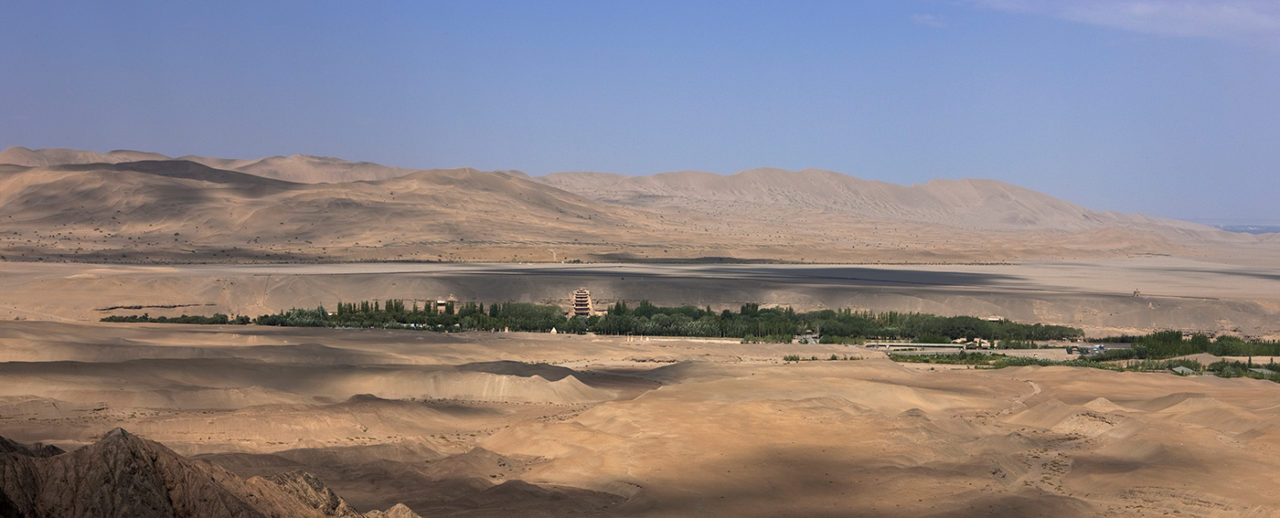
The cave temples of Mogao at Dunhuang, Western China, are carved into the cliff face along the Daquan River and are surrounded by austere desert (Sun Zhijun/Getty Museum).
The Mogao cave temples of Dunhuang have been shaped by more than the Buddhist artists and builders who crafted the site over the course of a thousand years -- the environment itself has played a vital role.

After several decades of research and conservation work carried out by the Dunhuang Academy in collaboration with the Getty Conservation Institute and others, we now have a greater understanding of how the natural setting and local climate -- from the wind and the desert sand to the water sources nearby -- influenced the design of the cave temples and their paintings.
 
Not only is this knowledge critical to developing strategies for preserving and managing the grottoes today, it also prompts art and architectural historians to study the history of the cave temples in connection with their broader ecological environment. What does an earth-centered approach to the art of Dunhuang look like?
 
A Desert Oasis
The overall configuration of the Mogao Grottoes is key to understanding the relationship between its art and environment. Nearly five hundred extant caves are distributed over a half-mile along the same cliff face in the southern tip of the Sanwei Mountains.

The heavy concentration of cave-building activity in this relatively limited area from the fourth to the fourteenth centuries underscores the remarkable allure that the place held for the local community.
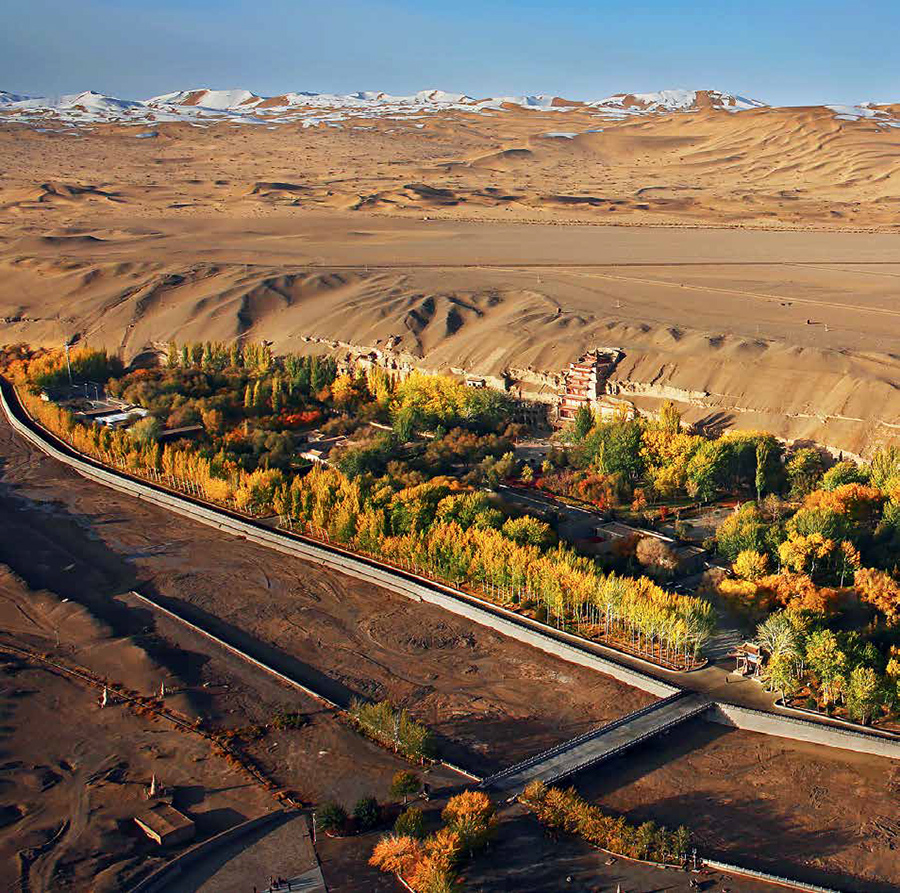
 
Aerial view of the Mogao Grottoes, looking west, showing desert and snow-capped mountains in the far distance
Aerial view of the Mogao Grottoes showing the location of the cave temples in the cliff face. Poplar and conifer trees provide shade for the site. Beyond the sandy expanse above the cliff rise the dunes known as the Mingsha Shan, capped with snow. Courtesy of the Dunhuang Academy (Sun Zhijun).
 
In material terms, the rock structure is the same for most of the temples, and the general climate is consistent throughout the site. Composed of conglomerate, a soft rock, the cliff was easily excavated with hammers and chisels, and the cave temple walls were plastered with sand, hemp fiber, and mud from the nearby Daquan riverbed before being painted.

Despite working in the same location, different generations of builders and painters dealt with these existing environmental conditions in disparate ways.
 
When the site was first established, artisans focused on finding appropriate materials and techniques to create an enduring work of art. Their concerns changed considerably in the ensuing years with the planning of new additions. Largely due to financial and time constraints, these later craftsmen did not reinvent the site but rather adapted new caves to the existing configuration.
 
When all the available cliff surfaces ran out in the tenth century, however, the need to reconfigure the site anew arose. Builders added many monumental cave temples by consolidating older units into one location, and they consulted the work of their predecessors while carrying out this renovation.

Their awareness of Dunhuang’s history of construction and adaptation enabled them to better respond to the immediate environmental pressures.

Flora and Fauna
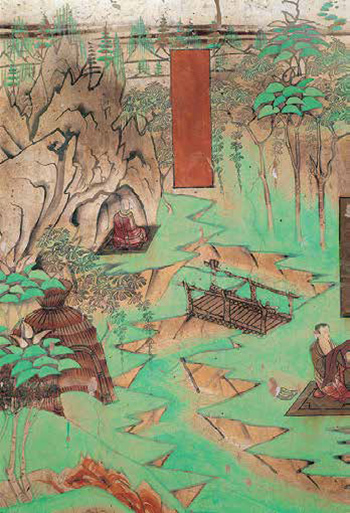
Wall painting from the Mogao caves showing topography and vegetation
Greenery abounds in this landscape illustrating the Maitreya Sutra. Detail, north wall, Yulin Cave 25. Late eighth-early ninth century (Dunhuang Academy).
  
In addition to the physical setting, the mural paintings inside the cave temples at Mogao offer ways to chart the shifting ecology of the area. Take, for example, representations of plants and animals. These paintings could be a source of information regarding environmental changes over time.

Although most of the scenes depicted at Mogao pertain to imaginary realms populated with Buddhist deities of all sorts, local painters often imbued these religious scenes with a touch of reality from their own earthly lives.
 
Indeed, plants and animals were often rendered with such remarkable accuracy that it’s possible to identify the individual species. By tracking when certain flora and fauna became prevalent subjects in Dunhuang paintings or disappeared from the artistic repertoire, researchers can infer whether climate changes contributed to the growth or decline of certain types of ecological life in the region.
 
Over the course of a millennium, environmental factors in this desert oasis shaped the very configuration and appearance of the Dunhuang cave temples, and the discovery and study of these natural influences is now more accessible than ever.

 
This post is part of the series Cave Temples of Dunhuang, featuring stories inspired by the exhibition Cave Temples of Dunhuang: Buddhist Art on China’s Silk Road. See all posts in the series

Saturday, July 23, 2016

Getty Center: Buddhist caves exhibit (video)

Jeff Albrizze, Dhr. Seven, CC Liu, Wisdom Quarterly; CCTV News; Getty.edu


The World in the Year 1000: The View from Dunhuang
Aurel Stein's Ruins of Desert Cathay (1912)
In the year 1000, dramatic cultural and political changes were underway in major regions of the world, including East and Central Asia. At Dunhuang, this was when the Library Cave (Cave 17) was sealed. Hear from Valerie Hansen, professor of history at Yale University, what the contents of this long-sealed cave reveal.
This lecture is made possible by the generous support of Mr. Andrew Cherng and Dr. Peggy Cherng, the Panda Restaurant Group, Inc. and complements the exhibition Cave Temples of Dunhuang: Buddhist Art on China's Silk Road. More

Friday, May 6, 2016

Buddhist Caves of Dunhuang, Getty LA

Getty.edu; CC Liu, Dhr. Seven via Roshi Jeff Albrizze (PasaDharma.org) Wikipedia edit
Cave Temples of Dunhuang at the Getty Museum, Los Angeles, May 7-Sept. 4, 2016
.
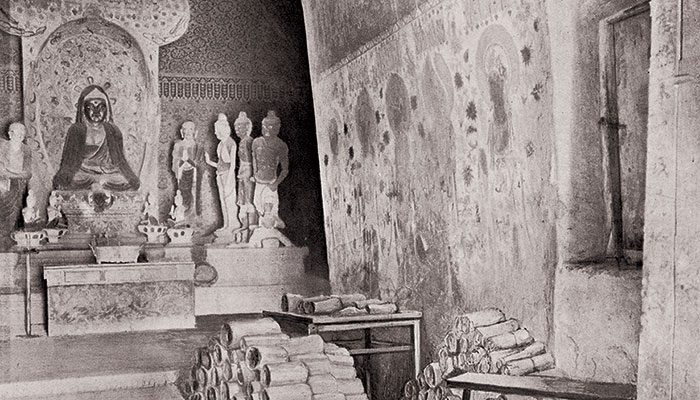
Ancient manuscripts, Library Cave
(Wiki) The Western Thousand Buddha Caves refers to a Buddhist cave temple site in Dunhuang, Gansu Province, China.
 
The site is located approximately 21 miles (35 km) southwest of the urban center and about the same distance from the Yangguan Pass.

The area once served as a staging post for travelers on the Silk Road (Xuerong) north of Afghanistan.

It is the western counterpart of the Mogao Caves, also known as the "Caves of the Thousand Buddhas."
Prof. Robert Thurman
For more than 20 years, theater and opera director Peter Sellars has been studying the Vimalakīrti Sutra -- a 1st century AD allegorical text of Buddhist teachings, scenes of which are well-represented in the Dunhuang cave temples -- and is collaborating with artists, composers, and scholars to stage a full-scale production that is anticipated to premiere in 2020.

At the Getty, Sellars will be joined by Robert Thurman, Uma's dad, the Jey Tsong Khapa Professor of Indo-Tibetan Buddhist Studies in the Department of Religion at Colombia University, for a discussion about Dunhuang and the Vimalakīrti Sutra as sources of inspiration for artists and for Sellars' forthcoming production. More
  
They are named after the founding monk Yuezun's vision in 366 of a "golden radiance in the form of a thousand Buddhas" (Whitfield).

The caves were excavated from a cliff that runs along the north bank of the Dang River. Some have been lost to floods and collapse.

Forty are still extant; 22 of the decorated caves house 34 polychrome statues and 800 square meters of wall paintings, dating from the Northern Wei to the late-Yuan and early-Ming Dynasties, sixth to fourteenth centuries (Zhang).

The site was included within the 1961 designation of the Mogao Caves as a Major National Historical and Cultural Site. More
  • Zhang Xuerong, ed. (1998). 敦煌西千佛洞石窟 [Dunhuang Western Thousand Buddha Caves]. 甘肃人民美术出版社. pp. 4-5. 
  • Whitfield, Roderick (et al.) (2000). Cave Temples of Mogao: Art and History on the Silk Road. Getty Conservation Institute. pp. 5, 9.

Monday, May 12, 2014

I'm a Mexican Buddhist...in LA/LA Land (video)

Crystal Quintero, Ashley Wells, CC Liu, Pfc. Sandoval, Wisdom Quarterly (Part 2)
"LA/LA"? Welcome to LA LA Land: Los Angeles, Latin America (sweetnrawme.com)

If I were Frieda Kahlo
LOS ANGELES, Latin America - The Getty is preparing to launch an art exhibit that accentuates the embarrassment of artistic riches we have in Los Angeles, which not everyone realizes is in Latin America.

It is for a lot of reasons. Not only did it used to be Mexico until European Invaders during U.S. War on the Spanish annexed it like Ukraine, it is again predominantly Latin American.

Buddhists discovered America before Columbus
Although Asians are the fastest growing ethnicity in the U.S., more Latinas and Latinos live in California than any other group.

Most are not Mexican Buddhists anymore, but a lot are. And it's amazing to find out that there is a connection between the Native Americans, First Nations people, and Mexicans (Aztecs, Maya or Mayans, Toltecs, Olmecs, Incas, and many others) from neighboring Mexico, Mesoamerica, and Central America.
 
The famous "Mayan Calendar" is Aztec
It will be a long time before that information goes mainstream.

But it takes awhile for the truth to surface. In 1885 Edward P. Vining published the facts about inglorious Columbus and the Afghan Buddhist missionaries, led by the Chinese Buddhist monk Hwui Shan (Hui Shen), who arrived in America in the 5th century. America is the Fusang they discovered. So everyone will have to settle for the Getty's Pacific Standard Time 2017.
Getty Foundation (getty.edu)
TheGetty and the Getty Foundation: Art and Art History in Los Angeles (getty.edu)
If I were a leftist Aztec warrior marching through the streets of Los Angeles (latimes.com)
 
In the fall of 2011 Los Angeles celebrated the launch of Pacific Standard Time: Art in L.A. 1945-1980, an unprecedented collaboration of arts institutions across Southern California joining together to tell the story of the birth of the L.A. art scene.
 
If I were Irish-Mexican like Peter (as Che)*
Yet it was 230 years earlier, in 1781, that the city of Los Angeles itself was born when El Pueblo de Nuestra Señora la Reina de los Ángeles [de Porciúncula] was founded as part of New Spain. [A pueblo like that of the Puebloan Buddhists!]

Thus, while Los Angeles [the "City of Angels"] often represents the vanguard of contemporary culture in the United States, it is at the same time a Latin American city of long duration.
 
If I went to BofA or KA
Today, nearly half of the population of Los Angeles has roots in Latin America, contributing to Southern California as a lively center of artistic production and a natural nexus of cultural creativity between North and South. 
 
In recent years a number of exhibitions in the Americas and Europe have offered an introduction to the original and varied heritage of Latin America and the Latin American diaspora.

Now there is an opportunity for a broader and deeper examination of this art through a renewed collaboration by the Pacific Standard Time partners. In the process, Southern California will play a significant role in the research and presentation of Latin American art. More

Buddhism was in Mexico before Christianity (PRI video)

Sunday, April 27, 2014

Byzantine History Made Easy (audio)

Pat Macpherson, Dhr. Seven, Wisdom Quarterly; (Off-Ramp)
Archangel Michael (Buddhist Sakka, King of the Devas), 1300-1350 AD, Constantinople, tempera and gold on wood (Gift from Istanbul, Byzantine & Christian Museum, Athens).

Byzantium: Heaven and Earth and Constantinople, too
Buddhist Messiah Maitreya (WQ)
What civilization lasted 1,100 years, almost into Columbus’ time, that hardly anyone thinks of as a civilization? Byzantium.

It was a Yelp-5-Star civilization that bridged ancient times to modernity. And it’s now showing at both of the Gettys in Los Angeles.
  
First the Romans took over the Greeks. Then, 800 years later, the Greeks took over the Romans. [Messianic Buddhism-influenced] Christianity came into the mix, and the result was the magnificent Byzantine Empire, which once spread from North Africa all the way to Crimea (Ukraine).

  • Greco-Buddha, Gandhara
    Greco-Indian Buddhist empires: Bactria, Seleucid, Sogdia, Gandhara
  • Ancient Greece: the Buddhist monk and King Menander I (Milinda) In the land of the Bactrian Greeks, there was a city called Sagala, a great center of trade. Rivers and hills beautified it, delightful landscapes surrounded it, and it possessed many parks, gardens, woods, lakes, and lotus-ponds. Its ruler was King Milinda (Menander I), a man who was learned, experienced, intelligent, and competent, and who at the proper times carefully observed all the appropriate Brahminical rites, with regard to things past, present, and future. As a disputant he was hard to assail, hard to overcome, and he was recognized as a prominent sectarian teacher. One day, a large company of Buddhist saints (arhats) living in a well-protected spot in the Himalayas sent a messenger to Ven. Nagasena. He was dwelling at Asoka Park in Patna. They asked him to come, as they wished to see him, to have him go dispute the Greek king. 
While Western Europe was collapsing during the Dark Ages, Byzantium was a world center of art, literature, and culture. Yet, its story is largely forgotten in the deep dark gap between ancient and modern history.
"Heaven and Earth: Art of Byzantium from Greek Collections" is at the Getty Villa through August 25. "Heaven and Earth: Byzantine Illumination at the Cultural Crossroads" is at the Getty Center through June 22, 2014.
Aphrodite, 1st century (NAM)
In a bid to remedy this, the Getty is hosting a rare doubleheader called Heaven and Earth. The art from several Greek museums is on display at the Getty Villa, while the manuscripts are at the Getty Center. This has never happened before. Nor has any art of the past millennium ever been shown at the classically dedicated Getty Villa.
Why now? Not that the recovery of the civilization of Greeks who called themselves Romans isn’t much overdue. But the new consciousness or awareness of this rich and tumultuous Byzantine culture seems to spring from Greece itself.
 
Buddha, 1st century (Guimet)
“It was always there,” said Peter Poulos, an American-born official of the Bernaki Museum. “There are wonderful Byzantine churches all over Athens, built over almost every ancient pagan temple.”
But in recent years, modern Greece has rediscovered this mighty culture that endured far longer than the glory that was Classical Greece. Byzantium continued that glory. That’s one reason Modern Greece wants to share this heritage to the world.

The Getty Villa has on show more than 160 ikons, sculptures, and other works of art, many of which illustrate Byzantine art’s connection to... The intricate passages of this great art through the medieval world were indeed truly byzantine. Some of the most fascinating stuff here shows the Byzantine effects on the art of Central Asia [land of the Shakyas, the Buddha's relatives]... LISTEN


RIP Mike Atta: Hardcore punk founder, guitarist for OC band
(Off-Ramp/SCPR.org)
The Middle Class may have invented hardcore, an important genre of punk rock, but to say they invented it implies intent.
"It's not like The Middle Class guys, who were all teenagers at the time, like 15-17, who had barely discovered punk, and kinda taught themselves to play. What they had heard was that punk was loud and fast, and be kind of crazy. So with that in their heads, they just started playing loud and fast, there was nobody around to tell them, 'Hey, you're playing too loud and too fast!'" - Chris Ziegler, editor and publisher of LA Record.
In any case, this group of teens from Santa Ana (Orange County) was doing something nobody else was doing, and they were successful and influential. LISTEN
  • Off-Ramp is a lively weekly look at Southern California through the eyes and ears of radio veteran John Rabe (from Pasadena's KPCC FM). News, arts, home, life... covering everything that makes life here exciting, enjoyable, and interesting.