Showing posts with label pali language terms. Show all posts

Wednesday, August 9, 2023

FaXiang: A Buddhist Practitioner's Encyclopedia

FaXiang: A Buddhist Practitioner's Encyclopedia
: The Buddha's Teachings have a unique and sometimes challenging language all their own. It was constructed from the many cultures and generations of practitioners they have touched. To help readers navigate this vast lexicon, Venerable Tzu Chuang, a senior Fo Guang Shan monastic and the first abbot of Hsi Lai Temple, compiled FaXiang, an encyclopedia of Buddhist terms. It is both extensive and accessible. Now available in English, "FaXiang" is replete with detailed entries.
Hardcover, English ISBN: 1932293558 ISBN13: 9781932293555 Release Date: July 2012. Publisher: Buddha's Light Publishing. Length: 405 pages. Weight: 1.35 lbs.

Friday, June 30, 2023

Sanskrit: The Most Scientific Language

Thinking Allowed TV  via videopostman, 1/31/11; Eds., Wisdom Quarterly

Sanskrit Language: The Most Scientific, Ancient, Spiritual
Most beautiful Hindu, Julia Roberts
(Videopostman) Thinking Allowed: "Sanskrit Tradition." Location: Israel. Prof. Dean Brown points out that most European languages can be traced back to a root (proto) language that is related to Sanskrit, the sacred (liturgical) language of the ancient Vedic Brahminical/Hindu religions of India.

Many English words actually have Sanskrit origins. Similarly, many Vedic religious concepts can be found in Western culture. Prof. Brown discusses the fundamental idea of the Upanishads -- that the essence of each individual, the atman (soul, self), is identical to the whole universe, the principle of brahman (the "ultimate reality").

In this sense, the polytheistic traditions of India can be said to be monistic or monotheistic at their very core.

CREDITS: rapidshare.com/files/396948324... Thanks to ThinkingAllowedTV for allowing upload of these videos. Visit the Thinking Allowed website at thinkingallowed.com and its YouTube channel at 
thinkingallowedtv. Copyright (C) ThinkingAllowed.com

Wednesday, October 2, 2019

Glossary of Buddhist Terms in Pali

AccessToInsight.org/glossary; PaliKanon.com; Dhr. Seven, CC Liu, Wisdom Quarterly

Buddhist Dictionary (Ven. Nyanatiloka)
A Glossary of Pali and Buddhist Terms
This glossary, courtesy of the online sutra collection Access to Insight (ATI), covers many of the Pali language [Magadhi, lingua franca, pidgeon-Sanskrit, Prakrit] words and technical Buddhist terms one comes across in the books and articles available on ATI. The more link that follows some entries leads to a more detailed article on select topics.

A

Abhidhamma:
(1) In the discourses of the Pali canon, this term simply means "higher Dhamma" [or the Dharma in ultimate terms], and is a systematic attempt to define the Buddha's teachings and understand their interrelationships. (2) A later collection of analytical treatises based on lists of categories drawn from the teachings in the discourses [and commentaries], added to the Canon several centuries after the Buddha's life. More
abhiññā:
Intuitive powers that come from the practice of concentration: the ability to display psychic powers, clairvoyance, clairaudience, the ability to know the thoughts of others, recollection of past lifetimes, and the knowledge that does away with mental effluents (see āsava).
ācariya:
Teacher; mentor. See kalyāṇamitta.
adhiṭṭhāna:
Determination; resolution. One of the ten perfections (pāramīs).
ajaan, ajahn, achaan, etc.:
(Thai). Teacher; mentor. Equivalent to the Pali ācariya.
akāliko:
Timeless; unconditioned by time or season.
akusala:
Unwholesome, unskillful, demeritorious. See its opposite, kusala. Glossary

Friday, December 21, 2018

Chanting: "Itipiso Katha" (video)

Thai Theravada monks (motionclip88); text buddhanet.net; Editors, Wisdom Quarterly

1. Buddha Vandana: Iti pi so Bhagavâ-Araham: Sammâ-sambuddho. Vijjâ-carana sampanno, Sugato Lokavidû Anuttarro, Purisa-damma-sârathi, Satthâ deva-manussânam Buddho Bhagavâti.

TRANSLATION: "Honoring the Buddha: Thus, indeed, is the Blessed One: He is the Awakened One, fully enlightened, endowed with clear vision and virtuous conduct, sublime, Knower of worlds, incomparable leader of humans to be tamed, teacher of devas and humans, enlightened and blessed."

2. Dhamma Vandana: Svâkkhato Bhagavatâ Dhammo Sanditthiko Akâliko Ehi-passiko Opanâyiko Paccattam veditabbo viññuhiti.

TRANSLATION:  "Honoring the Dharma: The Dharma [Teaching] of the Blessed One is well expounded, seen here and how, immediate in efficacy, inviting one to come and see (investigate for oneself), leading onward (to nirvana), to be realized directly by the wise, each for oneself."

3. Sangha Vandana: Supati-panno Bhagavato sâvaka sangho, Ujupati-panno Bhagavato sâvaka sangho. Ñâya-patipanno Bhagavato sâvaka sangho. Sâmici-patipanno Bhagavato sâvaka sangho Yadidam cattâri purisa yugâni attha-purisa-puggalâ Esa Bhagavato sâvaka sangho. Âhu-neyyo, pâhu-neyyo, Dakkhi-neyyo,añjalikaraniyo, anuttaram puññakkhetam lokassâti.

TRANSLATION: "Honoring the Community: The community of the Blessed One's [enlightened] disciples has entered on the good way; the community of the Blessed One's disciples has entered on the direct way; the community of the Blessed One's disciples has entered on the proper way. That is to say, the four pairs and eight types of persons, which is the community of the Blessed One's disciples, is worthy of gifts, worthy of hospitality, worthy of offerings, and worthy of reverential salutation, for they are an incomparable field of merit in the world."

*Pali language pronunciation basics
a as a in what
â as a in father
i as i in mint
î as ee in see
u as u in put
û as oo in pool
e as a in cage
o as o in no
n as ng in sing
ñ as gn in signore
 
Pausing
Prolong vowels with ^ or (-) such as â, î , û, e, and o. Pause for double letters such as dd in Buddha: Bu-ddha, mm in Dhammam: Dha-mmam, ss in Ehi-passiko: E-hi-pa-ssiko.

Saturday, December 15, 2018

Free: learn exclusively Buddhist language

Dhamma Us (DhammaUSA.com); Ellie Askew, Sayalay, Dhr. Seven, Wisdom Quarterly

Recently, scholar-monk Ven. Sumitta from University of the West was invited to teach a free Buddhist language class at the Thabarwa Nature Center's Arcadia temple. The hall was full, and the discussion was lively. The next class is in January 11, 2019.
 

Pali 101: Pali for Beginners
Level One – Lesson 10 [(Copyright) Dhamma USA]
Any inquiries about the exercises may be emailed to info@dhammausa.com. If coming to this free class at the center, please make sure to turn in exercises two days prior to the next class.

Lesson 10 will cover pages 23-26 of The New Pali Course Part 1 by Professor A. P. Buddhadatta.

Video updates so far:
  1. Introduction and Lesson1 - Pali Alphabet pronunciation

  • Course Overview


  • Lesson 2 - Parts of Speech, Gender, Number, Case


  • Lesson 3 - Declension of Nouns: Nara, Buddha; Exercises 1, 2


  • Lesson 4 - Conjugation of Verbs, Exercise 3


  • Lesson 5 - Different Conjugations - Exercise 4


  • Lesson 6 - Different Conjugations - Exercise 5


  • Lesson 7 - Past Tense - Exercise 6


  • Lesson 8 - Personal Pronouns - Exercise 7


  • Lesson 9 - Future Tense - Exercise 8
  • Friday, February 27, 2015

    Sanskrit language lives on (audio)

    The West loves the Indo-European Sanskrit language. The cast of the Sanskrit play "The Cleverness of the Thief." Patricia Sauthoff is in center wearing white (Patricia Sauthoff).
    IVC/India's Sanskrit affected Tibetan as well as many Vajrayana Buddhist practices.


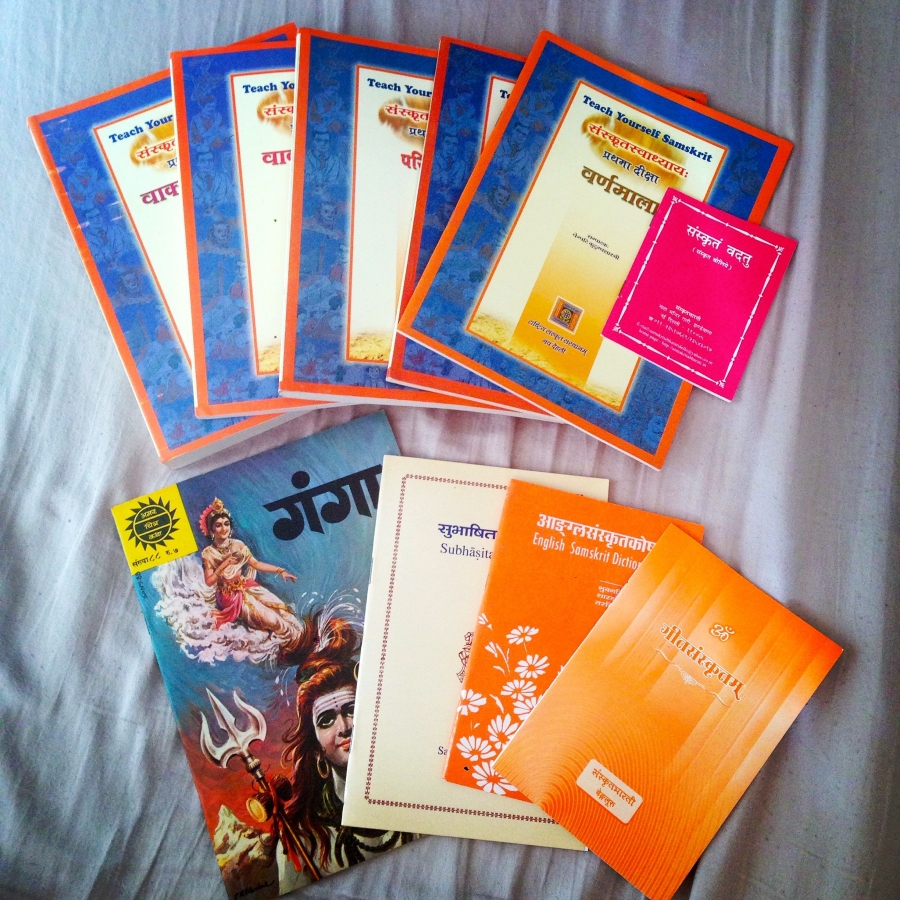
    Learning Sanskrit materials (Sauthof
    Sanskrit has been lingering at the edges of Western culture for a while now. It’s an obscure language that not many people know, but a lot of people know about.

    I started studying Sanskrit as a written language a few years ago. Back then, when I told people about it, they assumed I was a big "White Album"-era Beatles fan or into Transcendental Meditation. Now they just assume I spend a lot of time doing yoga.

    Sanskrit's sacred sound goes well with yoga
    I'm actually a Ph.D. candidate at The School of Oriental and African Studies in London. I study Sanskrit so I can do research and read ancient texts, not order lunch or hail a cab. But last year my studies took a turn for the practical when I decided to take a conversational Sanskrit course over the summer.
     
    Sanskrit tattoos (chakraboosters.com)
    Sanskrit is an ancient language, but it’s actually pretty easy to hear it out in the world -- if you know where to look. India's 2001 census counted 14,000 Indians [most probably Hindu nationalists who do not realize the language did not originate in India but in neighboring lands of the ancient Indus Valley Civilization] who claimed it as their mother tongue.

    There are Sanskrit language newscasts; I’ve seen Shakespeare and other plays performed in Sanskrit here in London; and there is a community of language learners and teachers from around the world who gather on Twitter to share their knowledge, ask for help, and meet others interested in communicating in Sanskrit.

    Sanskrit serious in England, stand up in India?
    (NDTV) Sanskrit is thriving among former British imperial colonialists: At St. James Junior School in London, the number of students wanting to learn it has grown by leaps and bounds.
    (Jay Hind!) Gujarat Sanskrit Academy has started translating Hindi film dialogues into Sanskrit. Sumeet presents some favorites. It's hilarious with a double H (or lame with a double L). He's mostly speaking Hindi with English mixed in.
     
    Some are in India, some are part of the Indian diaspora, and some -- like me -- are Westerners interested in learning something more about the language and culture of South Asia.
     
    And it does look like interest in Sanskrit is growing. The study of Sanskrit is certainly surging in popularity, both in India and in the West. Students at Princeton Univerisity recently launched a petition to get Sanskrit back into the curriculum. And at my own school, the second-year Sanskrit course grew to 20 this year, up from just two the year before.
     
    Sanskrit came from space like this crop circle.
    It turns out spending a month speaking Sanskrit day-in and day-out is pretty surreal. Instead of reading philsophy books, I learned how to say things like telephone -- दूरभाष  dūrabhāṣā -- and bicycle -- द्विचक्रिका dvicakrikā. It reminds me that Sanskrit isn’t just a [dead] language of dusty books. And as anyone who has ever namaste-d knows, it’s a language that’s really fun to say out loud -- or even to sing.

    India has 100 million+ Muslims, marry one.
    There were 20 of us in the class, learning, speaking and singing six days a week for four weeks.

    Several of my classmates were Indians living in Europe. Some were graduate students like myself, and others were professionals taking a break from work. There was even a Buddhist monk who out-chanted us all. More

    Did the Buddha speak Sanskrit? No!

    Dhr. Seven, Amber Larson, Ashley Wells, Wisdom Quarterly (COMMENTARY)
    The Buddha came from the Central Asia, which later became Bactria. See RanajitPal.com

     .
    The Buddha, wandering ascetic (WQ)
    If the question were, Did Prince Siddhartha know Sanskrit, then the answer is that the very well-educated royal (from a foreign land west of India in what is now Central Asia, Afghanistan, once known as Scythia or the Middle Country between East and West) must have.

    But Sanskrit was preserved and used not by ordinary people, but the Brahmin priest elites who promoted it, their interpretation of the Vedas, and the caste system which they placed themselves at the top of. Prince Siddhartha and his family clan, the Shakyans, were not Brahmins, were not priests, and were not much interested in spirituality. That as well as many administrative functions could be left to Brahmin intellectuals in their service. Kings ruled, and Brahmins were counselors, accountants, and chaplains in the royal (kshatriya) service.

    Walking pose, Thailand (Nippon_newfie)
    The ascetic Siddhartha did not leave home and travel to the East (to mahajanapadas like Magadha, Kasi, and Kosala) to become a temple priest. He went there to become a nomadic wandering ascetic from another anti-Vedic, anti-Brahminical shramana ("shaman," "wandering ascetic") school rising up to challenge the authority of the old and staid brahmana movement. Unless conversing, arguing, or publicly debating with Brahmins, there would be no reason for Siddhartha or, later, the Buddha to speak Sanskrit. Yet, the Brahmins were very interesting in undermining the Buddha-Dharma.

    And even while he was alive and teaching, they tried to co-opt his teachings and methods. After his final nirvana, they went all out to subsume Buddhism under the banner of Vedic Brahmanism and much later the organized Hinduism. But the Buddha and so many Buddhist teachings had run exactly counter to old Vedic and Brahminical assumptions and long held sacred teachings. The Buddha was not a Hindu, not born a Hindu (there was no Hinduism yet in existence, and he was most certainly not a Brahmin or aligned with the Brahmins. But because the Brahmins eventually succeeded in co-opting Buddhism and the figure of the Buddha (as an incarnation of the god Vishnu), Chinese Buddhism and other Mahayana traditions think that Buddhism was originally taught in Sanskrit and originally was just a kind of revival of the ancient Vedic religion of the very ancient Indus Valley Civilization.

    Indian Buddhaghosa writing in Sri Lanka
    What did the Buddha speak? He would have spoken various related languages -- Magadhi, Pali-Sanskrit, Prakrit, and the popular tongues of the many lands and territories he visited. There is only one exclusively Buddhist language, and it is not Sanskrit but its cognate Pali (what we interpret as a super-simplified Sanskrit but spoken by many more people, like common Aramaic compared to priestly Hebrew). Some of the oldest Buddhist texts are recorded in the spoken Pali tongue, which does not have an alphabet. It uses other alphabets, such as Sinhalese (from the island off the southern tip of the subcontinent). Sri Lanka, where Sinhalese is spoken, is where the most famous Indian Buddhist scholar-monk and commentator Ven. Buddhaghosa went to learn, record, and compile two massive Buddhist meditation manuals, the early Path of Freedom (Vimuttimagga) and the more refined and expanded Path of Purification (Visuddhimagga), the former preserved by the Chinese, and the later preserved by South and Southeast Asian Buddhists.

    Ancient Pali dictionary
    The earliest Buddhist texts (palm leaf scrolls) yet discovered must have been recorded in a regional Buddhist language. Indeed, those texts are not in Sanskrit but in a local language called Gandhari from Central Asia -- what today we generally call the 'stans:

    Ancient Gandhara (Afghanistan, at the foothills of the Himalayan range known as the Hindu Kush, and Pakistan), Uzbekistan, Tajykistan, Kazakhstan, Sistan, Balochistan, and so on.

    Maverick Dr. Ranajit Pal realized that Siddhartha was not from Nepal but from Afghanistan, the ancient Shakya-land (Greek Scythia) with one of its capitals at Kapilavatthu (Kapilavastu, near Bamiyan). And what is often forgotten is that many of the Buddha's earliest disciples were Brahmins who certainly spoke Sanskrit and would have spoken and memorized the teachings in that scholarly idiom as well as the Buddha's Prakrit, a form of the Magadha language, Magadha being the state where the Buddha mostly lived.

    His two chief male disciples, Ven. Sariputra and Ven. Maha Moggalana, were Brahmins. At least one of his chief female disciples, Ven. Khema and Ven. Uppalavana, may also have been. And more importantly the monk who turned the Buddha's Dharma (spiritual teachings) into a formal "religion," Ven. Maha Kassapa, was a Brahmin. Brahmins would have spread the Buddha-Dharma and with it remnants of their own earlier views, the language and concerns of the ancient Indus Valley Civilization and its ancient Knowledge Books (Vedas).

    Wednesday, May 21, 2014

    What is the "Dharma"?

    Ven. Nyanatiloka (A Buddhist Dictionary: Manual of Buddhist Terms and Doctrines), Dhr. Seven and Ashley Wells, (eds.), Wisdom Quarterly
    Where does wisdom come from? It derives from studying Dharma (teachings, phenomena)
    Yoga, meditation, relaxation, chanting banners draped on Sri Sri Ravi Shankar's beautiful Dharma center next to the Univ. of So. California (USC) the night of the "Yoga Rave" (WQ)
     
    Buddhist Dictionary (palikanon)
    [NOTE: The Sanskrit word dharma is multivalent with at least 12 distinct meanings, as is fairly common with many Indian terms. When capitalized it refers to the Buddha's Teachings, but all its meanings are related. This capitalization is only an English convention used to distinguish the Teachings from phenomena in general, other spiritual teachings, and one's duties and obligations, etc.]
     
    The Dharma (Pali Dhamma) literally means the "bearer," (what upholds, supports), constitution (the nature of a thing), norm, law (jus), doctrine; justice, righteousness; quality; things, objects of mind (see spheres or bases, āyatana) "phenomena."

    The word dhamma is met with in the texts in all of these meanings. The Commentary to the Long Discourses (Digha Nikaya) gives four applications of the term:
    1. quality (guna),
    2. instruction (desanā),
    3. text (pariyatti),
    4. selfless, void, empty (nijjīvatā), for example, "All dhammā, phenomena, are impersonal..."
    Buddha, cat, books (Dee McIntosh/flickr)
    The Commentary to the Dhammasangani has hetu (condition) instead of desanā (instruction).

    Therefore, the "analytical knowledge" of the law or lawfulness of phenomena (see patisambhidā) is explained in the Path of Purification (Vis.M. XIV) and in the The Book of Analysis (Vibhanga) as hetumhi-ñāna) "knowledge of the conditions."
     
    The Dharma, as the liberating truth discovered and proclaimed by the Buddha, is summed up in the Four Noble Truths (see sacca).
     
    It forms one of the Three Gems (Buddha, Dharma, and Sangha, ti-ratana) and one of the Ten Recollections (anussati), which are subjects for frequent recollection or mindfulness as contemplation.
     
    A dharma (dhamma) as object of mind (dhammāyatana, see āyatana) may be anything past, present or future, physical or mental, conditioned or unconditioned (cf. sankhāra, 4), real or imaginary. See wider Wiki discussion: Dharma.

    Thursday, October 3, 2013

    The Path to Freedom (self-guided tour)

    Wisdom Quarterly; FGS; AccessToInsight.org, Self-guided Tour of the Buddha's Teachings
    Modern Buddhist pyramid pagoda/stupa complex (Linc060/flickr.com)
      
    A foundation in the Buddha's Dharma
    By its nature, the truth invites us to "come and see," to question and investigate. Curious about exploring the Buddha's teachings as presented in the ancient Pali canon?
      
    Links are to selections of short passages from the Buddhist sutras introducing or illustrating aspects of a single topic.
     
    When encountering a particularly meaningful or interesting passage, look for the full text by simply following the link at the end. 
     
    The teachings are profound and complex
    Many passages are cross referenced with other pages, making it possible to pursue a theme to whatever depth is desired.
     
    This is not, of course, an exhaustive tutorial. A number of the topics introduced are explored more thoroughly in the Study Guides. The General Index also contains references to additional readings on related topics.
     
    Modern Buddhist pyramid, Fo Guang Shan, Taiwan (Steven Barringer/Zosoiv71/flickr.com)
      
    Begin the tour by exploring the Three Guides (Triple Gem):
    1. THE BUDDHA: Sketch of the Buddha's life based on sutra excerpts.
    2. THE DHARMA: Outline of the Buddha's teachings organized according to the "gradual instruction." The Buddha frequently used this framework to guide students from first principles through progressively more advanced teachings, all the way to the culmination of the Four Noble Truths by the realization of nirvana (Pali, nibbana).
    3. THE SANGHA: Descriptions of the Noble Order -- the community of monastics and laypersons who have gained at least the first stage of enlightenment called stream entry. This is known as they Ariya-Sangha).

    Monday, May 20, 2013

    Celtic LA, Lost Irish Buddhist Monk (ScotsFest)

    Pat Macpherson and Seth Auberon, Wisdom Quarterly; ScotsFest.com; UCCIreland
    General Info | Be A Games VIP | Piping & Drumming |  Highland Dancing | On-site Whisky Tasting | Tickets | Athletics |  Entertainment | Vendors | Clans | Hotel/Airports | Directions | Camping | Kids Activities | Schedules | ScotsFest Home | USS Home | Contact


    Why do the Irish have a reputation of telling the best stories? Is it possible we are eager to entertain and delight others to distract them from us? Is there a half-conscious motive to conceal ourselves?
     
    Do we stay private as part of the aftermath of near annihilation by the British, whose atrocities and occupation continued for...? Some might say it still continues, and certainly the hegemony persists. So much so that it once drove the first European to ordain as a Buddhist monk in faraway Asia. (See video).

    Irish-Americans have returned to the Emerald Isle with Buddhism. Thanks to the efforts of Mr. and Mrs. Rhys Davids, I.B. Horner, Woodward, and the Pali Text Society (P.T.S.) with its influential Journal, and even more influential Dictionary of Buddhist-Language Terms, the Dharma arrived on Albion and the Continent more than a century ago.

    The Lost Irish Buddhist


    Who was the first European Buddhist monk? An adventurer, an Irish rebel, a hobo, an inner-freedom fighter, a world traveler,  and finally a famous Buddhist in Asia. He blazed a trail but died, it seems, is ignored by history. Why?
     
    This enigmatic, free-thinking Dubliner used various aliases. As a monastic he was known as Ven. Dhammaloka ("Dharma Realm"), The Irish Buddhist. He converted to his adopted path-to-liberation about 1900. He came to be widely known throughout Asia and in the process managed to fall afoul of the colonial establishment and Christian missionaries.

    Danu, wee people, bhumi-devas (amayodruid)
    Uncovering Ven. Dhammaloka's unique story has taken inspired detective work on the part of UCC's Professor Brian Bocking and his colleagues. But their efforts have been fruitful.

    The lost Irish Buddhist emerges after all these many years as one of the earliest Western Buddhist monks, pre-dating many others who claim the title. Prof. Bocking guides us through his amazing odyssey.

    Now, with or without the Perks family, Wisdom Quarterly will represent Celtic Buddhism in Los Angeles at ScotsFest 2013.

    This year will feature a Saturday Night Closing in the Nan Daley Highland Dance Pavilion with all three Grade 1 pipe bands: Dowco Triumph Street, Alberta Caledonia, and the LA Scots (and no closing massed band in the main arena).
    • Celtic Celebration, Los Angeles
    • Memorial Day Weekend
    • May 25-26, 2013
    • Orange County Fair and Event Center
    Scooter/Wheelchair/Stroller Rentals available. More entertainment added. See Highland Dance entry form now available. More

    Saturday, April 14, 2012

    The Origins of the Pali Canon

    Pali Canon Online; Dharmachari Seven, Wisdom Quarterly
    Countless devas, devis, brahmas (extraterrestrial divinities), wanderers (shramans), brahmins, monks, nuns, and lay followers came to the Buddha for guidance. As a universal teacher, he welcomed and helped them all.

    "Suppose a monastic were to say, 'Friends, I heard and received this from the venerable one's own lips: This is the Dhamma, this is the Discipline, this is the Master's Teaching.' In that case, monastics, you should neither approve nor disapprove of those words.

    "Then without approving or disapproving, those words and expressions should be carefully noted and compared with the discourses and reviewed in the light of the disciplinary code. If they, on such comparison and review, are found not to conform to the discourses or the discipline, the conclusion must be:

    "'Assuredly this is not the word of the Buddha; it has been wrongly un­derstood by this monastic, and the matter is to be rejected.' But where on such comparison and review they are found to con­form with the discourses or the discipline, the conclusion must be:

    "'Assuredly this is the word of the Buddha; it has been rightly understood by this monastic'" (DN 16, The Buddha's Last Days, Mahāparinibbāna Sutta).

    The authentic teachings of Gotama (Sanskrit, Gautama) the Buddha have been preserved, handed down, and are to be found in the Three Divisions of the Dharma (literally, "three baskets," ti = three + piṭaka = collections of scriptures). All of the Buddha's teachings, when they were originally written down on ola palm leaves, were stored in one of three baskets according to subject matter.

    The Buddha had many prominent female disciples in an apparently smaller separate but equal Bhikkhuni Order that monks later subordinated by the institution of eight additional rules (garudhammas) for women. It has been claimed that the Buddha instituted these additional rules as a condition for female ordination -- an assertion contradicted by textual evidence that modern Theravada monks either do not know or choose to ignore to keep women out. It seems these sexist rules were a later fabrication. The issue is extremely important because based on these rules some assert that no woman can now legitimately gain the higher ordination in Theravada Buddhism to be a full nun and instead at best can only hope to be a ten precept holder living as a monastic without the rights and privileges full ordination would confer. For the Dharma to survive and prosper in modern times, particularly in the West, women are absolutely needed. Anyone who stands against them based on specious, fabricated, and unvetted "rules" harms the Dharma and limits how long it will survive to help everyone. Therefore, it is an issue of the utmost importance for monks interested in preserving the tradition as well as Buddhist women in the world today.
    1. The first part is known as the Vinaya Piṭaka containing all of the rules which the Buddha laid down for monks and nuns (and novices).
    2. The second part is called the Suttaṅta Piṭaka containing the discourses.
    3. The third part is known as the Abhidhamma Piṭaka containing the psychological [as well as the particle physics] and ethical teachings of the Buddha.
    It is known that whenever the Buddha delivered a sutra or prescribed a disciplinary rule (vinaya) in the course of his 45-year ministry, devoted and learned monastics would immediately commit his teachings word for word to memory.

    In this way the Buddha's words were preserved accurately and were in due course passed down in the oral tradition of the day from teacher to pupil. Some of the monastics who heard the Buddha teach in person (savakas or "hearers") were arhats -- "noble ones" free of passion, ill-will, and delusion. They were therefore capable of perfectly retaining the Buddha's words. So they ensured the Buddha's teachings would be preserved faithfully for posterity.

    Even those devoted monastics who had not yet attained full enlightenment but had reached the three preliminary stages and had powerful, retentive memories could also call to mind word for word what the Buddha had taught and so were worthy custodians of the Doctrine.

    There were almost always monastic companions as well as lay disciples present when the Buddha taught. Most of his teachings were to ordinary people. But since monks took it upon themselves to memorize and recite those delivered them -- not the ones delivered to the nuns or exclusively to lay people -- it now seems as if all of the sutras began, "O, monks..." This makes it seem as if the Buddha was only addressing them when he taught, or that this was the case the majority of the time. But we know that he taught almost daily, and most of the settings and circumstances are to ordinary people. This is to the detriment of women today, but it is also to the detriment of lay people and therefore Buddhism in general even as monks experience it. The most famous and significant sutra for lay people is the Sigalovada Sutta, the Advice to Laypeople," which is cobbled together imperfectly from more than one discourse. Where are those other discourses now? The monks did not retain them. With the loss of the Nuns' Order, the sutras addressed to them that they memorized and recited apparently disappeared as well. All that remains is what the monks considered important to retain, which is generally advantageous to them.

    One such monastic was Ānanda, the Buddha's chosen attendant and constant companion during the last 25 years of his life. Ānanda was kind, intelligent, and gifted with a remarkable ability to remember all that he heard. Indeed, in order to accept the position, it was his express wish that the Buddha always relate to him discourses originally delivered in his absence. Although he was not yet enlightened, he deliberately committed to memory word for word all of the Buddha's sutras.

    As a teacher the Buddha exhorted his monk, nun, and lay followers. The combined efforts of these gifted and devoted followers made it possible for the Doctrine and Discipline as taught by the Buddha to be preserved in its authentic state.

    The Pāli threefold division of the Dharma and its allied literature exists as a result of the Buddha's discovery of the noble and liberating path of the pure Dharma. This path enables all who follow it to lead a peaceful and increasingly happy life.

    Indeed, in this day and age we are fortunate to have the authentic teachings of the Buddha preserved for this and future generations through the conscientious and concerted efforts of his disciples down through the ages.

    The Buddha said to his disciples that when he was no longer among them, it was essential that the Saṅgha (monastic community) should come together for the purpose of collectively reciting the Dharma, according to formal oral tradition, precisely as he had taught it.

    Buddhaghosa was the greatest ancient Buddhist compiler and commentator, author of both The Path of Purification (Vissudhimagga) and The Path of Freedom (Vimuttimagga), texts important in both Theravada and Mahayana Buddhism.

    To comply with this instruction the first elders (theras, senior monastics) duly convened a council and systematically organized all of the Buddha's discourses and monastic rules then faithfully recited them word for word in concert.

    The teachings contained in the threefold division (Tipitaka) is also known as the "Doctrine of the Elders" (Theravāda). These discourses number several hundred and have always been recited word for word ever since the First Buddhist Council was convened. Subsequently, more councils have been called for a number of reasons, and at every one of them the entire body of the Buddha's teaching has always been recited by the Saṅgha participants together word for word.
    • That is, the oral tradition has continued in spite of writing because it is a more faithful form of keeping the Dharma from declining. Why? Words on a page can be altered, but no one can hope to simultaneously altered the memories of many thousands of seasoned monastics all at once. Therefore, change in the words is very slow and takes place only after deliberate debate and consideration. Councils define and settle issues that arise in the living body of the Buddhist community.
    The First Council took place three months after the Buddha's attainment of final nirvana (mahāparinibbāṇa) and has been followed by five others, two of which were convened in the 19th and 20th centuries. These collective recitations performed by the monastics present at these councils are known as Dhamma Saṅgītis, Dharma Recitations.

    They are so designated because of the precedent set at the First Dharma Council, when all the Teachings were recited first by an elder, either Upali in the case of monastic rules or Ananda for other material, of the Saṅgha then chanted once again in chorus by all of the monastics -- for a long time exclusively monks -- attending the assembly.The recitation was judged to have been authentic when and only when it had been unanimously approved as accurate by all of the members of the council. What follows is a brief history of the six councils.
    • Why was the First Council convened? It is said that Maha Kassapa called the first gathering of elder monastics in response to unskillful comments uttered by Subaddha, an unwise older man who ordained late in life and was disgruntled at there being so many rules: What all of those comments were is not certain. But according to Culavagga in Vinaya Pitaka, Maha Kassapa overheard Subaddha saying to the other monks who had just heard of the Buddha's attainment of final nirvana: “Friends…since the Buddha is dead, now there is no one to tell us what to do and what not to do. So we can do whatever we want.”
    The Six Buddhist Councils
    More


    One of the Buddha's greatest disciples is an American scholar-monk alive today. Born on the East Coast, educated on the West Coast, and a long time resident of Sri Lanka as editor of the Buddhist Publication Society, Bhikkhu Bodhi, like his eminent teachers (particularly Ananda Maitreya and Nyanaponika Thera). He has done more to preserve and promote the Pali Canon -- as editor, translator, interpreter, commentator, co-author, and promoter (organizer of ghost translators) -- than anyone alive. He is our longstanding teacher and an inspiration to this publication. Almost every Buddhist alive is familiar with his work even if the name does not sound familiar because of his translation. They have become the standards in English:



    Venerable Bhikkhu Bodhi
    Rev. Danny Fischer (elephantjournal.com)
    Though many know him well as the Pali scholar responsible for prodigious English translations of huge pieces of the Tripitaka, Ven. Bhikkhu Bodhi has also emerged in the last few years as one of the globe’s most important and industrious Engaged Buddhist leaders. Born Jeffrey Block in Brooklyn in 1944, he was ordained in the Theravada Buddhist tradition of Sri Lanka at age 28. In 1984, he succeeded the great Ven. Nyanaponika Thera as editor of the Buddhist Publication Society. By 1988, he was named president of the organization. He would hold these positions until 2002, when he returned to the United States. More