
(Natasha Yehenara) How did Buddhism reach China? Buddhism in China, Greco-Buddhism, the Buddha (Scythian Prince Siddhartha Gautama) was from Gandhara (Central Asia), modern Afghanistan (likely Buddhas of Bamiyan, Mes Aynak, and Kabul as one of the three seasonal capitals all collectively referred to as Kapilavastu). See Dr. Ranajit Pal: Non-Jonesian Indology and Alexander #academia #Buddhism #historyfacts #Gandhara #GrecoBuddhism #ChineseCulture
Showing posts with label greeks. Show all posts
Showing posts with label greeks. Show all posts
Friday, May 1, 2026


Tuesday, November 18, 2025
There were GIANTS: Baal, Asuras, Tiwanaku
The MEGALITHIC mystery of Baalbek — Massive stones no one can explain

One of these blocks weighs over 1,500 tons, yet it was somehow carved, transported, and stacked with perfect precision thousands of years ago. The mystery of how and why it was built has divided historians, engineers, and archeologists for decades.
In this short documentary, we’ll explore the origins of Baalbek, who might have built it, and the incredible techniques that made it possible.
- Baal [6][7][8] or Baʿal [9][a] was a title with the honorific meaning "lord" or "owner" in the Northwest Semitic languages spoken in the Levant during antiquity. From its use among people, it came to be applied to gods [11]. Scholars previously associated the theonym ("name of god") with solar cults and with a variety of unrelated patron deities, but inscriptions have shown that the name Baal was particularly associated with the storm and fertility god Hadad and his local manifestations [12]. The Ugaritic god Baal (𐎁𐎓𐎍) is the protagonist of one of the lengthiest surviving epics from the ancient Near East, the Baal Cycle. Known by epithets like “rider of the clouds” and “Victorious Baal,” he [like India's Indra/Sakra and ancient Greece's Zeus] was associated with rain, lightning, wind, fertility, and kingship, and was often depicted in opposition to sea and death deities like Yammu and Mot. More
From the colossal Trilithon stones to the legends of gods and giants, this investigation reveals why Baalbek remains one of the greatest unsolved mysteries of the ancient world.
Helios (Sun) City: Is Sun conscious? (Sheldrake)
The Asuras (Titans) of Buddhism and Hinduism


- If Suras are "gods" then A-suras are "anti-gods." In Buddhism, they came to earth when Sakka (Indra), King of the Devas, through them out of his heaven (the Realm of the Thirty-Three), but as proof that Suras and Asuras very closely related, Sakka's wife is said to be an Asuran princess.
In a Buddhist context, the word Asura is translated as "titan," "demigod," and "antigod" [2]. According to Hindu texts, the Asuras are in constant fear of the Devas [3]: 2–6.
Asuras are described in Indian texts as powerful superhuman demigods with good or bad qualities. In early Vedic literature, the good Asuras are called Adityas and are led by Varuna, while the malevolent ones are called Danavas and are led by Vritra [4]: 4.
In the earliest layer of Vedic texts, Agni, Indra, and other gods (Devas) are also called Asuras, in the sense of their being "lords" of their respective domains, knowledge, and abilities.
In later Vedic and post-Vedic texts, the benevolent gods are called Devas, while malevolent Asuras compete against these Devas and are considered "enemy of the gods" [4][5].
Asuras are part of Hinduism along with Yakshas (ogres, shapeshifting nature protectors, monsters, spirits), Rakshasas (fierce man-eating ogres, ghouls, demons), Bhutas (ghosts), and many more.
Asuras have been featured in many cosmological theories and legends in Hinduism and Buddhism [6][7][8]. More
Older mother of all civilizations? Scientists now think Tiwanaku was first civilization
Scientists think Tiwanaku was the first civilization

- 0:00 Intro
- 0:30 TIWANAKU
- 16:59 Puma Punku
- 22:38 Tiwanaku’s mystery, now with DNA
- 28:41 The sunken altar
Tuesday, December 24, 2024
Lost Greek-Buddhists of Alexander
%20wiki.jpeg) |
| 1st human representation of the Buddha: Gandhara |
The LOST Greek Buddhists: The Untold Story of Alexander's Monks


Discover how fierce Greek soldiers became peaceful Buddhist monks, why they created the world's first Buddha statues, and what happened when Greek philosophy met Buddhist enlightenment.
From lost kingdoms to hidden [Central Asian] monasteries, uncover the epic story that changed both East and West forever.
🗡️MAJOR REVEALS
- The warrior who dropped his sword and changed history
- The Greek king who chose enlightenment over empire
- Recently discovered scrolls that reveal ancient secrets
- The stunning truth about the Buddha's familiar face
- New evidence of undiscovered monasteries
- 0:00 Introduction
- 2:03 Warriors Meet Wisdom
- 6:38 The Naked Truth
- 9:18 Kingdom of Two World
- 13:08 The Face of Buddha
- 17:10 The Lost Scrolls
- 23:05 Legacy of the Lost Monks
- 17:59 Conclusion
- Scythian Prince Siddhartha, the Buddha, was from Gandhara
- Greco-Buddhist art: fusion of East and West
- Gandhara grave culture (Pakistan, Afghanistan, India)
- Partition of India led to creation of Pakistan (formerly part of Northwest India, with Afghanistan in Central Asia or Indo-Sakastan, as its neighbor)
- Buddha's Wisdom, 11/19/24; Amber Larson, Dhr. Seven, Pat Macpherson (eds.), Wisdom Quarterly
Friday, April 15, 2022
The real and fairytale "Jesus" (video)
Wisdom Quarterly; Mitch Jeserich ("Letters & Politics," Dec. 24, 2013, KPFA.org, Berkeley), Dr. Reza Aslan (rezaaslan.com, Zealot: The Life and Times of Jesus of Nazareth)
 |
| The Christ story (as opposed to accounts of the historical Jesus of Nazareth) borrows much from Buddhism. Christian scholar Reza Aslan explains the two Jesuses very well in Zealot. |
 |
| Zealot (amazon.com) |
Religious
scholar Dr. Reza Aslan discusses his fascinating, provocative, and
meticulously researched biography about the historical Jesus [Yah'shua or Joshua or Son-of-Zeus].
It
calls into question everything Westerners in Judeo-Christian societies thought we knew about Jesus of
Nazareth.
Two thousand years ago, an itinerant Jewish preacher (rabbi) and
miracle worker [siddha] walked across the Galilee, gathering followers [as an anti-imperial rebel like many modern Palestinians] to
establish what he called the “Kingdom of God.”
 |
| Good St. Issa as a bodhisattva |
Two decades after his shameful death, his followers would call him God.
Sifting
through centuries of mythmaking, Dr. Aslan sheds new light on one of
history’s most influential and enigmatic characters by examining Jesus
through the lens of the tumultuous era in which he lived: first century
Palestine, an age awash in apocalyptic fervor.
- Letters & Politics, 12/24/13, 10:00 am
- PLAY AUDIO NOW (in own media player)
- DOWNLOAD clip (MP3, 10.28 megabytes)
- Whistleblower journalist Glenn Greenwald excerpt at Minute 48:00
Scores of Jewish
prophets, preachers, and would-be messiahs [which always simply meant someone aiming to save Jews from Roman rule] traipsed through the Holy
Land, bearing messages from God.
 |
| Fairytale: white savior like Thor |
Balancing the
Jesus of the Gospels against the historical sources, Dr. Aslan explores this
diverse and turbulent age and, in doing so, challenges the conventional
portraits of Jesus of Nazareth. He describes a man full of
conviction and passion, yet rife with contradiction:
- a man of peace who exhorted his followers to arm themselves with swords;
- an exorcist and faith healer who urged his disciples to keep his identity a secret;
- and ultimately, the seditious “King of the Jews” whose promise of liberation from Rome went unfulfilled in his brief lifetime.
Aslan explores the
reasons why the early Christian church preferred to promulgate an image
of Jesus as a peaceful spiritual teacher rather than a politically
conscious revolutionary.
- [Biblical scholar Allegro points out that the Jesus cover-story came from an entheogen-using Jewish cult, possibly the Essenes, whose sacrament and "cross" was the magic mushroom. It provided them direct mystical experiences. The BBC documents that Jesus was a Buddhist monk. He returned from 18 lost years in India with long hair to continue his rebel and messianic activities to free the Jews.]
 |
| Vishnu, I'm going back to Palestine. - Good luck. |
And he grapples with the riddle of how Jesus
understood himself (as a Jew, a "messiah," a "god," and a man), the mystery that is at the heart of all subsequent
claims about his divinity.
Zealot questions what we
thought we knew about Jesus of Nazareth -- even as it affirms the radical
and transformative nature of his life and mission. The result is a
thought-provoking, elegantly written biography with the pulse of a
fast-paced novel: a singularly brilliant portrait of a man, a time, and
the birth of a religion.
“Riveting...Aslan synthesizes Scripture and scholarship to create an original account.”
—The New Yorker
“A lucid, intelligent page-turner.”
—Los Angeles Times
“Fascinatingly and convincingly drawn.”
—The Seattle Times
“[Aslan’s]
literary talent is as essential to the effect of Zealot as are his
scholarly and journalistic chops. . . . A vivid, persuasive portrait.”
—Salon
“This tough-minded, deeply political book does full justice to the real Jesus, and honors him in the process.”
“This tough-minded, deeply political book does full justice to the real Jesus, and honors him in the process.”
—San Francisco Chronicle
Friday, November 1, 2019
Forgotten Aryan tribes of India (video)
Benoy Behl, March 28, 2013; Pat Macpherson, Dhr. Seven (eds.), Wisdom Quarterly
Here are some forgotten Aryan tribes excerpted from Spectacular India (Number 5). In remote parts of Ladakh, Buddhist India, with its capital of Leh being the closest thing to a Tibetan city surviving after the Chinese invasion, destruction, and occupation of Lhasa. This ancient culture survives to this day in relative isolation. A film by culture historian Benoy K. Behl.
Monday, April 8, 2019
The Androgynous Race, Tartaria, Ireland (video)
Mind Unveiled, April 1, 2019; Pat Macperson, Seth Auberon (eds.), Wisdom Quarterly
The Androgynous Race (TARTARIA ORIGINS)
 This short video goes over the androgynous race -- a secret that has been preserved through allegory and myth. This is an additional piece to the puzzle of what is now being called "Tartaria" (Tartary). It seems Plato knew the truth: sacred-texts.com/cla/plato..., sacred-texts.com/cla/plato.... There are also hints toward the secret of the symbol of Mercury, or Hermes. More will be coming soon.
 Wednesday, October 11, 2017
NPR mocks discovery of Plato's Atlantis (audio)
Andy Bowers (Day to Day); Pat Macpherson, Dhr. Seven (eds.), Wisdom Quarterly; DailyMail

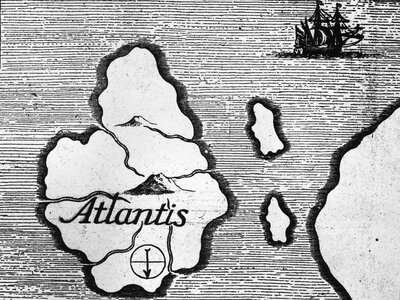 |
An illustration of Atlantis, circa 1600 (Fox Photos/Getty Images via NPR)
|
We've found the lost city of Atlantis...again
We have the great Greek philosopher Plato to thank for the ongoing obsession with the lost city [actually a continent] of Atlantis. Around 360 BCE, Plato wrote that Atlantis was a great and wonderful empire destroyed some 11,000 years before by earthquakes and floods during a 24-hour period. Here are just some of the many theories advanced over the years about where and what Atlantis was:
Mayans, Mexico, or Egypt
We have the great Greek philosopher Plato to thank for the ongoing obsession with the lost city [actually a continent] of Atlantis. Around 360 BCE, Plato wrote that Atlantis was a great and wonderful empire destroyed some 11,000 years before by earthquakes and floods during a 24-hour period. Here are just some of the many theories advanced over the years about where and what Atlantis was:
Mayans, Mexico, or Egypt

 |
| Aztecs, Mayans in pre-Mexico, Tlatelolco |
In the 19th century, several researchers suggested that ancient Mayan hieroglyphs spoke of a lost continent, and therefore, the site may have been near Mexico. The theory went that the Mayans had interacted with the ancient Egyptians who, in turn, passed the tale of Atlantis down to the ancient Greeks, which is where Plato got it. [But Plato said he had detailed memories of a past life or lives in Atlantis.] But that theory lost steam when it became clear that early Mayanologists didn't fully understand the culture's complex hieroglyphs.
In 1912, the public caught Atlantis fever, thanks to an article titled How I Found the Lost Atlantis in William Randolph Hearst's New York American. It was written by a man claiming to be the grandson of Heinrich Schliemann, the archaeologist who excavated Troy [Ancient Greece]. He'd alleged that Trojan artifacts revealed Atlantis' true location, submerged in the Atlantic Ocean between Europe and the United States.
The Azores
The Azores were supposedly the tips of Atlantean mountains. But the author disappeared [or was silenced] soon after the article was published, and it's now widely viewed as one of the great yellow journalism hoaxes [because to admit he was neutralized would suggest the truth of Atlantis].
Greek, Portugal, or Brazil
Other 20th century accounts placed Atlantis off the coast of Portugal, on a Greek island and even in the Brazilian rain forest, although the British explorer who went to prove that theory was never heard from again. [Was he silenced or lost in the perilous jungle?] Not to be outdone, the early 21st century has seen a flurry of Atlantis-itis.
Spain, Mediterranean, or Ireland
In June, a German physicist claimed the lost city was actually a region in southern Spain. Also this year, a Swedish geographer proposed that Atlantis wasn't near the Mediterranean at all but was, in fact, Ireland. He says the size of the Emerald Isle syncs up nicely with Plato's estimate and that the destruction myth was inspired by the submerging of a North Sea shoal around 6100 BC.
 Humans will upload their brains to computers to become IMMORTAL sooner than you think, claims Professor...
 Mysterious stone tools unlike 'anything ever seen before' are unearthed at a Bronze Age site in north Wales
 Radioactive particles are detected across Europe, and scientists have no idea where they came from
 From the invisible image to the cafe wall: The best brain-bending optical illusions of 2017 revealed
 Elon Musk warns the end of the simulation we live in is 'coming soon' in bizarre Twitter conversation with...
 Elon Musk reveals Tesla is delaying its electric truck plans to deal with Model 3 issues and boost battery...
 The heart of Old Faithful revealed: Scientists map the pathways beneath the geyser
 Does the iPhone 8 Plus have a battery issue? Apple is 'investigating' fresh claims of handsets 'bursting'...
 Twitter's saddest day: 'Hedonometer' reveals Monday's mass shooting triggered record emotions
 Elon Musk's claims for the autonomous capabilities of Tesla cars are 'full of crap', GM expert says
 A third of men and one in five women say they would have sex with a ROBOT, according to German survey
 Researchers reveal incredible 'innerspace' footage from a tiny probe traveling through a human artery
 Here's Johnny! Two ghostly apparitions spotted in photo taken at hotel that inspired Stephen King's The...
 Elon Musk says Tesla can solve Puerto Rico's electricity woes after Hurricane Maria decimated its grid and...
 |
| Mexico City when it was Tenochtitlan |
The Azores
 |
| Is it an underwater city like Mexico? |
- Azores underwater pyramid discovered: Atlantis Pyramid discovered underwater off the coast of Terceira Island.
- Location hypotheses of Atlantis (wiki) One of the suggested places for Atlantis is around the Azores Islands, a group of islands belonging to Portugal...
- VIDEO: Atlantis Azores: pyramid, city discovered underwater
- Azores : Lost Continent of Atlantis
- "Sao Miguel and the Azores: Misty Fragments of Atlantis"
- Atlantis in the Azores (Atlantis Rising Magazine) The sunken city was out of place in the Bahamas but must lie, he believed, among the Azores.
- UPDATED! Underwater pyramid found in Azores
- Lost City of Atlantis may been found National Geographic documentary called "Atlantis Rising"
 |
| The 9 Azores Islands, mountain tops of the continent of Atlantis, Portugal's Açores |
.
 |
| Volcanic cliffs of the mysterious Azores Islands |
Spain, Mediterranean, or Ireland
 |
| Irish-Atlantis, submerged North Sea shoal |
 |
| Ireland: Land of the Pharaohs by Andrew Power (Egypt linked to Atlantis) |
- In Search of Noah's Ark and Atlantis
- More Slate features heard on Day to Day
- From fish with human-like teeth to a fox frozen in ice: Mother Nature's dark side revealed
- VIDEO: Has lost city of Atlantis been found at last?
Humans will upload their brains to computers to become IMMORTAL sooner than you think, claims Professor... Mysterious stone tools unlike 'anything ever seen before' are unearthed at a Bronze Age site in north Wales Radioactive particles are detected across Europe, and scientists have no idea where they came from From the invisible image to the cafe wall: The best brain-bending optical illusions of 2017 revealed Elon Musk warns the end of the simulation we live in is 'coming soon' in bizarre Twitter conversation with... Elon Musk reveals Tesla is delaying its electric truck plans to deal with Model 3 issues and boost battery... The heart of Old Faithful revealed: Scientists map the pathways beneath the geyser Does the iPhone 8 Plus have a battery issue? Apple is 'investigating' fresh claims of handsets 'bursting'... Twitter's saddest day: 'Hedonometer' reveals Monday's mass shooting triggered record emotions Elon Musk's claims for the autonomous capabilities of Tesla cars are 'full of crap', GM expert says A third of men and one in five women say they would have sex with a ROBOT, according to German survey Researchers reveal incredible 'innerspace' footage from a tiny probe traveling through a human artery Here's Johnny! Two ghostly apparitions spotted in photo taken at hotel that inspired Stephen King's The... Elon Musk says Tesla can solve Puerto Rico's electricity woes after Hurricane Maria decimated its grid and...Wednesday, January 28, 2015
How to RAPE: "The Hunting Ground" (video)
I. Rony, Ashley Wells, Seth Auberon, CC Liu, Wisdom Quarterly; Director Kirby Dick, Producer Amy Ziering, Amy Goodman (DemocracyNow.org, Jan. 28, 2015); BBC; Femen.org
 |
| Instructions: Get into a US university, join the football team, target emotionally vulnerable person drinking alone, attack, allow the institution to cover it up for you, then repeat (VU). |
 |
| Vanderbilt covers up rapes. |
Rapists Brandon Vandenburg and Cory Batey could face decades in prison after being convicted of a combined total of 16 felony counts, including aggravated rape.
The Hunting Ground
(RTWC) An exposé of rape on U.S. campuses, institutional cover-ups, and the brutal social toll on victims and their families. With first-person testimonies, the film follows survivors who pursue an education while fighting for justice and to protect others -- despite harsh retaliation, harassment, and pushback at every level.
 |
| Tufts violated Title IX, student rape |
Two other former Vanderbilt football players, Brandon Banks and Jaborian McKenzie, are awaiting trial over their role in the rape.
However, the court cases mark a rare example where students accused of sexual assault have actually faced punishment.
Premiering at the Sundance Film Festival, "The Hunting Ground" (FB) shows how colleges and universities across the USA are covering up rapes and sexual assaults and failing to protect students from repeat offenders.
 |
| Who's a riot? (femen.org) |
Democracy Now! speaks with the film’s director, Kirby Dick, and producer, Amy Ziering. Their previous film, "The Invisible War," which exposed the epidemic of sexual assault in the military, won the Audience Award at Sundance in 2012 and was nominated for an Academy Award.
- Spencer! Heidi Montag's father arrested for sexual assault
- It doesn't really happen in the USA, does it? Child sex slavery ring busted in Denver
- Gang rape of Denver teen seemed like good idea?
- U.S. soldier has gay sex with transgender man then murders him in the Philippines; now U.S. military may have to leave the islands
- Drill Sergeant convicted of multiple sex assaults (AP) The charges were filed in May, days before a Pentagon study on sex assault in the military found that more than 5,000 reports of sexual abuse [and rape] had been filed in the previous fiscal year, a 50 percent increase from the previous 12 months.
(CD/InvisibleWarMovie.com) From Oscar and Emmy-nominated filmmaker Kirby Dick (This Film Is Not Yet Rated, Twist of Faith) comes "The Invisible War," a groundbreaking investigative documentary about one of America's most shameful and best-kept secrets -- the epidemic of rape of males and females by fellow soldiers within the U.S. military.

Twenty percent of all active-duty female servicewomen report being sexually assaulted. The total number who are actually assaulted is far higher as most attacks go unreported or, if reported, ignored and covered up.
 |
| The Invisible War: military rape epidemic |
 |
| Date rape of men? "Boost" (#yesallwomen) |
(BBC News) Are Greek system fraternities doing enough to stop campus rape? Statistics from the U.S. suggest 1 in 5 female students will be sexually assaulted during their time at college. It's such a serious problem that the White House has begun an investigation into how some schools have handled complaints. One of the colleges which has found itself under investigation is the U. of Colorado at Boulder. That's where the BBC Pop Up team has spent the past month. Benjamin Zand has been hearing the students experiences.


Subscribe to:
Posts (Atom)




























































