Showing posts with label orientation. Show all posts

Wednesday, June 5, 2024

How to pick a fun new gender in 3 steps

I was born a boy assigned my sex and gender at birth. Then I said, "O hell no!" I'm trans!


.
The Rainbow looks so cute as bottom to the S&S!
Happy gay month, everyone! It's time for PRIDE, which now celebrates every permutation of sexuality and gender fluidity. Want to be poly-bi-platinum-goldstar-xe? That's sensational, xe! Whaddya got rockin' under those skorts? None of our business? Right on! Now, hope you come to the meeting to explain it to Gen. Florg, and fly that freak flag like it's an original idea. Now we can all be Anais Nin and call ourselves "free."

Space alien confused as Earth leaders try to explain human gender
Thank you, God (Gnostic "Demiurge"), for giving us MEN and all these little BOYS, too!
Let me give you a little backrub here, Pope, and you try to hold down your excited pointer.
.
Trans (Helen Joyce)
(The Babylon Bee) General Florg from the planet Graxon V has visited Earth -- but he's having trouble understanding humans as he's never encountered a species with so many multiplying genders. Earth leaders try to explain.

(Of course, the real problem is that humans and leaders don't understand either. When no one agrees, anyone can say anything, and we all HAVE TO go along or we're some kind of sexist heteronormative secretly-gay pigs!)

How to choose a fun gender: 3 Steps

The Babylon Bee Guide to Gender
First, get the book, The Babylon Bee Guide to Gender. Second, pick a wording and pronoun from the 437 currently available, one that suits you. Don't skimp. The world is your oyster, and grammar doesn't matter at all. Definitions are included or write a new one.

Third, for general guidance, you may want to see which makes your dad the most upset. No dad? No problem. Ask a coach, uncle, drill instructor, sergeant, or scout leader. On second thought, avoid scout leaders.

Lost in Trans Nation (Grossman)
Viola! You now have a FUN gender you're happy with (and can change at any time whatsoever even post-surgery) to foist on everyone else who you can legally coerce to recognize and call you.

Now to pick a more fun SEX... Have you considered the U.S. military and the experimental vaccinations and environmental chemicals they will force you to endure and be exposed to even in bootcamp? It's a gay old time now, with lots of "friendly fire" from superior officers and horny bunkmates, fellas!

"Don't ask, don't tell"? - Ask! Tell! Let your freak flag fly, Fella!

Satan asks Democrats to tone down the evil

Dems should be openminded like Log Cabin Rs
(The Babylon Bee) Premiered May 17, 2024: In a regularly scheduled marketing meeting with Democrats, Satan asks them to tone down all the evil just a little bit.

Premium subscription: buff.ly/3mxrUba. The official The Babylon Bee Store: shop.babylonbee.com. Follow The Babylon Bee: website: babylonbee.com #woke #satire

If Ivan (ka) were a boy, I'd be gay. (Trump)
Become a premium subscriber: babylonbee.com. Subscribe to podcast channel: thebabylonbeepodcast. See the official The Babylon Bee Store: shop.babylonbee.com.

THE BABYLON BEE

Buddhism: simple answer to define 'woman'

Buddhism speaks of three sexes: female, male, and pandaka (LGBTQIA+), mixing in gender.
.
Academic anthology of texts
People are suddenly confused about a stable definition for "woman" (female biological sex)? This is understandable because we confuse and conflate words like sex (biology), gender (psychology), and orientation (sexuality). These things are all social constructs (categories defined by humans); nevertheless, they are not arbitrary. They have a basis. They are not assigned at birth (partition) and carried out post-partum, but during conception or gestation (pregnancy).

They did not arise from nothing, nor by chance, nor by some doctor or doula's whim. There really is a binary of females and males and even another category (pandakas) extending or derived from those two in Buddhism and the other Dharmic religions of Asia.

Variety of Buddhist schools
It is unclear if our long held Western biological distinction (XX or XY) in the West has now failed.

It would seem so if neither scientists nor right wing commentators can win an argument with color-tinted, left-leaning college students wishing to expand our minds and sensitize our hearts to the plight of LGBTQIA+ groups.

It is time to be more sensitive, more inclusive, more openminded. Nevertheless, there is a binary and in addition a recognized exception. The exception (P) is blurry and muddled and confounded with flexible societal norms. There may be no ultimate biological basis for the exception (P). But biology, like everything else, is interdependent.

Beloved LGBT Nemo (Eurovision 2024)
In Buddhism and other Dharmic religions, nama-rupa (name-and-form or body-and-mind) is the name of the distinction and analysis of what are understood to be interdependent categories.

While we debate the old nature/nurture dichotomy, there has always been a third category of gender recognized (and not in a flattering or equal way). The third category is called pandaka.

While most modern people nowadays may want to avoid recognizing this binary, it is nevertheless possible to make a clear distinction between what are biological males and biological females, men and women and the other.

This is a serious response to this very funny satire by The Babylon Bee.
Our post title was inspired by a mainstream media article that scientists
give in and say they have no 'simple' definition for what a 'woman' is.

DEFINITION
  • In Buddhist physics (Abhidhamma), What is a "woman"? A "woman" is an adult female, a "female" being a person (gandhabba) reborn through karma in a body (rupa, kaya) with the presence or propensity of itthindriya (femininity, bhava).
  • More study (learning, hearting, suta) and investigation (bhāvanā) is necessary. Why? With regard to the condition of wisdom (paññā) arising in Buddhism, one distinguishes three kinds of knowledge: (1) knowledge based on thinking (cintā-mayā-paññā), knowledge based on [study and] learning (suta-mayā-paññā), and knowledge based on [meditation] mental development (bhāvanā-mayā-paññā) (Saṅgīti Sutra, DN 33).
DISCUSSION
Is this a serious answer? Yes. If it is serious, how does it advance the discussion? Just as in the West we argue for the words (social constructs) "male" and "female" to mean XY or XX chromosomes (a biological basis), if we can accept that definition as sufficient, Buddhism says something deeper is going on.
  • We do not become male or female (or "other," pandaka = pan, hermaphroditic, asexual, trans(itioning), fluid, ambiguous, confusing, perverted, non-normative, bent, queer, intersex, neuter, eunuch) without a biological/physical basis. Admittedly, this is interdependent not independent of social factors (behavior, culture, training and physical interventions whether intentional or unintentional). This basis has karma-result (vipaka, phala) as its cause and basis.
  • Intentional or unintentional interventions? Dr. Joel Wallach claims to have scientific proof and abundant clinical experience for the PHYSICAL basis for sex and gender confusion, which is currently on the rise. The cause, according to Dr. Wallach? A micronutrient deficiency during gestation, that is, during pregnancy the mother does not have a trace mineral or similar essential nutrient and this has a considerable subsequent effect. This is unintentional, and it is not limited to biological sex, gender expression, or sexuality/sexual orientation. A biologically female body in gestation or infancy may be exposed to an excess of androgens or estrogens (more likely plastic xenoestrogens), and this has an effect. A biologically male body in gestation or infancy may be exposed to an excess of androgens or estrogens (and for all we know there may be another class of compounds that in the future will be termed "pandakogens" such as Atrazine).
  • Atrazine induces complete feminization and chemical castration in male African clawed frogs (Xenopus laevis) - PMC (nih.gov) Maybe Alex Jones (InfoWars/Prison Planet) was onto something?
  • An interesting question is, What happens to a male who takes The Pill (female birth control)? Males can take it just as water can be put in a gas tank. It will not prevent pregnancy. But it may cause hormonal disruptions, mood changes, cancer, toxicity, erectile dysfunction, or feminization.
  • The interesting part is, If there is no biological difference between males and females, why then do substances like The Pill affect males and females differently? There are individual differences, of course, but the point is that there are general differences as well, and that should not be the case if everything is arbitrary and without a biological basis.
  • Moreover, there are intentional interventions (administered hormones, hormone blockers, traumas, molestations, surgeries such as female and male genital mutilation called FGM or common circumcision, abuse, exposure to environmental toxins, substances, drugs, etc.)
  • Having thought about this, it seems aggressive lesbians and academic sophists may be right: there is no binary so much as a trinary or trinity: male, female, and pandaka (everything else, blends, absences, permutations). Sadly, however, this is not well defined or studied and was subject to a great deal of sexism, sexist assumptions, and cultural prejudices. Definitions change, but the original definitions are not "arbitrary" simply because they depend on changing social conditions.
  • One can imagine the needs of a community of humans to perpetuate itself and control its members and their multiplications, combinations, and behaviors. Then the society, because of changing climate or other external circumstance (coming under attack or sudden prosperity) changes from active hunting and gathering to sedentary farming or business dealing, or whatever. Now the needs of that community are different, change, and fluid or more polarized.
  • There is normative male, normative female, and everything else (pan-daka), which by definition gets the label nonnormative. Not yet taking the third category into consideration, is there a difference 
  • Note: The ancient rendering, translation, definition of pandaka as "eunuch" is very misleading but not without explanation. To us in modern times a eunuch would seem to be someone with removed genitalia, but in ancient times it was understood that those deprived of ordinary equipment (testicles, penis, clitoris, labia, vaginal canal, hormone, pituitary gland, pineal gland, other gland, or any part of the body) nevertheless found ways to be sexual, and these behaviors got them the label "eunuch," which often meant "pervert," "weirdo," "gay," "hypersexual," "flamboyant," "depraved," "pansexual," "nonnormative"... So it is not the lack of equipment that made one a "eunuch" but the subsequent increase of unusual (nonnormative) behavior associated or correlated with that lack.
  • Indeed, in India where this term originated (probably in ancient proto-India or the Indus Valley Civilization), there is even today a "Pandaka Festival" and it is NOT a bunch of Italian choir singers coming together and having tea, academic discussions, and a fashion show. What is it then? It is a pansexual, flamboyant, usually drunken or otherwise intoxicated, perverted, hypersexual "Pride Fest" of debauchery and depravity of all of the molested, neglected, abused, shamed, constrained, disciplined, forsaken, and exploited folks along with the healthy, well adjusted, questioning, and curious folks out to see the days long spectacle. It is considered dangerous, just as West Hollywood, Key West, San Francisco, or New York pride fests would be if public drunkenness, mass intoxication, and lawlessness were the norm. But in the US, we tamp it down so that these are nice, family-friendly entertainments.
  • Wisdom Q: Pandaka: Sex Addiction and Perversion (West Virginia Wisdom, 2011)
  • Pandaka Festivals are little understood annual events in India. It is a time of debauchery, cross-dressing, homosexual revelry, alcohol and drug abuse, adultery, sodomy, and all manner of societally-condemned behavior. The event is certainly not limited to the reviled modern pandaka (a widely feared amalgam of "pervert, criminal, heartless male prostitute, bully, and panderer") but to any curious person full of shame and repression or shameless attempts to come to terms with impulses and urges.
  • TRANSGENDERISM IN INDIAN HISTORY (Third Mirror)
Material: What is a physical being?
Ryan Seacrest is not confused; he knows
Further in S. XXII, 95: "Suppose a person who is able to see were to behold many bubbles on the river Ganges as they were floating along. And suppose that person were to watch them and carefully examine them. Carefully examining them, they will appear empty, unreal, and insubstantial.

"In exactly the same way does the meditator behold all corporeal phenomena (body, form, ultimate materiality)... feelings... perceptions... mental formations... states of consciousness, whether of the past, present, or future...far or near. And one watches them and examines them carefully.

"After carefully examining them, they appear empty, unreal and insubstantial."

The Five Aggregates clung to as self are compared, respectively, to
  1. a lump of froth,
  2. a bubble,
  3. a mirage,
  4. a coreless plantain stem, and
  5. a conjuring trick (S. XXII, 95).
See the Khandha Samyutta (S. XXII), The Path of Purification (Vis.M. XIV).

If we seek a "self" (an atta or atman, a soul, ego, personality, essence), what we find is not an eternal soul but a collection of aggregate factors: form (Four Elements, corporeality, materiality); feelings, perceptions, mental formations, and consciousnesses. These are categories of heaps or groups. The first category is fourfold and constitutes the body; the remaining four categories is fourfold and constitutes the mind. These eight are reduced to five and should never be thought of as five things but rather five categories or aggregations of things. There is not one feeling but many feelings, countless feelings, uncountable instances of pleasant, painful, and neutral sensations associated with perceptions, formations, and consciousnesses (of each of the six senses). While referred to as things, this might be misleading. They are dynamic processes rather than anything tangible, stable, reliable, or fixed.

Summary of the Five Aggregates clung to as self
.
I. Corporeality (bodily) group (rūpa-kkhandha)
  • A. UNDERIVED (no-upādā): Four Elements [characteristics of matter]: solidity or earth-element (pathavī-dhātu), cohesive or water-element (āpo-dhātu), temperature or fire-element (tejo-dhātu), and motion or wind-element (vāyo-dhātu)
  • B. DERIVED (upādā): 24 secondary phenomena:
  1. physical sense-organs of: seeing [not the eye but the sensitive portion within the eye that discerns forms],
  2. hearing [not the ear but the sensitive material that discerns sounds],
  3. smelling [not the nose...],
  4. tasting [not the tongue...],
  5. body [not the body but tactile sensation able to discern impression/pressure, temperature, etc.]
  6. physical sense-objects of: form (body),
  7. sound,
  8. scent,
  9. taste; ["bodily impacts" (photthabba) are generally omitted from this list because these physical objects of body-sensitivity are identical with the aforementioned solid, temperature, and motion elements; hence, their inclusion under "derived corporeality" would be a duplication.]
  10. A male-born, female-presenting pandaka
    femininity
     (itthindriya)
  11. virility (purisindriya)
  12. physical base of 'mind' (consciousness, not the heart itself but the sensitive material in or near the heart, hadaya-vatthu)
  13. bodily expression (kāya-viññatti)
  14. verbal expression (vacī-viññatti)
  15. physical life (rūpa jīvita)
  16. space element (ākāsa-dhātu)
  17. physical agility (rūpassa lahutā)
  18. physical elasticity (rūpassa mudutā)
  19. physical adaptability (rūpassa kammaññatā)
  20. physical growth (rūpassa upacaya)
  21. physical continuity (rūpassa santati, see santana)
  22. decay (jarā)
  23. impermanence (aniccatā)
  24. nutriment (āhāra)
CONCLUSION
You can count on science, Kids. It's testable.
We began with an audacious idea, that we could easily define "woman" with a biological/physical basis. If sex were a binary (on/off, 1/0, male/female, black/white, yes/no), there would be present in the DNA, genome, chromosomes or alleles of the individual either itthindriya or purisindriya, and this would be a simple way of determining who is a woman and who a man. This may still be possible, but it does not easily explain the existence of spontaneous hermaphrodites, intersexuals, and asexuals (neutered). All of this is separate from gender, gender roles, sexual orientation, or how one presents. If modern Western science had XX and XY chromosomes to rely on, Buddhism thousands of years earlier (and the Old Vedic Religion thousands of years before that) had a better, more minute marker. It may even be the same marker. For at the level of the particle (kalapa) there are discernible aspects and components one cannot imagine being present in the West -- odor, color, and so on. There are propensities of the various elements (maha dhatus). Therefore, one with the power to discern them internally could, in theory, discern them (externally) in someone else and would know, "This being is a male or female."

Unravelling the Mysteries of Mind and Body through Abhidhamma (Inward Wisdom)
.
Abhidhamma (Sayalay Susila and Dhr. Seven)
However, there are a number of problems. Problem 1: Would a shapeshifter (a being possessing the iddhi called the "power of transformation") exhibit femininity or masculinity, and would that remain constant throughout the transformation? It would likely change with the shift and revert to what it usually is, making it a viable marker only in the long run. This is impossible; no one can shape shift. Problem 2: If it is not discernible externally, we would only have self-report and not an objective measure. This is impossible; no one can discern particles (kalapas). Problem 3: What if everyone has both indriyas in varying measures, making not a binary but a propensity or predominance of one or the other? This is impossible; no one has indriyas (faculties). Problem 4: If it is not one OR the other but a combination of both, then it becomes a social construct as to what we mean by it, and if it is that everyone has "masculine" and "feminine" biological and psychological components (which is almost certainly the case) then there is instantly the possibility of a third construct, a blend resulting from a more or less equal level of both. This is impossible; no one has faculties. Problem 5: Once one is able to discern particles and sees the characteristics of femaleness and maleness, does it change in a single lifetime? It can, although this is extremely rare, or it can seem to change, which is common. This is impossible. No one does anything nor can they do anything. This applies to humans, which is a very rare kind of birth, but would it to devas or ghosts and animals. This is impossible; no one is reborn as a human, deva, animal, or anything else. So, as Douglas Adams would say, if you've already done six impossible things, could you call us so we can discuss a seventh: nailing this definition down and determining if this is a reliable basis for a stable definition of "sex."

FOR FURTHER READING
  • Indriya: 22 phenomenological faculties, femininity (itth-indriya), masculinity (puris-indriya), life faculty or vitality (jīvit-indriya)
  • wisdomlib.org 4.1. The Meaning of Indriya (Faculties) — femininity, masculinity, vitality, the first two material qualities designated as bhāvarūpa determine...
  • jstor.org NĀMARŪPA IN BUDDHAGHOSA'S PHENOMENOLOGY (name-and-form): taste (rasa), the feminine faculty (itthindriya), the masculine faculty (purusindriya), life faculty (jīvitindriya), the heart-substance (hadayavatthu)...
  • budsas.org BUDDHIST DICTIONARY: Explained in Pug. 55. itthindriya: 'femininity'; see bhāva.
  • dhammawheel.com What karma (Pali kamma) relates to gender differentiation? - Dhamma Wheel... Weak wholesome karma (kusala kamma) generates the female controlling faculty (itthindriya). Strong unwholesome karma (akusala kamma) causes the male controlling faculty to...
  • wisdomlib.org 22 Phenomenological Faculties: 1 definition... mind faculty (man indriya). Three physical faculties: femininity (itth-indriya); masculinity (puris-indriya); life or vitality (jivit indriya)
  • philpapers.org/rec/NGATAB Towards a Buddhist Metaphysics of Gender (PhilPapers, Sept. 25, 2023) Buddhist tradition, the Buddha is depicted as claiming that there is something called woman-faculty or power (itth-indriya) and something called man-faculty or power...
  • discourse.suttacentral.net Pali glossary for Ven. Bodhi and Ven. Sujato (SuttaCentral.net, Feb. 6, 2019) itthindriya, [faculty of] femininity. idappaccayatā, specific conditionality. iddhābhisaṅkhāra, feat of psychic potency, used his psychic...
  • themindingcentre.org The Body in Buddhism: femininity (itth'indriya); masculinity. (puris'indriya); physical base of the mind (hadaya, vatthu); 35 bodily intimations (k ya,vi atti), verbal intimation (vac ,vi ...)
  • budinoucenje.wordpress.com What does dhamma mean in Theravada Abhidhamma? Aug. 13, 2020... For example, a property of femininity (itthindriya) was added for the description of the matter or the physical mind-base (hadaya-vatthu)
  • Dhr. Seven, Amber Larson, Ananda (Dharma Buddhist Meditation), Ashley Wells (ed.), Wisdom Quarterly

Wednesday, February 21, 2024

The gay issue in Buddhism (is no issue)

CC Liu and Dhr. Seven (eds.), Wisdom Quarterly Wiki edit, 2/2/21

Is that natural? It seems unnatural!
  • The relationship between Buddhism and sexual orientation varies by major tradition and individual teacher. According to some scholars, early Buddhism (represented by the Theravada school) appears to have placed no special stigma on homosexual relations, since the subject was not mentioned [Note 1].

Laypeople versus monastic practices
What kind of gay? This man washes other men's feet.
In Buddhism's earliest sutras or discourses, "accepted or unaccepted human sexual conduct" for laypersons "is not specifically mentioned" [2].

"Sexual misconduct" (kamesu micchacara) is a term defined as having sexual intercourse with any of the ten forbidden persons who are to be considered out of bounds:
  • anyone under the protection of (1) mother, (2) father, (3) brother, (4) sister, (5) guardians, (6) religious community, (7) protected by law, (8) marriage, (9) betrothal/engagement, or (10) promised in marriage.
The term, however, has been treated as if it were subject to interpretation according to one's likes, dislikes, and relativistic social norms. Early Buddhism appears to have been silent concerning homosexual relations [1].

According to the Pali canon and the Āgamas (the early Buddhist texts), there is nothing that says that same gender relations have anything to do with sexual misconduct [3, 4]. Some Theravada monastics hold the view that same-gender relations do not violate the rule to abstain from sexual misconduct, which means abstaining from having sex with someone who is underage (or under the protection of parents, guardians, or the law), someone betrothed or married, or who has taken vows of religious celibacy [5].

Some later traditions feature restrictions on non-vaginal sex. (Some Buddhist texts mention non-vaginal sex as sexual misconduct, including men having sex with men or paṇḍakas) though some Buddhist monastics interpret such texts as referring to forced sex [6, 7, 8]. This non-vaginal sex view is not based on what the Buddha said but rather on later commentarial texts such as the Abhidharma or "Teaching in Ultimate Terms" [9,10].

Regarding Buddhist monks, the Vinaya (code of monastic discipline) bans all sexual activity, but does so in purely physiological terms, making no moral distinctions among the many possible forms of intercourse it lists.[11]

Among Buddhists, there is a wide diversity of opinion about homosexuality. Buddhism teaches that sensual enjoyment and desire in general are hindrances to enlightenment, and inferior to the kinds of pleasure (see for example pīti, a Pali language word translated as "rapture" or "bliss") that are integral to the practice of the meditative absorptions (jhāna).

Ubhatovyañjanakas
The word ubhatovyañjanaka is usually thought to describe people who have both male and female sexual characteristics: hermaphrodites (intersex) [14].

In the Buddhist Monastic Code (Vinaya), it is said that ubhatovyañjanaka should not be ordained as monastics, on account of the possibility that they would entice a fellow monk or nun into having sex [15].

Paṇḍakas
The paṇḍaka is a complex category that is variously defined in different Buddhist texts. In the earliest texts, the word seems to refer to a socially stigmatized class of trans-feminine and/or cross-dressing people, some of whom may have been sex workers [16, 17].

Paisarn Likhitpreechakul argues that these people are grouped together with groups who are excluded from ordination as well: those with physical disabilities such as deafness or dwarfism or those who have committed certain crimes [18].

"The Story of the Prohibition of the Ordination of Pandakas" from the Buddhist Monastic Code claims that the ban is a response to the example of a paṇḍaka (presumably gay) monk with a desire to have [gay] sex. Being rejected by other monks, he offered to have sex with animal handlers [farm hands], who then told the wider community and brought disgrace upon the Sangha [19, 20].

In the Lotus Sutra, it said that a bodhisattva [person intent on becoming a fully enlightened buddha] should not go near paṇḍaka [21, 22] like the monastic rules say in the Vinaya.

The "Questions to King Menander" (the Milinda Panha), claims that paṇḍakas let out secrets through their [untrustworthiness, disloyalty, and] imperfection [23, 24]. More

Monday, February 12, 2024

Science: Insects NOT attracted to light

Anton Petrov, Feb. 12, 2024; Sheldon S., Seth Auberon (eds.), Wisdom Quarterly

We were completely wrong about why bugs are attracted to lights
(Anton Petrov) Feb. 12, 2024:  This video discusses a new study that explains why bugs are attracted to light...and it's a bit depressing. They are not attracted to light. That is not what has been happening at all, even though we all thought that self-evidently it was.

Links: https://theconversation.com/the-surpr...
https://www.nature.com/articles/s4146... #insects #biology #bugs
  • 0:00 Bugs attracted to light
  • 1:30 Previous assumptions that were not correct
  • 2:50 New research and how it was done
  • 3:35 Discoveries and unusual findings
  • 5:20 How this affects insects' instincts
  • 6:55 Which lights are the worst?
  • 8:00 Conclusions
  • 9:20 Variations among insects
Support this channel on Patreon to help me make this a full time job: https://www.patreon.com/whatdamath.  Get a wonderful person tee: https://teespring.com/stores/whatdamath. More cool designs are on Amazon: https://amzn.to/3QFIrFX Alternatively, PayPal donations can be sent: http://paypal.me/whatdamath.

Wednesday, November 29, 2023

Survival Basics: Navigation Workshop (12/2)

Chris Nyerges, SchoolofSelf-Reliance.com; Dhr. Seven, Xochitl (eds.), Wisdom Quarterly
Go this way, or go that way, but whatever way you go, know where you're going (SOSR).
The local Tongva of proto-Los Angeles (Tongavaar) did not use the teepee but the kizh (wigwam)
.
Guide Without a Compass
Workshop in Nature from the School of Self-Reliance, Los Angeles:

It takes place on Saturday, Dec. 2, from 10:00 am to 1:30 pm  and is called BASIC NATURAL NAVIGATION AND ORIENTATION.

This field workshop is led by author, expert, and Nature Guide Christopher Nyerges.

It's easier to read than my iPhone!
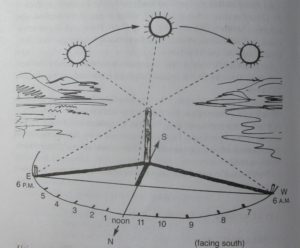
What are some of the tried-and-proven methods for navigation that people have used for centuries? We'll begin with observations of the terrain -- shadows, looking at trees, moisture, feeling rocks, insect signs, and so on, making use of Native American wisdom handed down over generations.

We’ll learn how to use the stars, sun, and moon for navigation, including how to read the natural terrain.

These are survival skills that our grandparents took for granted, but as we rely more and more on GPS technologies, we have forgotten these very basic skills to orient ourselves and know where we are.

We’ll ALSO learn the basics:
  • How to read a map
  • How to use a compass
  • How to align map and compass
  • Ways to navigate the terrain with these tools.

We’ll discover how to use the "star dial" to tell time the no-tech way (as shown here by James Ruther).

We’ll also exercise our newfound skills to test our ability. Bring a notebook. Believe it or not, also included in this class are a few fire-making skills!

Location sent with registration: Students and seniors, $45, regular $65. This class may be applied towards the School of Self-Reliance Bushcraft Certificate.

Thursday, November 17, 2011

Living for Outcomes and the "Yoga Sutras"

Ami Fox (foxpoweryoga.com); Wisdom Quarterly


I spent the summer re-reading the Yoga Sutras of Patanjali.

These are deep concepts that go far beyond the mat -- yet very practical, commonsense, and elegant.

Now as we ease into autumn, it seems that some of these concepts resonate more deeply. I have been getting hung up on my attachment to outcomes.

Let's face it. This world is all about outcomes: goals, objectives, focus. I am sucked into these frames. For my mental well being, it seems necessary to step away from being results-oriented and ease into a space where the process itself is my motivation for action.

For instance, when I teach a yoga class, I always want the class to go smoothly, for everyone to enjoy the pace, and delight in the presentation. That is not always the outcome. So it is hard to find motivation in the process.

Take working into a posture (asana), for example. It is common for us as Americans to want to look a certain way in a pose. And if it is not achieved, we are often disappointed and feel like a "yoga failure."

"It was the greatest leap ever taken. The speed of Hanuman's jump pulled blossoms and flowers into the air...they cheered" - Ramayana, retold by William Buck (yogajournal.com).

I have worked for years to achieve full Hanumasana. Yet at the end of the year, at the end of the decade, I am still so far from the floor that it is not what my ego would say is a "good" monkey pose splits.

I joke with my classes that there is no trophy in the back with someone doing the perfect monkey pose or downward dog. But I say this to remind myself. The postures are very intelligent, supporting liver, kidney, and endocrine function, as well as increasing flexibility and strength.

It is important to stay with the process not the aesthetics (or even the asceticism) of it, but rather the health benefits.

There is more to come concerning The Yoga Sutras. A conversation is a series of contemplation and utterances. Find more on my new blog.