Showing posts sorted by relevance for query ranajit pal. Sort by date Show all posts

Wednesday, December 17, 2008

Buddhist History Revolution: Ranajit Pal


Ranajit Pal, Non-Jonesian Indology and Alexander. New Delhi: Minerva Press, 2002. Pp. 268, including 41 black- and-white illustrations. ISBN 81-7662-032-7. US$17.00, UK£11.75. Further Details.

Reviewer: Jan-Mathieu Carbon, Corpus Christi College, Oxford

Self-described as a colloquial "must for the history buff" and a pleonastic "labour of hard work" (back cover), Non-Jonesian Indology and Alexander by Ranajit Pal is indeed both of these things -- a work at once fascinatingly suggestive, pioneering, and provocative, yet frustratingly confused and laborious. The main subject is Alexander's conquest of India, specifically locating Palibothra, the theoretical limit of his march east.

Pal in this book leads his own campaign west against those scholars, particularly Badian and his disciples, who ignore the Sanskrit and Pali sources and try to reconstruct Alexander's eastern campaign using only the Greek and Roman texts.[[1]]

He traces the origin of this methodological problem back to the work of Sir William Jones in the late eighteenth century.[[2]] Few scholars today think in an explicitly "Jonesian" framework, but Pal is right that the usual accounts of Alexander's march are founded on Jones' early premises and detective work.

Pal's hypothesis is that "Megasthenes" Palibothra was not Patna as Jones fancied, but Kahnuj in faraway Magan' (p. 9). In other words, Palibothra was located in what is now south-east Iran, not, as most scholars maintain, in modern eastern India.

As a provocative challenge to current orthodoxy regarding the extent of Alexander's Indian conquest the book is largely successful and will appeal to specialists and students alike. Pal's work is wide-ranging and offers multifarious perspectives on the impact of Alexander's conquests in Indo-Iran. More>>

Wednesday, September 23, 2009

"Aryans" of Asia: Kalash, Buddhist History


Blonde Kalash girls, left by Aryan invaders? (stormfront.org; indiamike.com)


Kalash girls [imranthetrekker (chitralguy)/flickr], women celebrating milk festival (BBC).

(WQ) Aryan has come to mean spiritually "worthy" or "noble" in Buddhism. But in ancient India it referred to widespread legends of northern invaders who brought their culture and Vedic religion to the Indus Valley with superior technology that seems to have come out of the blue. Alexander the Great, the Greeks, the Arabs, and others before them came in as maurading waves, plundering and occupying the fertile Punjab and the Gangetic plains. Eventually, Buddhism was wiped out. But originally Buddhism had some of its strongest support in modern day Afghanistan.


In numerous sutras the Buddha refers to himself as being part of the Solar race, a mythical lineage tracing itself back to Surya (the Sun God, who sent his emissary Manu "the law-giver"), who figures so powerfully in ancient Egyptian and modern Abrahamic traditions (see smritis). All of this is part of ancient pre-Buddhist Indian lore. The swastika -- an ancient and venerable Vedic, Hindu, Jain, and Buddhist symbol -- represents the sun. The Nazis appropriated the mythology and incorporated it into their propaganda to serve very unskillful political ambitions of world domination.


The Buddha, his son Rahula, and Ananda were all said to be potential "world monarchs," who bore the marks of great men (lakkhana). A world monarch is a righteous king who could rule not the planet, if one reads carefully, but the entire known world, that is, the continent extending in all directions, bounded by the sea. If China and Mongolia were known, it would include all of Asia, near east and far east. Madame Blavatsky and the Theosophists had brought these ancient legends back to the West. They were known throughout Siberia, India, and other parts of Asia, which at one time included the cradle of Western civilization, ancient Greece.

The Taliban brought Afghanistan's forgotten history into sharp relief by attempting to obliterate the largest standing Buddha figure in the world. Ancient Chinese historians had already documented how well establish the Afghani Sangha was, how numerous their buildings, how grand their statuary. At that time, the area was "India." The borders have changed, as has the dominant religion. Zorastrianism, Christianity, and Islam have all usurped legends and locations of great spiritual significance.


History and geography have shifted east to Nepal and Southeast Asia, where Buddhism continues to be the dominant religion or, as it is often called, "the light of Asia." But according to historian and independent scholar Ranajit Pal, the widespread belief that the Buddha was born in Nepal is clearly mistaken, the result of historical fabrications and forgeries.

Are they the original Aryans? Descended from Alexander the Great, strange tribes of white people reside in far northern Pakistan, formerly India, near Kashmir. They have definite Caucasian features, and their culture and religious practices are distinct from Islamic neighbors on all sides. They are the (Nordic-appearing) Kalash.


Gautama Buddha and Nepal

Text: Ranajit Pal

"Buddhism literally throbs with the history and geography of India. The archaeological finds from Sanchi, Ajanta, Bharhut, Amaravati, Mathura, and the Gandhara area (now in Pakistan and Afghanistan) firmly link India with the rise of Buddhism....there is much more to the history of early Buddhism than meets the eye. In fact, Buddhist history is a strange mix of facts and fiction that baffles the discerning reader.

"Historians such as H. C. Raychaudhuri and R. Thapar boldly affirm that Gautama belonged to the Nepal area, but sadly there is no firm archaeological basis at all for this conjecture. Early India [known as Bharat then Jambudvipa] was far wider than British India, and it is in this 'India' that Buddhism was born.

"Nepal is a beautiful country, but a careful study reveals that Gautama of Nepal is a nauseating fraud. Absolutely nothing in the literature, art, history, or archaeology of early Nepal has the faintest hint of Buddhism. The British researcher T. A. Phelps has exposed the widespread forgeries of...Dr. A. Führer, who moved pillars and other relics and produced fake inscriptions to locate Gautama's birthplace in Nepal. Gotama was a prince but after he was abandoned in the wilderness of the Terai by Führer, his history went to pieces. C. Humphreys points to the stark archaeological scenario in Nepal...

"The renowned Belgian scholar E. Conze also flatly dismisses the fanciful text-based accounts: 'To the modern historian, Buddhism is a phenomenon which must exasperate him at every point and we can only say in extenuation that this religion was not founded for the benefit of the historians. Not only is there an almost complete absence of hard facts about its history in India; not only is the date, authorship and geographical provenance of the overwhelming majority of the documents almost entirely unknown...' "


Was Tibet a theocratic Shangri-La with a god-king? Or was it an Aryan stronghold destroyed by Communist China? This National Geographic documentary explores Tibet in the popular imagination and explores other views, such as its relationship to Nazi Germany, using archival footage.

Tuesday, November 4, 2014

Where was the Buddha born? (letter)

Maya, Dhr. Seven, Amber Larson, Ashley Wells, Seth Auberon, and CC Liu, Wisdom Quarterly; Ranajit Pal (ranajitpal.com, lumkap.org.uk); Ajahn Brahm (video); E.P. Vining
The first human representations of the Buddha in Gandhara (Buddhaskulptur.de)

Birth of the Buddha-to-be (the Bodhisattva) Prince Siddhartha, Peshawar, Gandhara.
.
Devas, Buddha, Maya Devi, maid, Lumbini
In response to our exploration of who the Buddha's family was and where they came from on the post Shakyans were Scythians (Greco-Buddhist art), Ritesh Kumar Gupt writes in to explain the common view propagated by India with the help of its Muslim neighbors:

"Don't confuse Shakyans with Shakas. Shakyans were a very ancient kshatriya [warrior-caste] community of India (around 6th century BC) who lived in Tarai region of Nepal while Scythians came in a very later phase and got settled in Western India."

Gandhara-style (gatesofvienna)
Thank you, Gupt, but this is exactly our point. We refer you to the work of Dr. Ranajit Pal (ranajitpal.com) to explain that the Shakyas (Shakas, Sakkas, Sakyas, Sakkas, Sakas) were NOT from Nepal and that the Terai has very little Buddhist history (see below).

On the other hand, to the west -- as far as modern Iran down to Seistan Baluchistan province, where the modern Muslim countries of Afghanistan, Pakistan, and Iran converge -- there is a concealed history of Buddhism.

Afghan and Chinese Buddhist in America?
That history extends far to the north having traveled their from Afghanistan -- as far to the northwest as Ukraine and Kalmykia (Europe), north to Siberia (Russia), northeast to Mongolia, east to China.

Afghan Buddhist missionaries even made it to America, an astounding fact people cannot get their heads around. (See Edward P. Vining's An Inglorious Columbus from 1885). But this is how it was.

(PPH) Part I: Ven. Brahm on little known history of Buddhism west of India

Gandhara texts (gardendigest.com)
The Buddha's disciples and message made it to the Middle East and Europe and influenced the development of Coptic Christianity and the Vatican form (e.g., see Ajahn Brahm on early Buddhism in India, ancient Greece, and ancient Egypt, the Therapeutae and Part II on the tie in to Buddhism's direct influence on Jesus in Egypt and India). But all of this is unknown history outside of the world of scholars, except that it can be seen as implicit in the texts and be pieced together. This is what we are doing at Wisdom Quarterly. We are not presenting standard history twisted to India's advantage, ignoring the contributions of what is now the Muslim world. We are revealing it.


Part III: Ajhan Brahm (Pagoda Phat Hue/Buddhasweg.eu) on the Christian Father Origen,
whose teacher was Munias Sakka (the Muni, Sage, of the Sakka, the Shayas = Shakyamuni)

Buddha from Central Asia
Muslim countries do not want it known, and India by default gets credit it does not deserve. It did not create the Buddha. The Buddha was not from "India," as there was no "India" at the time, and more than that, he came from far to the west of anything that could really be called "India." This is what the mounting evidence shows us.

He was a foreigner, a prince, likely a Scythian (a word Greeks and others used to describe the nomadic tribes of Central Asia).

Afghan Indo-Pakistan (thaimangoes)
But ancient archeology is surfacing to show the truth. Indeed, Indo-Scythia may have eventually come to include Nepal's Terai and the Indian state of Bihar, where the ascetic Siddhartha traveled and found enlightenment in an area now known as Bodh[i] Gaya, "Enlightenment Grove."

Gupt, here is a small excerpt from Dr. Pal's maverick research and attempt to reveal real Buddhist history distorted by fraud and political considerations. Our goal, like his, is to get to the truth, to a story that makes sense, to reveal the unknown.
 
New Vistas in Early History of Buddhism
RanajitPal.com lightly edited by Wisdom Quarterly

Non-Jonesian Indology (amazon)
Buddhism literally throbs with the history and geography of India. The relics from Sanchi, Ajanta, Bharhut, Amaravati, Gandhara, Thotlakonda, and Mathura link India with early Buddhism. The Indian tradition of tolerance and moderation goes beyond 6th century B.C., and primitive Buddhism can be traced in the Harappan era, but Buddhist history is a queer mix of facts and fiction that baffles the discerning reader.

The poet Goethe wrote: "Wer den Dichter will verstehen. Muss in Dichters Lande gehen." "If you want to understand a poet, you must go to the poet's land." Indeed, in order to understand Gautama Buddha one has to go to his true land which was Afghanistan not Nepal.

The startling recent discovery of a 6th century B.C. Buddhist site at Mes Aynak in Logar province of Afghanistan, 35 km south-east of Kabul has dramatic repercussions on Buddhist history. Mes Aynak is one of the greatest Buddhist sites in the world.
 
[Great unearthed stupa (Buddhist reliquary mound) at Mes Aynak, Afghanistan.]
.
The Dreadful Nepalese Forgeries
Nepal is a beautiful country [under direct Indian influence], but Gautama Buddha of Nepal is a nauseating fraud.

Nothing in the art, archaeology, history, or literature of early Nepal has the faintest hint of Buddhism. 
 
Jonesian scholars such as R. Thapar and A.K. Narain affirm that Gotama [the Pali spelling of the Sanskrit Gautama] was from the Nepal area, but this is denied by archaeology. C. Humphreys points to the stark ground reality:

"The Lumbini gardens, where Gotama was born, lie in the difficult Nepal Terai, and Kusinara, where the Buddha passed away, has little to show."

In contrast to gullible historians such as A.K. Narain, the renowned Belgian scholar E. Conze also flatly dismisses the fanciful text-based accounts:

"To the modern historian, Buddhism is a phenomenon which must exasperate [one] at every point and we can only say in extenuation that this religion was not founded for the benefit of the historians. Not only is there an almost complete absence of hard facts about its history in India; not only is the date, authorship and geographical provenance of the overwhelming majority of the documents almost entirely unknown...."

The way out of the chaos is shown by the British scholar T.A. Phelps, whose painstaking study has exposed the dreadful forgeries of A. Führer, who moved pillars and faked inscriptions and relics to falsely locate Lumbini [the garden park where Prince Siddhartha, the Buddha-to-be, was born].

Nepal has no ancient Buddhist relics. Vincent Smith vehemently protested against the fabrications of Dr. Führer. Gotama was a prince, but after he was abandoned in the wilderness of the Terai [Nepal] by the rogue Führer, his history went to pieces.
...................
Indo-Scythian Buddha in the art of ancient Afghanistan and Pakistan (Gandhara).

Look, you can tell he's Indian!
Of course, Gupt, you may not care about these details like Dr. Pal, but we do because we're Westerners with Western historical roots. Nonetheless, we hope you care as much about the truth as we and Dr. Pal do wherever the chips may fall or whoever gets upset.

There is no topic we cover that so disturbs Nepalis and Indians as this one. Yet, no one sends us complaint letters with an opposing Muslim or Sufi (mystical Islam) position. On the contrary, people from Afghanistan (site of Kapilavastu, one of the three Shakyan capitals where the Buddha-to-be grew up) and Pakistan (site of the once glorious Indus Valley Civilization) want to know the history of their land even if the politicians do not want it known.

Finally, Gupt we ask you to read Non-Jonesian Indology and Alexander on the real origins of the Buddha by Dr. Ranajit Pal, which concerns the history of India. It offers a new perspective on the subject of how Buddhism arose. It is a must read for those interested in Buddhism, the history of Nepal, India, German and British Colonial historians, and Alexander the Great. Or there's something to read right now that will clear this matter up instantly: 

The present location of Lumbini (the site of the Buddha’s birth) in Nepal is a colossal fraud that began in 1896 and has been carefully fostered ever since. The details of its discovery disclose a sorry tale of deception and intrigue told here for the first time.
1. Introduction
2. Fuhrer’s Early Years
3. The Nigliva Discovery 
4. The Lumbini Discovery 
5. The Lumbini Pillar Inscription 
6. The Location of The Lumbini Pillar 
7. The Mayadevi Temple 
8. The Piprahwa Discoveries 
9. Tilaurakot 
10. The Kapilavastu of the Chinese Pilgrims 
11. Will the Real Kapilavastu Please Stand Up?
12. Lumbini 
13. The Rama Stupa 
14. From Rama to Kusinara 
15. Kusinara
16. Postcript17. References
18. Illustrations
  
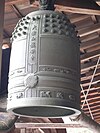
Bonshō
(Wiki) Bonshō are large bells found in Buddhist temples throughout Japan, used to summon the monks to prayer and to demarcate periods of time. Rather than containing a clapper, bonshō (example at Ryōan-ji pictured) are struck from the outside, using either a hand-held mallet or a beam suspended on ropes. The bells are usually made from bronze, typically augmented and ornamented with bosses, raised bands, and inscriptions. The earliest appearance of these bells in Japan dates to around 600 CE, although the general design is of much earlier Chinese origin. Their penetrating and pervasive tone carries over considerable distances, which led to their use as signals, timekeepers, and alarms. The sound is thought to have supernatural properties; it is believed, for example, that it can be heard in the underworld. Their spiritual significance means that they play an important role in Buddhist ceremonies, particularly the New Year and Bon festivals. Throughout Japanese history a number of these bells have become associated with stories and legends, both fictional, such as the Benkei Bell of Mii-dera, and historical, such as the bell of Hōkō-ji. In modern times, bonshō have become symbols of world peace. (Full article...)

Tuesday, July 23, 2024

The Buddha was a Scythian warrior (doc)

As WQ has covered, based on Dr. Pal's realization, Shakyamuni was a Scythian/Saka.

What kind of Scythia was the Buddha? Gandharan, Indo-Scythian, a Saka from Indo-Sakastan

Siddhartha Gautama the Buddha was from Gandhara/Afghanistan
Scythian females were warrior princesses, the basis of the Greeks' Amazonian legends

The frozen sarcophagus of a Scythian warrior discovered in Mongol Steppes | SLICE | full documentary
The Scythians (Shakyians) were fierce and proud
(SLICE) June 28, 2024: In the icy steppes of the Mongolian Altai, an archaeological expedition explores the 2,500+year-old tomb of an Eastern Scythian warrior.

The ancient Scythian practice of deep burial of the dead, combined with extreme climatic conditions, could uncover the last frozen tombs on the planet and shed light on this little-known branch of Scythian civilization.


Dr. Pal made the connections
But time is running out. Global warming is threatening the remains of these [Central Asian and] European pioneers who conquered the Asian side of the Altai.

The tombs are full of surprises. Attracted by the unusual hustle and bustle, Kazakh nomads set up their summer camp near the excavations. These people are among the last to be cut off from the modern world.

The Scythians (Barry Cunliffe)
Archaeology collaborates with ethnology to reveal disturbing similarities between these two peoples separated by 2,000 years.

Documentary: Le Sarcophage Glacé de Mongolie. Directed by Cédric Robion. Production: AGAT Films & Cie.

SLICE fully owns the rights to the use of the published content. Any illegal reproduction of this content will result in immediate legal action. SLICE wants to fill up viewers' curiosity! Accessible to anyone from anywhere at any time, this channel is a weekly dose of short docs about curious facts, discoveries, astounding info, unusual stories, weird, fun, and instructive. Be smart, have a slice!

Were there red head giants among them?
Subscribe now ► @slicedocumentary. Become a fan: @slicedocumentary. Follow 👇 in French: slicefr, Facebook: slicedocs. Instagram: slicedocs. #documentary #slice #fulldocumentary #freedocumentary #mongolia #mongol #steppes #scythian #warrior #archeology #nomad #amazing #tomb

Tattoos reveal hidden wonders of 2,300-year-old Scythian grave in Mongolia | Secrets in the Ice

Read Dr. Ranajit Pal, Ph.D.
(Science Channel) Join us on a remarkable journey as we delve deep into the ancient mysteries surrounding a 2300-year-old Scythian [pronounced \sih-thee-en\] grave in Mongolia. Prepare to be amazed as we unveil the hidden wonders hidden within the icy confines of this archeological marvel discovered in the heart of Mongolia's vast wilderness. Unearthed with care and expertise, this Scythian grave (kurgan, tumulus, Buddhist stupa) holds invaluable secrets waiting to be revealed.

ABOUT: Explore the most remote, cold, and inhospitable places on the planet and discover great mysteries that were once frozen in time on Secrets in the Ice. #sciencechannel #secretsintheice. Stream Secrets in the Icediscoveryplus.com/show/se...
  • Dhr. Seven and Amber Larson (eds.), Wisdom Quarterly; SLICE, 6/28/24; Science Channel, 7/14/23; Dr. Ranajit Pal, Ph.D. (Non-Jonesian Indology and Alexander

Saturday, May 3, 2014

Ask Maya: Was the Buddha born in India?

Maya, Ashley Wells, Dhr. Seven, Wisdom Quarterly; Dwaipayan; Orissa.gov.in/e-magazine
The caves of Orissa (Odisha), India - Udayagiri and Khandagiri (Aisamit/flickr.com)
.
Ask Maya is a regular service to WQ readers
Wisdom Quarterly reader Dwaipayan writes in questioning the Buddha's birthplace.
 
It is customary nowadays to say that Siddhartha was born in Nepal bordering India, near Gorakhpur. However, historian Dr. Ranajit Pal (ranajitpal.com), as well as reading a wide variety of Buddhist texts, makes it clear that Afghanistan (Gandhara, Mes Aynak, Bamiyan, Kabul) is a much more likely candidate for the real Kapilavastu.

We are convinced. But like no other issue, questioning Nepal inflames proud Nepalis, who remain anonymous and full of animosity. We are accused of being too "pro-India" -- with no mention made of the fact that Wisdom Quarterly is actually pro-truth (whatever that may be). And we are very pro-ancient Afghanistan.

Maya knows all and answers some.
But as a tribute to our friends in beautiful Buddhist Nepal, particularly "Buddha Boy" -- Ram Bahadur Bomjon (aka  Tapaswi Palden Dorje, Ven. Sanghamitta), here is our question of the day. It comes from an Indian reader on the possibility that the Siddhartha, who became the Buddha, was actually born in East India, rather than ancient India's northwestern frontier (now Afghanistan) very close to where he taught in Magadha.
 
QUESTION: Is it possible the Buddha was not born in faraway northwest frontier of India (modern Afghanistan beyond ancient Gandhara, India)? Might Siddhartha Gautama been born in Orissa? Please have an open mind and look at the evidence [which is conveniently put forward by the Government of Orissa].
ANSWER: Our reply comes courtesy of Ajit Kumar Tripathy (OHRJ, Vol. XLVII, No. 1) via the Indian government, which at the very least shows the fraud and falsification of German and British archeologists Dr. Pal rails against who gave us our current Nepalese misinformation:

The Real Birth Place of Buddha: Yesterday's Kapilavastu, Today's Kapileswar[?]
Old Orissa is now Odisha, India
It has long been taken for granted that Kapilavastu, the capital city of the Sakyas [the Shakya clan], and Lumbini, the actual birth place of Goutam Buddha, were situated in the Nepalese Tarai. 

The main basis of this belief is the inscribed pillar of Rummindei, recording the visit of the Mayuran emperor Asoka, the great to the place where Buddha was born. It is little known that the same fact in similar words and script existed in Orissa. So much has been taken for granted on this issue that few scholars are now prepared to go deep into the matter. That Buddha was born in India and not in Nepal, needs to be accepted on the basis of a number of proofs, which are discussed in this article.
 
Dr. Cunningham in his Ancient Geography of India points out the place where from the Tarai inscription had been discovered is not at all related to the name Kapilavastu or even the name Kapila. 

And the noted historian Dr. Smith asserts that the place of the discovery of the Tarai inscription was never called Rummindei; it was a forged name given to it by archaeologist Dr. Fuhrer. Besides it has been proved that Buddhism had not been adopted in Nepal till the 6th century A.D. In face of all these clear-cut statements of noted scholars, it is quite sane to focus our attention on the village Kapileswara in Bhubaneswar in Orissa.

The centuries old Kapileswara village has got some similarity with the Kapilavastu in name and a region nearby called Lembai is similar to Lumbini. According to [the] Tri-pitaka ["Triple Basket," not a citation because this is merely a very general name for canonical Buddhist texts taken as a whole], Lumbini was a small estate with its capital at Kapilvastu.

Till recently, as can be seen from maps of 1817 AD there was a Lembai Pragana; and Kapileswara was a part of it. Besides, the inscription of Kapileswara village corroborates the statement of [the] Tripitaka and the Kalinga war of Asoka. The mention of the era of [the] Buddha and the name of the scribe in the said inscription help us to take this as genuine.
 
Out of four places hallowed in memory of [the] Buddha, one is his birthplace Kapilavastu. When the birthplace sculptures were destroyed, the Buddhist monks searched for a new place in the dense forests of Tarai region in Nepal and put another stupa [burial mound, reliquary] there. As other places associated with the life of Buddha such as his enlightenment, turning the Wheel of Dharma, and his [final nirvana], all happened to be in the North, it was quite natural to locate it again in the same North.

In no Buddhist literature there is any description relating to history or geography of the so-called Kapilavastu or Lumbini of Nepal. Only because the Tarai inscription was discovered there, the place attained celebrity status throughout the world.
 
Dr. Fuhrer discovered the Asokan stone inscription in the Nepal Tarai in 1896. The Kapileswara birth-plate, also evidently an Asokan stone inscription, was discovered 32 years later. A great deal of discussion on the Kapileswara plate appeared in the Indian Historical Quarterly (Vol. V) in 1929, but no research was conducted on it. Research scholars both inside and outside Orissa and India did not examine the evidence with any seriousness and it was left at that, till Chakradhar Mahapatra conducted extensive research on the subject and brought out a book named The Real Birth Place of Buddha published in 1977.
 
Mr. Chakradhar Mahapatra argues that an Asoka-pillar existed at the then Kapilavastu and the present Kapileswar, which recorded the birth. It was destroyed in religious disturbances in Orissa. The Buddhists erected a second pillar in the then inaccessible Nepal Tarai, and engraved on it a duplicate of the original inscription. This is why, we are told, the date of the epigraph in “the Buddha era” and the name of engraver, Chundray, are not mentioned on Rumindei pillar. The duplicate plate makers were at least honest enough to remain silent on the date of the inscription and did not repeat the name, “Chundray.” It is also a fact that this pillar is devoid of the characteristic Asokan capital. It looks very much different from the standard Ashoka pillars.

The noted historian V.A. Smith challenges this statement of Dr. Fuhrer and comments -- “This gives no further evidence for Fuhrer’s assertion and it appears that neither the Nepalese officials nor the hill-men called it Rumindei.” This... More

Wednesday, June 27, 2012

Buddhas of Bamiyan, Afghanistan (new photos)

James Gordon, Los Angeles (photos); text Seven; graphic design CC Liu, Wisdom Quarterly

The Buddhas of Bamiyan, Afghanistan -- which the maverick scholar and historian Ranajit Pal, Ph.D. considers to be in vicinity of the original Kapilavastu, where Siddhartha grew up -- is ancient land in Himalayan foothills.
 
Buddhism is steeped in the geography of ancient Greater India (Maha Bharat), which at the time of the Buddha was a collection of loosely aligned territories. There are relics and markers throughout the region (many now outside the country) including ancient northwest Gandhara, present-day Afghanistan and Pakistan. 
   
Note people on foot. The tallest of the Buddhas of Bamiyan may not be the biggest in Asia.
  
India, and its Shakyan neighbor in the northwest, was expansive and fluid. People were aligned with extended family clans, and united by commonalities in language and trade. Buddhism and its precursor "wandering ascetic" (shramana) tradition are found even in the preceding Harappan era along with much of the history the Buddha mentioned, which we can assume was from the Indus Valley Civilization and earlier.
  
Bamiyan valley looking north to snow capped Himalayan range of Koh-i-Baba/Hindu Kush
  
Buddhas are spoken of as having arisen in previous aeons, far earlier than modern archeology is willing to concede that modern humans existed. But another maverick historian and archeologist shows evidence of the great antiquity of humanity (and hybrids) on this planet: Michael Cremo, who is informed not only by science but the ancient Vedas as well, as humans have been devolving through the ages.
  
The area of Bamiyan in Central Asia was Zoroastrian, founded by the asura Zoroaster (Zarathustra), and Buddhist at one time, that is, whatever fragments or memories remained of pre-Shakyamuni buddhas. before Gotama which implies that Buddhism was as old as Zoroastrianism. Dr. Pal contends that "detailed study reveals close links of early Buddhism with Hinduism, Judaism and Zoroastrianism which rose in the Bamiyan-Baluchistan-Gandhara area." 
   
The viewing point over Bamiyan valley from within the head of the tallest Buddha statue
  
(Holger Kersten is an excellent resource for information on ancient Jewish outposts in India). "The crucial fact that the Silk Road passed through the Buddhist heartland has escaped the notice of all," Dr. Pal explains. This is how Buddhism spread, even as the Buddha Gautama went back and forth from his native Kapilavastu to the ancient central kingdom of India, Magadha, where he otherwise spent much of his time teaching. He early on sent enlightened missionaries in all directions to spread the Dharma. They must have reached at least as far as Kalmykia, in indigenously Buddhist Europe.
  
Band-e Amir Bahar, west of and within two miles of the famous Buddhas of Bamiyan
  
Lumbini (Siddhartha's garden birthplace) or Kapilavastu (his hometown) in Nepal is, Dr. Pal contends, an archeological and historical "fraud." Wisdom Quarterly much to the chagrin of the governments of Islamic Afghanistan and Hindu-dominated Nepal and India. (Nepal was once the only Hindu nation in the world; India never was; they both now lean secular with a great financial interest in Buddhist tourism and history). Dr. Pal points out that, "Nothing in the art, archaeology, history or literature of early Nepal has the faintest hint of Buddhism." More photos
  
Shakya -- Siddhartha's clan name -- means "grey earth," a strange feature of Afghanistan.


Reassembling the Bamiyan fragments after the CIA/Taliban's destruction

























