Thursday, January 8, 2015

"Sayings of the Buddha" (Dhammapada audio)

Dhr. Seven, Crystal Quintero, Amber Larson, Wisdom Quarterly; Thee Refuge; Buddhanet.net

 
"Mind" is by the mind-door near the heart.
The key to great works of literature, particularly sacred texts, is the quality of translation. Quality is sacrificed here for excellence of presentation. For example, our lives are not guided or made by "thoughts." What the text actually says is that everything, in terms of perceive and are conscious of, is preceded by "mind." Mind is defined in Buddhism very technically as four processes: sensation, perception, formations, and consciousness. (The fifth factor, materiality or form, would be mind's physical base, which was not specified by the Buddha, although alluded to; it is generally believed to be in or around the heart not the skull. See all five).

Cittas+cetasikas=consciousness (UIC)
The third, sometimes translated as volition or intention, is in fact 50 processes with volition being the most salient of the grouping and therefore used to represent them all. But sensation and perception are also formations. They are so important that they are analyzed separately.

Consciousness is not a thing but a process, a stream of innumerable and nearly identical cittas (mind moments) and cetasikas (mental factors or mental concomitants). One citta is not a "thought." And we are guided and co-create our reality based on many subconscious views, not conscious thoughts. But for ease, using English, "Mind is the forerunner of all conditions," as the Dhammapada famously opens, becomes "Our thoughts create our reality" or some similar attempt to get at the original Pali, Magadhi, Sanskrit, or Prakrit the Buddha used.

What is the Dhammapada?
But the Dhamma-pada ("Dharma footprint," imprint, or path) is a collection of sayings or aphorisms from the sutras with commentaries. It is not a work with deep explanations like the sutras (discourses) or the Higher Teachings (Abhidharma), sometimes referred to as texts on Buddhist psychology. Instead, they are truisms with explanations or back stories for how each saying came to be uttered. It is not a "bible." Buddhism does not have a bible. But it is often treated as one in comparative religions courses because it is a collection of wisdom. The "bible" would be the discourse-collection, or sutta-pitaka, and perhaps the ancient commentaries (tika) that make the sutras intelligible now that the words are taken out of their original cultural and linguistic context. Here is another Dhammapada translation with illustrations:

BuddhaNet Presents - Treasury of Truth (The Illustrated Dhammapada)
Twin Verses The Buddha
Heedfulness Happiness
Mind Affection
Flowers Anger
Fools Impurities
The Wise Established
The Saints The Path
Thousands Miscellaneous
Evil Hell
Punishment The Great
Old Age Craving
Self The Monk
World The Brahmana

Get the Complete Illustrated Dhammapada (by Ven W Sarada Maha Thero)

Martin Luther King Jr., Oprah, Mumia ("Selma")

Pfc. Sandoval, Pat Macpherson, Wisdom Quarterly; Johnpg, Pacifica L.A. (KPFK.org)
The Rev. Dr. Martin Luther King, Jr. made noted that the U.S. government is "the greatest purveyor of violence in the world today" at a speech delivered in 1967 at Riverside Church, NYC, exactly one year before his assassination. It is one of his best speeches. Read it.
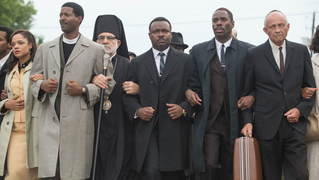
Dr. King marching for justice and equality
The Student Non-Violent Coordinating Committee (SNCC, "Snick"), formed to give younger blacks more of a voice in the civil rights movement, became one of the movement’s more radical branches. In the wake of the early sit-ins at lunch counters closed to blacks, which started in February 1960 in Greensboro, North Carolina, Ella Baker, then director of the Southern Christian Leadership Conference (SCLC), helped set up the first meeting of what became SNCC. She was concerned that SCLC, led by the Reverend Dr. Martin Luther King, Jr., was out of touch with younger blacks who wanted the movement to make faster progress. Baker encouraged those who formed SNCC to look beyond integration to broader social change and to view King’s principle of nonviolence more as a political tactic than as a way of life.

UPDATE: "Selma" director on Oscars and movie
(DemocracyNow.org, Jan. 27, 2015)

AvaduvernaydemocracynowSelma Director Ava DuVernay on Hollywood’s Lack of Diversity, Oscar Snub and #OscarsSoWhite Hashtag

10
"The Power of the People": Selma Director Ava DuVernay on Fight for Civil Rights, Voting Equality

Mlk_lbj"Selma" Director Defends Film’s Portrayal of LBJ-MLK Dispute on Voting Rights Legislation

Avaduvernayonselma"One Person Can Make a Difference": Ava DuVernay Remembers Film Critic Roger Ebert’s Early Support


"Mumia: Long Distance Revolutionary" new documentary tells untold story of Mumia Abu-Jamal’s life journey at the hands of the oppressive U.S. police state

KPFK (90.7 FM) Outreach Screening
Malcolm and I were peers and friends.
The KPFK Outreach Committee presents a screening of "Long Distance Revolutionary: A Journey with Mumia Abu-Jamal" (2012, 120 mins) at the
  • Echo Park Film Center
  • 1200 North Alvarado St., LA, CA 90026
  • (North of the Sunset Blvd./Alvarado St. intersection)
  • Friday, Jan. 9, 2015, 6:30-10:00 pm
How many roads must a man travel? [42]
Doors open and food will be served at 6:30 pm. The screening will begin at 7:00 pm. There will be a discussion after the screening. And a small donation will be requested at the door.

Before he was falsely convicted of murdering a policeman in 1981 and sentenced to death, Mumia Abu-Jamal was a gifted journalist and brilliant writer. Now after more than 30 years in prison and despite attempts to silence him, he is not only still alive but continuing to report, educate, provoke, and inspire.

Stephen Vittoria's new feature documentary is an inspiring portrait of a man whom many consider America's most famous political prisoner -- a man whose existence tests our beliefs about freedom of expression.

I have many other speeches, like my Vietnam material.
Prison interviews, archival footage, dramatic readings, and aided by a potent chorus of voices including Cornel West, Alice Walker, Dick Gregory, Angela Davis, Amy Goodman (DemocracyNow.org) and others, this riveting film explores his life before, during, and after Death Row -- revealing, in the words of Angela Davis, "the most eloquent and most powerful opponent of the death penalty in the world...the 21st Century Frederick Douglass."

Unlike any other film, book, or article produced about Mumia Abu-Jamal, "Mumia: Long Distance Revolutionary" focuses on his career as a prolific author and broadcaster from Pennsylvania's Death Row. In fact, the film does not deal with Abu-Jamal's case, but rather chronicles his life and work as a journalist and revolutionary -- both pre and post incarceration. After Abu-Jamal is falsely convicted of killing Philadelphia patrolman Daniel Faulkner, the story exposes Abu-Jamal's battles with the American court system to continue his work from prison -- a battle he continues to wage.
  
Director and British star of "Selma"
(Black Tree TV) "Selma" is the story of a movement. It chronicles a tumultuous three-month period in 1965 when Dr. Martin Luther King, Jr. led a dangerous campaign to secure equal economic, civil, and voting rights in the face of violent state oppression.

The epic march from Selma (Alabama) to Montgomery culminated in Pres. Johnson (Tom Wilkinson) signing the Voting Rights Act of 1965, one of the most significant victories for the civil rights movement.

I think I'm the real star of the movie (Oprah).
Director Ava DuVernay’s "Selma" tells the real story of how the revered leader and visionary MLK Jr. (David Oyelowo) and his brothers and sisters in the movement prompted change that forever altered American history. Director: Ava DuVernay, Cast: David Oyelowo, Tom Wilkinson, Cuba Gooding Jr., Alessandro Nivola, Giovanni Ribisi, Common, Carmen Ejogo, Lorraine Toussaint, with Tim Roth, and billionairess Oprah Winfrey hamming it up as “Annie Lee Cooper.”

Golden Globe nominations
Best Motion Picture (drama), Best Actor (David Oyelowo), Best Director (Ava DuVernay), Best Original Song (Common & John Legend, "Glory")

(CBS sunday Morning) Oprah and David Oyelowo on new civil rights film "Selma"

"The Buddhism of Tibet" from Indonesia

Ashley Wells, Pat Macpherson, Dhr. Seven, Wisdom Quarterly; L. Austine Waddell (archive)

The Buddhism of Tibet or Lamaism by L. Austine Waddell (archive.org)
What was Tibet like? Dennis Jarvis of Halifax, Canada, explores Drepung Gomang, a college within monastery walls, Great Assembly Hall, Drepung Monastery, Tibet (en/wikipedia.org).
Why did formerly officially Mahayana Buddhist now officially communist atheist mainland (Han) China invade, destroy, and militarily occupy Vajrayana (a division of Mahayana) Tibet?

"Esoteric" Buddhism in Southeast Asia
Ashley Wells, Dhr. Seven, Pat Macpherson, Wisdom Quarterly wiki edit
Borobudur Buddhist temple with its enigmatic "Time Travel Bells" Die Glocke stupas with Buddhas inside as dawn breaks through clouds, Java, Indonesia (TrevThompson/flickr).
Marco Polo's Old World travels to ancient Indonesia (Balkh and Shambhala)
 
Borobudur, Buddhist pyramid (22Kartika/wiki)
This Buddhist school -- now most prevalent in Tibet, Ladakh (India), Bhutan, Nepal, Mongolia, European Kalmykia, and Far East Russia -- refers to the traditions of Esoteric Buddhism found on the Indonesian islands of Java and Sumatra before 700 CE.

This predates the arrival of Esoteric Buddhism in Greater Tibet (a former empire) and the Himalayan region.

Indonesia is an enormous former empire.
The particular lineage in Indonesia is referred to as Mantranaya ("Mantra Path" aka Mantra-yana). Mantranaya is historically designated and evident in the oldest extant Old Javanese esoteric Buddhist literature.
Scythia, Pakistan, Gandhara, Ladakh, Tibet...
Mantranaya is an extension of Mahayana Buddhism consisting of differences in the adoption of additional techniques (upāya, "expedient" or "skillful means") rather than in philosophy. Some of these means are esoteric practices, which must be initiated and transmitted esoterically only through a skilled spiritual teacher or guru (khandro.net).

The Buddhist empire of Srivijaya in Palembang, Sumatra was for more than 600 years the center of Esoteric Buddhist learning in the Far East.
 
Yi Jing (635-713) praised the high level of Buddhist scholarship in Srivijaya and advised Chinese monastics to study there prior to making the journey to the great institution of learning, Nalanda Buddhist University (said to be the first in history), a vihara in ancient India. He wrote:
In the fortified city of Bhoga, Buddhist priests number more than 1,000, whose minds are bent on learning and good practice. They investigate and study all the subjects that exist just as in India; the rules and ceremonies are not at all different. If a Chinese priest wishes to go to the West in order to hear and read the original scriptures, he had better stay here one or two years and practice the proper rules (J. Takakusu, 2005, A Record of the Buddhist Religion: As Practised in India and the Malay Archipelago (A.D. 671-695)/I-Tsing, New Delhi, AES).
The temple complex at Borobudur in central Java, which is the world's largest Buddhist temple yet discovered, was built as a mandala, like most Buddhist temple complexes. A mandala is a giant three-dimensional representation of Buddhist cosmology.

All of the Buddha statues on each of its four sides have the same mudra, hand gesture, corresponding to one of the Five Dhyani Buddhas of the esoteric cardinal compass directions.

Borobudur temple walls adorned with bas relief (TrevThompson/flickr.com)

 
Another line of thought points to the depiction of the Gandavyuha, the last chapter of the "Flower Garland" (Avatamsaka) Sutra on the median levels of the Borobudur stupa (and Buddha's birth story or jataka from the Lalitavistara on the lowest).

The English language translation of the entire Flower Garland Sutra was completed in the early 1990s in the 20th century. As yet unidentified upper bas-reliefs on Borobudur temple walls may depict episodes from this sutra. It does not preach a specific group of Dhyani Buddhas but rather insists on innumerable identical buddhas throughout the universe. More