Showing posts with label non-violence. Show all posts

Tuesday, June 2, 2026

Bruce Lee: True meaning of martial arts

Don't fight like fire; dance like water
Bruce Lee
, what are the martial arts? Are they combat for war, a lack of peace, or something more?

Poet philosopher Bruce Lee was born Lee Jun-fan on Nov. 27, 1940, passing away at 32 on July 20, 1973. He was an American and Hong Kong mixed martial artist, teacher, actor, Hollywood superstar, and filmmaker.

He was the founder of Jeet Kune Do, a hybrid martial arts philosophy ["Lee-ism"?], which was formed from his experiences in unarmed fighting and self-defense—as well as eclectic, Zen Buddhist, Taoist, and Confucian philosophies—as a new school of martial arts thought [2, 3].

Standing on the shoulders of giants (symbol)
With a career spanning the United States and Hong Kong [4, 5, 6], Lee is regarded as the first global Chinese film star and one of the most influential martial artists in the history of cinema [7].

Known for his roles in five feature-length martial arts films, he is credited with helping to popularize martial arts films in the 1970s and promoting Hong Kong action cinema [8, 9].


I will kill you, Lee! - No, you won't, Tough Guy, because you didn't see this coming. Hah!

 
Smile. It's good for body and chi.
Born in San Francisco
and raised in Hong Kong, Lee was introduced to the Hong Kong film industry as a child actor by his father, Mr. Lee Hoi-chuen [10].

Lee's early martial arts experience included Wing Chun (trained under Ip Man), tai chi, boxing (winning a Hong Kong boxing tournament), and frequent street fighting (neighborhood and rooftop fights).

He moved to Seattle in 1959, enrolling at the University of Washington in 1961 [11]. More

Tuesday, January 27, 2026

When Buddhists Attack (Zen of martial arts)

Theravada Buddhist Muay Thai champion versus Shaolin Kung Fu master from Far East

Buddhist Wisdom (Tuttle Publishing)
Uncover the historical truth about Buddhist warrior monks with this informative and enlightening book.

Exploring the origins of Buddhism and the ethos of the Japanese samurai, martial arts practitioner Professor Jeffrey Mann traces the close connection between the Buddhist way of compassion (karuna) and the way of the warrior.

This Zen book serves as a basic introduction to the history, philosophy, and current practice of Zen as it relates to the Japanese martial arts.

Maybe they'll be ghosts (kami)
It examines the elements of Zen that have found a place in budo (bujutsu or bugei)—the "Martial Way"—such as zazen, mushin, zanshin, and fudoshin, then goes on to discuss the ethics and practice of budo as a modern sport.
 
Offering insights into how qualities integral to the true martial artist are interwoven with this ancient religious philosophy, this book on Buddhism helps practitioners reconnect to an authentic spiritual discipline of martial arts.


Film, television, and popular fiction have long exploited the image of the serene Buddhist monk who is master of the deadly craft of hand-to-hand combat.

While these media overly romanticize the relationship between a philosophy of non-violence and the art of fighting, When Buddhists Attack: The Curious Relationship Between Zen and the Martial Arts shows this link to be nevertheless real, even natural.
Prof. Jeffrey Mann, Dept. of Religious Studies
ABOUT: The author Jeffrey K. Mann is a professor and the chair of the Religious Studies Department at [the Protestant Evangelical LutheranSusquehanna University (susqu.edu) in Pennsylvania. He earned his doctorate in religious studies from Vanderbilt University and has also served as a visiting professor of religion at Senshu University in Ikuta, Japan. A longtime student of Japanese martial arts, he has trained and competed in karate tournaments throughout North America, Japan, Okinawa, and the Philippines. He is an instructor of the Susquehanna Goju-ryu Karate-do Club, a school affiliated with the International Okinawan Goju-ryu Karate-do Federation.

Wednesday, July 5, 2017

"A Journey into Buddhism" (Part II)

Elizabeth J. Harris, A Journey into Buddhism; A. Wells, Dhr. Seven (eds.), Wisdom Quarterly
The Buddha, Kanthaka, and a Christian saint, maybe Mary, maybe Jay (Ginger Mayerson)
 
2. Non-Retaliation
And this mudra means "peace"!
In one sutra in the Middle-Length Discourses of the Buddha (Majjhima Nikaya), one of the five divisions of the sutra collection that make up the Pali canon, the Buddha says to his disciples:
 
"Meditators, as low-down bandits might carve you limb from limb with a two-handed saw, yet even then whoever sets mind at enmity, that person for that reason is not a doer of my teaching (Dharma).

"This is how you must train yourselves: neither will my mind become perverted, nor will I utter unskillful speech, but kindly and compassionate will I dwell, with a mind/heart of friendliness and free of ill will."

The vividness of this picture has always moved me -- a criminal hacking off my arms and legs with a saw. And it isn't that far-fetched. War involves such butchery. The denial of human rights under totalitarian regimes produces similar horrors, and so does the obsessional urge of a serial killer or multiple murderer.

Get her! She has a look on her face!!
Fear, terror, or violent retaliation in self-protection would seem the natural reactions to such an attack, the way we're taught in Christendom (though not by Jesus), a reaction programmed into our bodies.
 
Yet, the challenge of Buddhism here is to not retaliate, not to hate, no to grow angry or seek revenge. Instead, it is to show compassion to all people even if they are about to kill you.

It is a challenge that reaches out from other religions also. Jesus of Palestine, suffering the agony of being nailed through his flesh to rough wooden posts, forgave his killers and even felt compassion for them [due to the karma they were accruing] in their blindness.

But does this imply that Buddhism advocates that we should never protect ourselves or others from violence, that we should submit to whatever exploitation we are subjected to, that in the face of "evil" forces we should remain passive?

To answer "yes" is to misread Buddhism and all true religion. Buddhism does not support hopeless passivity in the face of violence and evil. Rather, it encourages a mental attitude which can face and oppose violence without fear or hatred or delusion.
 
Nowhere in the Buddhist texts is it suggested that we should remain inactive when we or others are suffering. Nowhere does it say we should refrain from action if someone is murdering our son, daughter, neighbor, or colleague in front of our eyes.

In such situations, harm must be relieved, violence denounced, interceding or self-sacrifice might even be demanded, though the Buddhist texts also warn that to meet violence with violence brings a vicious circle of spiraling further violence.

What the Buddhist texts do say is that to hate, to feel anger towards the doer of violence, is self-defeating. It harms both and harms the hater even more than the hated.

In the ancient Buddhist texts, we come across many stories of non-hatred deflecting violence and making it powerless.

One woman, because she refuses to feel hatred, is unharmed when burning oil is poured over her by a jealous co-wife. And when a monk dies of snakebite, the Buddha says he would not have died if he had radiated loving kindness (metta) to the four families of snakes. (See the khanda paritta for protection from snakebites).

This might seem utopian in a world shot through with violence. The skeptic can point to the deaths of Gandhi in India, Oscar Romero in El Salvador, and Michael Rodrigo in Sri Lanka to show that the most compassionate of beings are sometimes unable to escape violent deaths caused by the greed and hatred of others.
  • [The fact that the chief disciple Maha Moggallana could not avoid such a death shows the power of past karma to bear its results when it gets the opportunity. This disciple was fully enlightened and foremost in the practice of magic yet could not always avoid karma consequences (vipaka and phala). What then of ordinary unenlightened beings without magical powers?]
But the force of these spiritual teachings will remain. Violence is not overcome by violence. Hatred is not defeated by hatred. Our lives are not made more secure by wishing to protect them [or by harming others in that effort.]

To face death without hatred or fear, even towards our killers, is the path of sainthood (arhatship, full enlightenment). These are eternal truths. More

Tuesday, August 19, 2014

Violence (Dhammapada verses)

Acharya Buddharakkhita (trans.), Dhr. Seven, Amber Larson, Crystal Quintero (eds), Wisdom Quarterly, Dandavagga: "Violence," Dhammapada 10 (Dhp X) PREV-NEXT
The Buddha, sunrise over Borobudur, Java, Indonesia (Ulambert/flickr.com)
 
The Dhammapada
Dhammapada Verse 129. All tremble at violence; all fear death. Putting oneself in the place of another, one should not kill nor cause another to kill.
 
130. All tremble at violence; life is dear to all. Putting oneself in the place of another, one should not kill nor cause another to kill.
 
131. One who, while seeking happiness, oppresses with violence other beings who also desire happiness, will not attain happiness hereafter.
 
132. One who, while seeking happiness, does not oppress with violence other beings who also desire happiness, will find happiness hereafter.
 
133. Speak not harshly to anyone, for those thus spoken to might retort. Indeed, angry speech hurts, and one may be overtaken by retaliation.
 
134. If, like a broken gong, one silences oneself, one has approached nirvana, for vindictiveness is no longer in one.
 
135. Just as a cowherd drives the cattle to pasture with a staff, so do old age and death drive the life force of beings (from existence to existence in samsara).
 
Reflecting on the world, on the causes of violence and peace (Ulambert/flickr.com)
.
136. When the fool commits unskillful deeds, the fool does not realize (their harmful nature). The witless person is tormented by those very deeds, like one burned by fire.
 
137. One who inflicts violence on those who are unarmed, and offends those who are inoffensive, will soon come upon one of these ten states:
 
138-140. Sharp pain, or disaster, bodily injury, serious illness, or derangement of mind, trouble from the government, or grave charges, loss of relatives, or loss of wealth, or houses destroyed by ravaging fire; upon dissolution of the body that ignorant person is reborn in hell.
 
Indian ascetics in Nepal (galuzzi.it)
141. Neither [engaging in ascetic extremes of mortification like] going about naked, nor wearing matted locks, nor wallowing in filth, nor fasting, nor lying on the ground, nor smearing oneself with pyre-ashes and dust, nor sitting on heels (in penance) can purify a person who has not overcome doubt (skepticism).
 
142. Even though one be well-attired, yet if one is poised, calm, controlled, and established in the pure life, having set aside violence towards all beings -- one, truly, is a holy person (sadhu), a renunciate, a monastic (samana, wandering ascetic).
 
143. Only rarely is there a person in this world who, restrained by modesty, avoids reproach, as a thoroughbred horse avoids the goad (whip).
 
144. Like a thoroughbred horse touched by the goad, be strenuous, be filled with spiritual yearning (to strive). By confidence and virtue, by effort and meditation, by investigation of the truth, by being rich in knowledge and purity, and by being mindful, destroy this unlimited suffering (of samsara).
 
145. Irrigators regulate the waters, fletchers straighten arrow shafts, carpenters shape wood, and the good control themselves.

Wednesday, August 28, 2013

The March on Washington! (video)


WARNING: Extremely moving! MLK said, "I Have a Dream" (see full speech)
 
The Rev. Dr. Martin Luther King, Jr. planned and participated in the historic 1963 "March on Washington" to promote peace (opposing the US/MIC's widespread secret bombing of Buddhist Cambodia, Laos, and the very public and wanton destruction of Buddhist Vietnam). Dr. King was a great promoter of Vietnamese Zen Buddhist monk and fellow peace activist Ven. Thich Nhat Hanh (Thay). Racism in America and widespread economic disparity, which kept large swaths of the population in "slave" conditions, could be tolerated by the Powers That Be at the time. But the one thing they could not tolerate was a direct assault on the military-industrial complex (the corporate and governmental interests that very profitably promote war and destruction as a means of enriching themselves and maintaining social control). Dr. King saw this and could not be silent on the matter:

"The greatest purveyor of violence: My [US] government, and I cannot be silent." 
- MLK
 
Malcolm X quietly supported the growing peace movement opposing segregation, racism, and economic inequality. He, however, was willing to examine other options -- the Islamification of the black community, direct resistance, black nationalism, and taking what communities were being deprived of due to race. He is often cast as promoting the opposite of Dr. King's peace model based on Gandhi and Jesus Christ (who is said to have come not to bring peace but a sword, Matt. 10:34). The saying, "By any means necessary" is repeatedly quoted like a battle cry -- as if it meant violence were the only way. All means included nonviolent resistance, active dissent, civil disobedience, self-defense, peaceful demonstrations, rallies, marches, finding allies in other oppressed parts of the world and the country (among other groups), and more. He did not believe that the Powers That Be were simply going to hand over equal rights and opportunities out of kindness and generosity. So much was at stake that no option was off the table. So to think that Malcolm X was all angry and violent, whereas Dr. King was all love and peace is a great misreading of history. But this is the simplistic tale we are told.


Peaceful means
Peace Pagoda, Ladakh, Himalayas (creative_pixels)
Malcolm X makes it clear that he has bigger plans for ending racism and oppression than what Rev. King has been heard promoting. Whether promoting pure peace or "all means necessary," the American government assassinated them just the same. But who made a bigger public impression?
 
Whose name is remembered and lauded as a sustainable movement? If we fight violent-power with violent-power, the more violently-powerful win, and we continue to live oppressed by violence. 
 
If we resist with peace, after a time, peace wins out, and we now live blessed by peace. The choice is always ours -- and it is not an easy choice when being prodded by violent police and racist institutions.

"It is time now for you and me to stop running away from the wolf right into the hands of the fox looking for some kind of help."
- Malcolm X
 
MLK, Thay, Browne (digitalunion.osu.edu)
(MalcolmXfiles)  "Recently when I was blessed to make a religious pilgrimage to the holy city of Mecca where I met many people from all over the world, plus spent many weeks in Africa trying to broaden my own scope and get more of an open mind to look at the problem as it actually is, one of the things that I realized -- and I realized this even before going over there -- was that our African brothers have gained their independence faster than you and I here in America have.
 
"They've also gained recognition and respect as human beings much faster than you and I. Just ten years ago on the African continent, our people were colonized.
 
"They were suffering all forms of colonization, oppression, exploitation, degradation, humiliation, discrimination, and every other kind of -ation. And in a short time, they have gained more independence, more recognition, more respect as human beings than you and I have.
  
"And you and I live in a country which is supposed to be the citadel of education, freedom, justice, democracy, and all of those other pretty-sounding words.
 
"So it was our intention to try and find out what it was our African brothers were doing to get results, so that you and I could study what they had done and perhaps gain from that study or benefit from their experiences."


Do police and soldiers fight or defend the corrupt offices of power?

Monday, March 12, 2012

Kucinich, Israel vs. Iran, Keystone (audio)

Lila Garrett, Mark Maxwell, Connect the Dots (KPFK.org, Mondays 7:00-8:00 am)

KUCINICH Pro-peace Congressman Dennis Kucinich concedes his loss: he has not been renominated to run in his newly gerrymandered Cleveland, Ohio district. Rather than regretting what might have been, he is looking toward the future and finishing out his term. His non-progressive competition curries favor with the military-industrial complex rather than concerning herself with civil rights issues like Kucinich. Having been in politics since 1967 and in 40 elections and having lost on eight occasions, this is only a "temporary setback." He will run again, join the media, or go with what the universe brings him. As for WW III, there is now one less person to stand in the way of it.


ISRAEL vs. IRAN (Minute 15:00) Rabbi Michael Lerner has placed a full-page ad in the New York Times as the voice of the majority of Jews oppose war on Iran. The Network of Political Progressives is sending Netanyahu and Obama a single message in no uncertain terms: We are not behind you! The media is obscuring the situation as it is, pretending there was a substantive difference between Obama and Netanyahu's position. They only differ on timing, and the only reason for that is Obama's concern for his re-election. War will be catastrophic for the American economy, world oil prices (benefiting the oil companies), and civil liberties everywhere. Thousands have signed the letter in the ad demanding peace and a diplomatic resolution to any issues with Iran.


KEYSTONE (Minute 34:45) Attorney Thomas Linzey -- Executive Director for the Community Environment Legal Defense Fund providing free legal services to save the environment, author of Be The Change, and co-host of "Democracy Matters" at KYRS in Spokane, Washington -- talks about fracking (hydraulic fracturing shale for natural gas and oil extraction that contaminates the water table) and small town legislation to prevent it. He has helped hundreds of successes and can help draft more municipal ordinances. These Bill of Rights protect our right to clean air, a clean environment, and a clean world for subsequent generations.


  • For CD copies of Connect the Dots, contact the Pacifica Archives at (800) 735-0230 or online

Monday, December 5, 2011

Should Animals be Stunned before Slaughter?

"But darling, he doesn't kill the cows. We do by buying them."

A woman pays a man to kill another man. He does. She pays him. Who killed? The hitman would not have except that he expected to be paid. The woman, by offering to pay him, induced him. We have the same relationship with our butchers.


Should Slaughterhouse Animals Be Stunned?
Raffi Berg, BBC News Amsterdam
The slaughter of conscious animals was widely abandoned in the 20th Century and is now practiced mainly in the Jewish and Muslim communities.

Consumers increasingly expect animals to be stunned before death -- but would banning other slaughter methods be an unacceptable violation of religious rights?

The sound of pistons and mechanics fills the air as the last calf of the day steps into a holding box.

A device the size of a hand-held drill is brought to the animal's head, a trigger pulled and a four-inch bolt shot into its brain, causing it instantly to collapse. The unconscious calf is hoisted upside down and slaughtered seconds later with a massive cut to its throat, showering the floor with a torrent of crimson blood.

"Killing animals is never friendly," says Paul Meeuwissen, director of the Vitelco abattoir in the central town of s'-Hertogenbosch, "but what we do is done in the most animal-friendly way possible." More

Should Animals Be Slaughtered?
Amber Dorrian, Wisdom Quarterly (ANALYSIS)
That, of course, is not the question. And it does not address this serious issue. The rate of killing, on behalf of salivating meat purchasers and consumers, is going on at more than 1 million animals per day in the US alone.

Killing one animal on our behalf should not be acceptable or tolerated. Yet we tolerate wholesale slaughter. We turn our eyes and will not see just how cruel the living conditions and murder are.

Eating the toxic (germ ridden, poorly fed, hormone injected) byproducts is worse for the body. But when the mind looks and sees what is happening because we want to eat meat, the mind flags at the killing.

Who then would argue to murder domesticated livestock more cruelly rather than less?

Nonviolence (ahimsa), one of our national ideals, goes out the barn door with the animals led onto trucks or cattle cars on a fearful march to the abattoir. Are the butchers and handlers asking, "Should we put them out of their misery?" or is it the corporate factory farmers asking because it would cost a few cents more?

So the answer is easy!
A) Allow animals to live.
B) Raise them in light, air, on soil rather than in dark, foul smelling, closed off pens and cages.
C) When you can no longer do A and B, be kind in every way possible, choosing stunning over the excruciating live torture of conscious slaughter.

Sunday, December 4, 2011

Interview with Gene Sharp (audio for Occupy)

Wisdom Quarterly; KPFK.org; NYTimes.com; YesMagazine.org
War without violence? Yes, neither Gandhi nor Burmese Buddhist monks were pacifist do-nothings. They instead did what worked, according to Gene Sharp. (state of collapse)

Radical Radio LA: Sojourner Truth
Margaret Prescod, Dec. 2, 2011
KPFK broadcast an hour long special with Gene Sharp. Sharp is the senior scholar at the Albert Einstein Institution, advancing freedom through strategic non-violent action. He is also the author of books on non-violent direct action. His work was reportedly widely read by activists in the uprisings in Egypt around Freedom (Tahrir) Square and the awakening of the "Arab Spring" and worldwide Occupy Movement.

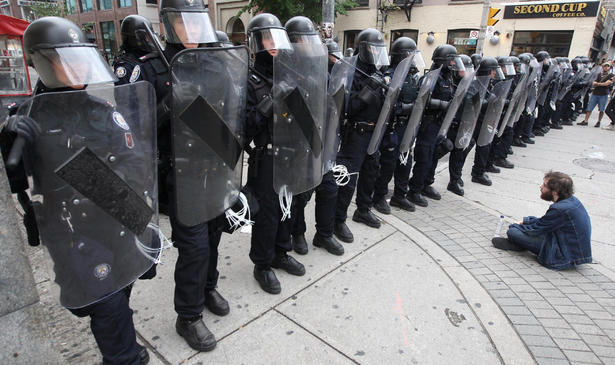
Many agencies having nothing whatsoever to do with national defense now have their own paramilitary units (extremumspiritum.com).

Have American police become militarized?
(New York Times Sunday Review, Dec. 3, 2011)
RIOT police officers tear-gas protesters at the Occupy movement in Oakland. There is a surprising nighttime invasion of Zuccotti Park in Lower Manhattan; it is carried out with D-Day-like secrecy by officers deploying klieg lights and a military-style sound machine. Campus police officers in helmets and face shields dousing demonstrators at the Univ. of California, Davis with pepper spray. Is this the militarization of the American police? Police forces undeniably share a soldier’s ethos, no matter the size of the city, town, or jurisdiction: officers carry deadly weapons and wear uniforms with patches denoting rank. They salute one another and pay homage to a “Yes, sir,” “No, sir,” hierarchical culture. More

This Changes Everything
Edited by Sarah van Gelder and YES! Magazine staff
The Occupy Wall Street movement named the core issue of our time: the overwhelming power of Wall Street banks and large corporations. It was something the political establishment and most media had long ignored.

But the movement goes far beyond this critique. This Changes Everything shows how the movement is shifting the way people view themselves and the world, the kind of society they believe is possible, and their own involvement in creating a society that works for the 99% as well as the 1%. More

What it is like just before being beaten by line of police (Guido Corleone TV)

Post Occupy LA raid morning return march from Pershing Square

Saturday, December 3, 2011

Revolutionary Wisdom: A primer

Gene Sharp; Wisdom Quarterly; LA Times; KPFK.org


Occupy: Sharp Strategies for Success
In 1993, American political scientist Gene Sharp wrote a massively successful 88-page guide to nonviolent revolution:
(LA Times) "No one should believe that with the downfall of the dictatorship an ideal society will immediately appear," warns Gene Sharp's pamphlet on nonviolent resistance to dictatorships.

It has now been translated into more than 30 languages (by Sharp's count). It is available for free download at his website. This plainspoken book has found its way from Burma to the Balkans and beyond. More

Sojourner Truth with Margaret Prescod (KPFK.org)
DEC. 2, 2011 - On Friday, KPFK had a one-hour special with Gene Sharp -- the author whose work has guided successful nonviolent revolutions around the world.

His 88-page booklet inspired activists in Buddhist Burma (Saffron Revolution) as well as Islamist Egypt (Green Revolution), Tunisia, Syria, Libya, Yemen, essentially stirring up the "Arab Spring."

It is sure to eventually be directly used by the Occupy Movement in the West, which itself claims to have been inspired to launch an "American Fall" (or Autumn) emulating the Arab Spring by occupying Wall Street and other major centers. Sharp is a senior scholar at the Albert Einstein Institution. He is also the author of many books on using the strategy of non-violent action to topple dictators.


Waging Non Violent Struggle: 20th Century Practice, 21st Century Potential is one of the works that are widely read by activists in the lead up and during the uprising in Egypt.

  • Is non-violence as a strategy for change a sustainable approach?
  • Are there ever times when violence is necessary?
  • What are his definitions of democracy and dictatorship?
  • What was his relationship with the civil rights movement and what are his views on the uprisings in North Africa and the Middle East?
NOTE: This show was originally aired 4-29-11. The news segment is for 12-2-11.