Showing posts with label self development. Show all posts

Tuesday, January 27, 2026

When Buddhists Attack (Zen of martial arts)

Theravada Buddhist Muay Thai champion versus Shaolin Kung Fu master from Far East

Buddhist Wisdom (Tuttle Publishing)
Uncover the historical truth about Buddhist warrior monks with this informative and enlightening book.

Exploring the origins of Buddhism and the ethos of the Japanese samurai, martial arts practitioner Professor Jeffrey Mann traces the close connection between the Buddhist way of compassion (karuna) and the way of the warrior.

This Zen book serves as a basic introduction to the history, philosophy, and current practice of Zen as it relates to the Japanese martial arts.

Maybe they'll be ghosts (kami)
It examines the elements of Zen that have found a place in budo (bujutsu or bugei)—the "Martial Way"—such as zazen, mushin, zanshin, and fudoshin, then goes on to discuss the ethics and practice of budo as a modern sport.
 
Offering insights into how qualities integral to the true martial artist are interwoven with this ancient religious philosophy, this book on Buddhism helps practitioners reconnect to an authentic spiritual discipline of martial arts.


Film, television, and popular fiction have long exploited the image of the serene Buddhist monk who is master of the deadly craft of hand-to-hand combat.

While these media overly romanticize the relationship between a philosophy of non-violence and the art of fighting, When Buddhists Attack: The Curious Relationship Between Zen and the Martial Arts shows this link to be nevertheless real, even natural.
Prof. Jeffrey Mann, Dept. of Religious Studies
ABOUT: The author Jeffrey K. Mann is a professor and the chair of the Religious Studies Department at [the Protestant Evangelical LutheranSusquehanna University (susqu.edu) in Pennsylvania. He earned his doctorate in religious studies from Vanderbilt University and has also served as a visiting professor of religion at Senshu University in Ikuta, Japan. A longtime student of Japanese martial arts, he has trained and competed in karate tournaments throughout North America, Japan, Okinawa, and the Philippines. He is an instructor of the Susquehanna Goju-ryu Karate-do Club, a school affiliated with the International Okinawan Goju-ryu Karate-do Federation.

Monday, June 23, 2025

Message of love from the Dalai Lama


(Dechen wangdi 🇨🇦) H.H. the 14th Dalai Lama has an important message for all religions, a message of love and unity (mutual respect, tolerance, celebration, amity, peaceful coexistence). #tibetanvlogger #tibetanyoutuber June 21, 2025. Background music: "Tears" (Produced by MX Audio Library) Link: • Tears - No Copyright M...

  • Dalai Lama (dalailama.com); CC Liu, Crystal Q. (eds.), Wisdom Quarterly

Thursday, May 29, 2025

Dried plants bring dead land to life

Vegetation restoration and its environmental effects on the Loess Plateau, China (MDPI.com)

How could dead and dried plant matter bring a mountain and a dry, dusty desert plateau back to life, making a wasteland lush with green plants and a restored ecosystem after its manmade ruin?

The Loess Plateau
[a] is in north-central China. It is formed of loess, a clastic silt-like sediment formed by the accumulation of wind-blown dust. It is located southeast of the Gobi Desert and is surrounded by the Yellow River. It includes parts of the Chinese provinces of Qinghai, Gansu, Shaanxi and Shanxi [4].

The depositional setting of the Chinese Loess Plateau was shaped by the tectonic movement in the Neogene period, after which strong southeast winds caused by the East Asian Monsoon transported sediment to the plateau during the Quaternary period [5].

The three main morphological types in the Loess Plateau are loess platforms, ridges, and hills [4], formed by the deposition and erosion of loess.

How could dried plants give life to dead mountain?
Most of the loess comes from the Gobi Desert and other nearby deserts [6]. The sediments were transported to the Loess Plateau during interglacial periods by southeasterly prevailing winds and winter monsoon winds.

After the deposition of sediments on the plateau, they were gradually compacted to form loess under the arid climate [4]. Loess Plateau
What's happening in the world?
(DemocracyNow.org) World headlines for May 30, 2025

Monday, December 23, 2024

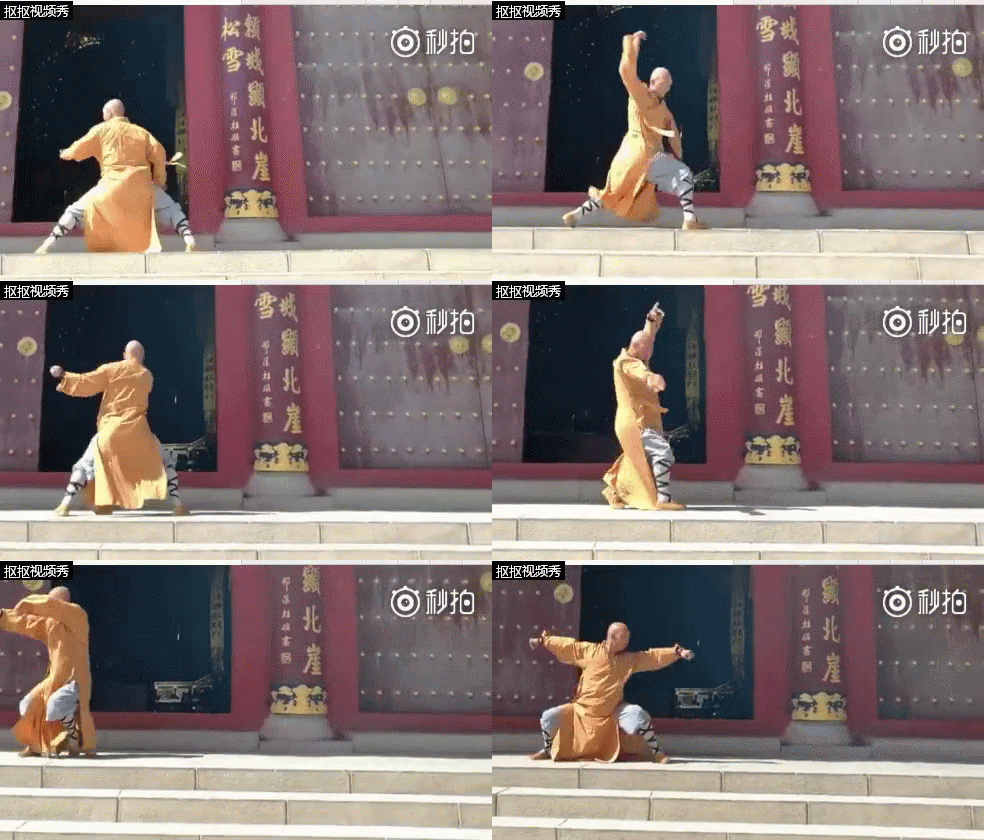
Buddhist fighter Shaolin monk Yi Long


Hiya! Take that! - Whoa, I didn't see that one coming from above onto my shoulder neck back!!

Yi Long: Kungfu in Modern Combat Sports
At the monastery, everyone stood back as I went off
(Ramsey Dewey) Jan. 27, 2020: Ramsey Dewey Podcasts. Chinese kickboxing star Yi Long discusses the role of traditional Chinese martial arts in modern combat sports. Listen to the whole interview on the Ramsey Dewey podcast.
In the dojo we learn the Way of Combat when we would rather be mastering meditation, and it never ends well... One must be disciplined, peaceful, and humble. For the best mastery is mastery of oneself. Just ask war cheerleader Alfred, Lord Tennyson. As soon as one seeks to master others, a world of hurt opens up:

 
What is the best way to fight?

Kung fu is for self-defense and protecting Dharma
Why is Buddhist Shaolin monk Yi Long demonstrating his Shaolin kung fu training? 

It's hard to say. What was once a Buddhist temple practice developed alongside mental training of the heart and mind in meditation eventually became the martial (war) arts independent of their roots in moral and wisdom training.

It is said that South Indian Bodhidharma brought these skills to China, which gave rise to the Chan ("Meditation") school that went on to Japan as Zen, to Korea as Seon, and Vietnam as Thien.

Shaolin kung fu (Chinese 少林功夫, Pinyin Shǎolín gōngfū), also called Shaolin Wushu (少林武術; Shǎolín wǔshù), or Shaolin quan (少林拳, Shàolínquán), is the largest and most famous style of kung fu.

It combines Chan Buddhist philosophy and martial arts. It was developed in the Shaolin Temple in Henan, China during its 1,500-year history. In Chinese folklore there is a saying, "Shaolin kung fu is the best under heaven." More

The Charge of the Light Brigade
By Alfred, Lord Tennyson: European pride? Let's ride into the jaws of death? 

I
Half a league, half a league,
Half a league onward,
All in the valley of Death
   Rode the six hundred.
“Forward, the Light Brigade!
Charge for the guns!” he said.
Into the valley of Death
   Rode the six hundred.

II
“Forward, the Light Brigade!”
Was there a man dismayed?
Not though the soldier knew
   Someone had blundered.
   Theirs not to make reply,
   Theirs not to reason why,
   Theirs but to do and die.
   Into the valley of Death
   Rode the six hundred.

III
Cannon to right of them,
Cannon to left of them,
Cannon in front of them
   Volleyed and thundered;
Stormed at with shot and shell,
Boldly they rode and well,
Into the jaws of Death,
Into the mouth of hell
   Rode the six hundred....

V
Cannon to right of them,
Cannon to left of them,
Cannon behind them
   Volleyed and thundered;
Stormed at with shot and shell,
While horse and hero fell.
They that had fought so well
Came through the jaws of Death,
Back from the mouth of hell,
All that was left of them,
   Left of six hundred.

VI
When can their glory fade?
O the wild charge they made!
   All the world wondered.
Honour the charge they made!
Honour the Light Brigade,
   Noble six hundred!

Rematch with Thai kickboxer
WARNING: Fighting is ugly and fraught with danger, so it is always best avoided. The highlight reels make it seem fun and easy, but the truth is much uglier, vicious on the street, technical in the ring.

Dulce et Decorum Est
By Wilfred Owen
Bent double, like old beggars under sacks,
Knock-kneed, coughing like hags, we cursed through sludge,
Till on the haunting flares we turned our backs,
And towards our distant rest began to trudge.
Men marched asleep. Many had lost their boots,
But limped on, blood-shod. All went lame; all blind;
Drunk with fatigue; deaf even to the hoots
Of gas-shells dropping softly behind.

Gas! GAS! Quick, boys!—An ecstasy of fumbling
Fitting the clumsy helmets just in time,
But someone still was yelling out and stumbling
And flound’ring like a man in fire or lime.—
Dim through the misty panes and thick green light,
As under a green sea, I saw him drowning.

In all my dreams before my helpless sight,
He plunges at me, guttering, choking, drowning.

If in some smothering dreams, you too could pace
Behind the wagon that we flung him in,
And watch the white eyes writhing in his face,
His hanging face, like a devil’s sick of sin;
If you could hear, at every jolt, the blood
Come gargling from the froth-corrupted lungs,
Obscene as cancer, bitter as the cud
Of vile, incurable sores on innocent tongues,—
My friend, you would not tell with such high zest
To children ardent for some desperate glory,
The old Lie: Dulce et decorum est
Pro patria mori.*

*Latin phrase is from the Roman poet Horace: “It is sweet and fitting to die for one’s country.” 

Friday, June 7, 2024

Cosmic Consciousness: Evolution of Mind


Cosmic Consciousness: A Study in the Evolution of the Human Mind
Cosmic Consciousness
This book has 4.4 out of 5 stars with 515 ratings. It is a 2010 reprint of the 1905 edition.

This is the magnum opus of editor Richard Maurice Bucke's career, a project that he researched and wrote over many years.

In it, Bucke describes his own experience, that of contemporaries (most notably Whitman, but also unknown figures like "C.P."), and the experiences and outlook of historical figures including
  • the Buddha,
  • Jesus,
  • Paul,
  • Plotinus,
  • Muhammad,
  • Dante,
  • Francis Bacon, and
  • William Blake.
Bucke developed a theory involving three stages in the development of consciousness:
  • the simple consciousness of animals;
  • the self-consciousness of the mass of humanity (encompassing reason, imagination, etc.); and 
  • cosmic consciousness -- an emerging faculty and the next stage of human development.
Among the effects of this progression, Bucke believed he detected a lengthy historical trend in which religious conceptions and theologies had become less and less fearful. It is a classic work. Cosmic Consciousness: A Study in the Evolution of the Human Mind

Friday, February 16, 2024

'7' and the Seven Factors of Enlightenment

Dhr. Seven, Amber Larson (eds.), Wisdom Quarterly Wiki edit; ReligionForBreakfast, 2/8/24

Is anything more wonderful than enlightenment?
In Buddhism, the Seven Factors of Enlightenment (Pali satta bojjhaṅgā or satta sambojjhaṅgā, Sanskrit sapta bodhyanga) are:
  1. Mindfulness (Pali sati, Sanskrit smṛti) to maintain unbiased, undistorted, unembellished awareness of reality (dhammas, "phenomena," "things") just as it is, in particular the Teachings (the Dhamma).
  2. Investigation of the true nature of reality (Pali dhamma vicaya, Sanskrit dharmapravicaya)
  3. Energy (Pali viriya, Sanskrit vīrya) also effort, determination
  4. Joy or rapture (Pali pīti, Sanskrit prīti)
  5. Calm or tranquility, relaxation, serenity (Pali passaddhi, Sanskrit prashrabdhi) of body and mind
  6. Stillness (samādhi) a calm, one-pointed state of mind [1], or "bringing the buried latencies or samskaras into full view" [2]
  7. Equanimity (Pali upekkhā, Sanskrit upekshā), which is unbiased looking on, accepting reality just as-it-is (yathā-bhuta) without clinging or aversion.
The Seven Factors of Enlightenment as a set is one of the "seven sets of thing" comprising the Thirty-Seven Requisites of Enlightenment (the bodhipakkhiyadhamma or "things pertaining to awakening").

The Pali Buddhist term bojjhanga is a compound of bodhi ("enlightenment" or "awakening") and anga ("limb" or "factor") [3]. More
Of course, the number seven comes up many more times than this in Buddhism. A person, having realized the first stage of enlightenment (a stream-enterer) has at most only seven more rebirths. Why? It's just that way by the cosmic order of things, the niyamas in Abhidharma terms.

"Why does the number 7 appear everywhere in religion?"

(ReligionForBreakfast) The number seven appears everywhere in the Bible...and a bunch of other religious traditions, too. Why is the number seven sacred?
  • 00:00 Why so many 7s?
  • 00:24 Near Eastern context
  • 5:03 Later development of Sacred 7
  • 5:59 Cross-cultural phenomenon?
  • 7:18 Origin theories
  • 10:46 Patreon
Support on Patreon: religionforbreakfast

BIBLIOGRAPHY
  • Arvid Kapelrud, "The Number Seven in Ugaritic Texts," Vetus Testamentum, Vol. 18 (Oct 1968), 494-499.
  • Denise Flanders, "The Rhetorical Use of Numbers in the Deuteronomistic History," 2022.
  • Denise Flanders, "Saul has Killed His Thousands, David His Ten Thousand," dissertation, 2019.
  • James Pritchard (ed.), "Ancient Near Eastern Texts Relating to the Old Testament," Third Edition with Supplement, 1969.
  • R.A. Kraft, "Philo's Treatment of the Number Seven in On Creation," in "Exploring the Scripturesque, (2009), p. 217-236.
  • Botterweck et. al. (ed.), "Theological Dictionary of the Old Testament," Vol. 14. Laki, "On the Origin of the Sexagesimal System," Journal of the Washington Academy of Sciences, Vol. 59, No 1/3 (Jan-March 1969).
  • Kazuo Muroi, "The Origin of the Mystical Number Seven in Mesopotamian Culture"
  • Adela Harbro Collins, "Cosmology and eschatology in Jewish and Christian Apocalypticism," 1966.
  • Bendt Alster, "Early Dynastic Proverbs and other Contributions to the Study of Literary Texts from Abu Salabikh," Archiv für Orientforschunb (1991/1992), 1 - 51.
  • Leonid Zhmud, "From Number Symbolism to Arithmology," Zahlen- und Buchstabensysteme im Dienste religiöser Bildung.
  • L. Schimmelpfennig (ed.) Tübingen: Seraphim, 2019. P. 25-45.

Friday, February 2, 2024

Voice Liberation Playshop with Mayumi

Mayumi B. (kinshipyoga.com, Instagram); Dhr. Seven (ed.), Wisdom Quarterly

WHAT HAPPENED?

Mayumi on IG (@shaktimayumi)
We gathered on the wood floors of Kinship, forming a circle and were welcomed by Mayumi, with introductions going around. Say your name and make a sound with a body movement, and we will all mimic it. We each came up a signature exclamation and move. Everyone followed suit.

We got up as Mayumi turned into a Japanese American shaman from Highland Park (L.A.), pulsing a horseskin drum she made by hand. We moved rhythmically, and I suddenly began to think, "Wow, I really am in L.A."

The group was about 99% women, all wanting to open their throat chakras and express themselves without shame, overcoming the shaming, belittling, and being told to quiet down we all experience. Childhood trauma was an underlying issue in the group.

We made sounds, drank tea, danced like Burning Man/Bhakti Fest hipsters, and made sounds, expressing our range of vocal ability.

I had been privileged to have a hands-on healing from Mayumi at the Collective a few days in advance. I thought there would be more of that, which is available in private sessions.

Instead, it was a group healing, over all too soon. Will there be another? There will. Keep an eye on Dharma Buddhist Meditation and her Instagram for details.

Event details
Explore the magic, wisdom, and infinite creative potential of the voice that's waiting to be unlocked, expressed, and liberated!

This is a supportive, healing space to:
  • ✧ Explore the pure sound of the voice with curiosity, playfulness, and presence
  • ✧ Clear physical and energetic blockages in throat chakra and free it from self-judgment, comparisons, and old stories of "not being good enough"
  • ✧ Soothe the inner critic and cultivate deeper compassion, respect, and self-love
  • ✧ Strengthen intuition, trust, ability to listen to the wisdom within
  • ✧ Gain confidence in sharing the voice with others from a regulated place of peace, resilience, and wholeness
  • ✧ Awaken the healing power of voice to create inner and outer harmony
  • ✧ Connect with an inspiring, supportive community to feel seen, heard, honored, and celebrated
  • ✧ Have fun and inJOY yourself!
As we do this practice to courageously open and liberate our voices, we send ripples of healing to our ancestors, loved ones, the world, and future generations ♡

I look forward to sharing this sacred space! Register now as space is limited and will fill up. Questions? Email Mayumi at shaktimayumi@gmail.com or DM on Instagram @shaktimayumi

~ Mayumi
ABOUT: Mayumi B. is a Dragon Priestess, Ancestral Voice Liberation Guide, Community Leader, and Multidimensional Artist. She weaves voice liberation, ancestral wisdom, dragon embodiment, sacred prayer, inner child integration, community connection, and sound healing into her offerings to awaken the grace, brilliance, and infinite creative potential of our unique soul expression into the here and now. As a 4th generation Japanese-American, born and raised in Highland Park, Los Angeles, Mayumi is honored to give back to her hometown community and share her lineage, culture, and ancestral roots. She is deeply passionate about supporting people to transmute shame, suppression, and self-doubt into liberated, authentic self-expression so they can feel confident, connected, and creatively empowered in their voice. Mayumi shares the sonic medicine of her voice to bring healing, harmony, and love to humanity and Mother Earth. She has offered sound healings with diverse communities around the world, from large festivals to classrooms in inner-city schools. Both in her group gatherings and one-on-one sessions, she supports people to come back home to themselves, to cultivate self-trust, to love, and to remember who they truly are.

Saturday, May 13, 2023

ASK MAYA: Meditation vs. Absorption?

Maya, Dhr. Seven, Amber Larson, Kelly Y., Wisdom Quarterly  ASK MAYA, 2/7/14
Not excited, not distracted, not asleep, not doing, wakeful-attention to a single object eventually leads to what we were always missing. (Sue90ca/flickr)
  
This question comes from Wisdom Quarterly reader Ron: "What is the difference between meditation and absorption?" Here we answer in a more practical than theoretical way with instructions.
 
Meditation is dull and unclear until...
"MEDITATION" (bhavana) is a very general term. It literally means, "bringing into being." So it is often translated as "mental cultivation" or "self development." The mental and self can be misleading if taken too literally; it is not a brain or head thing, nor is the ego being built up. Intellectualizing the process or cultivating ego are the opposite of what's happening.
 
One might cultivate or develop many beneficial things such as virtue (the foundation of concentration) or calm or restraint.
 
One might develop one's knowledge of the Dharma (Buddhist Doctrine) through fantastically woven Mahayana stories penned long after the Buddha but written as if the Buddha had said them. Or one might get closer to the source by studying Theravada "lists," sutras, and commentaries.

Or one might learn the precepts, further precepts, or Disciplinary Code for long-term intensive practice. Or one might study the life of the Buddha and various figures from ancient India, such as these four fascinating enlightened Buddhist nuns: Khema, Uppalavanna, Bhaddhakaccana, and Sundari Nanda. Little is heard of them today as nearly all of the focus is put on monks, kings, and warriors. (The first two were the Buddha's beautiful chief disciples, the third his former wife, and the fourth his princess sister).

Stay awake (PeterFroehlich/flickr.com)
Or one might learn a meditation technique from a teacher and regularly cultivate it.

Sitting-meditation to bring "right concentration" into being first means settling the mind/heart (more correctly, letting it settle). This is done so that it can strengthen and achieve its potential. What potential?

The heart/mind has the miraculous ability to so focus its attention that it becomes one-pointed. This temporarily purifies it. 

Absorption! (Jess Allison)
"ABSORPTION" (jhana) is this effortless focus as the mind/heart is "absorbed" or pulled into the appropriate single object of its attention.
 
Getting to this point can be a long slog or a spontaneous occurrence. (No one for whom it happens spontaneously was expecting it, so it is better to prepare for a long slog. Expectations kill concentration).

So does it take effort, or is it effortless?
 
Until one lets go of the striving, efforting, grunting, and "trying," the heart/mind will not cohere and blossom. This is why we refer to it as "effortless." 
 
But one had made the effort to cultivate virtue and to meditate with regularity, which develops the Five Factors of Absorption (jhananga). Meditation will all seem to have been preliminary and preparatory when one tastes the first absorption. All of that effort was unnecessary and in the way? Yes and no. Would we have stayed with it and gotten here if we had not put forward a tremendous amount of effort to abstain from many distracting things, to develop regularity in practice, to inquire, to study, and so on? Virtue is the foundation. It's benefit is "concentration" (samadhi).

Samsara is turbulent, swirling flood (FP)
Concentration is a misleading English translation. The word in modern American English suggests scrunching our foreheads and trying. That is NOT samadhi. 
 
Imagine when one wants clear water, but it's cloudy; one wants it clean, but it's full of obscuring particles in suspension. What is the best way to get it clear?

Let it settle. How much effort does that take? None or next to none. But we're going to need tons of effort to be patient, sit still, and wait. "Patience is the highest virtue," the Buddha said. As an American, that's the last thing we have. Clear water? Drain it, filter it while pouring it back in, irradiate it, and throw in some chlorine because we're busy! Who has time to wait and do nothing?
 
The heart/mind is naturally clear, but there are all of these defilements floating around so that we never see things clearly. And we will do anything -- except the easiest and most natural thing -- to clear things up.

ANSWER: The difference between "meditation," usually thought of as sitting crosslegged even though it means so much more, and "absorption" is like the difference between muddy turbulent water and a crystal clear still forest pool.

One can suddenly see clearly in a still forest pool (nyanamolibhikkhu/plus.google.com)
 
The Buddha gives an analogy to explain the first two Factors of Absorption, "applied-attention" (vitakka) and "sustained-attention" (vicāra).
 
These factors form the bridge between meditation and absorption. They are like the effort a bird makes to get into flight and the effort(lessness) to stay in flight. One is messy jumping and flapping, the other easy holding and gliding.
  • Translating vitakka as "thought-conception" and vicāra as "discursive thinking," as was done by the earliest Western translators is incorrect and completely misleading. Scholarship by nonpractitioners has this liability. Ven. Pa Auk Sayadaw, who is both a scholar and a meditation master with many accomplished Western students, was able to clarify this matter for us.
"The first absorption is free from five [hindrances], and five [Factors of Absorption] are present. Whenever the meditator enters the first absorption, there have vanished: sensual craving, ill-will, sloth/torpor, restlessness/worry, and doubt. And there appears: applied-attention, sustained-attention, rapture, joy, and concentration (samādhi)" - Path of Purification (Vis.M. IV).

(jhanasadvice.com)
Another analogy used is that of poured water, which is choppy and broken. It is contrasted with poured oil, which is steady and unbroken. If one practices consistently and correctly then it no longer becomes anything about thinking. Instead, it becomes all about "getting in the zone." As soon as we start thinking, we are no longer in the zone. The same is true of absorption, which is free of discursive thinking. It is full of one-pointed attention. It's all zen (jhana). It is different from "the zone" in sports because it is full absorption; there is only one object of attention. 
 
Translating absorption as "trance," as the earliest Western translators did, can be misleading because it suggests that there is no object of attention at all. There is only one object.
 
Note, not all objects of meditation can lead to absorption. For example, we loosely say we were "totally absorbed" in a movie or videogame such that we lost track of time. That form of high external stimulation in no way leads to meditative-absorption. In fact, it leads away from it because the mind/heart becomes weaker and weaker, growing more and more dependent on intense stimulation.
 
The Buddha suggested the breath as suiting most temperaments (among 40 different objects of meditation), but it is very easy to misunderstand what he meant. Fortunately, he explained it to Ananda. He meant the subtle breath at the tip of the nose just under the nostrils when it becomes so still as to be almost imperceptible. And it will be imperceptible until the mind intensifies enough to notice it no matter how subtle it has grown. This is one of the great benefits of choosing the breath, he explained to Ananda: The more one pays attention, the subtler the breath grows. The subtler it grows, the more one needs to pay attention. This feedback loop leads right to absorption BECAUSE it leads to more subtlety with more attention.
 
 
If one strains or pushes or is otherwise disturbed, the breath will instantly be disturbed (becoming grosser and easier to notice). This does not strengthen attention, and one must again wait for it to settle into the subtle breath, which is the object of meditation. Therefore, a balance must be kept or one will go from strain and overeager striving for something to happen to sleepiness and lapsed attention (distractability).

Any strain reflects craving. And it is the very problem pointed out in the famous Indian expression ridiculing the origin of meditation: "One meditates, mismeditates, premeditates, overmeditates... One is like a cat or an owl waiting by a mouse hole..." This is what meditation was in the beginning according to the Buddha. It comes from the Buddhist "Origins of Life on Earth" story (the Aggañña Sutra, DN 27). It is called "meditation" (from the stem related to jhana), but it is not right-meditation. It will not lead to absorption. But why? They look exactly the same!

Looks have little to do with these matters. What is the state of mind of an unsuccessful meditator? Expectant, eager, craving, impatient. Like a cat or an owl, one looks patient just sitting there staring hour after hour. That is not patience; that is greed. When one meditates in another way, fully attentive but not expectant, eager, impatient, or full of craving, suddenly things happen. One did not do them; they happened. But one did set up the causes and conditions without which they would not have happened.

In absorption there is no thinking about the meditation object. One is aware of it without evaluation and without lapse. Meditation, on the other hand, means bringing attention back to the object again and again every time it wanders, which can be millions of times. Absorption refers to being immersed in one object without distraction or wavering or struggling. It is very blissful. People would never guess how blissful it is. (Next we will explain how to take this to enlightenment).

Friday, August 19, 2022

Can I manifest from EGO? (Eckhart Tolle)


(Eckhart Tolle) Aug. 18, 2022 - Eckhart Tolle explains that it is indeed possible to manifest while engaging in egoic thinking, but the material results of these achievements will disappoint; they will not bring about long-term satisfaction to our lives.

Truly enduring manifestation in the realm of form arises from Presence [mindfulness of the present moment].

With all this said, Eckhart Tolle also emphasizes that understanding how material achievement is [by its integral nature] unfulfilling is a major step toward realizing Presence. “One of the most useful things in life is mistakes,” states Eckhart.

“Make as many as possible, and then you will learn what your path is.” [In other words, as Alan Watts frequently quotes, "The fool who persists in his folly will become wise." That is to say, one will learn from one's folly after a while. We may have to repeat it a million times, but we'll learn.]

Subscribe. More of Eckhart Tolle's teachings? Membership or enjoy a FREE 10-DAY TRIAL.

Wednesday, December 25, 2019

Meditate or "Rocky & Bullwinkle"? (cartoon)

Ashley Wells, Dhr. Seven, Amber Larson (eds.), Wisdom Quarterly, Wikipedia edit
Tibetan Vajrayana meditation, deity worship. Goddess Green Tara visualization thangka.
One can either meditate (cultivate, develop, grow) or watch cartoons like "Rocky & Bullwinkle"
.
Östasiatiska, Sweden, c. 1000 AD
Buddhist meditation is the practice or cultivation of purification of view (wisdom), virtue, and concentration in Buddhism.

The closest words for meditation in the classical Buddhist languages like Pali and Sanskrit are bhāvanā ("cultivation, development" lit. "bringing into being"), jhāna/dhyāna ("meditative absorption, "mental training resulting in a calm and luminous mind"), and kammatthana ("field of endeavor or effort").

Buddhists pursue meditation as part of the path of purification toward liberation, awakening, and nirvana, which includes a variety of meditation techniques -- usually divided into two, serenity and insight.
Mindfulness of death, Thai Theravada
  • For the gaining of insight or vipassana
  • there is asubha bhavana ("reflections on repulsiveness"),
  • contemplation of Dependent Origination (pratityasamutpada),
  • mindfulness (sati), and recollections or reflections (anussati),
  • including mindfulness of in-and-out breathing (anapanasati),
  • jhana developing singlepointednesss of mind),
  • the Four Sublime Abidings (Brahma Viharas, loving-kindness, compassion, sympathetic joy, and equanimity).
The historical Buddha
These techniques aim to develop mindfulness, samadhi (coherence, focus, lucidity, concentration) or, more generally, shamatha (tranquility) and insight (vipassanā). They can also lead to magic power (abhijñā).

These meditation techniques are preceded by and combined with practices that aid self-development, such as moral restraint (virtue, sila), and right effort to develop wholesome states of mind/heart.

Standing, walking, reclining, sitting meditation
While these techniques are used across Buddhist schools, there is also significant diversity. In the old  Theravada tradition, reflecting developments in early Buddhism, meditation techniques are classified as either shamatha (calming the mind) and vipassana (producing insight).

Later Chinese and Japanese Mahayana Buddhism preserved a wide range of meditation techniques, which go back to early Buddhism, most notably the defunct Sarvastivada school.

In Tibetan, Nepalese, Bhutanese, Mongolian, and Russian Vajrayana Buddhism, deity worship and tantric yoga include visualizations, which precede the realization of shunyata ("emptiness" or the impersonal nature of all things). More