South Korea’s first robot monk joins Buddhist ceremony; internet split over AI in religion About 130 cm tall and dressed in traditional Buddhist robes, Gabi took part in an ordination ceremony alongside senior monks at Jogye Temple.
Humanoid robot monk ‘Gabi’ introduced at Seoul South Korean Buddhist temple, triggers online debate Humanoid robots are often designed to assist people in workplaces like factories, warehouses, and offices. But in South Korea, one such robot is now stepping into an entirely different role—that of a Buddhist monk. According to Reuters, a temple in Seoul recently introduced its first humanoid robot monk named "Gabi" ahead of the Buddha’s birthday celebrations, sparking curiosity and debate online.
Robots can't be Buddhist monks
Bow to me, Bar-buh-ruh. Pay respect to the robe. - Well, if I have to. Who ordained you?
.
From a Theravada perspective, this would not be a real monk for various reasons right off the top of one's head for anyone familiar with the Vinaya Collection. For one, it's not human, and Buddhist ordination is reserved for human beings: no reptilians (naga-shapeshifters) allowed. At least one nāga tried to ordain and when found out was disrobed. It is also said that no pandakas ("eunuchs") are allowed. Is the robot Gabi neutered? If so, it could not be ordained. This is tragic because pandaka does not really mean "eunuch" as we understand the word in the West but culturally does include perverted eunuchs in the East. A pandaka is a sexually perverted person, more of an out-of-control pansexual, bisexual, homosexual, and possibly a libertine heterosexual unable by nature to control his/her sexual impulses. The literature includes mention of hermaphrodites, crossdressing transvestites, transsexuals, and those exhibiting aberrant, non-normative behaviors as defined in an ancient subcontinental context. This would seem to include kathoeys ("ladyboys") in Buddhist South and Southeast Asia.
The Eunuch (Pandaka) Festival of India is where all of these aberrations are on full exhibition for the public to fear, ridicule, and condemn. Being tricked, induced, or forced to participate in homosexual prostitution or to undergo castration (or those born asexual or intersexual), many young males act out and lead a life of debauchery, abusing alcohol and drugs and engaging in sexual misconduct. It is in this context that the ill-defined term pandaka should be understood. Instead, due to Western influence, it has come to mean a male without a penis -- for whatever reason -- cannot be ordained as a monk (bhikkhu). It might be possible to become a novice (samerera) depending on the elder monk administering the precepts, so a person could look like a monk and live in a monastery yet not actually be a fully ordained "monk." It seems safe to imagine that all of this applies to nuns (bhikkhunis) and female novices (samaneris). The upshot is that robots -- oddly, unless they're sexbots -- would not be eligible for true ordination. Any monk or monastic Sangha might nevertheless ordain an AI bot at their discretion, but would it really be valid? Not likely. Third, the purpose of ordination, at least in the Theravada tradition, is to bring suffering and rebirth to an end. Do robots suffer? Are they reborn? We may imagine analogues to these unpleasant emotions and the forced wandering on through samsara, but neither would seem to apply to inanimate objects, particularly of the nonhuman variety. Still, one could use sophistry and philosophy to make some argument in favor of a robotic sangha. In Mahayana, many say the goal is neither enlightenment nor liberation but to save all other beings first. Would a robot ever be able to do that? Maybe, if it trained on the texts, commentaries, disciplinary code, higher doctrine, history, and miscellaneous human issues (feelings, psychology, etiquette, customs, cultural sensitivities, existential, ontological, theological questions, etc.) No doubt that by the measure of the Turing test, robots will be able to pass eventually. Do they already "feel," are they already "conscious"? That depends on how humans define the terms or "feel" about it. Surely, an argument can be made that the simplest robot, the lowly smoke detector, is conscious and has a feeling. How? It "knows" when there is smoke and can say so by being triggered to send out an alarming call. And how does it do that? It does it by feeling (sensing) the smoke. If one buys this argument then a car, computer, and mainframe are much more advanced and able to act in their environment. If they could only act in programmed ways, that might not be much, but if they could "learn," that would be something. Yes to robot monks? No.
However, there's a slight conundrum. Long ago, Thai Theravada Buddhist monks in the Forest Tradition began to "ordain" trees. Why? They did it to save them. Loggers and poachers were cutting everything down, and they could not be induced to knock it off. So the local sangha came up with a brilliant solution. Do a ceremony, don the tree (or dryad) with robes, and magically no faithful karma-fearing logger or poacher dared touch it. The motivation was good, the solution was problematic, but it worked. The trees and forests and Thai environment were saved, just barely. But it did open up a loophole, did it not? If living, organic, old growth trees can (not because they themselves are possessed of self-view but possibly because the tree spirits inhabiting them are). After all, trees are conscious, sentient, organic lifeforms. Because a tree is much less overtly responsive than a boop-boop-bee-doop robot being, some might argue that robots are much more human like and deserving of ordination. That's ridiculous because no one is ordaining or professing to ordain robots for their benefit. There's a selfish human motive for doing it. Perhaps we should wait until AI is sufficiently advanced that a Robo-Buddha arises among the legions of chips, plastic, and metal automatons, and then that Robo-B can set up rules for ordination and teach them the way to mechanical-nirvana.
Bar-buh-ruh, Bar-buh-ruh! Where are you?
This did not begin in our era. The first robot monk is actually over 500-years-old. How is that possible? Robots have only been around since that episode of The Twilight Zone where that guy built that one in his basement that could not pronounce his wife's name correctly: "Bar-buh-ruh, Bar-buh-ruh." No, the first humanoid robot monk was Catholic and was composed of gears and levers, according to NPR. Fortunately, it still exists in a museum, or who would believe it.
The problem is bigger than "Gabi" (the Korean robot monk), of which there seems to be a swarm already and not a singular example, because in 2016, there was already Venerable Xian'er:
Robot monk seeks to merge Buddhism and cutting edge tech
Xian'er: I'm a cartoon character come to "life."
Popular Mechanics) Buddhism is increasingly trying to connect with the modern world. Mahayana monks across China have taken this word ("modernity") to heart, and their latest effort is Xian'er, an adorable robot that lives in a monastery answering questions and chanting mantras.
Xian'er first came to "life" as a cartoon character drawn by Master Xianfan of the Longquan Temple on the outskirts of Beijing, China.
The temple is over 500 years old but a decade ago, Longquan Temple was in disrepair. Xianfan wrote for Chinese websites before becoming a monk and found that Buddhism enhanced his natural creativity.
The Xian'er character gave life to the Temple, which eventually added an animation studio. The Xian'er robot monk, built in conjunction with [blank], is the Temple's furthest extension of its brand yet. More
Mirror Now; The Independent; David Grossman, Popular Mechanics, April 29, 2016; Ashley Wells and Dhr. Seven (eds.), Wisdom Quarterly COMMENTARY
Japanese Hotei (known in Chinese as Budai) is one of the Shichi Fukujin, or "Seven Shinto-Gods of Luck." He is the "god of happiness, laughter, and the wisdom of contentment" and the patron of the weak and of children, fortunetellers, and bartenders.
The term "Shinto" derives from the combination of two Chinese characters -- shin (神), which means "spirit" (kami, supernatural entities, possibly heavenly ETs coming to this dimension) or "god," and tō (道, tao), which means "way," "road," or "path" [45]. Shintō (神道) is therefore "the Way of the Gods" (or Spirits, the shapeshifting kami at the center of the priestly religion). It was a term already used in the I-Chingor Book of Changes, referring to the divine order of nature [46]. Around the time of the spread of Buddhism in the Han Dynasty (206 BCE–220 CE), the term was used to distinguish indigenous Chinese religions (shamanic or magic-based traditions) from the new imported religion. Ge Hong used it in his Baopuzi as a synonym for Taoism [47]. Shinto is animistic and polytheistic with priests who deal with the unruly shapeshifting monsters/gods known as the kami. The Chinese term 神道 (MCzyin daw) was originally adopted into Japanese as Jindō [48]; this was possibly first used as a Buddhist term to refer to non-Buddhist deities [49] or spirits. More
Budai points at the Moon
Hotei is distinguished by his [fat] body, which is of generous proportions with a round belly exposed beneath loose robes. This big jelly belly is a symbol of happiness, luck, and generosity.
On his back he carries a huge linen sack, containing candy, precious things, and gifts of good fortune, including children.
He also holds an uchiwa, a flat fan of Chinese origin used by ancient chieftains as an emblem of authority and wish granting.
Hotei may sit in an old cart drawn by boys, as the Wagon Priest, and can be compared with the BuddhisticMi-lo-Fo.
Chinese backstory
I am the big Friendly One. Here's some candy!
In Chinese Buddhism he is known as Budai, the "Loving or Friendly One." He was a wandering Chan Buddhistmonk who lived in the 9th century.
At his death between the years of 901 and 903, he recited a poem that revealed to the world that he was in fact the BodhisattvaMaitreya in disguise.
Maitreya, Chinese Mahayana Buddhists believe, is the Future Buddha, who will return to the world and bring innumerable individuals to realization (bodhi) and salvation (nirvana).
This concept of hope for all those who suffer, combined with Budai’s pleasing (always kind and smiling) human features, made him a most popular Buddhist deity (deva).
Good Luck Budai honored in Thailand
It was not until the 16th century that he was canonized as the sixteenth and last Chinese Bodhisattva.
According to Chinese legend he carried a sack of candy to give to children. He is sometimes worshiped as a god of good luck and prosperity.
He is always represented as very stout (fat), with breasts and upper abdomen exposed to view. His face has a widely grinning, joyful, or laughing expression, so he is also known loosely as "the Laughing Buddha" even though he is NOT a buddha.
[EDITOR'S NOTE: Even "Maitreya Buddha" is actually not yet a buddha as his name would suggest but rather a bodhisattva, that is, "a being striving to become a supreme buddha" (samma sam buddha) in the future.]
He stands in the first hall of Buddhist monasteries. Because of his constant good nature, he has become the symbol of philosophical contentment. Source
The Laughing Buddha Story | Joy of Enlightenment | Zen Buddhism
(Narrative Dreamscape) This short Zen story follows the tale of Hotei (Budai, Putai), a Chinese Buddhist monk who attains "enlightenment" [satori or kensho, an epiphany or spiritual realization] after hearing a child's laughter. He then wanders the land being called the "Laughing Buddha" [Bodhisattva], spreading joy and showing that enlightenment [a realization] can be found by embracing the humor and impermanence of life. This lighthearted and inspirational Zen tale reminds us not to take life too seriously but to greet each moment with childlike joy and presence. Let this [Fat Happy] Laughing Buddha story bring a smile to the face and warmth to the heart.
Hiya! Take that! - Whoa, I didn't see that one coming from above onto my shoulder neck back!!
Yi Long: Kungfu in Modern Combat Sports
At the monastery, everyone stood back as I went off
(Ramsey Dewey) Jan. 27, 2020: Ramsey Dewey Podcasts. Chinese kickboxing star Yi Long discusses the role of traditional Chinese martial arts in modern combat sports.
Listen to the whole interview on the Ramsey Dewey podcast.
In the dojowe learn the Way of Combat when we would rather be mastering meditation, and it never ends well... One must be disciplined, peaceful, and humble. For the best mastery is mastery of oneself. Just ask war cheerleader Alfred, Lord Tennyson. As soon as one seeks to master others, a world of hurt opens up:
What is the best way to fight?
Kung fu is for self-defense and protecting Dharma
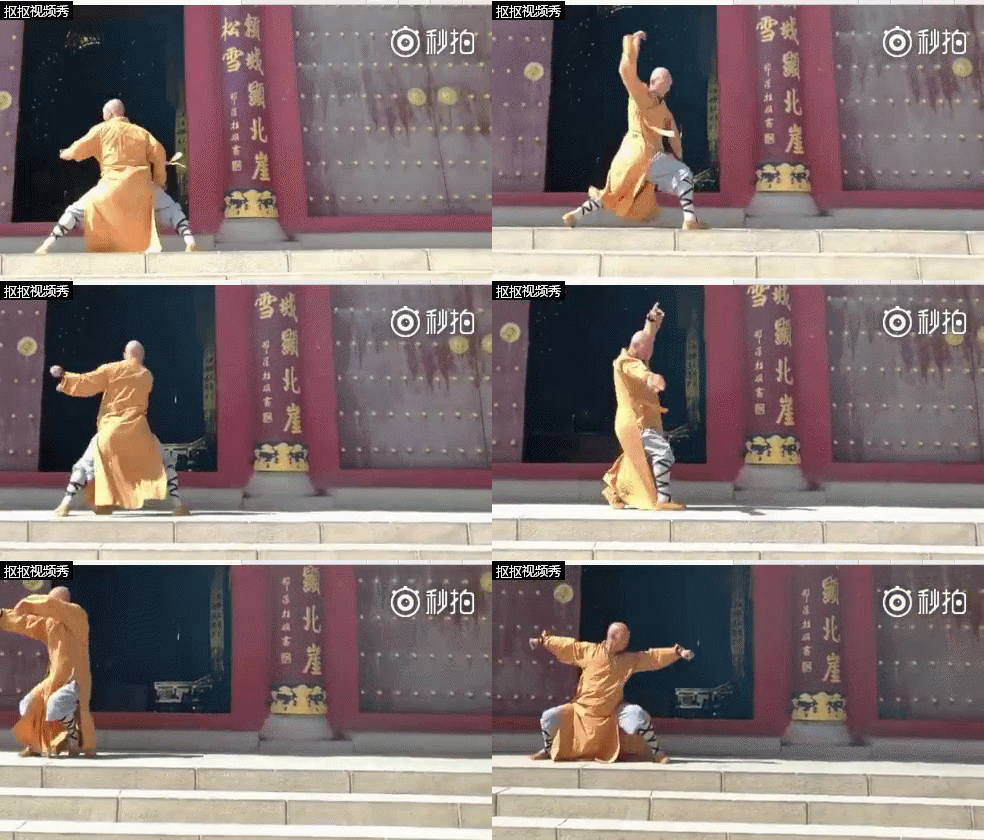
Why is Buddhist Shaolin monk Yi Long demonstrating his Shaolin kung fu training?
It's hard to say. What was once a Buddhist temple practice developed alongside mental training of the heart and mind in meditation eventually became the martial (war) arts independent of their roots in moral and wisdom training.
It is said that South Indian Bodhidharma brought these skills to China, which gave rise to the Chan ("Meditation") school that went on to Japan as Zen, to Korea as Seon, and Vietnam as Thien.
Shaolin kung fu (Chinese 少林功夫, Pinyin Shǎolín gōngfū), also called Shaolin Wushu (少林武術; Shǎolín wǔshù), or Shaolin quan (少林拳, Shàolínquán), is the largest and most famous style of kung fu.
It combines Chan Buddhist philosophy and martial arts. It was developed in the Shaolin Temple in Henan, China during its 1,500-year history. In Chinese folklore there is a saying, "Shaolin kung fu is the best under heaven." More
The Charge of the Light Brigade
By Alfred, Lord Tennyson: European pride? Let's ride into the jaws of death?
I
Half a league, half a league,
Half a league onward,
All in the valley of Death
Rode the six hundred.
“Forward, the Light Brigade!
Charge for the guns!” he said.
Into the valley of Death
Rode the six hundred.
II
“Forward, the Light Brigade!”
Was there a man dismayed?
Not though the soldier knew
Someone had blundered.
Theirs not to make reply,
Theirs not to reason why,
Theirs but to do and die.
Into the valley of Death
Rode the six hundred.
III
Cannon to right of them,
Cannon to left of them,
Cannon in front of them
Volleyed and thundered;
Stormed at with shot and shell,
Boldly they rode and well,
Into the jaws of Death,
Into the mouth of hell
Rode the six hundred....
V
Cannon to right of them,
Cannon to left of them,
Cannon behind them
Volleyed and thundered;
Stormed at with shot and shell,
While horse and hero fell.
They that had fought so well
Came through the jaws of Death,
Back from the mouth of hell,
All that was left of them,
Left of six hundred.
VI
When can their glory fade?
O the wild charge they made!
All the world wondered.
Honour the charge they made!
Honour the Light Brigade,
Noble six hundred!
Rematch with Thai kickboxer
WARNING: Fighting is ugly and fraught with danger, so it is always best avoided. The highlight reels make it seem fun and easy, but the truth is much uglier, vicious on the street, technical in the ring.
Dulce et Decorum Est
By Wilfred Owen
Bent double, like old beggars under sacks,
Knock-kneed, coughing like hags, we cursed through sludge,
Till on the haunting flares we turned our backs,
And towards our distant rest began to trudge.
Men marched asleep. Many had lost their boots,
But limped on, blood-shod. All went lame; all blind;
Drunk with fatigue; deaf even to the hoots
Of gas-shells dropping softly behind.
Gas! GAS! Quick, boys!—An ecstasy of fumbling
Fitting the clumsy helmets just in time,
But someone still was yelling out and stumbling
And flound’ring like a man in fire or lime.—
Dim through the misty panes and thick green light,
As under a green sea, I saw him drowning.
In all my dreams before my helpless sight,
He plunges at me, guttering, choking, drowning.
If in some smothering dreams, you too could pace
Behind the wagon that we flung him in,
And watch the white eyes writhing in his face,
His hanging face, like a devil’s sick of sin;
If you could hear, at every jolt, the blood
Come gargling from the froth-corrupted lungs,
Obscene as cancer, bitter as the cud
Of vile, incurable sores on innocent tongues,—
My friend, you would not tell with such high zest
To children ardent for some desperate glory,
The old Lie: Dulce et decorum est
Pro patria mori.*
*Latin phrase is from the Roman poet Horace: “It is sweet and fitting to die for one’s country.”
(The Fictionist) Join Akira on a transformative journey as he learns the power of emptying the mind in this Zen story. Overcome worry, embrace mindfulness, and find inner peace.
Zen: An Introduction
Chill out, be cool, and go with the flow.
(Share Ideas) Zen is a form of Mahayana Buddhism that developed in the 7th and 8th centuries in China, when Buddhism arrived from India and interacted with the indigenous Taoist tradition. The word "Zen" reflects this: It is the Japanese way pronouncing the Chinese chan (from channa), which is derived from the Indian Buddhist term jhana, from the Sanskrit dhyana, which originally meant "meditation." So Chan Buddhism or Zen Buddhism literally means a particular school that emphasizes meditation (which originally meant meditative absorption as the central practice). March 4th, 2018.
Video script written by David Loy. Narration by Luke Mullins. Film by Digifish. Websites: David Loy (http://www.davidloy.org/), Luke Mullins (https://voice123.com/profiles/lukemul...), Digifish (http://www.digifish.tv/).
Hindu monk Dandapani: How to control the mind (brainwash yourself) to achieve anything
(Be Inspired) Aug. 7, 2018: Try this for 21 days, and see a huge difference in your life. ►If you struggle and have a hard time, consider taking an online therapy session with partner BetterHelp. http://tryonlinetherapy.com/beinspired, which receives commissions for referrals to BetterHelp. BeInspired only recommends products it knows and trusts. ►Motivational Alarm Tones
An Irish dojo is an emerald zendo in Ireland.
(The Fictionist) May 15, 2023. #ZenStory #EmptyYourMind #findingpeace💡 Catch the latest videos exploring groundbreaking techniques to master the mind and enhance life: How an Introvert Learned from a Zen Master | A Story of YOU. Instagram: https://www.instagram.com/unfazed_211... TikTok: https://www.tiktok.com/@thefictionist... To read the story: https://thefictionist2116.blogspot.co... Want your videos to look amazing? Use the following video editor: https://www.mvvitrk.com/71fXJa. Image by: https://hannahjanewrites.com/2015/02/... #ZenStory #EmptyYourMind #FindingPeace #OvercomingAnxiety #Mindfulness #SelfDiscovery #InnerPeace #LettingGo #LivinginthePresent #ZenWisdom #FindingClarity #MeditationJourney #TransformYourLife #EmbracingtheMoment #PeacefulExistence
Ever dream of having a casual conversation with a real-life Zen master? Here's a talk is about life, love, success, and happiness with Korean Zen Buddhist monk Ven. Pomnyun Sunim.
ABOUT: Zen Master Pomnyun is a peace activist, humanitarian assistance expert, and an environmentalist, speaking about four topics and taking questions on all topics.
How the president of a Tibetan Buddhist temple became an Orthodox Jew
(Jewish Learning Institute) Sept. 13, 2022. Rob Fashler was raised in an atheist home where Judaism was anything but trendy. On the contrary, Judaism was ridiculed, particularly the Hasidic (extremely sexist orthodox) kind.
The quest for spirituality and truth permeated his adolescent years, turning him to experiment with mind-expanding hippie drugs (e.g., LSD), sex-drugs-n-rock 'n roll, transcendental meditation (The Beatles' Hindu practice called TM), and eventually Tibetan Buddhism (Vajrayana).
From the president of a Buddhist temple to an Orthodox Jew, here is the journey of a man to whom the meaning and relevance of Judaism is nothing short of a miracle.
Subscribe to channel for more of the best Jewish video content on YouTube.
The Rohr Jewish Learning Institute (JLI) has the largest collection of Jewish media content with exclusive videos that range from Torah insights to the most hotly debated contemporary topics. Facebook.com/myJLI, instagram.com/myjli. See full video library: torahcafe.com Website: myjli.com
ABOUT:
Serving learning centers in over 1,800 communities and on the internet, the Rohr Jewish Learning Institute (JLI) is the world's preeminent provider of Jewish learning.
The mission of JLI is to inspire Jewish learning worldwide and to transform Jewish life and the greater community through Torah study.
To make Jewish learning accessible and personally meaningful to every Jew, regardless of background or affiliation. JLI's insightful curriculum utilizes cutting-edge pedagogical techniques, embracing the multiple intelligence model and utilizing multimedia and an array of approaches to engage, educate, and inspire all kinds of minds in a dynamic Jewish learning experience.
Another Jew supporting Boycott, Divestment, Sanctioning of Israel (Jewish Voice for Peace)
I saved you. - Naff off! - Don't you know it's wrong? - How the F would I know that?
A wandering ascetic Buddhist monk journeys into the forest in search of enlightenment (awakening, bodhi). It's not so easy. There are roadblocks and diversions. What this celibate monastic finds is a pretty girl trying to commit suicide. Her story leads him into a deep cycle of karma (the ripening of past actions in the present). He has to fix this loop for her sake as well as his own. But ain't nobody got time for grrrl troubles. Will he ever gain the enlightenment he seeks?
Katskhi Pillar, high in Georgia, with its one-man hermitage (Amos Chapple)
(Maboroshi Productions) Early documentary trailer about the monk who now lives atop
a 140 foot rock pillar in the central Imereti region,
Georgia. He is the first to try in 600 years. Research will culminate in a short documentary
out soon.
One of the men helped by Qavtaradze
The Eastern Orthodox Christian monk Maxime Qavtaradze is literally close to the heavens [space, the akasha deva loka]. The 59-year-old
monastic lives atop a limestone pillar in the Eastern European Republic of Georgia.
He has to scale a 131-foot ladder in
order to leave or return to his lofty home, reports CNN, the CIA/MIC's trusty American "news" outlet. Photographer Amos Chapple ascended the cliff to document his life there.
The Katskhi Pillar (wiki) has long been venerated as a "holy" place by locals in the area, although it has been uninhabited since about the 1400s. In 1944, when climbers ascended it, after centuries, of isolation,
they found the ruins of a church and the 600-year-old bones of the last
"stylite" who lived there.
(Paul Brian) "This.is.Georgia!" (comedy/documentary) follows the experiences of
a volunteer English teacher in a small-town in the Republic of Georgia looking at the traditions, character, and quirks of rural
communities in this small and proud nation where medieval meets modern and
the hilarious exists side-by-side with the humbling. Nothing ever goes
the way you expect in Georgia, but there's always more adventure (and
alcohol) around the corner.
Waiting for the space saviors to return
The stylite tradition is believed to have
begun in 423 when St. Simeon the Elder climbed a pillar in Syria in
order to avoid worldly temptations. But the practice has since fallen
out of favor. Nevertheless, Qavtaradze is a modern devotee.
Qavtaradze on ladder to heaven
Although isolated, he is not a total solitary yogi-hermit. He comes down once or twice a
week to counsel the troubled young men who come to the monastery below for his help. After all, he was once one of them. He may now
live at the top of the world, but Qavtaradze found his vocation when he was
the lowest he had ever been -- doing time in prison after he "drank, sold
drugs, everything" as a young man. But it's okay, for as we at Wisdom Quarterly say:
"Every saint has a past, every sinner a future."
He took monastic vows in 1993 and has been working to rebuild the
monastery complex, chapel, and hermitage for the last 15 years,
according to the makers of "The Stylite," a documentary about Qavtaradze and his community.
Yasmine Hafiz
Yasmine Hafiz, editorial fellow for The Huffington Post's Religion
desk, holds a B.A. from Yale Univ., and co-authored The American Muslim Teenager's Handbook. Hafiz is a former State Dept. intern and a founding member of the
Arizona Youth Interfaith Movement. She was a 2008 Presidential Scholar
and has extensive public speaking experience regarding religion in
America.
Text by Deborah Jiang Stein (Huffington Post, Dec. 28, 2009) A monk [not the first] skateboards inside an historic temple and causes controversy in China.In Sichuan province near the top of Mount Emei, the highest of the Four Sacred Buddhist Mountains of China, stands the Dafu Temple. Here, a monk on a skateboard has stirred controversy about whether his skateboarding is appropriate behavior for a monk. Many are asking: Is this the way monks ought to live? Clad in his gray cloak and true skater form, the monk twists his legs, leans forward, and skateboards in the temple. More>>
Monks on Skateboards Wisdom Quarterly COMMENTARY
Is skateboarding appropriate behavior within the monastic code of conduct (Vinaya)? Technically, this behavior is fine in private. But in terms of decorum, it is pushing the envelope. On one occasion monks were bathing in a reservoir and splashed each other playfully. This innocent act offended a prominent disciple of the Buddha, who complained to him about how this might look to others. The Buddha then established a monastic rule barring playing in water.
PHOTO: Tibetan Buddhist monk tries skateboarding at Arou Temple in Arou, Qinghai Province, China (Rob Thompson).
One could easily imagine that the Buddha would also deem recreational skateboarding out of bounds. But as it did not come up, he did not. It is therefore left to the abbot or the local Sangha to decide. Until such a decision is handed down, the bhikshus might consider a stint on the Warped Tour. After all, if that's the worst thing they're doing, we should rejoice.
Skateboarding has already met Christian "spirituality" in Australia and elsewhere. We know firsthand that Ven. Thanissaro (Wat Metta, California), who is known as "Tan Jeff," hikes, camps, and photographs every chance he gets -- and he's the author of the English version of the Buddhist monastic code.
All materials on this site are submitted by editors and readers. All images, unless otherwise noted, were taken from the Internet and are assumed to be in the public domain.
In the event that there is still a problem, issue, or error with copyrighted material, the break of the copyright is unintentional and noncommercial, and the material will be removed immediately upon presented proof.
Contact us by submitting a comment marked "private."
Do not follow this journal if you are under vinaya or parental restrictions. Secure protection by Sucuri.
Wisdom Quarterly: American Buddhist Journal is licensed under a Creative Commons Attribution-Noncommercial-Share Alike 3.0 United States License. Permissions beyond the scope of this license may be available at creativecommons.org/about/licenses.