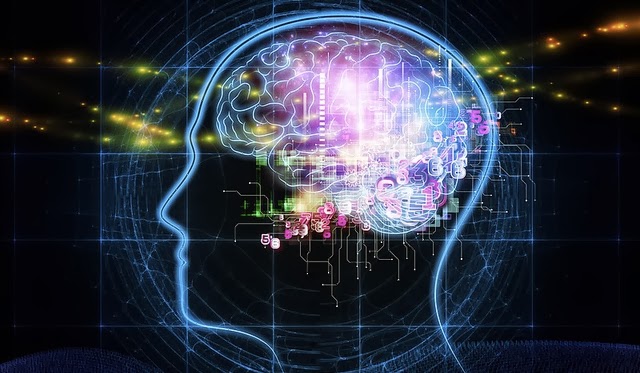
What is a dream but an astral journey to Wyrd? (dreamingdog.multipy.com)
.
Dream Dancer (Josephine Wall)
Lucid dreams, in which people are aware of and can control their
dreams, are rare.
But now scientists have found they can induce this [magical] state of mind in people by zapping their brains with a specific
frequency of electricity.
"I never thought this would work," said study researcher Dr. John Allan
Hobson, a psychiatrist and longtime sleep researcher at Harvard
University. "But it looks like it does."
The results showed that when the inexperienced dreamers were zapped
with a current of 40 Hertz, 77 percent of the time these participants
reported having what were described as lucid dreams.
"They were really excited," said study researcher Ursula Voss, of J.W.
Goethe-University Frankfurt, who designed the experiments. "The dream
reports were short, but long enough for them to report, 'Wow, all of the
sudden I knew this was a dream, while I was dreaming.'
Dream waves
(Bruce Rolff/shutterstock/livescience.com)
A lucid dream can be thought of as an overlap between two states of consciousness -- the one that exists in normal dreaming, and the one during wakefulness, which involves higher levels of awareness and control.
"If I'm aware, if I'm self-reflective, if I'm thinking about myself,
about my past and future, that's normally a waking function," Voss said.
In lucid dreaming, we transfer elements of waking consciousness into
the dream, she said.
Such overlap is also reflected in the brain waves that researchers can detect using electroencephalography, or EEG... More
"Waking Life"
(Waking Life) Dreaming on purpose and with a conscious objective (by Richard Linklater)
Vern Lovic: I'm curious. Has anyone run MRIs (magnetic resonance imagings) of meditators that have reached a
flatline mind -- no thought... stopped mind?
WQ: a flatline would seem to indicate that someone is dead. But, yes, it's been done. It is causing a wave in new medical research. There is neurotheology, where people have "GOD on the brain." There is scientific mind reading. There is at least one meditator sufficiently skilled as to directly manipulate his EEG readings. (See below). He is not a monk but can flatten his line at will, a skill of great subtlety and practice. Yet, it would seem, he must be thinking to intend it and be aware that he is getting the results he is after.
Monk's fMRI (Zoran Josipovic video still)
In a
laboratory tucked away off a noisy NYC street, a soft-spoken
neuroscientist (Zoran
Josipovic) has been placing Tibetan monks into a car-sized brain
scanner to better understand the ancient practice of Buddhist
meditation. Could this unusual research unravel the secrets of leading a harmonious life and also shed
light on some of the world's more mysterious diseases?
Josipovic, a research scientist and adjunct professor at NYU, says he has been peering into the brains of monks.Brains of meditating monks get MRI scans.
VL: The monks are meditating, so
they're doing something. There is another state -- the state of, well,
"flatline" for lack of a better word.
WQ: We tracked him down, Vern, so you could see it for yourself. A functional MRI scan would certainly show activity. "Flatlining" is for graphs with lines, which is characteristic of an EEG (electroencephalograph) machine. It is the remarkable speaker Ken Wilber, who videotaped his own flatlining to demonstrate the amazing level of self control he can exhibit.
His proficiency is such that he can enter states that would seem to be reserved not only to arhats but wondrous masters. We covered him back in 2009. Look: "Family Guy" Meditation Master Ken Wilber!

Flatline
(IntegralNaked) Ken Wilber stops his brain, flatlines, at will.
This is incredible! (psychcentral.com)
Ken Wilber can stop his brainwaves on demand. Actually -- and in a more
serious vein -- this is the famous EEG machine recording where Wilber enters
various meditative states, one of which is a type of "thoughtless,"
"image-less," or "formless" state:
His
brainwaves come to an almost complete stop, as clearly recorded on this
portable EEG machine. (This video is discussed
in One Taste, April 10 entry).
Wilber was asked to do a short
10-minute commentary on these various meditative states and the
corresponding brain-wave patterns that are shown on the EEG machine in
the video. He enters four meditative states (nirvikalpa samadhi with closed eyes, open eyes, sahaj ["ever present awareness"], and mantra-savikalpa), each of which has a
very distinctive brain-wave pattern.
In his commentary, Wilber emphasizes
that the patterns shown on this machine may or may not be typical, but
they do emphasize that profound states of consciousness can be evoked at
will, and these show immediate correlations in brain-wave patterns.
If
nothing else, seeing somebody's brainwaves flatline in about four seconds
is a sight not easily forgotten! It also explains why it was once heard that Wilber's girlfriend, upon delivering news that she thought might not be
happily received, "Now, um, honey, make your brain waves go to
zero..."
More seriously, as Wilber often says, "If you want to know
God [Brahman], you've got to get your brain out of the way first. It's just one
big stupid filter...."
Green, postmodernism, Oprah (Eckhart Tolle) A New Earth, The Secret, manifesting?
Who is Ken Wilber? He is a meditator, author, and apparent self-promoter rooted in Western science. Ken has no "heart," now we find he has no brain either! Ken can stop his brainwaves at will. That is, while hooked up to a personal EEG machine, Ken enters various meditative states, one of which is a type of "thoughtless," "sign-less," "image-less," or "formless" state.
It is not the famous Buddhist meditative state known as cessation (nirodha samapatti) but what he calls (in more traditional Hindu terms) nirvikalpa samadhi. Its correlate is that his brainwaves come almost to complete rest, as clearly recorded on his portable electroencephalograph (EEG) machine.
(This video is discussed in One Taste, April 10 entry.) We asked Ken to do a short 10-minute commentary on these various meditative states and the corresponding brainwave patterns that are shown on the EEG machine in the video. Ken enters four meditative states (nirvikalpa closed eyes, nirvikalpa open eyes, sahaj, and mantra-savikalpa), each of which has a very distinctive brainwave pattern.
In his commentary, Ken emphasizes that the patterns shown on this machine may or may not be typical, but they do emphasize that profound states of consciousness can be evoked at will. And these show an immediate correlation to brainwave patterns.
If nothing else, seeing someone's brainwaves flat line in about four seconds is something not easily forgotten! It also explains why we once heard Ken's girlfriend say, upon delivering news that she thought might not be well received: "Now, um, honey, make your brainwaves go to zero...."
More seriously, as Ken often says, "If you want to know God, you've got to get your brain out of the way first. It's just one big stupid filter." — IntegralNaked
Binaural beats (explained below) use stereo headphones to stimulate brain wave entrainment, instant relaxation, emotional balance, healing, well-being, and heightened consciousness. Binaural beats are a sonic alternative medicine. They can be used as a dependable relaxation tool for resolving depression and anxiety and provide support to make meditating easier.
Binaural beats are a proven brain entrainment process that began to gain recognition after an article entitled "Auditory Beats in the Brain" was published by Dr. Gerald Oster (Scientific America, October 1973). They work by sending two different hertz frequencies, one to each ear via headphones. This causes the left and right brain hemispheres to work in unison to hear a third tone, a phantom frequency, the centered difference between the two tones. Since humans cannot hear sounds low enough to be useful for brain stimulation, these special techniques must be used. The hertz separations create a constant, gentle beat that facilitate meditation.
For example, if a 500Hz tone is played in one ear and 510Hz tone in the other, this sets up a binaural beat frequency of 10Hz, which is Alpha. If the brain is monitored with an EEG machine, it shows increased 10Hz activity with equal frequency and amplitude of the wave form in both hemispheres. There are four types of brain wave activity: Beta (discursive thinking), Alpha (meditating Zen monks), Theta (sudden understanding), and Delta (oneness, dreamless sleep). Review the scientific research at project-meditation.org.
The new mind-reading device shows letters on a screen that flash one at a time. When the user thinks of a letter, and then that letter finally flashes, brain waves send a signal to the computer that it recognizes as, "Hey, choose that letter." It is slow, but it works for crafting short messages such as tweets for Twitter (Credit: UW-Madison).
.
Twitter messages are so short -- a 140-character limit -- that you have to really think about what you want to say. For Adam Wilson, thinking is all he has to do.
Earlier this month, Wilson thought of a tweet (the name for a post to the social networking site) and poof, his computer read his mind and sent the darn thing. At just 23 characters, Wilson's message, "using EEG to send tweet," was done with a computer setup that interprets brain waves.
The technology could one day help patients who otherwise can't communicate finally talk to the outside world. Among them are people with amyotrophic lateral sclerosis (ALS), brain-stem stroke or high spinal cord injury. More>>
All materials on this site are submitted by editors and readers. All images, unless otherwise noted, were taken from the Internet and are assumed to be in the public domain.
In the event that there is still a problem, issue, or error with copyrighted material, the break of the copyright is unintentional and noncommercial, and the material will be removed immediately upon presented proof.
Contact us by submitting a comment marked "private."
Do not follow this journal if you are under vinaya or parental restrictions. Secure protection by Sucuri.
Wisdom Quarterly: American Buddhist Journal is licensed under a Creative Commons Attribution-Noncommercial-Share Alike 3.0 United States License. Permissions beyond the scope of this license may be available at creativecommons.org/about/licenses.