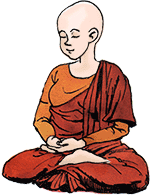
The Therīgātha (the gathas or verses" of the theris or "female elders," i.e., nuns with ten or more rainy seasons standing in the Sangha, in this case enlightened nuns) is a collection of verses spoken by, to, or about fully enlightened nuns who lived in the time of the Buddha. It is uplifting to take time to get to know the lives of these great female "saints" or arahants. If one enjoys sutras about how women and others became enlightened, reached the stages of awakening, one is bound to enjoy the ancient collection of verses by male enlightened elders known as the Theragātha.
First Buddhist Women is a readable, contemporary translation of and commentary on the "enlightenment verses" of the first female disciples of the historical Buddha.
It explores Buddhism’s relatively liberal attitude towards women since its founding nearly 2,600 years ago, through the study of the Therigatham, the earliest known collection of women’s spiritual poetry.
Through commentary and storytelling, author Susan Murcott traces the journey of the
wanderers,
wives,
mothers,
teachers,
courtesans, and
prostitutes
who became leaders in the Buddhist community, roles that even today are rarely filled by women in other often patriarchal religions.
Their poetic verses beautifully express their search for enlightenment, wisdom, spiritual attainments, peace, and their struggles in society. More
Cool scene in the Tibetan movie Samsara where a wife chews out her husband for leaving home to become enlightened and wrongly cites the plight of Yasodhara and now nobody considers her story or what she went through. It is very beautiful, fierce, and feminist -- but it is just not true, not a historically accurate condemnation.
But Prince Siddhartha was. His wife's name was Bimba Devi, popularly known as Princess Yasodhara.
Like the words buddha and rahula, yasodharais not a name but a title. It means "Bearer of Glory" [from yaśas "glory, splendor" + dhara "bearing" from the verbal root dhri "to bear, support"].
She has been obscured from history -- her greatness hidden by diffusion -- through all of the different names she is given in the texts [possibly due to Indian sexism that later glorified men and all but erased females and the Order of Buddhist Nuns].
The name generally given to her in the texts is "Rāhula's Mother" (Rāhula-mātā, e.g., Vin.i.82) and Siddhartha Gautama's wife.
She is also spoken of as Bhaddakaccā* and, in later texts, Yasodharā (BuA., p.245; Dvy.253), Bimbā Devī (J.ii.392f.; DA.ii.422) and, probably, Bimbā Sundarī (J.vi.478 [12]).
*For example, Bu.xxvi.15; Mhv.ii.24 calls her Bhaddakaccānā. But see Thomas, op. cit., 49; she is also called Subhaddakā, this being probably a variant of Bhaddakaccānā.
[The Buddha had a sister and brother, or at least half-sister and half-brother, Sundari Nanda and Nanda, who also became enlightened monastics and lost in the shuffle of names. The Buddha got them to ordain on his return to his Scythian homeland, "Shakya Land," seven years after his enlightenment around the time his son, Rahula, was ordained as a Buddhist monk.]
The northern texts [of the Mahayana movement] seem to favor the name Yasodharā, but they also call her the "Daughter of Dandapānī." (See also Rockhill, op. cit., where various other names are given as well).
It is probable that the name of Prince Siddhartha Gautama's wife was actually Bimbā and that Bhaddakaccā, Subhaddakā, Yosadhāri, and all the other names [see below] were descriptive epithets applied to her, which later became regarded as additional names.
It is also possible that in Siddhartha Gautama's court there was also a Yasodharā, a daughter of Dandapānī, and that there was a later confusion of names.
The Commentarial explanation (AA.i.204) that she was called Bhaddakaccānā because her body was the color of burnished gold is probably correct.
To suggest (e.g., Thomas, op. cit., 49) that the name bears any reference to the Kaccāna gotra ["lineage, clan"] seems to be wrong because that was a Brahmin lineage, and the Sākiyans [Scythians, Sakas] were not Brahmins
[The Shakyians/Scythians, who were actually outside of the Vedic/Brahminical "Indian" caste system were considered kshatriyas, i.e., fierce warrior princes/princesses, nobles, nomads, soldiers, wanderers from the northwest frontier lands of Central Asia in what is now the Stans west of modern India].
Yasodhara/Bimba was born on the same day as Prince Siddhartha, the Bodhisattva or "Buddha-to-be" (J.i.54; BuA. 106, 228).
They were cousins (or members of the same clan) who married, as nobles/royals tend to do, when they were both 16. The following account is taken chiefly from J.i.58ff:
She was placed at the head of 40,000 females given to Prince Siddhartha by the Sākiyans/Scythians after he proved his manly prowess to their satisfaction.
Prince Siddhartha renounced the household life on the day of the birth of his son, Rāhula or "Bond, Fetter." (According to one account, referred to in the Rebirth Tales/Jātaka Commentary, i.62, Rāhula was seven days old at that time).
If I don't go now, I'll never be able to go.
It is said that just before he left the royal palace to become a wandering ascetic on his quest for enlightenment to save all beings (at least all of his Shakyian/Scythian subjects) from suffering, he took one last look at his wife and child from the door of her room, not daring to go nearer lest he should wake them.
After his enlightenment, when the Buddha paid his first visit to Kapilavastu [one of three seasonal capitals of the Shakyians/Scythians], he went about the streets for alms on the second day of that visit.
The news of this spread, and Princess Yasodhara/Bimba Devi looked out of her window to see if it was true.
She saw the Buddha and was so struck by the glory of his personal beauty that she uttered eight verses in its praise. These verses have been handed down under the name of Narasīhagāthā.
On that day, after the Buddha finished his meal in the royal palace of his father, King Suddhodana, who had invited him, all of the ladies of the Shakyian court, with the exception of his former wife went to pay him obeisance as their former prince and future king.
The royals were once in love from the age of 16 on.
Yasodhara refused to go, saying that if she had any virtue in her the Buddha would come to visit her.
The Buddha went to her with his two chief male monastic disciples and gave instructions that she should be allowed to greet him as she wished.
Yasodhara fell at his feet and, clasping them with her hands, put her head on them.
King Suddhodana related to the Buddha how, from the time he had left home, Princess Yasodhara/Bimba had herself abandoned all luxury and had lived in the same manner as she had heard that he, her former husband the wandering ascetic, was living:
She had taken to wearing saffron robes of a spiritual wayfarer/wanderer rather than royal raiment, eating only once a day, sleeping on the ground rather than using a high and luxurious bed, and so on [things such as the 13 sane ascetic practices] as the ascetic Siddhartha took on additional austerities, some sane, some severe.
[This should pause to those who believe that Prince Siddhartha abandoned his family, left them behind, and had no consideration about their feelings. They knew where he was, why he left, and what he was doing. This means his former wife and the mother of his child knew. His father and mother, King Suddhodana and Queen Prajapati, the sister and co-wife of the Buddha's biological mother, Maya Devi, Queen Maya, who passed away seven days after his birth.]
[Though she was free to, she had also, it is said, rejected every offer and proposal to remarry, which came from the richest and most handsome royals around.]
[It may be that Prince Rahula was not his one and only child. Ananda may have been a son not a cousin, as the Mahavastu states" Ananda's mother's name was Mrigi ("little deer"), who is named in the Kanjur and Sanghabedavastu as one of Gautama's royal harem wives (prior to his renunciation). This points to the strong possibility that Ananda was in fact the Buddha's son (Wendy Garling, Stars at Dawn: Forgotten Stories of Women in the Buddha's Life, Shambhala Publications, 2016, pp. 94-106). In the 20th year of (20 being the minimum age when a male can take full ordination in the Buddhist Monastic Order) of the Buddha's ministry, Ananda became the Buddha's personal attendant, accompanying him on most of his wanderings and taking the part of Socratic interlocutor in many of the recorded dialogues or sutras/discourses.]
Life in one of the three palaces of the Shakyians' three royal palaces for the couple
.
The Buddha then related the Candakinnara Jātaka to show how, in the past, too, Bimba/Yasodhara's loyalty had been supreme.
On the seventh day of the Buddha's visit, when he left the palace at the end of his meal, she sent Prince Rāhula -- their son and heir apparent -- to him saying: "That is your father, so go and ask him for your inheritance."
Prince Rāhula followed the Buddha and asked for his inheritance. The Buddha took great pity realizing all of the suffering inherent in ruling and living in the world. So he, with the highest welfare of Prince Rahula in mind, requested his chief male disciple foremost in wisdom, Ven. Sāriputra, to ordain him.
Royal family as monks: Rahula, the Buddha, Ananda
The account of this event is given in Vin.i.82 (the Vinaya or Monastic Disciplinary Code, which contains origin stories for each of monastic rule established by the Buddha).
This is probably the only passage in the Three Collections of Buddhist texts (Tri-pitaka) where Bimba/Yasodhara/Rāhulamātā is mentioned by name.
This child-ordination caused an uproar. The prince's mother, Yasodhara, was probably hoping for an inheritance of riches and title, passing down the right to rule the Shakyians/Scythians for her 7-year-old son.
King Suddhodana, moreover, was upset because he intended little Prince Rahula to eventually rule. Now the king, or local ruler of the Shakya clan (this particular band of Scythians), had no proper heir.
Cool! I get to go be with my dad and relatives!
They complained to the Buddha (who is, after all, Rahula's father returned to Shakya Land after a seven year absence), who instituted a new monastic rule on who could ordain.
Prince Siddhartha had gone away to find the way to the end of suffering for everyone, not least his own family and people. He was now called the muni ("sage") of the Scythians/Shakyas or Shakyamuni. They treated the Buddha, the Light of Asia and the World, as if he had returned to rule and lead a home life.
The new rule was that anyone who is not yet an adult (i.e., who is under 20, the age of majority at that time, which is equivalent to our 21 because in Asia people are born 1-year-old for the 10 lunar months they have spent on earth in the womb) should not be ordained by the monastics without parental consent.
The Buddha established that rule for all future Buddhist ordinations. But Prince Rahula, with the consent of his father, had already become the world's youngest novice Buddhist monk or little shraman trainee.
Princess Bimba (like mother Maya shown as a salabhanjika) giving birth to Rahula.
Together at home and wandering
Later, when the Buddha accepted females into the Buddhist Monastic Order, Yasodhara/Bimba became a Buddhist nun under the tutelage of the world's first Buddhist nun:
Who was the first Buddhist nun ordained by the Buddha? That would be his adoptive mother, who raised him from the time he was 7 days old, Queen Mahā Prajāpatī Gautamī, the sister of the Buddha's biological mother Queen Maya (AA.i.198) King Suddhodana's primary wife.
Ven. Buddhaghosa, the greatest Buddhist commentator, identifies (AA.i.204f) Yasodhara/Bimba (Rāhulamātā) with Ven. Bhaddakaccānā who, in the Collection of Numerical Discourses (Anguttara Nikāya, A.i.25) is mentioned as "chief among female monastic disciples in the possession of supernormal powers" (mahābhiññappattānam).
She was one of the four disciples of the Buddha who possessed such an attainment. The others were the chief male disciples Ven. Sāriputra and Ven. Maha Moggallāna, and Ven. Bakkula. She expressed her wish for this achievement in the time of Padumuttara Buddha.
Merit (wholesome and profitable karma) makes one wise and attractive life after life.
In this account Bhaddakaccānā is mentioned as the daughter of the Shākyian [Scythian] Suppabuddha and his wife Amitā.*
*Cf. Mhv.ii.21f. It is said (DhA.iii.44f) that Yasodhara's father, Suppabuddha, did not forgive Prince Siddhartha (now the Buddha) for leaving his daughter; Devadatta [the Buddhist "Judas"] was Bhaddakaccanā's [brother], and it has been suggested that Devadatta's enmity against the Buddha was for reasons similar to her father's.
Yasodhara/Bimba joined the Buddhist Female Monastic Order under Ven. Pajāpatī Gautamī in the company of Janapada Kalyānī (Nandā). And it also states that in the Order of Nuns she was known as Ven. Bhaddakaccānā Therī.
Later, she developed insight [vipassana] and became an arhat. She could, with one effort, recall one aeon of indeterminate length (asankheyya kalpa) and 100,000 [ordinary] kalpas (AA.i.205).
[The significance of this is that a kalpa (Pali kappa) may in this case refer to "an ordinary human lifespan" rather than a "great aeon." If that is the case then the time between the arising of buddhas is not enormous epochs, ages, and aeons but rather just many lives.]
In the "Stories of Nuns' Lives" or Therī Apadāna (Ap.ii.584ff ) an account is found of a therī [Buddhist "elder," a senior nun, meaning having been a nun for at least ten rains], Yasodharā by name, who is evidently to be identified with Yasodhara/Bimba because she speaks of herself (vvs. 10, 11) as the Buddha's pajāpatī before he left the household (agāra) and says that she was the chief (pāmokkhā sabbaissarā) of 90,000 women.
In the time of Dīpankara Buddha, when the Bodhisattva (future Buddha) was born as Sumedha, she was a Brahmin maiden named Sumittā who gave eight handfuls of lotuses to Sumedha, which he, in turn, offered to the Buddha.
Dīpankara Buddha, in declaring that Sumedha would ultimately become a buddha in the distant future, added that Sumittā [Yasodhara/Bimba] would be his companion in several lives/rebirths.
The Apadāna account (vvs. 1ff ) mentions how, just before her passing into final nirvana, at the age of 78, took leave of the Buddha and performed various miracles. It also states (Ap.ii.592f ) that 18,000 fully enlightened (arhat) nuns, companions of Ven. Bhaddakaccana (Yasodharā/Bimba), also passed into final nirvana on the same day.
The Abbhantara Jātaka* mentions that Ven. Bimbā (who was called the chief wife of Prince Siddhartha Gautama and is therefore evidently identical with Rāhula's mother/Rāhulamātā) was once, after becoming a nun, ill with indigestion.
The kind and swift witted Princess Bimba
When Ven. Rāhula came to visit his mother the nun Ven. Bhaddakaccana, as was his custom, he was told that he could not see her.
When she had suffered from the same trouble at home, she had been cured using fresh mango juice with raw sugar. Ven. Rāhula reported this matter to his monastic preceptor, Ven. Sāriputra [in charge of getting monks to stream entry, the first stage of enlightenment], who obtained mango juice from their royal supporter King Pasenadi.
When King Pasenadi learned why the mango juice had been needed, he arranged that from that day forward that it should be regularly supplied. The rebirth tale (jātaka) relates how in a past rebirth Sāriputra had also come to her rescue.
*J.ii.392f.; cf. the Supatta Jātaka, where Sāriputra, at Rāhula's request, obtained for her from Pasenadi rice with ghee flavored with [presumably savory/umami/fermented digestive aid] red fish. This was for abdominal pain (J.ii.433).
The great Yasodhara by other names
"Was I in the past? Who was I? Will I be in the future? Who will I be?" These four questions are foolish and lead not to liberation from rebirth. "What is suffering? What is the cause of suffering? What is the end of suffering? What is the way to the end of suffering?" These four questions are wise, for reflected on, they lead one out to enlightenment and liberation.
.
Buddha as a Central Asian king
Numerous stories are found in the Commentary to the Jātaka [Birth Tales or Rebirth Fables of the Buddha]in which Yasodhara/Bimba is identified with one or other of the characters.
[This shows how she was connected to the Bodhisattva, the Buddha-to-be, from the distant past because we are all often reborn in cohorts due to our karma].
A story from the Verses of Enlightened Nuns (Therigatha 14.1)
As Subha* the nun was passing through Jivaka's delightful mango grove, a libertine (son of a goldsmith) blocked her path, so she said to him:
Subha, which means "lovely" or "beautiful," is not likely to be her name but simply a descriptive term, as in "The Beauty and the Beast," where the princess is not Beauty and the creature not Beast but for simplicity we like to think of it that way. [InBuddhism over time people lose their names and take on titles or descriptive terms for ease of remembering stories or making a point. Siddhartha becomes the Buddha, which means "the Enlightened One," or Tathagata (Wayfarer), or Mahavira (Great Hero), or Bhagavan (teacher, venerable), so the use of the word "Buddha" not preceded by "the" is ridiculous as it suggests it is a name rather than a descriptive title. His wife, Bimba, becomes Rahulamata ("Mother of Rahula") or more popularly "Yasodhara" ("Bearer of Glory," a name that never occurs in the Pali canon), who when she becomes a Buddhist nun, an enlightened master, a winning debater becomes Ven. Bhaddhakaccana Theri, etc.]
Verses
"What wrong have I done you that you stand in my way? It is not proper, my friend, that a man should touch a woman who has gone forth (become a nun). I respect the Teacher's message, the training pointed out by the Well-Gone One (the Wayfarer, the Tathagatha, the Buddha).
I am pure, without blemish [ennobled by her actions, her merits, at some stage of enlightenment, the highest stage, arhatship, being the suggestion]: Why do you stand in my way? You with your mind/heart agitated, whereas I am unagitated -- you, impassioned, whereas I am dispassionate, blemish-free [fully enlightened], with a mind/heart in all ways released. Why do you stand in my way?"
Let's have sex, honey!
Sexy men have sexy back hair (or not).
[The goldsmith's son answered the enlightened nun]: "You are young and good looking, so what need have you of going forth [taking ordination, being a nun, living a celibate life]?
"Throw off your saffron robe! Come, let's delight [have sex] in the flowering forest. Sweetness they exude wafting all around, the towering trees and their pollen.
The beginning of spring is a pleasant season. Come, let's delight in the flowering forest. The trees with their blossoming tips moan, as it were, in the breeze: What delight is there for you if you plunge into the forest alone [to meditate in solitude, withdrawn from distractions]?
Frequented by herds of wild beasts, disturbed by elephants rutting and aroused, and you want to go unaccompanied into the great, lonely, frightening forest?
The forest is scary. Who would go there, much less live there, on purpose?
Like a doll made of gold you will go about, like a goddess in the gardens of heaven [a devi, a "shining one," in sagga]. With delicate, smooth Kasi fabrics [the finest Varanasi cloth], you will shine, O beauty without compare! I would be under your power if we were to dwell in the wood together. For there is no creature dearer to me than you, O nymph who makes me languish!
If you do as I ask, happy, come live in my house! Dwelling in the calm of a palace, have women wait upon you, wear delicate Kasi fabrics, adorn yourself with garlands and aromatic balms. I will make you many and varied ornaments of gold, jewels, and pearls.
Climb onto a costly and high bed, scented with sandalwood carvings, with a clean cover, beautiful, spread with a new woolen quilt. Like a blue lotus rising from the water where water spirits dwell, you arrive at old age with your limbs unseen, if you stay as you are in the high life [the celibate life of a monastic]."
Why would anyone retreat into the forest, woods, or lonely places on purpose?
The beauty replies
When one knows-and-sees one is free.
[The beauty, Ven. Subha:] "What do you assume of any essence, here in this cemetery-filler, grown fat with corpses, this body destined to break up? What do you see when you look at me,* you who are out of your mind?"
[*MEANING: What do you see in this body (or any body no matter how beautiful), which only serves to swell up cemeteries as they fill with corpses, this composite-thing that just breaks up? What do you see in me when you're only looking at my appearance?]
[The libertine:] "Your eyes are like those of a fawn, like those of a nymph in the mountains. Seeing your eyes, my sensual delight grows all the more. Like tips of blue lotuses they are on your golden face -- spotless: Seeing your eyes, my sensual delight grows all the more. Even if you should go far away, I will think only of your piercing gaze with long lashes, for there is nothing dearer to me than your eyes, O nymph who makes me languish!"
Pure and Simple (K. Nanayon)
[The beauty, Ven. Subha:] "You want to stray from the road, you want the Moon as a plaything, you want to jump over Mount Sumeru [an impossibly high mountain that reaches up into space like magnetic lines], you who have designs on one born of the Buddha. For there is nothing anywhere at all in the world with its devas [fairies, angels, gods, unseen spirits] that would be an object of passion (sensual craving) for me.
"I no longer know what such passion would be, for it has been uprooted by the path [magga-phala, path and fruition resulting in enlightenment and liberation]. Like embers from a pit scattered, like a bowl of poison evaporated, I no longer see what that passion would be, for it has been uprooted by the path.
"Try to seduce one who has not reflected on this, or whom the Teacher has not instructed. However, try it with this one who knows [who has gained such liberating wisdom] and you do yourself violence. For whether I am insulted or worshiped, in pleasure or pain, my mindfulness remains firm.
"Directly knowing-and-seeing how unattractive formations (all composite things) actually are, my heart/mind gets stuck nowhere at all.
"I am a follower of the Well-Gone One riding the vehicle of the Eightfold Way: My arrow removed [heart unpierced], taint-free, I delight in going to an empty dwelling. For I have seen well-painted puppets hitched up with strings and sticks made to dance in various ways.
"When the strings and sticks are removed, tossed away, scattered, splintered, smashed to bits, not found, in what will the mind/heart cleave or make its home?
"This body of mine, which is just like that puppet, without phenomena (dhammas, things, composite elements of formations) does not function. When without elements (devoid of dhammas) it does not function, in what will the heart/mind there cleave and make its home?
"Like a mural painted on a wall, smeared with yellow pigment, there your vision has been distorted, insubstantial (meaningless) is your perception, that of a [figuratively blind] human being.
"Like a mirage that has evaporated, like a golden tree in a dream, like a magic show in the midst of a crowd -- you run blind after what is unreal.
"Resembling a ball of sealing wax set in a hollow with a bubble in the middle and bathed in tears, eye secretions are born there, too: The parts of the eye are rolled all together in various ways."
Then plucking out her lovely eye, with mind completely unattached she felt no regret [to help him, out of compassion for his sake], "Here, take this eye. It's yours." She gave it to him.
[Mortified, horrified, the spell her beauty had cast on him -- or his avarice had made for himself -- was broken]. Immediately his passion faded away, evaporated on the spot, went extinct right then and there, and he begged her forgiveness:
[He said:] "Be safe, follower of the high life. This sort of thing will not happen again! Harming a person like you [a taintless, enlightened. blame-free person] is like embracing a blazing fire. It is as if I have seized a poisonous snake [by the tail, which will surely turn to bite me because of my foolishness]. So may you be safe. Forgive me!"
And freed from there, the nun went to the excellent Buddha's presence. When she saw the mark of his excellent merit, her eye miraculously became as it was before.
The Buddha -- the One Awakened from the dream of delusion (maya) -- serenely dwells in the forest of the senses, amid a world that is incessantly burning (Alistair and Rachel/flickr.com).
Subhābelonged to an eminent Brahmin family of Rājagaha. Seeing the bane in the pleasures of the senses she became a nun under Pajāpatī Gotamī, the Buddha's mother and the first Buddhist nun. She was called "Subhā" because her body was beautiful. One day in the grove a libertine, in the prime of youth seeing her and filling with lust, stopped her and invited her to partake of sensual pleasures. She talked to him about the hidden harm of such pleasures, but he persisted. Seeing that he was particularly enamored of the beauty of her eyes, she pulled out one of them and said: "Come, here is the offending eye." The man was appalled and asked her forgiveness. Subhā went to the Buddha and, at sight of him, her eye recovered. Filled with joy, she stood paying homage to him. And he taught her and gave her an exercise for meditation. She developed insight and became an arhat (Thig.vss.366-399; ThigA.245f.).
Tibetan nuns in the Himalayas, Ganden Jangchup Choeling nunnery (Reuters/dailymail.co.uk)
The Buddha, a Scythian from the west who was enlightened in the East, opened the Path to enlightenment and liberation to everyone regardless of sex, race, class, caste, or wealth.
Let's explore the sacred gathas, verses or songs,
composed by enlightened Buddhist nuns (arhat bhikkhunis and/or theris) from the time of the Buddha,
looking at them as springs of inspiration for contemporary
Buddhists.
Most of the verses are preserved in the Therigathaor "Psalms of the Sisters," a small section of the vast Pali language canon.
The Buddha ordained and taught nuns and female novices as well as monks (chandwimala).
Therigatha (Dr. A. K. Singh)
The Therigatha has been published twice in English translation by the Pali Text Society, London, first in 1909 (reprinted in 1980) by Mrs. Caroline Rhys
Davids in verse under the title Psalms of the Early Buddhists: The Sisters and again in 1971 by K. R. Norman in prose under the title The Elders' Verses, II. (Theri literally means "female elder," an "elder" being a person of any age who has at least ten years as a monastic).
Quotations from both translations are used here, referring to Psalms of the Early Buddhists by page number and to The Elders' Verses
by verse number. Mrs. Rhys Davids' translations have sometimes been
slightly modified.
This discussion also draws upon the verses of female ascetics from the Kindred Sayings (Samyutta Nikaya) included by Mrs. Rhys Davids at the end of Psalms of the Sisters.
From the sayings of some enlightened nuns at the time of the Buddha modern followers of the Noble Eightfold Path to enlightenment can receive a great
deal of instruction and inspiration, help and encouragement.
These verses can assist us
in developing and strengthening virtue, concentration, and liberating wisdom, the three divisions of
the Path to complete freedom (nirvana). With their aid we are able to play-and-work more effectively
towards eliminating mental defilements that hold us back life after life and towards finding lasting
peace and unshakeable happiness.
Our beloved California Buddhist nuns, like Ayya Tathaloka (shown here in center) from the Bay Area, with the help of progressive elder monks like Ven. Piyananda, helped reestablish the Theravada Nuns' Order known as the Bhikkhuni Sangha (bhikkhuni.net).
In some respects, the inspiration we can gain from these verses may be stronger
for females than for males, since these are in fact women's voices speaking. (Males have an analogous text, Psalms of the Elders or Theragatha). And when the theme of the verses is the mother-child bond, this
is bound to be the case.
However, at a deeper level, the sex or gender of the
speakers is irrelevant. For the ultimate truths they articulate
explain universal principles of reality far beyond gender or other social constructs like race, socioeconomic status, beauty, age, and so on. They are equally valid for
males and females.
The "Lord of Death," rules samsara (rebirth).
The verses of the nuns, if systematically examined, can help serious
Buddhist meditators understand many central aspects of the Dharma, the Teachings of the Buddha, which as a coherent Path again set in motion the Wheel of Timeless Truth.
The background to the verses, including biographical information on the
nuns who uttered the inspired songs, is provided by the ancient commentary on the Therigatha by the Venerable Acariya Dhammapala.
Mrs. C.A.F. Rhys Davids included some of these background stories in Psalms of the Early Buddhists. In the first part of this essay we look at these stories and
consider the themes they suggest which are relevant to contemporary
students ofBuddhist meditation.
Then we discuss a
selection of the verses themselves, which deal with many specific Teachings of the Buddha.
We in the 20th century who are seeking to attain enlightenment and final liberation will
find ourselves deeply grateful to these fully awakened Buddhist nuns of
the past for their profound assistance in illuminating the Dharma for us in
their own distinctly personal ways.
I. The Background Stories
Samsara, the frightful Wheel of Life and Death
The ancient commentaries give us information about each nun's
background and also explain the verses themselves. Two major themes of
relevance to modern students of the Dharma run through these
stories.
One is the immeasurably long time that we -- as males and females, as light beings in blissful worlds and miserable beasts in worlds of woe and everything in between -- have all been lost in this samsara,
this Endless Round of Birth and Death.
The second is the inscrutable working out of the impersonal law
of karmic causality, the truth that our actions really do have effects, which brought these women into contact with
the Buddha's Teachings in what was to be their final rebirths when they finally found liberation from all further suffering. More
All materials on this site are submitted by editors and readers. All images, unless otherwise noted, were taken from the Internet and are assumed to be in the public domain.
In the event that there is still a problem, issue, or error with copyrighted material, the break of the copyright is unintentional and noncommercial, and the material will be removed immediately upon presented proof.
Contact us by submitting a comment marked "private."
Do not follow this journal if you are under vinaya or parental restrictions. Secure protection by Sucuri.
Wisdom Quarterly: American Buddhist Journal is licensed under a Creative Commons Attribution-Noncommercial-Share Alike 3.0 United States License. Permissions beyond the scope of this license may be available at creativecommons.org/about/licenses.