Showing posts with label women and arhantship. Show all posts

Tuesday, March 19, 2024

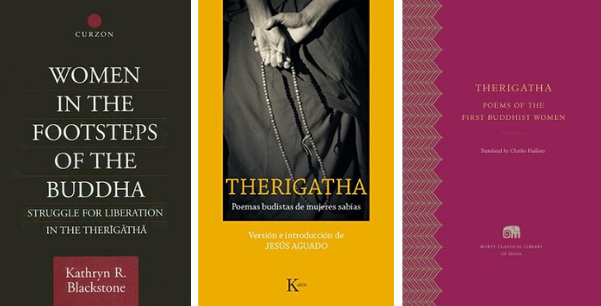
Verses of Enlightened Nuns (Therigatha)

SuttaFriends.org; Amber Larson (ed.), Wisdom Quarterly
Verses of Arahant Nuns: Therīgāthā
The Buddha blesses the enlightened nun Subha ("Beautiful") Jivakavandavanika
.
Therigatha (store.pariyatti.org)
The Therīgātha (the gathas or verses" of the theris or "female elders," i.e., nuns with ten or more rainy seasons standing in the Sangha, in this case enlightened nuns) is a collection of verses spoken by, to, or about fully enlightened nuns who lived in the time of the Buddha. It is uplifting to take time to get to know the lives of these great female "saints" or arahants. If one enjoys sutras about how women and others became enlightened, reached the stages of awakening, one is bound to enjoy the ancient collection of verses by male enlightened elders known as the Theragātha.

Wednesday, December 6, 2023

Verses of Subha the Goldsmith's daughter

Ven. Sujato (trans.), Therigatha: "Verses of the Elder Nuns" (13.5), The Book of the Twenties; Dhr. Seven, Amber Larson (eds.), Wisdom Quarterly
Now I know and see and wish to be a nun. Buddha, ordain me and teach me more.*

Awakened Women of Buddhism in the Therigatha
The Therīgāthā, often translated as "The Verses of the Elder Nuns" (from Pāli therī "elder," a female with more than ten rainy seasons as a nun, and gāthā, "verses") is an important Buddhist text.

It is a collection of short verses or poems of early enlightened women, who were "elders" in the Noble Sangha or "community of enlightened individuals in the world."

Elder here does not mean old, as having been in robes for ten Vass or "monsoon periods," starting at a young age, as young as 7, one might be a 17-year-old fully enlightened nun. If one received full ordination at the age of consent, 20 (which would be 21 because in many Asian countries one is born at age 1, not 0, as in the west).

The poems date from a 300-year period, with some dated as early as the late 6th century BCE. According to American Ven. Thanissaro, abbot of Wat Metta, the Therigatha is the "earliest extant text depicting women’s spiritual experiences."

In the Pāli Canon, the Therigatha is classified as part of the Khuddaka Nikaya, the collection of short books in the Sutta Pitaka. It consists of 73 verses organized into 16 chapters. It is the companion text to the Theragatha, "The Verses of Elder Monks" or men's spiritual awakenings. It is the earliest known collection of women's literature composed in ancient India. Here is one example:

Subhā, the Goldsmith’s Daughter

1.1 “I was so young, my clothes so fresh,
1.2 at the time I heard the Teaching.
1.3 Being attentive [in meditation/contemplation],
1.4 I comprehended the truth;

2.1 And then I became profoundly dispassionate
2.2 towards all sensual pleasures.
2.3 Seeing danger in this insubstantial reality,
2.4 I longed for renunciation [to let go].

3.1 Giving up my family circle,
3.2 bonded servants and workers,
3.3 and my flourishing villages and lands,
3.4 so delightful and pleasant,

4.1 I went forth [ordained as a wandering ascetic nun];
4.2 all that is no small wealth.
4.3 Now that I’ve gone forth in confidence like this,
4.4 in the true Teaching so well proclaimed,

5.1 since I crave for nothing,
5.2 it would be inappropriate
5.3 to take back gold and money,
5.4 having already gotten rid of them.

6.1 Neither money nor gold
6.2 lead to peace or awakening.
6.3 It does not befit a wandering ascetic.
6.4 It is not the wealth of the noble ones;

7.1 It’s just greed and vanity,
7.2 confusion and growing decadence,
7.3 dubious, troublesome —
7.4 there is nothing lasting there.

8.1 Depraved and heedless,
8.2 unenlightened folk, their hearts corrupted,
8.3 fight each other,
8.4 creating conflict.

9.1 Killing, caging, misery,
9.2 loss, grief, and lamentation,
9.3 those sunk in sensual pleasures
9.4 see many disastrous things.

10.1 My family, why do you urge me back
10.2 to [lowly] pleasures as if you were my enemies?
10.3 You know I have gone forth [from all that],
10.4 seeing great danger in [clinging to] sensual pleasures.

11.1 It is not due to gold, minted or unminted,
11.2 that defilements come to an end.
11.3 Sensual pleasures are enemies and murderers,
11.4 hostile forces that bind us to thorns.

12.1 My family, why do you urge me on
12.2 to pleasures as if you were my enemies?
12.3 You know I have gone forth,
12.4 shaven, wrapped in my outer saffron robe.

13.1 Leftovers as gleanings,
13.2 and cast-off rags as my robes —
13.3 that is what is fitting for me,
13.4 the essentials of the left-home life.

14.1 Great seers expel craving for sensual pleasures,
14.2 whether human and divine.
14.3 Safe in their sanctuary, they are free,
14.4 having found unshakable happiness.

15.1 May I not encounter [sticky] sensual pleasures,
15.2 for no safety is found in them.
15.3 Sensual pleasures are enemies and murderers,
15.4 as painful as a bonfire [one is cast upon].

16.1 Greed is an obstacle, a threat,
16.2 full of anguish and thorns;
16.3 it is out of balance,
16.4 a great gateway to confusion.

17.1 Hazardous and terrifying,
17.2 sensual pleasures are like a snake’s head [with fangs],
17.3 where fools delight,
17.4 the blind ordinary [uninstructed] folk.

18.1 Mired in the swamp of sensuality,
18.2 there are so many ignorant in the world.
18.3 They know nothing of making an end
18.4 of rebirth and future deaths.

19.1 Because of [craving for] sensual pleasures,
19.2 people fall onto a path that goes to a bad place.
19.3 So many walk that path
19.4 that brings them disease.

20.1 That is how [attachment to] sensual pleasures creates enemies;
20.2 they are tormenting, corrupting,
20.3 trapping living beings with worldly pleasures of the flesh.
20.4 They are nothing less than the bonds of death.

21.1 Enticing, maddening,
21.2 sensual pleasures derange the heart/mind.
21.3 They are a snare laid by Māra [the Tempter]
21.4 for the corruption of living beings.

22.1 Sensual pleasures are boundlessly dangerous.
22.2 They are full of suffering, a terrible poison;
22.3 Offering little gratification, they are makers of strife,
22.4 withering bright qualities away.

23.1 Since I have created so much ruination
23.2 because of [craving for] sensual pleasures,
23.3 I will not relapse to them again
23.4 but will always delight in quenching.

24.1 Fighting against sensual pleasures,
24.2 longing for that cool state,
24.3 I shall meditate diligently
24.4 for the ending of all fetters.

25.1 Sorrowless, stainless, secure:
25.2 I’ll follow that path,
25.3 the straight noble eightfold way
25.4 by which the seers have crossed over.”

26.1 “Look at this: Subhā the goldsmith’s daughter,
26.2 standing firm in the teaching.
26.3 She has entered the imperturbable state,
26.4 meditating at the root of a tree.

27.1 It’s just eight days since she went forth,
27.2 full of confidence in the beautiful Teaching.
27.3 Guided by Ven. Uppalavaṇṇā,
27.4 she is master of the Three Knowledges, conqueror of death.

28.1 This one is freed from slavery and debt,
28.2 a nun with faculties developed.
28.3 Unyoked from all yokes,
28.4 she has completed the task and is free of defilements [asavas].”

29.1 Thus did Sakka, lord of all creatures,
29.2 along with a host of devas,
29.3 having come by their psychic powers,
29.4 honor Subhā, the goldsmith’s daughter.

*The enlightened author
G. P. Malalasekera, Buddhist Dictionary of Pali Proper Names (1899-1973), London, edited by Dhr. Seven, Wisdom Quarterly
Subhā Kammāradhītā was the daughter of a rich goldsmith in Rājagaha, the royal city wrung by seven hills, where the Buddha spent many rainy seasons on Vulture's Peak and where "Buddhism" was founded near Pipphali Cave.

One day she went to pay homage to the Buddha and he, recognizing her ability to grasp the timeless Dhamma, taught her a gradual discourse. She became a stream enterer (sotāpanna, the first stage of enlightenment).

She later joined the Bhikkhuni Sangha or "Nun's Order," under Ven. Mahā Pajāpatī Gotami (the world's first Buddhist nun, the Buddha's adoptive mother, sister of his biological mother, Queen Maya).

From time to time her relatives tried to persuade her to disrobe and leave the Monastic Order to return to the lay life and the world.

So one day she set forth, in 24 verses, the dangers of household life and dismissed them, convinced of her having rightly grasped the ultimate meaning of life due to her initial awakening.

Then, striving for insight (vipassana), she attained full enlightenment (arahantship) on the eighth day (Therigatha, Verses 338-361).

The Buddha saw this and praised her in three verses (Thig.vs.362-364).

Sakka (the king of the devas of Tavatimsa or the "Heaven of the Thirty-Three" and the "Realm of the Four Great Regents") visited her with the devas of Tāvatimsa and uttered another verse in her praise (ThigA.365; ThigA.236f.)

Monday, January 1, 2018

Females make better Wanderers (photos)

(twitter, original post, July 16, 2016) edited by Amber Larson, Ananda M., Dhr. Seven, Ashley Wells, Crystal Quintero, Pat Macpherson (eds.), Wisdom Quarterly
The Priestess Path with Elizabeth Wilcock (elizabethwilcock.com)
1

10 lesser-known facts about female ascetics
Anum Ansari
The Maha Kumbha Mela ("Great Ambrosia-Pot Festival") is joyously celebrated in the city of Ujjain.

Few realized that the Kumbh Mela is attended by sadhvis, female sadhus, not only male sadhus. It is a great attraction for these naga-sadhvis and -sadhus.

There are certain rules for the ascetics who attend the mela, which are mandatory for males and females. Here are some interesting facts about them most people might not know:
 
3

1. Prior to becoming a wandering ascetic or hermit, a woman has to follow all the rules of brahmacharya (celibate rules) for 6-12 years. If she succeeds in doing that, she is ordained by her guru.
  
2

2.  Sadhus investigate the woman’s past, family, and friends before making her a naga sadhvi.

3. Before becoming a sadhvi, the woman has to do her own pinddan and libation.

How to become a female wanderer
What is the path to enlightenment, the Eight Limbs of Yoga or the Buddha's Path?
  • INQUIRE WITHIN
    How to become a wandering ascetic: Processes and rituals for becoming a sadhvi vary by sect. In almost all of them she is initiated by a guru, who bestows upon the initiate a new name and a mantra (a sacred sound or phrase), which is generally known only to the initiate and guru and may be repeated by as part of meditative practice. Becoming a wanderer is a path followed by millions. It is the final of four stages of a good Hindu life: after being a young celibate student, a retired worker, a householder, it is time to let it all go to become a celibate wanderer or pilgrim in search of Truth/godhood/moksha.
  • I did it! (Sadhvi Saraswati)
    But for most Hindus, particularly in modern times, this does not seem like a practical option. For a person to become a sadhvi/sadhu, vairagya is needed. This term means "a desire to achieve something by leaving the world" (cutting familial, societal, and worldly attachments).
  • A person who wants to become sadhu must first seek a guru then perform "service to the teacher" or guru-seva. The guru then decides whether the person is eligible to take to wandering (sannyasa) by observing the candidate or sisya (the person who wants to become a sadhu or sanyasin). If the person is eligible, guru upadesa (teaching) is done. Only then does the ordinary person transform into an ascetic, wayfarer, or wanderer. There are different types of sanyasins in India who follow different sampradya. But all sadhus, even Buddhist ones, from time immemorial have a common goal in mind: attaining moksha (liberation). More


FEMALE Buddhist monastics are known as bhikkhunis ("nuns"), Northern California.
9

4. Females are first made to shave their heads and then bathe in the river as a part of a [baptismal] cleansing ritual.
 
5

5. Female ascetics are given equal respect as males. They also take the royal "purification bath" along with males the holy river, usually the sacred Ganges.
 
7

6. In the path of becoming a sadhvi, a woman has to show that she is a complete devotee of God/GOD and has no interest in worldly pleasures.
 
6

7. There is only one difference in female and males. Females are made to cover themselves with a yellow cloth. They are not allowed to bathe naked -- like many of the "skyclad" males -- and so they have to use that same yellow cloth while bathing.
 
4
Acharya Mahamandaleshwar ordains women in the holy river as sanyasins.

8

8. As their lives are completely devoted to realization (of GOD/Brahman, of union with the universe, of finding the ultimate truth), their day starts with praying (japa) devotions (puja) and ends with the same.

12

9. Female ascetics put tika (tilaka, colorful makeup using sacred cremation pyre ashes as the base) on their foreheads and wear just a single yellowish or white cloth.
 
11

10. When a woman becomes a sadhvi, all of the priestesses/ascetics in her group start calling her mata ("mother," like female-padre). More
 
10
Want To Know What Your Egyptian Zodiac Sign Tells About You?
Want to know what your Egyptian Zodiac sign tells about you?

Sunday, March 20, 2016

International Women's Month Film Festival

Crystal Quintero, Ashley Wells, CC Liu, Wisdom Quarterly; DowntownIndependent.com; KPFK
Int'l Women's Month Film Festival $15 FESTIVAL PASSES (brownpapertickets.com)
.
Program 1: Women and Work
10:30 am DOUBLE FEATURE 
All Work and No Pay. The US premier of this film classic from the 1970s women's movement in the UK. It includes the lost history of the 1975 women's general strike in Iceland, which shut down the entire country! Women share stories of their workday, waged and unwaged, and the inter-relationship between them. Also discussed is their exhaustion and need to decrease their workload, and how winning a wage for housework would transform their lives and relationships. Length 30 minutes. 
 
Caring, Survival and Justice vs the Tyranny of the Market
11:00 am US Premier! A riveting discussion on where the women's movement come since the 1970s, the grassroots movement for justice, a living wage, and a total change of priorities. Alison Wolf -- British economist, professor, member of the House of Lords, and author of The XX Factor: How the Rise of Working Women Has Created a Far Less Equal World -- joins women's rights/anti-racist campaigner Selma James and author of Sex, Race and Class: The Perspective of Winning to define and take on market feminism and the impact of today's golden skirts, the 15% of women at the top whose success hasn't benefited most women. Length 45 mins.

2: Women and Incarceration
1:00 pm Civil Brand: Never underestimate the power of a woman! Filmmaker Neema Barnette brings us award winning Civil Brand now a cult classic. Lisa Raye found herself in prison for killing her abusive husband. After being abused, violated, and persecuted by the prison warden, the women from the cellblock rise up and revolt as they battle for justice. Music score by Mandrill. Length 91 mins.

3: Women and War
3:00 pm The Invisible War is a groundbreaking investigative documentary about one of our country's most shameful and best kept secrets: the epidemic of rape within the US military.

This Academy Award-nominated and Sundance Film Festival winner features accounts by several young women, including interviews with high-ranking military officials, that exposes the truth about the systemic cover up of the crimes against young women in the military, and what we can do to bring about much needed change. Length 97 mins.
 
4: Indigenous Women and the Environment
5:00 pm Broken Rainbow is the Oscar-winning documentary that chronicles attempts by energy companies, and the federal agencies who collaborate with them, to forcibly remove traditional Diné (Navajo) elders from their ancestral homeland.

This is a story about the power of resistance, maintaining culture and tradition in the face of brutal physical and emotional attacks. The Diné grandmothers continue to lead this struggle against cultural genocide, preserving their language, art, and sustainable practices to this day. Length 70 mins. Tickets:

Friday, June 3, 2011

New (Theravada) "Heart Sutra"

Seven Dharmachari (Wisdom Quarterly) based on classic Edward Conze translation
The female personification of the Perfection of Wisdom (Prajna-paramita), Java, Indonesia (wikipedia.org)

Khema, the arhat and foremost in wisdom, while coursing through the wisdom that has gone beyond, looked down from on high and beheld but Five Aggregates. She saw that in and of themselves, they were impersonal.

Here, O Sariputra! Form is impersonal, and the very impersonal is form.

The impersonal does not differ from form; form does not differ from the impersonal. Whatever is impersonal, that is form. Whatever is form, that is impersonal.

The same is true of sensations, perceptions, mental formations [most notably volition], and consciousness.

Here, O Sariputra! All phenomena are impersonal; they are dependently-originated and cease but not the composite-existence they represent, which is neither produced nor stopped, neither defiled nor immaculate, neither deficient nor complete.


Therefore, O Sariputra, in the impersonal-composite there is neither body, nor feeling, nor conception, nor volition, nor consciousness.

There is neither internal eye, ear, nose, tongue, body, nor mind; neither external forms, sounds, smells, tastes, tangibles, nor objects of mind; no sight-organ sensitivity...no mind-consciousness sensitivity, nor the coming together of the three.

There is no ignorance for the impersonal-composite, no extinction of ignorance...there is no decay and death, no extinction of decay and death. There is no suffering for the impersonal-composite, no origination, no stopping, no path.

There is no cognition, no attainment, and no non-attainment for anyone.

Therefore, O Sariputra, it is because of there being no attainment that an arhat, through having developed the path culminating in the perfection of wisdom, abides without labels (discursive thoughts) and in the absence of labels has been relieved of trembling.

One has overcome what can upset and, entering the stream, in the end attains final nirvana.

All those who appear as supremely-enlightened teachers in the three periods of time -- past, present, and future -- fully awake to the utmost, right and complete enlightenment because they have developed the perfections culminating in the perfection of wisdom.

Therefore, one should know the perfection of wisdom as the great mantra, the mantra of great insight, the ultimate mantra, the unequalled mantra, uprooter of all suffering, in truth -- for how could the directly observable be otherwise? The perfection of wisdom has yielded this mantra which runs:

Gone,* gone, gone beyond, gone fully beyond, O enlightenment, so it is!

This completes the heart of perfect wisdom.

*Gone (Sanskrit, gate) literally means "gone-and-going," a grammatical form available in Sanskrit and even in German but not in English. How could something be gone and going? A river goes out to sea. Even as it is going, it has already gone; even as it is gone, it is still going. So, too, the Path of the Tathagata (the Wayfarer, both the "Welcome One," the "Well Gone One") has led out and still leads out to freedom from all suffering. See Thomas Ashley-Farrand for more on the Sanskrit and a more accurate pronunciation and translation into English. The climax of this short sutra (discourse) is its mantra: Gate, gate, paragate, parasamgate, bodhi, swaha!

Friday, July 18, 2008

Can Women attain Enlightenment?


Rurui Shi (China) and Buddhist nuns (bhikkhunis) studying

Sister Soma's Sutra
Bhikkhu Bodhi (translator)

Then, in the morning, the bhikkhuni Soma dressed and, taking bowl and robe, entered Savatthi for alms. When she had walked for alms in Savatthi and had returned from her almsround, after her meal, she went to the Blind Men's Grove for the day's abiding. Having plunged into the Blind Men's Grove, she sat down at the foot of a tree for the day's abiding.

Then Mara the Evil One, desiring to arouse fear, trepidation, and terror in the nun Soma, desiring to make her fall away from concentration, approached her and addressed her in verse:

That state so hard to achieve
Which is to be attained by the seers,
Can't be attained by a woman
With her two-fingered wisdom.

Then it occurred to Soma: "Now who is this that recited the verse — a human being or a non-human being?"

Then it occurred to her: "This is Mara the Evil One, who has recited the verse desiring to arouse fear, trepidation, and terror in me, desiring to make me fall away from concentration."

Then Soma, having understood, "This is Mara the Evil One," replied to him in verse:

What does womanhood matter at all
When the mind is concentrated well,
When knowledge flows on steadily
As one sees correctly into [phenomena].

One to whom it might occur,
"I'm a woman" or "I'm a man"
Or "I'm anything at all" —
Is fit for Mara to address.

Then Mara the Evil One realizing, "The nun Soma knows me!" sad and disappointed, disappeared then and there.
-

108 Female Saints of the World
--
TRANSLATION: "Soma Sutta" from Discourses of the Ancient Nuns (BL 143), translated from the Pali by Bhikkhu Bodhi (Kandy: Buddhist Publication Society, 1997). Copyright © 1997 Buddhist Publication Society.