
Ven. Sujato (trans.), Therigatha: "Verses of the Elder Nuns" (13.5), The Book of the Twenties; Dhr. Seven, Amber Larson (eds.), Wisdom Quarterly
 |
| Now I know and see and wish to be a nun. Buddha, ordain me and teach me more.* |

 |
| Awakened Women of Buddhism in the Therigatha |
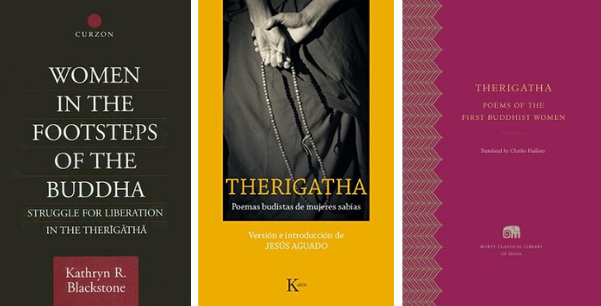
It is a collection of short verses or poems of early enlightened women, who were "elders" in the Noble Sangha or "community of enlightened individuals in the world."
Elder here does not mean old, as having been in robes for ten Vass or "monsoon periods," starting at a young age, as young as 7, one might be a 17-year-old fully enlightened nun. If one received full ordination at the age of consent, 20 (which would be 21 because in many Asian countries one is born at age 1, not 0, as in the west).
The poems date from a 300-year period, with some dated as early as the late 6th century BCE. According to American Ven. Thanissaro, abbot of Wat Metta, the Therigatha is the "earliest extant text depicting women’s spiritual experiences."
In the Pāli Canon, the Therigatha is classified as part of the Khuddaka Nikaya, the collection of short books in the Sutta Pitaka. It consists of 73 verses organized into 16 chapters. It is the companion text to the Theragatha, "The Verses of Elder Monks" or men's spiritual awakenings. It is the earliest known collection of women's literature composed in ancient India. Here is one example:
Subhā, the Goldsmith’s Daughter

1.1 “I was so young, my clothes so fresh,
1.2 at the time I heard the Teaching.
1.3 Being attentive [in meditation/contemplation],
1.4 I comprehended the truth;
2.1 And then I became profoundly dispassionate
2.2 towards all sensual pleasures.
2.3 Seeing danger in this insubstantial reality,
2.4 I longed for renunciation [to let go].
3.1 Giving up my family circle,
3.2 bonded servants and workers,
3.3 and my flourishing villages and lands,
3.4 so delightful and pleasant,
4.1 I went forth [ordained as a wandering ascetic nun];
4.2 all that is no small wealth.
4.3 Now that I’ve gone forth in confidence like this,
4.4 in the true Teaching so well proclaimed,
5.1 since I crave for nothing,
5.2 it would be inappropriate
5.3 to take back gold and money,
5.4 having already gotten rid of them.
6.1 Neither money nor gold
6.2 lead to peace or awakening.
6.3 It does not befit a wandering ascetic.
6.4 It is not the wealth of the noble ones;
7.1 It’s just greed and vanity,
7.2 confusion and growing decadence,
7.3 dubious, troublesome —
7.4 there is nothing lasting there.
8.1 Depraved and heedless,
8.2 unenlightened folk, their hearts corrupted,
8.3 fight each other,
8.4 creating conflict.
9.1 Killing, caging, misery,
9.2 loss, grief, and lamentation,
9.3 those sunk in sensual pleasures
9.4 see many disastrous things.
10.1 My family, why do you urge me back
10.2 to [lowly] pleasures as if you were my enemies?
10.3 You know I have gone forth [from all that],
10.4 seeing great danger in [clinging to] sensual pleasures.
11.1 It is not due to gold, minted or unminted,
11.2 that defilements come to an end.
11.3 Sensual pleasures are enemies and murderers,
11.4 hostile forces that bind us to thorns.
12.1 My family, why do you urge me on
12.2 to pleasures as if you were my enemies?
12.3 You know I have gone forth,
12.4 shaven, wrapped in my outer saffron robe.
13.1 Leftovers as gleanings,
13.2 and cast-off rags as my robes —
13.3 that is what is fitting for me,
13.4 the essentials of the left-home life.
14.1 Great seers expel craving for sensual pleasures,
14.2 whether human and divine.
14.3 Safe in their sanctuary, they are free,
14.4 having found unshakable happiness.
15.1 May I not encounter [sticky] sensual pleasures,
15.2 for no safety is found in them.
15.3 Sensual pleasures are enemies and murderers,
15.4 as painful as a bonfire [one is cast upon].
16.1 Greed is an obstacle, a threat,
16.2 full of anguish and thorns;
16.3 it is out of balance,
16.4 a great gateway to confusion.
17.1 Hazardous and terrifying,
17.2 sensual pleasures are like a snake’s head [with fangs],
17.3 where fools delight,
17.4 the blind ordinary [uninstructed] folk.
18.1 Mired in the swamp of sensuality,
18.2 there are so many ignorant in the world.
18.3 They know nothing of making an end
18.4 of rebirth and future deaths.
19.1 Because of [craving for] sensual pleasures,
19.2 people fall onto a path that goes to a bad place.
19.3 So many walk that path
19.4 that brings them disease.
20.1 That is how [attachment to] sensual pleasures creates enemies;
20.2 they are tormenting, corrupting,
20.3 trapping living beings with worldly pleasures of the flesh.
20.4 They are nothing less than the bonds of death.
21.1 Enticing, maddening,
21.2 sensual pleasures derange the heart/mind.
21.3 They are a snare laid by Māra [the Tempter]
21.4 for the corruption of living beings.
22.1 Sensual pleasures are boundlessly dangerous.
22.2 They are full of suffering, a terrible poison;
22.3 Offering little gratification, they are makers of strife,
22.4 withering bright qualities away.
23.1 Since I have created so much ruination
23.2 because of [craving for] sensual pleasures,
23.3 I will not relapse to them again
23.4 but will always delight in quenching.
24.1 Fighting against sensual pleasures,
24.2 longing for that cool state,
24.3 I shall meditate diligently
24.4 for the ending of all fetters.
25.1 Sorrowless, stainless, secure:
25.2 I’ll follow that path,
25.3 the straight noble eightfold way
25.4 by which the seers have crossed over.”
26.1 “Look at this: Subhā the goldsmith’s daughter,
26.2 standing firm in the teaching.
26.3 She has entered the imperturbable state,
26.4 meditating at the root of a tree.
27.1 It’s just eight days since she went forth,
27.2 full of confidence in the beautiful Teaching.
27.3 Guided by Ven. Uppalavaṇṇā,
27.4 she is master of the Three Knowledges, conqueror of death.
28.1 This one is freed from slavery and debt,
28.2 a nun with faculties developed.
28.3 Unyoked from all yokes,
28.4 she has completed the task and is free of defilements [asavas].”
29.1 Thus did Sakka, lord of all creatures,
29.2 along with a host of devas,
29.3 having come by their psychic powers,
29.4 honor Subhā, the goldsmith’s daughter.
*The enlightened author
G. P. Malalasekera, Buddhist Dictionary of Pali Proper Names (1899-1973), London, edited by Dhr. Seven, Wisdom Quarterly

Subhā Kammāradhītā was the daughter of a rich goldsmith in Rājagaha, the royal city wrung by seven hills, where the Buddha spent many rainy seasons on Vulture's Peak and where "Buddhism" was founded near Pipphali Cave.
One day she went to pay homage to the Buddha and he, recognizing her ability to grasp the timeless Dhamma, taught her a gradual discourse. She became a stream enterer (sotāpanna, the first stage of enlightenment).
She later joined the Bhikkhuni Sangha or "Nun's Order," under Ven. Mahā Pajāpatī Gotami (the world's first Buddhist nun, the Buddha's adoptive mother, sister of his biological mother, Queen Maya).
From time to time her relatives tried to persuade her to disrobe and leave the Monastic Order to return to the lay life and the world.
So one day she set forth, in 24 verses, the dangers of household life and dismissed them, convinced of her having rightly grasped the ultimate meaning of life due to her initial awakening.
Then, striving for insight (vipassana), she attained full enlightenment (arahantship) on the eighth day (Therigatha, Verses 338-361).
The Buddha saw this and praised her in three verses (Thig.vs.362-364).
Sakka (the king of the devas of Tavatimsa or the "Heaven of the Thirty-Three" and the "Realm of the Four Great Regents") visited her with the devas of Tāvatimsa and uttered another verse in her praise (ThigA.365; ThigA.236f.)

























































