Showing posts with label Gelug Order. Show all posts

Tuesday, September 10, 2024

Tibet: Dalai Lama w/ Richard Gere (video)


The 14th Dalai Lama in conversation with Hollywood actor Richard Gere | TIBET

For the people of Tibet (and the CIA)
(Kailash Bauddha) Aug. 17, 2024: DISCLAIMER: This conversation between the spiritual leader of the Tibetan people in exile, the 14th Dalai Lama (dalailama.com), and famed Hollywood actor Richard Gere (Pretty Woman), who is also chairman of the International Campaign for Tibet (ICT), took place on September 16, 2018, in Rotterdam, the Netherlands.

The purpose of posting this video is for the people of the world to understand the current situation for Tibetans in and outside of Tibet (which is under permanent Chinese military occupation and severe state oppression). #dalailama #tibet #richard

Friday, June 9, 2023

Tibetan mantra in honor of Tara (video)

Kon Sea Ring, June 14, 2021 (video); Ashley Wells, CC Liu (eds.), Wisdom Quarterly

Tibetan mantra to Tara sung as a ballad
(Kon Sea Ring) MEANING: Om Tara tu Tara tu ray swaha is an ancient mantra used in Tibetan Buddhism (Vajrayana or Mantrayana) as a way of honoring Tara, the protector or “Mother of all Buddhas.”

This mantra can be used as a main salute to all 21 major forms of Tara, but it is particularly associated with her Green Tara form, which is connected with enlightenment and abundance.

Om Tara tu Tara tu ray swaha is one of the most significant and most commonly chanted mantras in Tibetan Buddhism, where it is used to attract help, compassion, strength, and healing.

Om Tara tu Tara tu ray swaha may be translated as “I prostrate to Tara the liberator, mother of all the victorious ones.”

This song is from the movie Ballad from Tibet, a popular movie song. Sadly, the subtitles differ from the actual mantra because that's how the film industry commonly behaves.

Friday, September 4, 2020

Moon "science": consensus reality (video)

The Richest, July 20, 2020; CC Liu, Pfc. Sandoval, Ashley Wells (eds.), Wisdom Quarterly


China's weird moon discovery baffles scientists
Will all the life found be revealed?
China recently stumped the world's scientists with what they found on the dark side of the moon. This discovery, along with its camera footage and still pictures, claims to reveal something about our past.

The United States is alleged to have spent some $288 billion [in equivalent dollars to today's decreased value of American currency] to reach the moon in 1969. Now China’s found something strange, and the USA is allegedly seething that it didn’t find it first.

For decades, powerhouse governments have been locking horns in a "Space Race." Once the USA landed on the moon, the focus turned to Mars. And now it’s all about finding life that is being harbored on other planets.

The USA and Russia’s space race is well documented, but who knew China and India run ongoing lunar projects as well? Recently, they found an odd gel-like substance on the dark side of the moon, and this discovery sent the space world into a tailspin.

For copyright matters contact The Richest at: legal@valnetinc.com

Tuesday, November 19, 2019

What and who is the Panchen Lama?

CC Liu, Seth Auberon (eds.), Wisdom Quarterly Wiki edit
Khedrup Gelek Pelzang, first (to be retroactively titled) "Panchen Lama"
.
The Panchen Lama (Tibetan པཎ་ཆེན་བླ་མ།) is a tulku of the Gelug (Yellow Hat) school of Tibetan Buddhism.

Panchen Lama is one of the most important figures in the Gelug tradition, with spiritual authority second only to Dalai Lama.

"Panchen" is a portmanteau word combining "Pandita" and "Chenpo," meaning "Great scholar."
  
The recognition of Panchen Lamas began with Lobsang Chökyi Gyaltsen, tutor of the 5th Dalai Lama, who received the title "Panchen Bogd" from Altan Khan and the Dalai Lama in 1645. Bogd is Mongolian, meaning "holy."

John Oliver interviews the 14th Dalia Lama.
Khedrup Gelek Pelzang, Sönam Choklang, and Ensapa Lobsang Döndrup were subsequently recognized as the first, second, and third Panchen Lamas posthumously and retroactively after the term was invented.

There is a big controversy about the current Panchen Lama in China. More

  • China kidnaps official Panchen Lama, hides him away
  • China trots out its own offically crowned "Panchen Lama"

Tuesday, January 24, 2017

Two hats in the world: Pussyhat vs. MAGA

Crystal Quintero, CC Liu, Ashley Wells, Wisdom Quarterly; PussyhatProject.com; Wiki
Ears matter. Pussyhat Project for Women's March causes run on pink yarn (SFgate.com)

.
There are two hats you can wear in the world, Red Hats or Yellow Hats. But that's in Buddhist Tibet up in the Himalayas (see below). Coming down from those heights, we're in a tiny part of America (a big continent) in a country that rules the world or in any case thinks that it does. And here it's MAGA ("Make America Great Again" baseball cap) against Pussyhat (pink knitted beanie). Choose your side. We all want a great America, but we don't need to dress like a trucker to say so. We want a pink, pussy-friendly country.

They should be illegal. Because I said so. I bigly don't like 'em. Makes me want to grab 'em.
.
PUSSYHAT PROJECT We did it! We created a sea of pink. Women's March on Washington D.C. and over 600 sister solidarity marches took place January 21st, 2017 (pussyhatproject.com).

Pussyhat locations (this Ally offers a #Pussyhat related discount... This Ally will allow knitters to drop off their #pussyhats during business hours...)

Those hat are stupid. These hats are best.
Our Story (Pussyhat Project was co-founded by Krista Suh and Jayna Zweiman. Krista is a...Kat Coyle designed the Pussy Power Hat pattern. Kat owns The Little Knittery...

The creators of the Pussyhat Project explain how craft projects... (fastcompany.com) Born from this protest was the Pussyhat Project, a movement with...a bit of a rock star in the knitting community, designed the simple pattern...

United we knit, divided we split: let's make pink pussyhats together. Take that, Trump.
Finally, the pendulum is swinging from fake "liberals" under Obama to real progressives.
National Split by Hats: Tibet
Je Tsongkhapa, founder of the Yellow Hat sect or Gelugpa school, on the altar in his birthplace temple, Kumbum Monastery, near Xining, Qinghai (Amdo), China (Mario Biondi/wiki).
   
Emergence as the Dominant School
The 14th Dalai Lama is a Yellow Hat ruler.
By the end of the 16th century, following violent strife among the sects of Tibetan Buddhism, the Yellow Hats or Gelug school emerged as the dominant one over the Red Hats.

According to Tibetan historian Samten Karmay, Sonam Chophel (1595-1657), treasurer of Ganden Palace, was the prime architect of the Gelug's rise to political power.

True colors - sea of pink, Women's March
Later he received the title Desi, meaning "Regent" [person left in power who awaits the return of the king], which he would earn through his efforts to establish Gelugpa power.
 
From the period of the 5th Dalai Lama in the 17th century, the Dalai Lamas held political control over central Tibet. The core leadership of this government was also referred to as the Ganden Phodrang.
 
14th Dalai Lama, CIA op.
Scottish Botanist George Forrest, who witnessed the 1905 Tibetan Rebellion led by the Gelug lamas, wrote that the majority of the people in the Mekong valley in Yunnan were Tibetan.

According to his accounts, the Gelugpas were the dominant power in the region, with their lamas effectively governing the area. Forrest said they used "force and fraud" to "terrorise the...peasantry" [giving some credence to China's modern propaganda campaign that it helped average Tibetans by  "liberating" them from serfdom under Vatican-style overlords in the Vajrayana Sangha, with the Dalai Lama ("Pope-King") emerging as a kind of authoritarian Trump figure]. More

Saturday, June 22, 2013

Richard Gere's Buddhism (Vajrayana)

Dhr. Seven, Bela Larson, Wisdom Quarterly; Japanese-Buddhism.com
Richard Gere with living Buddhist Master Ajahn Jumnien (right) in Theravada Borbudur, Indonesia, the largest discovered Buddhist complex in the world (ego.globo.com/WQ)

 
[Vajrayana Buddhism's exalted priesthood, pomp and circumstance, and nearly forgotten nuns often lead to easy comparisons with Roman Catholicism, in form if not function.] Vajrayana Buddhism involves esoteric visualizations, symbols, and complicated rituals that can only be learned by study with a master. This explains why Vajrayana is also referred to as Esoteric Buddhism. Vajrayana Buddhism lays great emphasis on mantras (incantations), mudras (hand gestures) and mandalas (diagrams of deities and cosmic forces), as well as on magic and a multiplicity of deities... 

Mandala (kasina) in Vajrayana esoteric meditation (indiebookevent.com)
Meeting the current Dalai Lama (left) in Washington, D.C. (japanese-buddhism.com)
 
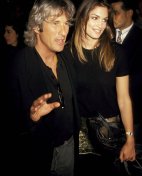
Gere, Cindy Crawford (redlist)
Emmy and Golden Globe Award winning American actor Richard T. Gere has another identity. In the spiritual dimension of his life, far from his worldly Hollywood fame, he is a Vajrayana Buddhist.
 
Gere was raised by Methodist Christian parents. He began his search for the beauty of Buddhist tranquility in 1978 when he was traveling in Nepal with a Brazilian painter named Sylvia Martins.

Liz Taylor, Martins, hipster (Getty)
Since then he became an active supporter of the 14th Dalai Lama, the former spiritual-political leader of Tibet, now the head [quasi "pope"] of the Gelug branch of Tibetan Vajrayana, the "Diamond Way" or "Thunderbolt Vehicle."

Tibetan Buddhism is composed of four principal schools, namely, the Nyingma (ancient) School, the Sakya School, the Kagyu (Oral Tradition) School, and the Gelug (Tradition of Virtue or "Yellow Hat") School. Tsongkhapa is the pioneer of this Buddhist school.
In trouble in India for kissing (richardgere.tv)
After spending about 20 years studying with Nyingma, Sakya, Kagyu, and Kadam (Oral Instruction) teachers, the concept of Gelug came into being through the insight of Tsongkhapa in the early 15th Century. More
Short history of Vajrayana Buddhism
Wisdom Quarterly (Wikipedia edit)
Vajrayana/Bon masks and rituals in Himalayan culture (madamepickwickartblog.com)
  
Vajrayana (onmarkproductions.com)
Although the first tantric Buddhist texts appeared in India in the 3rd Century and continued to appear until the 12th century (Williams, 2000, p. 194), scholars such as Hirakawa Akira assert that the Vajrayana school probably came into existence in the 6th or 7th Century (History of Indian Buddhism, 1993, p. 9), while the term Vajrayana itself first appeared in the 8th century (Macmillan Encyclopedia of Buddhism, 2004).
 
Vajrayana was preceded by the Mantrayana, and then followed by the Sahajayana and Kala-chakra-yana (Schumann, Buddhism: an outline of its teachings and schools, 1974). The period of Indian Vajrayana Buddhism has been classified as the fifth (Akira, 1993) or final (Macmillan, 2000) period of Indian Buddhism. The literature of Vajrayana is absent from the oldest Buddhist literature of the Pali Canon and the Agamas.

But practitioners claim mythological origins for the Tibetan Buddhist tradition. Those origins claim that the historical Shakyamuni Buddha taught tantra. But since these are "secret," occult, or esoteric teachings, confined to the guru/disciple relationship, they were generally written down long after the Buddha's other teachings -- the Pali Canon and the Mahayana sutras. 
 
The Vajrayana tradition holds that its teachings were first expounded by the Buddha 16 years after his great enlightenment. Historians have identified an early stage of Mantra-yana beginning in the 4th Century, and they argue that assigning the teachings to the historical Buddha is "patently absurd" (Kitagawa, The Religious Traditions of Asia: Religion, History, and Culture, 2002). More
American actor Richard Gere (whose real name is Richard Tiffany Gere), winner of Emmy Awards and Golden Globes, has another identity in the world of spiritualism, far apart from the rest of the worldly life and fame. He is a Buddhist.

Richard Gere and the Dalai Lama

Gere, who was raised by Methodist parents, began his search for the beauty of tranquility in 1978 when he was traveling in Nepal with a Brazilian painter named Sylvia Martins. Since then, he became an active supporter of his holiness the Dalai Lama who leads religious officials of the ‘Gelug’ branch of Tibetan Buddhism.

Tibetan Buddhism is composed of four principal schools, namely, ‘ the Nyingma (ancient) School’, ‘ the Sakya School ’, ‘ the Kagyu (Oral Tradition) School’, ‘ the Gelug (Tradition of Virtue, sometimes known as the 'Yellow Hat') School’. Tsongkhapa is the pioneer of this last born ‘Gelug’ Tibetan Buddhism school.

After spending around 20 years studying with Nyingma, Sakya, Kagyu and Kadam (Oral Instruction) teachers, the concept of ‘Gelug’ came into being through the insight of Tsongkhapa in the early fifteenth century.
- See more at: http://www.japanese-buddhism.com/richard-gere-buddhist.html#sthash.4XcrciX7.dpuf

Friday, May 8, 2009

The Dalai Lama/Dorje Shugden Controversy

Documentary in three parts (Part 2, Part 3)

Unpleasant facts within the Tibetan community are easily forgotten. Therefore, this documentary is of historical importance.

For centuries the deity Dorje Shugden has been worshipped by the greatest and most important Buddhist masters, many of whom are among the most respected in Tibetan history. This includes the Dalai Lama's own teacher, Kyabje Trijang Dorje Chang.

If the Dalai Lama thinks that all of the great masters were mistaken, he denies them their qualification. They would not be great masters.

  • Question: If the great masters have worshipped this deity for centuries, were they all wrong?
  • Dalai Lama: "Wrong! Yes, wrong!"

The Dalai Lama's criticism and defamation of his own Root Guru created the schism of the Gelug order of Tibetan Buddhism and conflicts within the Tibetan community.

Dorje Shugden practitioners are currently experiencing ostracism and oppression in India and throughout the world due to the Dalai Lama's ban on their practices.