Showing posts with label abbots. Show all posts

Thursday, January 22, 2026

Hypocrisy, poetry, iconoclasm in Zen


Wild Ways: Zen Poems of Ikkyu
Japanese Zen Buddhist priest Ikkyū (一休宗純, Ikkyū Sōjun) was an iconoclast with an "enlightenment certificate" (inkajo). He was born in 1394 and died in 1481. He was an eccentric, iconoclastic, "crazy wisdom" Japanese Zen Buddhist monk, poet, musician, alcoholic, and womanizer.

He had an impact on the infusion of Japanese art and literature with Zen attitudes and ideals [1]. He is perhaps best known for his radical approach to Zen, which included breaking Buddhist monastic precepts and his stance against celibacy [2, Note 1].
Biography
In 1394, Ikkyū was born in a small suburb of Kyoto, Japan. It is generally held that he was the illegitimate child of Emperor Go-Komatsu and a low-ranking court noblewoman [1]. His mother was forced to flee to Saga, where Ikkyū was raised by servants.

At the age of 5, Ikkyū was separated from his mother and placed in a Rinzai Zen temple in Kyoto, Japan called Ankoku-ji, as an acolyte [1, 5].

The temple masters taught Chinese culture and language as part of the curriculum, a method termed Gozan Zen. He was given the name "Shuken" and learned about Chinese poetry, art, and literature. More

Friday, May 26, 2023

Ajahn Brahm on the necessity of jhanas

Daniel Aitken (dharmachats.com); Pat Macpherson, Dhr. Seven (eds.), Wisdom Quarterly

Ajahn Brahm and the necessity of the jhānas
(Daniel Aitken) Oct. 24, 2022. Listen to the entire interview at dharmachats.com. In this Dharma Chats clip, Ajahn Brahm (British Theravada Buddhist monk Ajahn Brahmavamso, formerly Peter Betts) speaks with Host @DanielAitken about the jhāna ("meditative absorption") states and how these shed a better perspective on the senses and perception.

Sunday, December 7, 2014

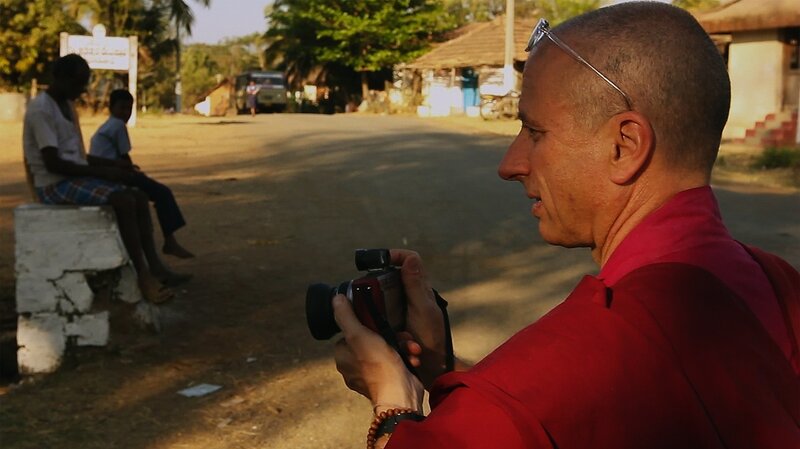
American Buddhist: Monk with a Camera (film)

CC Liu, Amber Larson, Wisdom Quarterly;Weekend Edition Saturday (

Before becoming a monk, Nicky Vreeland apprenticed with the great photographers Richard Avedon and Irving Penn.
Before becoming a Buddhist monk, Nicky Vreeland apprenticed with the great photographers Richard Avedon and Irving Penn in New York (Asphalt Stars/NPR, 12-6-14).
.
From Chic Manhattanite to Monk...
Nicholas Vreeland in Naples, Italy.
It's all about seeing subject and object. Or not.
(NPR) When we first see Nicky Vreeland in the new film Monk with a Camera, he's a middle-aged man in a burgundy robe and with a shaved head.
 
In other words, he's a Buddhist monk -- the abbot of Rato Dratsang, one of the Dalai Lama's monasteries, and director of The Tibetan Center in New York City.
 
But as Ven. Vreeland maneuvers through his present, we get glimpses of his past as the grandson of fashion icon Diana Vreeland. Once upon a time, he was a chic, young Manhattanite who hobnobbed in posh zip codes and apprenticed with the great photographers Richard Avedon and Irving Penn.
  
American men love Buddhist monks.
Ven. Vreeland gave that all up in the late 1970s for the life of a [Vajrayana] monk. But the film doesn't make us ask what he gave up; it makes us ask, "What did Nicky Vreeland find?"

He tells NPR's Scott Simon that there was no single life-changing event that made him become a monk. "I think that one takes little steps along one's path, and if one takes them honestly and seriously, they lead to all sorts of funny places." 

Interview Highlights
Dashing, fashionable, trendy Nicky Vreeland living it up in New York City before ordination.
 
On deciding to become a monk and getting his head shaved
For me it was a desire to remove a part of my image. I think we all...work at presenting ourselves the way we wish to be presented, to be seen. And I think that shaving my head the first time was really to be naked, to remove that, to just feel what it was like to be without.
On raising more than $400,000 with his photography to finish building a new monastery after the 2008 crash prevented other cash promises from being fulfilled
[The photographs] saved us. They became a show that went around the world and raised a lot of money. ...I have to admit that I must believe in magic: If my photographs could raise that, something was happening to make it happen.
 
Being the abbot or abbess is a weighty worldly responsibility on any monastic.
 
On what it's like to sit on the throne of the Rato Dratsang, which has been occupied for centuries
That's very tough. In all seriousness, sitting on that throne is really humbling. To sit on top of everyone -- people whom I know are more qualified, are brighter, are more advanced in their practice [closer to enlightenment] -- and to preside over them on a throne is really an exercise in working on your mind and in remembering impermanence, remembering that all attainments are so easily lost and remembering the work that I still have to do.
 
On what happens to us after this life
The Dalai Lama's attendant once took me by the arm and said to me, "You know, when our robes get worn out we get rid of them and we have new ones made. It's the same with the body. When we die, the body has ceased to exist and we reincarnate and continue our lives." More + AUDIO

Wednesday, July 14, 2010

Beloved monk leaves California monastery

Ajahn Amaro leaves Abhayagiri Monastery
Special to the Ukiah Daily Journal
Ajahn Amaro, the founding abbot of California's Abhayagiri Buddhist Monastery in Redwood Valley, will be moving to England this month to fill the role as abbot of Amaravati Monastery near London.

Since moving to Redwood Valley in 1996, Amaro has been generous in sharing the teachings of the Buddha with our local community. He has offered many classes, guided meditations, and daylong mini-retreats at the monastery as well as at Yoga Mendocino in town. Larry Restel, an investment adviser from Ukiah, first met Amaro in 1990 in England:

"I've seen him grow up as a monk. He feels like a brother to me," Restel said. "He's always been amazing. When he gives one of his well-known talks, if he has to finish by ten o'clock, he'll be finished at ten. He weaves his stories so intricately, with so many different branches, but when there's only a minute to go he ties up all the knots. The tradition with Theravada Buddhist monastics is that people keep coming and going. So to me it seems natural that he's heading to England."

Amaro, who was born in England and just two years ago gained American citizenship, enjoys talking about the environment. He notes that the weather seems to be reversing between these two countries. "This year, Mendocino County, cold and rainy, experienced what we once thought of as being English weather," Amaro said.

"My sister, a gardener back in England, recently reported that once-green fields are already parched from too much sun, certainly what we in Mendocino County consider to be our weather." Although he is looking forward to seeing the seasons change, Amaro has mixed feelings about leaving Abhayagiri. More>>

Life outside the monastery

Saturday, December 12, 2009

Ordaining Buddhist Nuns Again

Bhikkhuni Ordination
Theravadin.wordpress.com
Regarding the current Buddhist nun (bhikkhuni) ordination excitement in Ajahn Chah’s Sangha and the resulting excommunication of Ajahn Brahm (left), the following Dhammapada verse comes to mind:

Other’s faults are easy to see
Yet hard it is to see one’s own,
And so one winnows just like chaff
The faults of other people, while
Hiding away those of one’s own
As crafty cheat the losing throw
(Dhp. 252).

When such a great number of contemporary monks show such a plain disregard for even the most basic precepts, it seems like a joke that they would so vehemently oppose bhikkhuni ordinations pointing towards the Vinaya and tradition. More>>

Sunday, July 12, 2009

Bits and Pieces of Teaching Buddhism


New research on Sukhothai's most intriguing monument
Chris Baker (7/13/09)

Gathering Leaves and Lifting Words: Histories of Buddhist Monastic Education in Laos and Thailand, Justin T. McDaniel (Silkworm Books; Univ. of Washington Press)

Histories of Buddhism in Southeast Asia have imagined a clear break between pre-modern and modern practices. In the past, they claim, each Buddhist temple (wat) and abbot was very independent. Teaching depended heavily on moral tales, especially the Jataka birth stories. The teaching style was predominantly oral.

Beginning in the mid-19th century, there was a revolution: Printing made available standard editions of texts. Western scholars invented the idea of a "canon" of older, orthodox texts. The court in Siam and the colonial administrators in Indo-China imposed a "purified" teaching based on this canon and a more regimented organization of the Sangha.


Nun (maechi) students, Pali grammar class, Samnak Santisuk nunnery, Nakhon Pathom.

Justin McDaniel has studied Buddhist education from past to present. Unlike most scholars, he based himself in the "Lao" periphery of Lanna, Laos, and Isan. He ordained for a time in a small wat beside the Mekong River and tramped all around the periphery, peering into wat libraries, listening to sermons, and quizzing novices. He concludes that the break between pre-modern and modern was much less clear than it seems.

He cannot find out very much about pre-modern teaching in the wats in either Laos or Lanna except for two things. First, abbots paid a lot of attention to collecting and copying manuscripts. Abbots who did this on a large scale became honored and famous. Often they distributed copies of manuscripts over a wide area. Second, the most common form of manuscript found in the wat libraries and used by the monastics and abbots are not the classical texts, but nissaya (and the similar vohara and namasadda). These are literally "supports" or crib-guides for a monastic delivering a sermon or homily. More>>