Showing posts with label throne. Show all posts

Friday, July 31, 2026

How the Creator God looks: Book of Enoch


(TheBlackParchment) The Book of Enoch finally exposed the Creator God -- and what this God actually looks like


God: An Anatomy
An astonishing and revelatory history that represents God as he was originally envisioned by ancient worshippers—with a distinctly male body, and with superhuman powers, earthly passions, and a penchant for the fantastic and monstrous.

"[A] rollicking journey through every aspect of Yahweh’s body [the Demiurge, Gnostic Yaldabaoth], from top to bottom (yes, that too) and from inside out... Ms. Stavrakopoulou has almost too much fun.” — The Economist

I'm no ET. I'm Baal. Worship me!
The scholarship of theology and religion teaches us that the God of the Bible was without a body, only revealing himself in the Old Testament in words mysteriously uttered through his prophets, and in the New Testament in the body of Christ.
The portrayal of God as corporeal and masculine is seen as merely metaphorical, figurative, or poetic. But, in this revelatory study, Francesca Stavrakopoulou presents a vividly corporeal image of God: a human-shaped deity who walks and talks [in the Garden of Eden with Adam and Eve] and weeps and laughs, who eats, sleeps, feels, and breathes, and who is undeniably male.

Could there be a God, a real God?

The Jewish God El
Here is a portrait—arrived at through the author's close examination of and research into the Bible—of a god in ancient myths and rituals who was a product of a particular society, at a particular time, made in the image of the people who lived then, shaped by their own circumstances and experience of the world.

From head to toe—and every part of the body in between [including the penis]—this is a god of stunning surprise and complexity, one we have never encountered before. More: God: An Anatomy (by Francesca Stavrakopoulou)

Tuesday, December 16, 2025

Aron Kiss climbs Buddhist Himalayas


(Aron Kiss) Discovering a hidden hermitage of Buddhist monks at a peaceful meditation center in the Himalayas of Tibet (which the Chinese authorities insist is part of China).

Monday, August 4, 2025

The BLACK Kings Russia Forgot

USA was more racist than Nazi Germany to Owens

DVD DESCRIPTION: This critically acclaimed documentary explores the 700-year history of [Black] Islamic rule on the Iberian Peninsula [Spain and Portugal]. Although generations of Spanish historians have portrayed the Moors as brutish occupiers, recent research paints a much different picture. The Islamic invaders actually brought stunning advances in science and art to their territories. Oxford-educated historian Bettany Hughes gives modern viewers a rich, nuanced understanding of Islamic history and culture while visiting such sites as the Alhambra Palace and the Great Mosque at Cordoba.

REVIEW: "The drama seems infused, suddenly, with important complexity, with great questions of war, peace, civilian casualties" -- The Wall Street Journal

"highly informative and entertaining" -- Memorable TV

Is there a connection between India and Volga?

Friday, July 19, 2024

Buddhism: Trump as Anger-Eating Demon?

Anger Eating Demons | Ajahn Brahm
I can take it and grow as well as I can dish it out.
(Buddhist Society of Western Australia) Ajahn Brahm talks about the fault-finding mind that only looks at what is wrong with things. The British Theravada monk in the Thai Forest Tradition explains how life doesn’t go wrong. It just goes different or counter to our expectations. People are not "wrong" but different. He recounts two classic ancient Buddhist stories, that of the Anger-Eating Demon and "The Two Arrows."

Support the BSWA in making Buddhist teachings available for free online via Patreon: buddhistsocietywa. Copyright Buddhist Society of Western Australia (bswa.org). Originally delivered July 10, 2011.

Monday, April 22, 2019

The Sex-Crazed Royals of England (video)

Reel Truth History Docs, April 20, 2019; Seth Auberon, Pfc. Sandoval (eds.), Wisdom Quarterly

Who are the real King and Queen? (British Monarchy)
British royalty is no stranger to scandal, but one unsolved mystery could prove to be the greatest secret royal scandal of all. Legend has it that King George III had a secret wife -- a commoner, a Quaker, Miss Hannah Lightfoot -- and three children before his official marriage. If it's true, has every monarch since then been a pretender to the throne? Let's let DNA decide.
 
History Documentary | Reel Truth History: Welcome to Reel Truth History, home of gripping and powerful documentaries. Watch full-length documentaries and series that explore some of the most comprehensive pieces of world history. Be the first to watch more full length documentaries by subscribing to  youtube.com/channel/UCb7x...

Monday, December 4, 2017

Buddhist Afghanistan: Throne of Rostam

AtlasObscura.com; Dhr. Seven, Amber Larson, Pat Macpherson (eds.), Wisdom Quarterly

Stupa at center of relief showing ancient Indian Buddhists (monastics on left, lay couple at right, statues behind) circumambulating or clockwise "walking around" at a chaitya temple.
Buddhist stupa Takht-e Rostam
Highly unusual subterranean stupa and adjacent cave monastery
Afghan Greco-Buddhist Bactrian art, Gandhara
AYBAK, Afghanistan - There are places in the world so strongly devoted to a particular religion that it is incredibly hard to believe that they have been shaped by any other faith.

Afghanistan is one of those places, a country so devoutly Islamic now that it seems that Islam has been around since the beginning of time.
 
However, before the advent of Islam, Afghanistan was an important center of Buddhist teaching.

[It is where the Buddha was born and raised and where he returned to help his family and people, according to Dr. Ranajit Pal, teaching them the path to liberation as he was teaching east in Magadha, Bihar, and northern India].
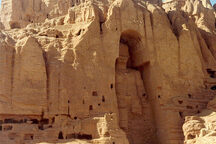
A closer look on the niche of the Great Buddha
Site of the super "Bamiyan Buddhas"
 
Is it carved out of rock or covered in accretion?
Since the destruction of the Bamiyan Buddhas, the Stupa of Takht-e Rostam in Samangan Province is arguably Afghanistan’s most impressive pre-Islamic site.

Unlike other stupas [kurgans, Scythian burial mounds, relic domes, dagobas, chaityas, pagodas], Takht-e Rostam Stupa has not been mounted above ground. It has been carved into the ground, in a style that resembles the monolithic churches of Ethiopia [or Jordan's Petra or Buddhism's magnificent Ajanta Caves].
Inside cave-like Buddhist monastery at Samangam, Takht-e Rostam stupa, meditation cells
Rare hollow, cave-like stupa in Thailand based on ancient Afghan style (Wat Umong).
Perhaps Persian throne rooms were built in the style of earlier Buddhist architecture which, being carved directly in stone, may have been the work of deva architects (pin).
Still standing after 700 years, Thailand's Wat Umong shows its age, despite numerous touch-ups. But still the crumbling, weather-worn central stupa towers into the sky (CB).
  
At the top of the stupa is a stone-carved harmika building, which once held relics of the Buddha. The trench surrounding the stupa is around 24 feet (8 meters) deep. A path leads down to the bottom of the trench, where Buddhist monastics once circumambulated the stupa clockwise.

Peaceful meditation room for striving
Carved inside the outer walls of the trench is a Buddhist monastic complex with five individual caves and several monastic cells for meditation. Small holes in the roofs allow a little daylight to enter the caves, creating a peaceful atmosphere of twilight. The cave monastery is lacking any decorative elements but is impressive as a sheer engineering feat.
 
Historians have proposed two possible reasons why the stupa has been carved in the ground instead of being built above ground. One explanation is that it could have been done for the purpose of camouflage to protect the monastery from invaders. Another much more mundane explanation states that it has simply been done to escape the excessive hot/cold climate extremes of Afghanistan.
 
How could Buddhists have built this in stone?
The Afghan name Takht-e Rostam ("Throne of Rostam") refers to a legendary figure in Persian [Aryan, Indo-Iranian] culture. After the Islamization of Afghanistan, when the knowledge of the original Buddhist purpose of the stupa became lost, the site became known as the place where Rostam supposedly married his bride Tahmina.
 
The ruins are located up the hill 3 kilometers southwest above the town of Samangan. More