
(Asian Ancestry) What did British musician and artist Brian Eno know about China? "China My China," he sang.
Showing posts with label Tibetan Plateau. Show all posts
Showing posts with label Tibetan Plateau. Show all posts
Thursday, April 30, 2026
Monday, July 28, 2025

Saturday, May 17, 2025
Sunday, March 23, 2025
City found beneath Pyramids of Giza

 |
| Structures recently found inside pyramid go way down, thousands of feet, impossible depths |
.
Researchers claim they’ve discovered the legendary Halls of Amenti in a “vast city” beneath Egypt’s Pyramids of Giza — a wild theory that has perplexed archeological experts who dismiss the claims as “fake news,” to quote a moronic Trumpism.
 |
| Pyramids of Giza near Cairo ("Mars"), Africa |
Italian and Scottish scientists studying the pyramid of Khafre say the “groundbreaking study has redefined the boundaries of satellite data analysis and archeological exploration,” according to spokesperson Nicole Ciccolo.
- PHOTO: A 3D model was created displaying the newly discovered structures inside the central part of the Pyramid of Khafre (Khafre Project)
Aptly named the Khafre Project, Corrado Malanga from Italy’s University of Pisa and Filippo Biondi of the University of Strathclyde in Scotland led the expedition to discover the Giza Plateau’s second-largest pyramid.
 |
| Tomographic images showing different feedback results could indicate internal artificial structures under the pyramid in most recent discovery made public (Khafre Project). |
Scientists said they located five small room-like structures inside the pyramid using Synthetic Aperture Radar (SAR) technology. One structure contained a sarcophagus mistakenly thought to be the Pharoah’s Tomb, the team said in a press release.
The group claims the five structures — previously unknown before the images — were found in the center of the pyramid.
The newly discovered structures are connected to pathways that lead below the surface and are believed to expose hidden rooms and wells underneath the 4,500-year-old world wonder.
Electromagnetic signals were turned into phononic data that unveiled larger infrastructure leading down thousands of feet underground.
The eight large, vertical structures — theorized to be wells or shafts — are thought to extend over 6,500 feet across and 2,000 feet below ground.
Researchers didn’t reveal the use of the larger structures that stretch below “ground zero” but plan for further analysis and possible excavation to verify the “artificial nature of the structures.”
The project used two satellites 420 miles up in space to send down radar signals that “photographed” the pyramids, according to the Daily Mail.
Data was compiled into images to create a rough copy of what is believed to be below the pyramids, including the eight wells.
The hollowed structure consists of spiral pathways leading down further underground.
Tomographic images showing different feedback results could indicate internal artificial structures under the pyramid (© Khafre Project).
The group used the data to make a rough 3D model estimating what is believed to be hidden from the world’s eye.
“When we magnify the images [in the future], we will reveal that beneath it lies what can only be described as a true underground city,” Malanga said, according to the outlet.
Skepticism and accusations that the study was a hoax arose when the project did not publish the information with any peer review from independent researchers.
Renowned archaeologist and Egypt’s former minister of antiquities, Dr. Zahi Hawass, promptly called the claims “completely wrong” and “fake news.”
“The claim of using radar inside the pyramid is false, and the techniques employed are neither scientifically approved nor validated,” he told The National.
Researchers created a 3D model for the giant “wells” that descend below the pyramid with a spiral pathway. The group used the data to make a rough 3D model estimating what is believed to be hidden from the world’s eye (Khafre Project).
One researcher at the University of Denver said the claims were “exaggerated” as the technology is not advanced enough to create such images.
Radar expert Lawrence Conyers said there is a likelihood the five smaller structures found just below the surface may be there because of the history of the area.
Conyers said the land was sacred to the ancient civilizations even before the pyramids were constructed, according to the Daily Mail.
The wild claims have contributed to a growing interest in the possibility of a discovery of ancient texts and other resources from Egyptian myths.
“A remarkably strong correlation between the layout and characteristics of these underground chambers and legendary Halls of Amenti as described in ancient myths,” Ciccolo said.
Radar expert Lawrence Conyers said there is a likelihood the five smaller structures found just below the surface may be there because of the history of the area. Khafre Project
The Halls of Amenti include the fabled Hall of Records, a hidden room believed to be underneath the pyramid complex or the Great Sphynx containing resources of information about the ancient people of the area.
“These new archaeological findings could redefine our understanding of the sacred topography of ancient Egypt, providing spatial coordinates for previously unknown and unexplored subterranean structures,” Ciccolo added
- More + VIDEO: There’s a ‘vast underground city’ below Egypt’s Giza pyramids, scientists’ wild theory claims — but experts debunk it as ‘fake news’
- VIDEO: Elongated {ET] skulls of Peru complete analysis, DNA results and surprising blood types
Something MASSIVE was JUST found beneath the Pyramids of Giza

- MSN.com, March 23, 2025; The InBetween; Pat Macpherson, Dhr. Seven, Seth Auberon (eds.), Wisdom Quarterly
Friday, June 29, 2012
Another "Buddha" - Padmasambhava (video)
Buddhist Films; Wisdom Quarterly
(DharmaPublishingBookstore.com)
 This is the dramatic story not of Maitreya, the Buddha-to-come, but of the ancient Indian Buddhist missionary Guru Padmasambhava. He was born in Udhyana -- modern Swat Valley, Pakistan -- and traveled across mountains and icy desert plains, moving across the spectacular Himalayas and finally reaching the Tibetan Plateau. Benoy K. Behl created this film to tell his story of one of the most forceful personalities of all history. Padmasambhava, with his magic and flamboyant masked dances, dominated the Rooftop of the World within his lifetime and is still revered today.
Behl in Berkeley
 Mangalam Centers and the Tibetan Nyingma Institute in Berkeley co-sponsored a special screening of art historian and photographer Benoy K. Behl’s film “The Second Buddha.” The filmmaker was present to discuss his work and take questions with Mangalam Research Center director Jack Petranker. The program included Sylvia Gretchen, the Dean of the Nyingma Institute, on the importance of Padmasambhava in the Tibetan Buddhist tradition.
“The Second Buddha” follows the journey of Guru Padmasambhava, an emanation of the Mahayana “Buddha” Amitabha who is regarded as the founder of Vajrayana Buddhism in Tibet and Bhutan.
The 25-minute film traces segments of Guru Padmasambhava’s journey across the Himalayas and the cold, high deserts of the Tibetan Plateau. According to Behl, the film tells “one of the greatest true stories of the world and is also the story of one of the most forceful personalities in all history.” More
(DharmaPublishingBookstore.com)
 This is the dramatic story not of Maitreya, the Buddha-to-come, but of the ancient Indian Buddhist missionary Guru Padmasambhava. He was born in Udhyana -- modern Swat Valley, Pakistan -- and traveled across mountains and icy desert plains, moving across the spectacular Himalayas and finally reaching the Tibetan Plateau. Benoy K. Behl created this film to tell his story of one of the most forceful personalities of all history. Padmasambhava, with his magic and flamboyant masked dances, dominated the Rooftop of the World within his lifetime and is still revered today.
 Mangalam Centers and the Tibetan Nyingma Institute in Berkeley co-sponsored a special screening of art historian and photographer Benoy K. Behl’s film “The Second Buddha.” The filmmaker was present to discuss his work and take questions with Mangalam Research Center director Jack Petranker. The program included Sylvia Gretchen, the Dean of the Nyingma Institute, on the importance of Padmasambhava in the Tibetan Buddhist tradition.
“The Second Buddha” follows the journey of Guru Padmasambhava, an emanation of the Mahayana “Buddha” Amitabha who is regarded as the founder of Vajrayana Buddhism in Tibet and Bhutan.
The 25-minute film traces segments of Guru Padmasambhava’s journey across the Himalayas and the cold, high deserts of the Tibetan Plateau. According to Behl, the film tells “one of the greatest true stories of the world and is also the story of one of the most forceful personalities in all history.” More
 |
| (Myo Edizioni) |
Sunday, June 12, 2011
Rare look into Tibet's Buddhist grottoes
 "The frescoes have a twist of Kashmir flavor. They are a valuable resource for archeologists trying to figure out when and where Buddhism was introduced to China." Shangri la is full of Buddhist caves and treasures (TibetanAltar)
China Exclusive: A rare look into Tibet's largest Buddhist grottoes
 (PeoplesDaily) Hidden among sandstone hills in remote western Tibet, a stretch of honeycomb-shaped caverns is way beyond the reach of most travelers.
Known as the Donggar Piyang grottoes, the 1,000-year-old caverns in the Tibet Autonomous Region's Ngari Prefecture hold one of the world's greatest collections of Tibetan Buddhist murals.
The grottoes, divided into two clusters of 200 and 1,000 caves, respectively, hold remains of ancient monasteries, fortresses, and forests dating back as far as the 10th century.
Experts expect that the well-preserved grottoes will shed some light on the Guge Kingdom, an ancient kingdom that is estimated to have existed between the 9th and 17th centuries in what is known today as Zanda County.
The exotic frescoes of the Donggar Piyang grottoes were first discovered in 1992, when an archaeological expedition team set foot in this remote corner of the Qinghai-Tibet Plateau... More
Donggar Frescos and Rutog Rock Paintings (TibetTravel.org)
Shangri la (Digital Tibetan Buddhist Altar)
Touring Tibet and China's minority cultures
China's lunar orbiter off to new space horizon
What's driving China's pursuit of financial success
China dying of drought and flooding
China's Bezeklik Thousand Buddha Caves
Friday, December 10, 2010
Mongolian Motorcycle Nomads (video)
Genghis Khan (BIO) once tore through the fertile grasslands of Asiatic animist and Buddhist nomads spread across an endless expanse of blankness between empires. The entire area was more shaman and animistic than the majority group in China but quite similar to the countless indigenous tribespeople related to Tibetans, Siberians, and Native Americans.
"He guaranteed freedom of religion, protecting the rights of Buddhists, Muslims, Christians, and Hindus alike. Genghis Khan himself worshipped the sky [ETs?]..."
Today Mongolian nomads ride motorcycles
Sisi Tang (AP)
CHIFENG, China – It's no longer about the armed warriors, Genghis Khan and the robed nomads prancing through lush greenery on horseback. In China's barely populated Inner Mongolian grasslands, what had defined Mongolian culture for outsiders have long been swapped for leather outfits, motorbikes, cell phones, and tourism.
Sisi Tang (AP)
CHIFENG, China – It's no longer about the armed warriors, Genghis Khan and the robed nomads prancing through lush greenery on horseback. In China's barely populated Inner Mongolian grasslands, what had defined Mongolian culture for outsiders have long been swapped for leather outfits, motorbikes, cell phones, and tourism.
Five hours outside Inner Mongolia's southeastern city of Chifeng and deep in the grasslands, I chanced upon a local couple riding a mule-pulled cart on a quiet road, heading toward their coal-heated yurt.
The old woman said she loves watching drama shows on TV, gesturing toward the dish propped up against her roof. On the freeway nearby, cars and buses seem to be the only other form of transportation, with horse-riding existing mostly for tourists.
The old storybook nomad life has dwindled, with most nomads now farming, living in compact brick huts, tending to tourists, or working in nearby cities. Desertification, too, is real and apparent... More>>
(Blacktreemedia) Award-winning Russian filmmaker Sergei Bodrov illuminates the life and legend of Genghis Khan in his stunning historical epic, MONGOL. Based on leading scholarly accounts and written by Bodrov and Arif Aliyev, MONGOL delves into the dramatic and harrowing early years of the ruler who was born as Temudgin in 1162. As it follows him from his perilous childhood to the battle that sealed his destiny, the film paints a multidimensional portrait of the future conqueror, revealing him not as the evil brute of hoary stereotype, but as an inspiring, fearless and visionary leader. Filmed in the very lands that gave birth to Genghis Khan, MONGOL transports us back to a distant and exotic period in world history, to a nomad's landscape of endless space, climatic extremes, and ever-present danger.
Monday, March 22, 2010
Mummy find in China desert stirs ethnic debate
Nicholas Wade (NYT News Service, Mar. 17, 2010)
 The mummy of an infant excavated from the cemetery in north China. In the middle of a terrifying desert north of Tibet, Chinese archaeologists have excavated an extraordinary cemetery. Its inhabitants died almost 4,000 years ago, yet their bodies have been well preserved by the dry air. The cemetery lies in what is now China's northwest province of Xinjiang.
The mummy of an infant excavated from the cemetery in north China. In the middle of a terrifying desert north of Tibet, Chinese archaeologists have excavated an extraordinary cemetery. Its inhabitants died almost 4,000 years ago, yet their bodies have been well preserved by the dry air. The cemetery lies in what is now China's northwest province of Xinjiang. However, the people have European features, with brown hair and long noses. Their remains, in one of the world's largest deserts, are buried in upside-down boats. And where tombstones might stand, declaring pious hope for some god's mercy in the afterlife, their cemetery sports instead a vigorous forest of phallic symbols, signaling an intense interest in pleasures or utility of procreation. More>>
Saturday, August 29, 2009
Tibet Nomads: China intensifies resettlement
China Intensifies Resettlement of Tibetan Nomads
Michael Lipin, Washington (VOA, Aug. 28, 2009)
 The Chinese government announced this week that it has moved about 50,000 Tibetan nomads out of a nature reserve in the west of the country as part of a resettlement program that began in 2005. Beijing says the program is meant to protect the ecosystem of the Qinghai-Tibet Plateau. But Tibetan activists accuse the Chinese government of destroying an ancient nomadic culture that treats the environment with respect. More>>
Michael Lipin, Washington (VOA, Aug. 28, 2009)
The Chinese government announced this week that it has moved about 50,000 Tibetan nomads out of a nature reserve in the west of the country as part of a resettlement program that began in 2005. Beijing says the program is meant to protect the ecosystem of the Qinghai-Tibet Plateau. But Tibetan activists accuse the Chinese government of destroying an ancient nomadic culture that treats the environment with respect. More>>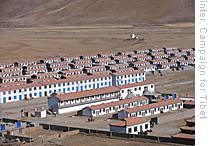 Nomad village settlement in Darlag County, Golok Prefecture, Qinghai Province, China (VOA/File).


Monday, August 24, 2009
China's "Shangri-La" is a real dream

A street in China's officially recognized Shangri-La (Chicago Tribune/Ashley Colby).
SHANGRI-LA, China -- If you've ever dreamed of finding Shangri-La -- that mythical mountain paradise made famous in James Hilton's novel The Lost Horizon -- it's time to wake up. These days, the elusive Shangri-La isn't that hard to find. It's in China's Yunnan province.
SHANGRI-LA, China -- If you've ever dreamed of finding Shangri-La -- that mythical mountain paradise made famous in James Hilton's novel The Lost Horizon -- it's time to wake up. These days, the elusive Shangri-La isn't that hard to find. It's in China's Yunnan province.
- Buddhism (Chicago Tribune)
It might not be exactly what you had in mind, however. When I arrived in Shangri-La, it was cold and raining, and there was a cow eyeing me as it lapped up water from a bucket in the Old Town, a patchwork of wooden houses on narrow streets. Not exactly the shining pathways and endless enlightenment I imagined, but I had just gotten there.
Shangri-La, with a population of more than 100,000, is nestled in a valley near the edge of the Tibetan Plateau in far south-central China, about 1,000 miles northwest of Hong Kong. In the far distance are glimpses of Himalayan snow-capped peaks hiding behind much lower mountains that hug the city.
In the late 1990s, with the expanding Chinese middle class thirsty to spend tourist yuan, several Chinese provinces started claiming they were the true Shangri-La. The government saw an opportunity and proposed that each place prove through empirical research that its physical characteristics match those in the novel. Several years later, Zhongdian County in Yunnan province was granted the title.
People come to get a glimpse of Tibetan Buddhist culture. Getting into Tibet can be difficult for tourists. Shangri-La, however, lies just outside the formal Tibet Autonomous Region but well within the plateau where Tibetans reside. More>>
Subscribe to:
Posts (Atom)





















































