Showing posts with label alert. Show all posts

Sunday, December 1, 2024

China: world's biggest gold deposit? No

African Mansa Musa would laugh in his soup at calling China gold rich. Uganda's where it's at.
Gold nuggets, metallic mineral from the earth (Bodnarchuk/Getty Images/Nature)
Now, along with our partner, Putin's Russia, we will divide the world in three: CH, RU, US.
.
World's largest gold deposit found, worth over US $80 billion
(Nature) A deposit of high-quality gold ore containing around 1,000 metric tons (1,100 US tons) of the precious metal has been discovered in central China, according to Chinese state media.

Valued at approximately 600 billion yuan or U.S. 83 billion dollars, the discovery could be considered the largest and most lucrative reservoir of gold ever uncovered, surpassing the 900 metric tons estimated to lie within the mother of all gold reserves, South Deep mine in South Africa.
Chinese technicians survey the gold (Xinhua)
PHOTO: Technicians of Hunan Province Geological Disaster Survey and Monitoring Institute check rock samples at the Wangu gold field in Pingjiang County, central China's Hunan Province, Nov. 5, 2024 (Xinhua/Su Xiaozhou).

The Geological Bureau of Hunan Province announced the detection of 40 gold veins within a depth of 1.2 miles (2 kms) in the northeast Hunan county of Pingjiang.

These alone were thought to contain 300 metric tons of gold, with 3D modeling suggesting additional reserves may be found to a depth of 3 kms.

The massive find was made in Pingjiang County, well within undisputed Chinese territory. "Many drilled rock cores showed visible gold," says bureau prospector Chen Rulin.

Core samples suggest every metric ton of ore could contain as much as 138 grams (nearly 5 ounces) of gold – an extraordinary level of quality considering ore excavated from underground mines is considered high grade if it contains more than 8 grams.

China already dominates the world's gold market with reserves considered to be in excess of 2,000 tons earlier in 2024, its mining industry contributing around 10 percent of the global output.

Monday, July 22, 2024

System of a down: US state of emergency


"HIGH ALERT! This is a state of emergency in the US" | Morris Invest
(Morris Invest) July 22, 2024: We are witnessing a tipping point moment for the United States of America. Pres. Biden [aka Genocide Joe] is stepping down from the next presidential race, the other candidate was almost assassinated, and there a massive collapse of America's infrastructure will be used to control all of us. The [Clinton-affiliated] CrowdStrike failure is just the beginning.

Thanks to Alaska Energy Metals for sponsoring today's video. Read more about their latest nickel projects here: https://alaskaenergymetals.com. Morris owns shares in Alaska Energy Metals, purchased on the open market. 📞 Ready to buy a first fully done for you rental property? Book a free call: https://morrisinvest.com ❓Ask Morris a 30-second question at https://morrisinvest.com/clayton 📺

Watch next: How to Create a Personalized Path to Financial Freedom: https://bit.ly/392kAsB 🏠 What's Your Freedom Number? Download a free PDF to help determine how many rental properties are needed to achieve financial freedom: https://morrisinvest.com/freedom 💵 Ready to get finances in order? Download the FREE 90-Day Financial Empowerment Bootcamp: https://morrisinvest.com/bootcamp 🎓 Want to learn more about creating an individualized plan to wealth with a proven system? Join Financial Freedom Academy: https://financialfreedomacademy.com 👨🏻‍💻 Sign Up for Morris' Webinar: https://morrisinvest.com/webinar

DISCLAIMER: Morris Clayton is not a financial adviser. He only expresses his opinion based on his experience. Other's experience may be different. These videos are for educational and inspirational purposes only. Investing of any kind involves risk. While it is possible to minimize risk, all investments are solely the responsibility of those involved in them. It is imperative that everyone conduct his/her own research. There is no guarantee of gains or losses on investments [but of course losses are much more likely, so be able to lose any money invested].
  • Morris Clayton, Morris Invest (YouTube); Pfc. Sandoval, Seth Auberon (eds.), Wisdom Quarterly

Thursday, May 23, 2024

UCLA's new protest camp, cops (live)


After protests, UCLA reassigns police chief, chancellor to face congressional committee
(ABC7) May 22, 2024: Weeks after clashes at a pro-Palestinian protest on UCLA's campus, the school police chief has been reassigned [demoted] to other duties and Jewish Chancellor Gene Block is set to be grilled by Congress about antisemitism [but not rampant Islamophobia] on campus. abc7.com/post/fallout-continues...

LIVE: Officers respond to UCLA as protesters try to push into new camp

LAPD on tactical alert as new pro-Palestinian encampment grows at UCLA
(KTLA 5) May 23, 2024: Pro-Palestinian demonstrators built a new encampment on the campus of UCLA on Thursday as the university's Jewish chancellor testified in Congress. Kareen Wynter and Jennifer McGraw reports. May 23, 2024.
  • KTLA 5, May 23, 2024; ABC 7 News, May 22, 2024; Shauna Schwartz, Ashley Wells, Pfc. Sandoval (eds.), Wisdom Quarterly

Thursday, April 25, 2024

Infinite size of Multiverse infinitely bigger


Physicists think the infinite size of the multiverse could be infinitely bigger
When another universe begins: samsara
(ScienceAlert) Not only does God play dice, that great big casino of quantum physics could have far more rooms than we ever imagined -- an infinite number more, in fact.

Physicists from the University of California at Davis (UCD), the Los Alamos National Laboratory in the US, and the Swiss Federal Institute of Technology Lausanne have redrawn the map of fundamental reality to demonstrate the way we relate objects in physics could be holding us back from seeing a bigger picture.

For about a century, our understanding of reality has been complicated by the theories and observations that fall under the banner of quantum mechanics.

Gone are the days when objects had absolute measures like velocity and position. To understand the fabric from which the Universe is made, we need mathematics that breaks down games of chance into likely measures.

This is far from an intuitive view of the Universe. In what has come to be known as the Copenhagen Interpretation of quantum physics, it seems there are waves of possibility until there isn't.

Quantum computing and Schrödinger’s Cat – Michael Sandberg's data visualization
.
Even now, it's not at all clear what ultimately decides the fate of Schrödinger's cat. [Is it dead, alive, or both?] That hasn't stopped physicists from considering the options.

American physicist Hugh Everett suggested in the 1950s that all possible measures constituted their own reality. What makes this one special is merely the fact you happen to be observing it.
  • Related video: What if the Universe were just an illusion? (What If)
Universes are like bubbles; beings mostly stay put
Everett's "many worlds" model isn't quite a theory so much as a way of grounding the absolute weirdness of quantum mechanics in something tangible.

We start with an impression of the infinite multiverse of maybes, or what physicists might refer to as the sum of all energies and positions known as a global Hamiltonian, and then zoom in on what interests us, constraining the infinite within a finite and far more manageable Hamiltonian subsystem.
Yet as a means of comprehending the infinite, could this "zooming in" be holding us back? Or as the researchers behind this latest exercise frame it, is it "too provincial an approach, born out of our familiarity with certain macroscopic objects?"

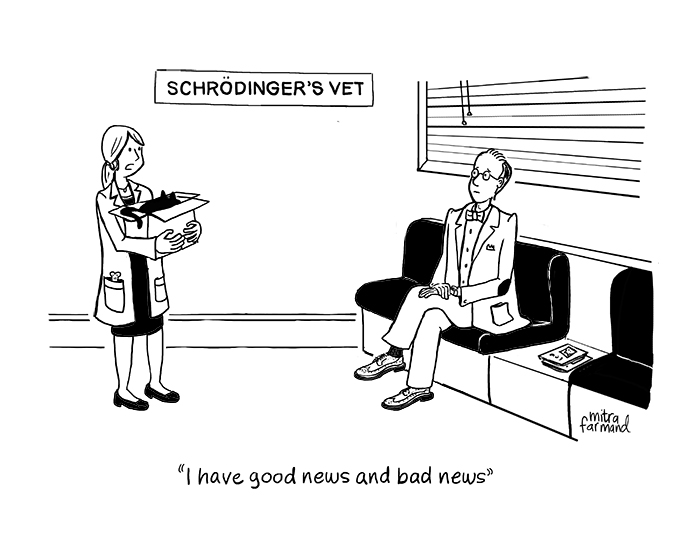
Schrodinger’s vet | Fuffernutter (mitrafarmand)
To put it another way, we might readily ask whether Schrödinger's cat is alive or dead inside its box but not consider whether the table beneath is warm or cold or if the box is starting to smell.

In an effort to determine whether our tendency to keep our focus on what's inside the box even matters, the researchers developed an algorithm to consider whether some quantum possibilities known as pointer states might be a little more stubbornly set than others, making some critical properties less likely to entangle.

If so, the box describing Schrödinger's cat is to some degree incomplete unless we're considering a long list of factors that may potentially stretch far across the Universe.

"You can have part of the Earth and the Andromeda galaxy in one subsystem, that's a perfectly legitimate subsystem," UCD physicist Arsalan Adil explained to Karmela Padavic-Callaghan at New Scientist.

Countless worlds in at least 31 categories
In theory, there is no limit to the way subsystems could be defined, adding long lists of states near and far that could fence off a reality in subtly different ways.

Starting with Everett's "many worlds" the team have come up with what they refer to as a "many more worlds" interpretation – taking an infinite set of possibilities and multiplying it with an infinite range of realities that we might not normally consider.

Much as with the original interpretation, this novel take is less a comment on how the Universe behaves but more about our attempts to study it one bite at a time.

The researchers emphasize they haven't attached a lot of conceptual significance to their algorithm but do wonder if it might have applications in developing better ways of probing quantum systems, such as those inside computers.

No doubt in some other reality, they already have their answer. This research is yet to be peer-reviewed and is available on arXiv. More:
  • Physicists think the infinite size of the multiverse could be infinitely bigger (ScienceAlert)
  • The best explanation for this world, which means this universe, was given by an American who went to the Andes to a doorway (portal) carved in stone, near Lake Titicaca. A shaman told him its secrets and taught him the utterances needed to enter. He did it and regretted it. What he found was the beginning of this world. There in a lab along the way, he saw "scientists" trying to control the size of our expanding world so that it did not overtake theirs. Ours started by accident. It's organic and a natural process, not uncommon. Once it gets going, it's inhabited by beings who circle the round of samsara without end. A buddha awakens, discovers the way out. Do we listen?
Multiverse?

O, Buddha, tell me the truth so I can do the math
(Richard Milner/Grunge) So we all know about the multiverse, right? One day a physicist somewhere thought, "Man, I wish I'd played in the NBA instead of sitting around doing math all day," and bam: instant childhood fantasy fulfillment meets theoretical physics

If Einstein asked, the B knew it
Then there's that Marvel movie, that other Marvel movie, and the DC one, and the one with like three Spidermen that was actually pretty solid and better than expected, especially Andrew Garfield.

And somewhere in there, drowning in the morass of fictional portrayals, evidence-less reality, the religious zeal of multiversal proponents, and grounded reservations of skeptics rests the truth of the multiverse: It's not a thing.

Okay, it could be a thing, but only in the way that "God" is a thing because its existence can't be disproven -- yet. But how to gather data on the multiverse? Behold the conundrum:
  • 1) The universe, by definition, is that which contains everything that is and
  • 2) to test for another universe we would have to test outside of all that is; therefore,
  • 3) science = impossible.
Yet, some researchers point to the oldest light in the universe -- cosmic background radiation (CBR) -- as holding multiversal clues, per a collaborative paper at Cornell University. More: Is the multiverse actually scientifically possible?

Wednesday, March 6, 2024

It's impossible that life exists, yet here it is

Martin MacInnes (ScienceAlert via MSN, 2/28/24); Douglas AdamsEuglenoids, Dhr. Seven, Sheldon S., Pat Macpherson (eds.), Wisdom Quarterly COMMENTARY
When we first arrived, it was vegan Eden. Tasty!
It’s sometimes claimed that, measuring by orders of magnitude, humans are midway in scale between subatomic particles and the observable universe.

(Or, to put it another way, we fall halfway between nothing and everything.) [Or, to put it yet another way, this is a middle world between heaven and heck, between glory and oblivion, light and shadow, the deva worlds and hellish narakas.]

Life arrived on Earth. It did not begin here.
Whether or not this claim is strictly true, it’s arresting and resonant in all sorts of ways. [To think that the only difference between the two destinations is karma is hard to accept, but the Buddha was a Karmavadin, a "Teacher of Karma," for just that reason; it's not obvious, and it needs to be known.]

Each of our lives might feel like a whole universe – surpassingly important and infinite in scope – and yet from another perspective, each is utterly trivial and ephemeral.
The best new science fiction books of February 2024 (© provided by New Scientist /MSN)
.
It’s an impossible paradox, this state of having both a surplus and redundancy of value, and it brings with it certain creative and moral opportunities.

I’m interested in how these opportunities might be explored in fiction, how scale can defamiliarize human life, and indeed all life, reminding us of the infinitesimal nature of its expanse and the improbability and wonder of its existence.

In each of my novels, and especially In Ascension, I have placed non-intuitive spatial and temporal perspectives next to the more mundane concerns of my characters.

Telescopes and microscopes recur, as do deep time, evolution, and the life cycles of parasites and viruses.
Alongside this, characters are eating, walking between rooms, anxiously going over circular thoughts, worried about their families, or bored.


The lens zooms in and out from “domestic” to “alien” scenes. I’m not doing this to mock or belittle my characters, but rather to try to evoke something of that paradoxical quality in which we are both infinite and infinitesimal, equally close to something very large and very small.

I’ve always been drawn to fiction that attempts this. When scenes with very different perspectives collide, the effect can be startling, exhilarating, unforgettable.

Who's afraid of V. Woolf?
My favorite example is in Virginia Woolf’s 1927 novel To the Lighthouse, which I first read as a teenager. In the 134 pages of its opening part, “The Window,” Woolf gives us, through the character Mrs. Ramsay, a consciousness so luminous it seems impossible to define or limit.

In the following part, “Time Passes,” the perspective undergoes a radical shift. The house is empty, the people long gone; Mrs. Ramsay, we are informed in two short lines enclosed between brackets, like an afterthought, is dead.

I will never forget the shock and thrill of first reading this. I didn't realize fiction could do this; Woolf’s audacity and ambition took my breath away.

She had shown, tragically, the power and precarity of every consciousness. It’s a truism that cannot be repeated enough: Life feels infinite, and it’s gone in a second.

Much of Woolf’s fiction is interested in this dissonance, and it is not coincidental that, as well as experiencing both world wars, she lived through radical advances in telescopic power that changed all understanding of the size of the universe.

And it should be no surprise – though it apparently still is to many people – that Woolf was not just an avid reader of astronomy books and science fiction, but saw herself engaged in a lifelong project of writing that bore comparison to the most ambitious works of sci-fi.

In Ascension (Martin MacInnes, Freya Miller)
From a new Jasper Fforde to post-apocalyptic hellscapes aplenty, February’s science fiction offers something for everyone.

The protagonist of In Ascension, Leigh Hasenbosch, is a microbiologist who travels into deep space. She experiences not only astonishment at seeing the whole Earth, but dejection at seeing the planet disappear.

Anthropocentrism -- unarguably the default perspective in English language fiction -- has never looked so absurd. [That is the idea that Earthling humans are the center or some significant part of the universe.]

Approaching the Oort cloud, she is aware of the other orders of life around her, from algal food stocks to the colonies of bacteria travelling between her and the other crew.

Beyond the composite walls of the ship, there is nothing. Since childhood, after an epiphany while almost drowning, Leigh has pursued the origins of life, absorbed by the theory of symbiogenesis and struck by its improbability.

Look inside 13K animals, no scalpel needed
It is all but impossible life exists, and yet it is here. At the same time, she interrogates her own childhood and the formative influences on the person she has become.

Her life and work gather around this ambiguous pursuit of origins. Which scale, then, is “correct”? Which story is she really invested in -- the universal or the personal?

The answer, of course, is both. For neither answer alone can be sufficient.

Martin MacInnes’s In Ascension, published by Atlantic Books, is the latest pick for the New Scientist Book Club. Sign up and read along HERE.

Because you're a nut, that's why. I mean, because you are different and like Bowie, Starseed
.
[Don't like nerds who take their sci-fi seriously? Read The Hitchhiker's Guide to the Galaxy instead. It's perhaps the greatest comedy ever written -- relevant, important, brilliant, genius, tackling the big questions in life. It's a Wisdom Quarterly top pick.]

Wha's "life"? New form neither plant nor animal

Thursday, July 20, 2023

Cannabis linked to epigenetic changes: science

Rebecca Dyer, ScienceAlert, 7/20/23; Ananda (DBM), CC Liu (eds.), Wisdom Quarterly
There's a better to access "altered states" than drugs. Meditation expands consciousness.


Cannabis use linked to epigenetic changes, scientists discover
Is it a magic plant or a genetic coincidence?
Using cannabis [weed, pot, marijuana] may cause changes in the human body's epigenome [the top (epi-) portion of our genetic code that turns other instructions on and off], a study of over 1,000 adults suggests.

The epigenome functions like a set of [on and off] switches, activating or deactivating genes [instructions] to change how our bodies function.

Epigenetics ("above genetics") definition  - Wikipedia
.
Smoking largely replaced by gummy candies
"We observed associations between cumulative marijuana use and multiple epigenetic markers across time," says Dr. Lifang Hou, a preventative medical doctor and epidemiologist from Northwestern University Feinberg School of Medicine.

Cannabis is a commonly used substance in the United States, with 49 percent of people [admitting to] trying it at least once, Dr. Hou and a team of US researchers report in their published paper.

Some US states and other countries have made it legal [due to US pressure], but we still don't fully understand its effects on our health.

The researchers studied around 1,000 adults who had participated in a long-term previous study where they had been asked about their cannabis use over a 20-year period. Study participants provided blood samples on two occasions during that time, at the 15- and 20-year points.

They were aged between 18 and 30 at baseline, or "year 0."  Using these blood samples from five years apart, Dr. Hou and her team looked at the epigenetic changes, specifically DNA methylation levels, of people who had used cannabis recently or for a long time. More

Saturday, March 11, 2023

March Guided Meditation w/ Ajahn Brahm

Ajahn Brahmavamso, BWSA, March 11, 2023; Amber Larson (ed.), Wisdom Quarterly
Who's this guy? Where does he come off meditating? He's already a rich and famous dad.
.
Guided Meditation | Ajahn Brahm
(Buddhist Society of Western Australia) Streamed live March 11, 2023. Recorded at Dhammaloka Buddhist Centre, Perth, Western Australia.

Copyright Buddhist Society of Western Australia (bswa.org). Buddhist Society of Western Australia’s teaching's page: bswa.org/teachings. 

Support the BSWA in making teachings available for free online via Patreon.com/BuddhistSociety... To find the full playlist, visit: buddhistsocietywa or click on "Playlists" in the top menu bar.

Wednesday, December 11, 2019

I fall asleep when I meditate

Sayalay Susila (sayalaysusila.net), edited by Dhr. Seven, CC Liu, Wisdom Quarterly
Q: How do I deal with sleepiness?
A: There are many ways to deal with both kinds of sleepiness, sloth (physical) and torpor (mental). Sometimes, we must find the external cause of sleepiness. For example, don’t meditate right after eating. If you do, you'll be overwhelmed by both sloth and torpor. The same will occur if you meditate when you are already too tired. If sleepiness comes, here's help:
  • Open the eyes. Look at light. This will brighten the mind. [Looking at the internal light also helps]. Reciting some of the Buddha's words and temporarily putting aside the object of meditation will also make the mind more alert. Scanning the body up and down makes the mind more attentive. Pulling on the ears is also extremely effective to energize the brain; there are many acupressure points on the ears that connect right to the brain. Do standing meditation instead of sitting. Worrying about falling down on the person in front of you will probably keep you awake.


I'll also share my own way of staying awake. It is more difficult but very effective. The very moment I notice sloth and torpor, I just look at them, and they are gone. However, this method requires alert mindfulness. Most people are unable to be aware of subtle laziness right when it arises. By the time they notice it, the laziness has already gained momentum – body swaying and head nodding. By this time, it is too late to apply this method. If your mindfulness is precise and you are clear on what is happening in the mind, the moment you know sloth and torpor, they disappear.