Ancient Sumerian secrets will change perspective on life
(Video Advice) Summer 2024: This Tablet Holds the Truth About Humanity. Eric Rankin, a renowned expert in the field, guides us through the intricate connections between sound frequencies and geometric patterns, revealing how these elements form the very matrix of reality.
The universe looks like this diagram: mandala
Discover how ancient knowledge and modern science converge in Sonic Geometry, offering insights into the fundamental structures of the universe. Rankin's compelling presentation not only explains the theoretical foundations but also demonstrates the practical implications of these patterns in our understanding of reality.
Speaker Eric Rankin footage provided by Storyblocks and Artgrid. Music provided by Epidemic Sound and Artlist. References used under Fair Use Law. 📩 For any concerns or business inquiries, please get in touch with us at videoadvice@yahoo.ro.
It's not really space. But enjoy this artist's rendering as if it were (Shutterstock/Live Science)
.
(Live Science) The Big Bang is commonly thought of as the start of it all: About 13.8 billion years ago, the observable universe went boom and expanded [popped] into being. [It did not expand into something, as there was nothing to expand into prior to that.]
But what were things like before the Big Bang?
Short answer: We don't know. Long answer: It could have been a lot of things, each mind-bending in its own way.
[What was the universe/multiverse like before the before? Only the Buddha knows, and some high-plane devas, and the people he told, and the rishis or "seers" of the Vedas and other knowledge books, given what they saw and were told by extraterrestrial visitors to the Indus Valley Civilization, Emperor Ashoka's Bharat/India. Science does not really want to know for knowing's sake but to argue and posit and prove with the evidence it finds convincing, never mind the actual Truth. Because what if the answer is too weird, like this all being a samsaric simulation, a trap, an endless cycle of karma and becoming in a loop, like Neitzche's nightmare scenario?]
The first thing to understand is what the Big Bang actually was.
"The Big Bang is a moment in time, not a point in space," said Sean Carroll, a theoretical physicist at the California Institute of Technology (Caltech.edu) and author of The Big Picture: On the Origins of Life, Meaning and the Universe Itself (Dutton, 2016).
[It is dumb for science to say there was a Big Bang and then define it as they do. It is like saying, "Religion and spirituality are stupid because they believe in miracles. We don't. So just give us this one miracle at the beginning, unexplained and inexplicable, and we promise not to resort to any more miracles after that. We'll explain everything else and define what is an isn't reality with reason and constructs hammered out by mere reasoning and then constantly update that picture with new ideas, theories, and assumptions, never getting anywhere but having fun and making lots of money along the way, unlike those stupid religionists and magicians talking their nonsense and mysticism.]
[There's a new beginning! It's called the Big Bounce, which isn't exactly new
The gods did it.
The Big Bang may not have been the beginning of the universe, according to a theory of cosmology that suggests the universe can “bounce” between phases of contraction and expansion. If that theory is true, then it could have profound implications about the nature of the cosmos, including two of its most mysterious components -- black holes and dark matter.
With this in mind, a recent study suggests that dark matter could be composed of black holes formed during a transition from the universe's last contraction to the current expansion phase, which occurred before the Big Bang.
You can be happy. Here's how. Grab some paper
If this hypothesis holds, the gravitational waves generated during the black hole formation process might be detectable by future gravitational wave observatories, providing a way to confirm this dark matter generation scenario. (Ergo, we just figured out a way to make a lot more money, funding new kinds of super-expensive observatories. And while we're at it, we need a bigger electron collider.)
Observations of stellar movements in galaxies and the cosmic microwave background — an afterglow of the Big Bang — indicate that about 80% of all matter in the universe is dark matter, a substance that doesn't reflect, absorb, or emit light (even though it's all around us, not just off in deep space where we can't see it because it's so far away).
Oh, Buddha, give me some insight it all.
Despite its abundance, scientists have not yet identified what dark matter is made of. In the new study, researchers explored a scenario where dark matter consists of primordial black holes formed from density fluctuations that occurred during the universe's last contraction phase, not long before the period of expansion that we observe now.
Demiurge: Check it out, Chugs. Quiick, give me your lighter. I'm going to create something.
(Family Guy) God (Demiurge) created the universe
Thus, it's possible that the universe at the Big Bang was teeny-tiny or infinitely large, Carroll said, because there’s no way to look back in time at the stuff we can’t even see today.
[Dumb. All we do is look back. And there are ways of looking back, not to mention the beings who were there when it happened because the universe, this universe, is far older. And we live in a multiverse. And it is possible to know things by direct perception, but that requires purification of mind and development of the dibba cakkhu or "divine eye," the human capacity to exhibit marvelous powers of perception, even us, even now.]
All we really know is that it [It? What? The pre-universe, something was preexisting?] was very, very dense and that it very quickly got less dense.
Hey, Everybody, sign up for the Live Science daily newsletter now. Get the world’s most fascinating discoveries delivered straight to an inbox. By submitting your information, you agree to be legally bound to the Terms & Conditions and Privacy Policy and are aged 16+.
As a corollary, there really isn't anything outside the universe, because the universe is, by definition, everything.
[Unless we mean the multiverse, but they're separate, except for trans-dimensional travelers who have found a way to break through to other dimensions and universes, but they haven't told us how to do it, I mean they've told us, but they haven't gotten it published in a peer-reviewed journal of our liking and raked over the coals by friends of ours in the elite circles of The Academy who are gatekeepers to keep Truth and the riff-raff out, so until then there is just no way to be outside the All which is the Everything and the only Reality that we know of and can ever know.]
Question. Answer. I've got it!
So at the Big Bang, everything was denser and hotter than it is now, but there was no more an "outside" of it than there is today. As tempting as it is to take a godlike view and imagine you could stand in a void and look at the scrunched-up baby universe right before the Big Bang, that would be impossible, Carroll said.
The universe didn't expand into space; space [you know, that stuff that is nothing but holds everything, defined as the delimiting distance between things, yeah, that stuff] itself expanded.
"No matter where you are in the universe, if you trace yourself back 14 billion years, you come to this point where it was extremely hot, dense, and rapidly expanding," he said.
No one knows exactly what was happening in the universe until 1 second after the Big Bang, when the universe cooled off enough for protons and neutrons to collide and stick together.
Many scientists [that we approve of and never mind the others] do think that the universe went through a process of exponential expansion called inflation during that first second. This would have smoothed out the fabric of space-time and could explain why matter is so evenly distributed in the universe today.
Before the bang
Secret life before the BIG bang
It's possible that before the Big Bang, the universe was an infinite stretch of an ultrahot, dense material, persisting in a steady state until, for some reason, the Big Bang occurred.
This extra-dense universe [the previous universe before the current universe] may have been governed by quantum mechanics, the physics of the extremely small scale, Carroll said.
The Big Bang, then, would have represented the moment that classical physics took over as the major driver of the universe's evolution. [What is Quantum Mechanics?]
Try hedonism. I liked it.
For [horndog atheist] Stephen Hawking, this moment was all that mattered: Before the Big Bang, he said, events are unmeasurable, and thus undefined. Hawking called this the no-boundary proposal: Time and space, he said, are finite, but they don’t have any boundaries or starting or ending points, the same way that the planet Earth is finite but has no edge.
"Since events before the Big Bang have no observational consequences, one may as well cut them out of the theory and say that time began at the Big Bang," he said in an interview on the National Geographic show "StarTalk" in 2018.
Or perhaps there was something else before the Big Bang that's worth pondering. One idea is that the Big Bang isn't the beginning of time, but rather that it was a moment of symmetry.
In this idea, prior to the Big Bang, there was another universe, identical to this one but with entropy increasing toward the past instead of toward the future.
Increasing entropy, or increasing disorder in a system, is essentially the arrow of time, Carroll said, so in this mirror universe, time would run opposite to time in the modern universe and our universe would be in the past.
[Strangely, the mathematical functions and Einstein's equations do not have an arrow and therefore time can run in either direction without violating math rules or fundamental quantum mechanics, what with retro-causation even being shown to possibly exist.]
E Questions, Buddha Answers
Proponents of this theory also suggest that other properties of the universe would be flip-flopped in this mirror universe.
For example, physicist David Sloan wrote in the University of Oxford Science Blog, asymmetries in molecules and ions (called chiralities) would be in opposite orientations to what they are in our universe.
A related theory holds that the Big Bang wasn't the beginning of everything, but rather a moment in time when the universe switched from a period of contraction to a period of expansion.
[Ah, this would be in line with Buddhist and Vedic cosmology and the views of the other Dharmic religions, which speak of periods of expansion and contraction within a great aeon or maha yuga, a staggering period of time humans had no business imagining if it were not for space beings filling their minds with explanations of what goes on out there in boundless reaches of space known as the akasha deva loka or "world of light beings in the sky."]
This "Big Bounce" notion suggests that there could be infinite Big Bangs as the universe expands, contracts, and expands again.
[Ah, now we're getting somewhere, and the Indian books of the subcontinent have been reaching Western scientists by various means after all. This is exactly what the East posits, not a finite first point or cause, but only cycling that neither has a need for a beginning nor any end in sight. There is. And when is it? Now, the eternal now.]
The problem with these ideas, Carroll said, is that there's no explanation [that I know of] for why or how an expanding universe would contract and return to a low-entropy state. [But, of course, I haven't read the ancient texts, have I?]
Let's send this one up and see if it flies.
Carroll and his colleague Jennifer Chen have their own pre-Big Bang vision.
In 2004, the physicists suggested that perhaps the universe as we know it is the offspring of a parent universe from which a bit of space-time has ripped off.
It's like a radioactive nucleus decaying, Carroll said: When a nucleus decays, it spits out an alpha or beta particle. The parent universe could do the same thing, except instead of particles, it spits out baby universes, perhaps infinitely.
"It's just a quantum fluctuation that lets it happen," Carroll said. These baby universes are "literallyparallel universes," Carroll said, and don't interact with or influence one another.
If that all sounds rather trippy [then you have been smoking 5-MeO-DMT or regular DMT or], it is — because scientists don't yet have a way to peer back to even the instant of the Big Bang, much less what came before it.
Theoretical physicists also have work to do, Carroll said, like making more-precise predictions about how quantum forces like quantum gravity might work.
"We don't even know what we're looking for," Carroll said, "until we have a theory."
When you purchase through links on Live Science's site, they may earn an affiliate commission. Here’s how that works.
How did Buddha know about the Truth? (Buddhism and science)
Amitabha: Cosmic Buddha of Limitless Light
(Pure Land Buddhism) Recent scientific discoveries, particularly in the field of quantum physics, reveal that what the Buddha taught 2,600 years ago was right. This video talks about how the Buddha knew about the Truth and what scientists can learn from Buddhism.
What is the very devotional Pure Land School of Mahayana Buddhism that is so devoted, not to the historical Buddha (Shakyamuni, Siddhartha Gautama) but to the "Cosmic Buddha" (one of various such beings) Amitabha?
🔸Official website for daily Nianfo (Buddhānusmṛti or "Recollection of the Buddha") and free Dharma resources): pure-land-buddhism.com. 🙏 Namo Amitabha Buddha! Namo Amituofo! 🙏
Pure-land-Buddhism.com (Pure Land Buddhism, YouTube, Sept. 7, 2020; CC Liu, Dhr. Seven (eds.), Wisdom Quarterly
Philadelphia to Montauk and Beyond | Al Bielek's Journey through Time and Space
(The Why Files) Al Bielek lived an ordinary life until vivid dreams and a late-night movie unlocked memories of an extraordinary past. He claimed to be [brother of Duncan] "Edward Cameron," a participant in the infamous Philadelphia Experiment of 1943.
Bielek's tale spans decades, involving time travel, secret U.S. government projects, and encounters with future [American] civilizations.
His story intertwines with the mysterious Montauk Project, allegedly continuing the work begun in Philadelphia.
When Bielek shared his experiences, he became a prominent figure in UFO and conspiracy circles. His accounts challenge our modern understanding of reality, raising questions about time, space, and [constant] government secrecy.
Was Al Bielek truly a time traveler, or was his story an elaborate fiction? Ride this rollercoaster of twists and turns, then decide.
EXECUTIVE PRODUCERS: Gino Gentile Jennifer Gentile AJ Gentile Patreon Members THANK YOU MODS: jengen13 (Mrs. Why Files) Victoria Young The Hybrid Paul Rohrbaugh Mischief Timothy Weal Messor SnowCrash RobinSparkles BeezySmeezy TrashPanda SmarmyNarwhal MaryJaneMcweed AC Sanzel DarkLighter
SPONSOR: Try Rocket Money for free: https://RocketMoney.com/WhyFiles #rocketmoney #personalfinance. Thanks Rocket Money for sponsoring this video.
Physicists think the infinite size of the multiverse could be infinitely bigger
When another universe begins: samsara
(ScienceAlert) Not only does God play dice, that great big casino of quantum physics could have far more rooms than we ever imagined -- an infinite number more, in fact.
Physicists from the University of California at Davis (UCD), the Los Alamos National Laboratory in the US, and the Swiss Federal Institute of Technology Lausanne have redrawn the map of fundamental reality to demonstrate the way we relate objects in physics could be holding us back from seeing a bigger picture.
For about a century, our understanding of reality has been complicated by the theories and observations that fall under the banner of quantum mechanics.
Gone are the days when objects had absolute measures like velocity and position. To understand the fabric from which the Universe is made, we need mathematics that breaks down games of chance into likely measures.
This is far from an intuitive view of the Universe. In what has come to be known as the Copenhagen Interpretation of quantum physics, it seems there are waves of possibility until there isn't.
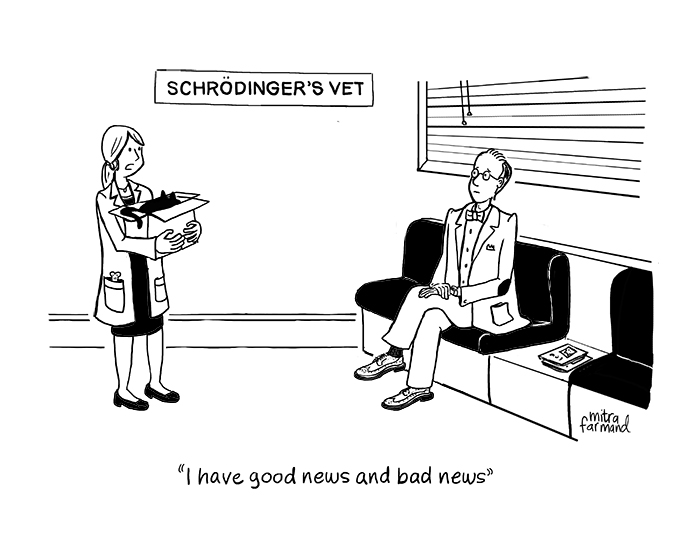
Even now, it's not at all clear what ultimately decides the fate of Schrödinger's cat. [Is it dead, alive, or both?] That hasn't stopped physicists from considering the options.
American physicist Hugh Everett suggested in the 1950s that all possible measures constituted their own reality. What makes this one special is merely the fact you happen to be observing it.
Related video: What if the Universe were just an illusion? (What If)
Universes are like bubbles; beings mostly stay put
Everett's "many worlds" model isn't quite a theory so much as a way of grounding the absolute weirdness of quantum mechanics in something tangible.
We start with an impression of the infinite multiverse of maybes, or what physicists might refer to as the sum of all energies and positions known as a global Hamiltonian, and then zoom in on what interests us, constraining the infinite within a finite and far more manageable Hamiltonian subsystem.
Yet as a means of comprehending the infinite, could this "zooming in" be holding us back? Or as the researchers behind this latest exercise frame it, is it "too provincial an approach, born out of our familiarity with certain macroscopic objects?"
To put it another way, we might readily ask whether Schrödinger's cat is alive or dead inside its box but not consider whether the table beneath is warm or cold or if the box is starting to smell.
In an effort to determine whether our tendency to keep our focus on what's inside the box even matters, the researchers developed an algorithm to consider whether some quantum possibilities known as pointer states might be a little more stubbornly set than others, making some critical properties less likely to entangle.
If so, the box describing Schrödinger's cat is to some degree incomplete unless we're considering a long list of factors that may potentially stretch far across the Universe.
"You can have part of the Earth and the Andromeda galaxy in one subsystem, that's a perfectly legitimate subsystem," UCD physicist Arsalan Adil explained to Karmela Padavic-Callaghan at New Scientist.
Countless worlds in at least 31 categories
In theory, there is no limit to the way subsystems could be defined, adding long lists of states near and far that could fence off a reality in subtly different ways.
Starting with Everett's "many worlds" the team have come up with what they refer to as a "many more worlds" interpretation – taking an infinite set of possibilities and multiplying it with an infinite range of realities that we might not normally consider.
Much as with the original interpretation, this novel take is less a comment on how the Universe behaves but more about our attempts to study it one bite at a time.
The researchers emphasize they haven't attached a lot of conceptual significance to their algorithm but do wonder if it might have applications in developing better ways of probing quantum systems, such as those inside computers.
No doubt in some other reality, they already have their answer. This research is yet to be peer-reviewed and is available on arXiv. More:
The best explanation for this world, which means this universe, was given by an American who went to the Andes to a doorway (portal) carved in stone, near Lake Titicaca. A shaman told him its secrets and taught him the utterances needed to enter. He did it and regretted it. What he found was the beginning of this world. There in a lab along the way, he saw "scientists" trying to control the size of our expanding world so that it did not overtake theirs. Ours started by accident. It's organic and a natural process, not uncommon. Once it gets going, it's inhabited by beings who circle the round of samsara without end. A buddha awakens, discovers the way out. Do we listen?
Multiverse?
O, Buddha, tell me the truth so I can do the math
(Richard Milner/Grunge) So we all know about the multiverse, right? One day a physicist somewhere thought, "Man, I wish I'd played in the NBA instead of sitting around doing math all day," and bam: instant childhood fantasy fulfillment meets theoretical physics
If Einstein asked, the B knew it
Then there's that Marvel movie, that other Marvel movie, and the DC one, and the one with like three Spidermen that was actually pretty solid and better than expected, especially Andrew Garfield.
And somewhere in there, drowning in the morass of fictional portrayals, evidence-less reality, the religious zeal of multiversal proponents, and grounded reservations of skeptics rests the truth of the multiverse: It's not a thing.
Okay, it could be a thing, but only in the way that "God" is a thing because its existence can't be disproven -- yet. But how to gather data on the multiverse? Behold the conundrum:
1) The universe, by definition, is that which contains everything that is and
2) to test for another universe we would have to test outside of all that is; therefore,
Family Guy; BeeyondIdeas, 11/2/23; Pat Macpherson, Dhr. Seven (eds.), Wisdom Quarterly
Hubble did it first even if it didn't do it better. Now Webb is wowing public. Crab Nebula above
"This universe existed before the Big Bang" ft. Roger Penrose
(BeeyondIdeas) Let's unravel the mysteries surrounding (our) Big Bang. Was it truly the beginning of everything?
31 Planes/Zones of Existence
[No, obviously not. In Buddhist cosmology, the universe (multiverse) is aeons (kalpas) old, ordinary aeons and great aeons, of incalculable lengths as the universe arises, expands, disintegrates, goes into a state of chaos, and arises again, cyclically, repeatedly, endlessly.
It is unclear what constitutes a universe, the everything, because there are world systems (cakkavalas), and each world system is similar to the countless others, like bubbles in space. If each constitutes a universe, a self-contained system of planets and stars and a diverse population of creatures, then we live in a multiverse with such universes extending out in 10,000 directions.
There are 31 Planes of Existence, divided into three spheres, our Sensual Sphere, the more subtle Fine Material Sphere above us, and the Immaterial Sphere, which is formless, above that. These 31 Planes are general categories with countless individual worlds and inhabitants. Space is big, very big, and multidimensional, so it's even bigger than we can imagine.
So from a Buddhist cosmological point of view, if a "Big Bang" is the initial point of an expanding universe, this is just a phase after a lengthy period of contraction. After expanding, it dissipates into chaos for a lengthy period. But after a time, it again establishes order and regularity, and this is a new beginning, a Golden Age or Satya Yuga, an Age of Truth. We are currently in a Kali Yuga, but it is hard to say because within these massive cycles there are subcycles, mini periods of revolution, of dark and bright, cycles within cycles.
And it just goes on this way without end and, therefore, without a discernible beginning, which is not to say there was not one, only that it cannot now be found. And we cannot reason our way there. It is one of the Four Imponderables.
One would sooner become deranged, a "mad scientist," before settling on a satisfactory answer. And, in any case, it would not actually be satisfactory, like The God Idea as the cause of all things, with Maha Brahma (the "Great Supremo") as the cause of all things, which the Buddha declared a wrong view.
A creator god is as good as any explanation only because it stops all further searching. It is said that science is ridiculous in positing a Big Bang as a first cause because in doing so it is saying, "Everything is rational, mechanical, explicable, and understandable IF you just give us this one bit of irrational, supernatural, inexplicable, and nonsense Big Bang magic as the cause and origin of everything.]
🔍
Want to support production? Feel free to join our membership at BeeyondIdeas...Special thanks to beloved YouTube members this month: Poca Mine, Powlin Manuel, Gregory Stone, Lord, Saïd Kadi, and Brad Clemmer. 🚀
Experts featured in this video include Roger Penrose and Paul Steinhardt.
#BigBang#Infinity#CyclicUniverse
British astrophysicist Dr. Becky Smethurst, University of Oxford, Christ Church (Dr. Becky on YouTube, July 27, 2023; Sheldon S., CC Liu (eds.), Wisdom Quarterly
Has JWST shown that the universe is TWICE as old as we thought?!
With all the CGI, color enhancements, photographic manipulations, projections, and theoretical mathematical calculations, this slice of heaven/space could be any age (James Webb Telescope)
It's really big: JWST prepped on earth
(Dr. Becky) The great Dr. B. has attitude, doubting that new evidence and explanations for the current data suggest the universe is older than we thought.
A new research study has come out claiming that to explain the massive galaxies found at huge distances in James Webb Space Telescope images, the universe is older than we think, at 26.7 billion years (rather than 13.8 billion years old).
JWST: Note two tiny white ants in foreground.
00:00 - Introduction: #JWST's massive galaxy problem
01:48 - Our current best model of the Universe: λ-CDM
03:16 - The problems with λ-CDM and the "Crisis in Cosmology"
04:28 - Getting distance from redshift
05:13 - A new model of the Universe: a HYBRID of "tired light" and expansion of the Universe
06:25 - The history of "tired light" and why it was eventually dismissed (Tolman Surface Brightness Test)
08:18 - What Gupta (2023) have found
09:30 - The change to the calibration of redshift and distance (and the new age of the Universe)
10:02 - What other problems does this new model help solve?
11:07 - The observational evidence that this new model ignores...
12:39 - How else do we explain JWST's massive galaxy problem? Universal IMF issues
14:35 - Outro: the legacy of JWST
15:23 - Brilliant
16:46 - Bloopers
Video filmed on a Sony ⍺7 IV
This video dives into that study, looking at what model they used to get at that claim (a combination of the expansion of the universe and "tired light" ideas of redshift), how this impacts our best model of the universe and the so-called "Crisis is Cosmology," and why Dr. B. is not yet convinced.
📚 My new book, A Brief History of Black Holes, out NOW in hardback, e-book, and audio (narrated by myself): http://hyperurl.co/DrBecky
📚 The Year In Space celebrating all things space in 2022 from me and the rest of the Supermassive Podcast team: https://geni.us/jNcrw
👕 My new merch, including JWST designs, are available here (with worldwide shipping): https://dr-becky.teemill.com/
🎧 Royal Astronomical Society Podcast I co-host: podfollow.com/supermassive
🔔 Forget to subscribe and click the little bell icon to be notified or don't...
👩🏽💻 ABOUT: I'm Dr. Becky Smethurst, an astrophysicist at the University of Oxford (Christ Church). I love making videos about science with an unnatural level of enthusiasm. I like to focus on how we know things, not just what we know [epistemology], especially the things we still don't know. If you've ever wondered about something in space and couldn't find an answer online, ask me. My day job is to do research into how supermassive black holes can affect the galaxies that they live in. In particular, I look at whether the energy output from the disk of material orbiting around a growing supermassive black hole can stop a galaxy from forming stars.
http://drbecky.uk.com
https://rebeccasmethurst.co.uk
All materials on this site are submitted by editors and readers. All images, unless otherwise noted, were taken from the Internet and are assumed to be in the public domain.
In the event that there is still a problem, issue, or error with copyrighted material, the break of the copyright is unintentional and noncommercial, and the material will be removed immediately upon presented proof.
Contact us by submitting a comment marked "private."
Do not follow this journal if you are under vinaya or parental restrictions. Secure protection by Sucuri.
Wisdom Quarterly: American Buddhist Journal is licensed under a Creative Commons Attribution-Noncommercial-Share Alike 3.0 United States License. Permissions beyond the scope of this license may be available at creativecommons.org/about/licenses.