(The Theory of Samsara) CANADA - I'm done. I can't do this anymore! Why I'm giving up my Western Vajrayana Buddhist monastic robes as a lama.
The Bhavacakra is a Tibetan Buddhist depiction of Saṃsāra, the "Wheel of Life and Death" (the "continued wandering on," cycling through endless rebirths in search of unattainable satisfaction and fulfillment through pleasure).
All things are hurtling towards destruction. If they just ended, that might be all right. Sadly, they will renew, and the suffering (dukkha, "disappointment") will continue. Beings in their becoming (bhava) will continue to wandering, not having made an end of suffering in this life, never having glimpsed nirvana (won the stream).
The same applies to Buddhist monastics (monks and nuns) who fail, fall short of the goal, or quit. Westerners will one day learn the wisdom of the East.
Sangha means "spiritual community"
Take care of one another, monks.
One key is that the monastic experience is a collective one, not a solo endeavor. It would be nice to move into a cave and just meditate. But that is not how the Buddha set up this path-of-practice towards enlightenment (bodhi) and liberation (nirvana) in this very life.
So, sadly, another one bites the dust. This fine Western monk realized too late that going it alone was no way to go. Support is crucial. How crucial is it? One day, the Buddha's attendant, the much-beloved Ven. Ananda realized something, and he went to the Buddha to confirm it.
Venerable sir, it seems to me that half the high life [the life of well-conducted monastic in the Buddha's Dharma] is noble friendship, good companions on this path.
"Do not say so, Ananda, do not say so!" the Buddha scolded Ananda.
Ananda was startled. Surely noble friends (kalyana-mitta) are wonderful companions, helpers, inspirers, guides, supporters, and encouragers along this sometimes-arduous path to awakening.
The Buddha continued, "they are not half the path; they are the whole path!" If only someone had told this fine gentleman before he set off alone on so noble a task as carrying on the tradition.
(Gubba Homestead) Sept. 1, 2026: The doctor who invented the cloudbuster [atmospheric manipulator, not rainmaker] died while in a federal prison for contempt, and the court ordered his research and books was burned.
His name was Wilhelm Reich, a physician and psychoanalyst who spent decades studying what he called "orgone" energy, a force (orgastic potency) he believed moved through living things and the atmosphere.
Dr. Reich designed arrays of hollow metal pipes connected to water and pointed them at the sky. He claimed they could shift atmospheric conditions, dissipate clouds, and even bring rain.
Conspiracy theorist, IG grifter?
(Lea's Off-Grid Perspective) Queen of the Instagram Homesteaders fake?
Do beings have an aura?
In 1953, blueberry growers in Maine paid Dr. Reich after rain followed one of his experiments.
In the mid-1950s, he ran the same tests in the Arizona desert.
Then the FDA came for his medical device orgone accumulators, a federal court issued an injunction, and quantities of his publications were destroyed by burning under court order. He died in detention in 1957.
Gubba has been running her own backyard version of Dr. Reich's work:
copper pipes in the garden,
a gravel basin with water,
blackberries and strawberries responding on the copper side,
skies clearing after wildfire smoke, and
posts about her personal experiences getting flagged and hidden (ghost blocked, censored) online.
On January 6, 1858, The Raftsman Journal published an intriguing article called Antiquities in America, discussing many of the ruins and structures [found] around this continent that have not been discussed by official history... Source: onenewspage.com
There are real "giants" living in Dubai, Middle East?
There's a chemical in dark chocolate (real Theobroma cacao) related to happiness and good sensations. It's also present in mary-jah-wanna, which probably explains why consumers get so clingy and attached to using the herbal substance. This naturally occurring chemical is called anandamide.Ananda, of course, is the name of the Buddha's closest friend and monastic attendant (likely his son with Mriga from before the birth of Rahula with his wife Yasodhara (aka Bimba Devi, according to some Buddhist schools). In Sanskrit and Pali anand means "bliss, joy, rapture." The suffix amide is added: In the usual nomenclature, one adds the term "amide" to the stem of the parent acid's name. For instance, the amide derived from acetic acid is named acetamide (CH3CONH2).
Now, one might be wondering, “What on earth is anandamide, and why should I care?” Well, pull up a chair and grab a square of dark chocolate, because we’re about to embark on a flavor-filled journey into the world of neuroscience and cocoa chemistry. Anandamide, derived from the Sanskrit word ananda, meaning “bliss or joy,” is a naturally occurring compound in our brains. It’s part of the endocannabinoid system, a complex network that helps regulate various bodily functions, including mood, appetite, and pain sensation. In essence, anandamide is the brain’s very own mood-enhancing, stress-busting superhero. But how does this marvelous molecule work its magic? When anandamide binds to specific receptors in our brains, it triggers a cascade of feel-good effects. More
Happiness is literally an inside job, according to scientific materialism, which believes that we are nothing more than material constructs and that the miracle of consciousness is but an epiphenomenon following on the interaction of material objects like cells, chemicals, molecules, and ever smaller atom, electrons, and quarks.
Organized religion errs on the side of spiritualism, believing us to be a "soul," "spirit," or "magical subtlety." These three things are real, but they are not the self any more than consciousness is.
There is nama rupa, "name" (the instructions) and "form" (the carrying out of those instructions in the material sphere). But self (atta) is not that. How else could it be? If it not one, it has to be the other, unless it is both? It is both both and neither.
What we regard as "self" (soul, ego) is mind-and-body, but though mental and physical processes exist and are active, they do not amount to a concrete "self."
The "self" that exists is dependent, temporary, ephemeral subject to Three Characteristics of All Conditioned Things: they are impermanent, incapable of satiating/fulfilling, and are impersonal.
This last characteristic is the one that is impossible to believe, but it is the key to awakening/enlightenment in the Buddha's teaching.
We can see that all things are impermanent, in flux, constantly changing, undependable. We can see that we have never been fulfilled for long; we experience great pleasure but remain hungry, in many cases becoming more hungry for newer and better pleasures.
IF THERE IS NO SELF, WHAT IS THERE THEN? The Buddha answered this question in terms of Dependent Origination (paticca-samuppāda). And it is on account of not seeing this, not grasping, not penetrating this that we have wandered so long in this painful samsara.
Will we fall under the spell of scient-ism, run to religion for shelter, or begin to see what the Buddha was getting at when he encouraged us to strive for calm and liberating-insight?
"Science can prove what it says." Can it? It redefines "happiness" as an endorphin then shows a peptide "walking," and viola, nonmaterialistic Buddhism is wrong? That's how it might seem, but it is not the case. We must look more deeply. Science fails us. And coming and seeing and investigating what the Buddha taught liberates us. Try it.
Buddha's Brain: The Practical Neuroscience of Happiness, Love, and Wisdom
Change your brain, change your life with this essential classic from New York Times bestselling author Dr. Rick Hanson—now celebrating 15 years in print with more than 500,000 copies sold.
Great teachers like the historical Buddha, Jesus, Moses, Mohammed, and Gandhi were all born with brains built essentially like everyone else’s—and then they changed their brains in ways that changed the world.
Neuroscience now reveals how the flow of thoughts actually sculpts the brain. More and more, we are learning that it’s possible to strengthen positive brain states.
By combining breakthroughs in science with insights from thousands of years of mindfulness practice, we too can shape our own “Buddha’s Brain” for greater happiness, love, and wisdom.
Buddha’s Brain draws on evidence-based neuroscience to show readers how to stimulate their brains for
more fulfilling relationships,
a deeper spiritual life, and
a greater sense of inner confidence and self-worth.
Using guided meditations and mindfulness exercises, learn how to activate the brain states of calm, joy, and compassion instead of worry, sorrow, and anger.
Most importantly, anyone who implements these practices will foster positive psychological growth that will literally change the way life is lived day-to-day.
This book provides an essential intersection of psychology, neurology, and contemplative practice. It’s filled with practical tools and skills useful every day to tap into the unused potential of the brain and rewire it over time for greater well-being. More
Hey, can I be the next pope? - Get real, Don. - C'mon, Jorgie, who cares? Can I be Antipope?
(CBS News) April 26, 2025: Who will be the next pope? Here's a look at some of the top possible papal candidates as the cardinals prepare for the papal conclave (Latin for "with key," i.e., "behind locked doors"), which will take place in early May, likely after Cinco de Mayo. They promise to start on May 7, 2025.
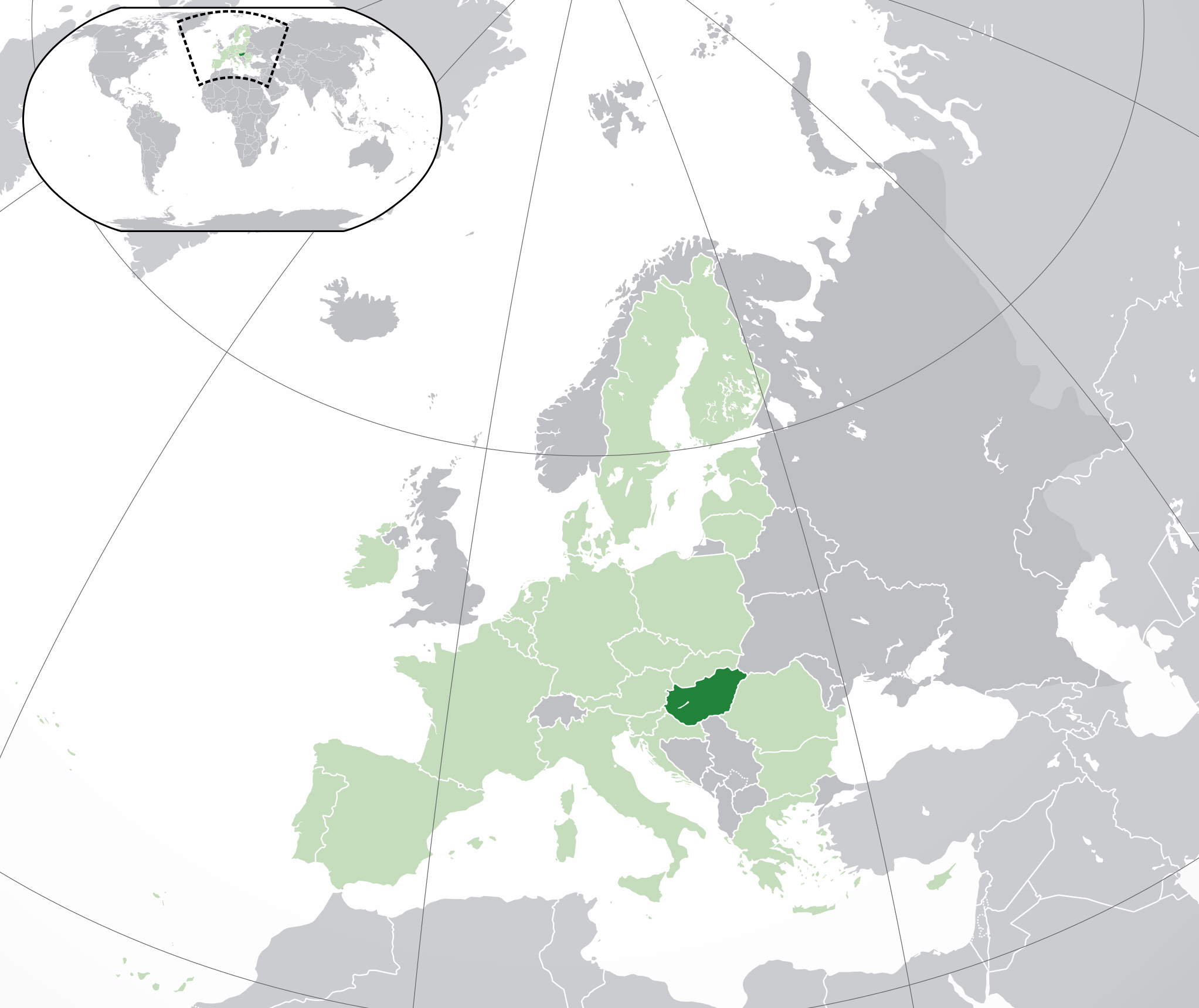
Hungary is a landlocked Central European country not far from Italy (ancient Rome). Spanning much of the Carpathian Basin, it is bordered by Slovakia to the north, Ukraine to the northeast, Romania to the east and southeast, Serbia to the south, Croatia and Slovenia to the southwest, and Austria to the west.
Hungary lies within the drainage basin of the Danube River and is dominated by great lowland plains. It has a population of 9.6 million, consisting mostly of ethnic Hungarians and a significant Romani minority.
Hungarian is the official language; it is among the few in Europe that lies outside the Indo-European family of languages [13].
Budapest is the country's capital and its largest city, the dominant cultural and economic center [14, 15]. Prior to the foundation of the Hungarian state, various peoples settled in the territory of present-day Hungary, including the Romans, Celts, Huns, Germanic peoples, Avars, and Slavs.
Hungarian statehood is traced to the Principality of Hungary, which was established in the late 9th century by Álmos and his son Árpád through the conquest of the Carpathian Basin [16, 17].
King Stephen I ascended the throne in 1000 and forcibly converted his realm into a Christian kingdom.
The medieval Kingdom of Hungary was a European power, reaching its height in the Late Middle Ages [18]. MoreCould anyone from modern Hungary be reasonably referred to as a "Roman"? If so and such a person bore the name "Peter," that would make that man "Peter the Roman" for predictive purposes, making Saint Malachy close enough in his ancient prediction.
The funniest thing about the upcoming papal conclave is the FACT that anyone can be installed as pope. One only has to have been confirmed as a Catholic after First Communion, which doesn't actually mean one has to be a Catholic, just in official records. One could be confirmed now, before beginning. One could be the most popular kind of Catholic: Lapsed. Unlapse or say you're back. Oh, yeah, though -- most Catholics don't qualify. Boys only. It's an Old Boys' Club. It's the original corporation, all top-down hierarchy and a strict Patriarchy. Even though it can be anyone, the cardinals always pick a fellow cardinal. Go figure.
Prophecy of the Popes: Petrus Romanus (aka a dark skinned "Peter the Roman"?) Says who? Says Irish Catholic Saint Malachy: Prophetia Sancti Malachiae Archiepiscopi, de Summis Pontificibus (the "Prophecy of Saint-Archbishop Malachy, concerning the Supreme Pontiffs")
Never mind the Virgin Mary. Like the name of a ship, most of which are by convention named after females, she's just for show. Anyway, it has already been decided, and this conclave business is all for show. Heard about the smoke? The color of it will tell if it's black or white. Isn't that a lovely imperial Roman custom? Who knew the Holy (See)Roman Empire (religious arm), as part of the Ring of Power and the Empire of the City, still ruled the world alongside Washington DC (military arm) and London's high-street (financial arm)?
CBS News 24/7 is the self-aggrandizing anchored streaming news service from CBS News and Stations that is available free to everyone with access to the internet and is the destination for breaking news, live events, original reporting and storytelling, and programs from CBS News and Stations' top anchors and correspondents working locally, nationally, and around the plane of the earth. It is available on more than 30 platforms across mobile, desktop, and connected TVs for free, as well as CBSNews.com and Paramount+ and live in 91 countries.
What in the world do you mean four? Half are gone, and there were only ever five. The Fifth Beatle (Brian Epstein or any of the others) didn't even play, just managed.
He can manage again, if he's around. There's the real Paul McCarthy living a peaceful life in England:
There's pretty boy Pete Best still cashing checks for a little sessions work, replacement Ringo Starkey doing everything he can to prove he was a Beatle after all, like this great song:
And there's Fake Paul, touring and making speeches like always:
The son of Yoko "Chuck Berry Fan" Ono and John Lennon, Julian, the inspiration for the song "Hey Jude." That's more than enough to reform and go out on tour, maybe even make a few mega mass selling singles with the help of AI, psychics (in touch with George and John in the beyond), and old found tapes that can be developed into something:
(YouTube Movies & TV)
Based on a true story, Jeremy Irons and Dev Patel star in this inspirational film about an obscure Indian mathematician whose groundbreaking theories changed mathematics forever.
The Goddess told me these secrets.
If the genius author (the modern rishiSrinivasa Ramanujan) is to be taken at his word, it is not his genius but that of his Hindu GoddessNamagiri Thayar who imparted pure math knowledge and insights. She is said to be an avatar or incarnation of Lakshmi Narayana, though the titular goddess of knowledge and learning in the Hindu pantheon is said to be the great Saraswati (who together with Parvati and Lakshmi form a trinity known as Tridevi).
Indian math genius Srinivasa Ramanujan Aiyangar[a] (Dec. 22, 1887–April 26, 1920) was an Indian mathematician often regarded as one of the greatest mathematicians of all time. He had almost no formal training in pure mathematics. Yet, he made substantial contributions to mathematical analysis, number theory, infinite series, and continued fractions, including solutions to mathematical problems then considered unsolvable. Ramanujan initially developed his own mathematical research in isolation. According to Hans Eysenck, "he tried to interest the leading professional mathematicians in his work, but failed for the most part. What he had to show them was too novel, too unfamiliar, and additionally presented in unusual ways; they could not be bothered." More
The Man Who Knew Infinity is a 2015 British biographical dramatic film about the Indian mathematician Srinivasa Ramanujan, based on the 1991 book of the same name by Robert Kanigel. The film stars Dev Patel as the real-life mathematician who, after growing up poor in Madras, India, earns admittance to England's Cambridge University during World War I, where he becomes a pioneer in mathematical theories with the guidance of his professor, G. H. Hardy, portrayed by Jeremy Irons.
Fraulein Sabine, authors did not account for my quote on Buddhism so could not see big picture
A new theory of everything just dropped
(Wisecrack) The philosophy of Everything Everywhere All At Once, a kind of "theory of everything"
(Sabine Hossenfelder)
Sept. 9, 2024: Queen Sabine got a bunch of requests to comment on a new attempt at a theory of everything (unified field theory) that supposedly combines quantum physics with general relativity.
She had a look, a laugh, and this quick comment: It's basically a first reaction since she didn't get very far into the paper, as viewers will see. She is sorry if she appears unkind, but this kind of junk science really p*ss*s her off. It's junk, worse than junk, not peer reviewed by assigned reviewers, not even copyedited (corrected for simple errors), just "cr*p,"
✪ Members first on September 9, 2024 #science #sciencenews #physics. Learn maths and science on Brilliant! Use this link and get the first 30 days free, plus get 20% off an annual premium subscription ➜ brilliant.org/sabine.
All materials on this site are submitted by editors and readers. All images, unless otherwise noted, were taken from the Internet and are assumed to be in the public domain.
In the event that there is still a problem, issue, or error with copyrighted material, the break of the copyright is unintentional and noncommercial, and the material will be removed immediately upon presented proof.
Contact us by submitting a comment marked "private."
Do not follow this journal if you are under vinaya or parental restrictions. Secure protection by Sucuri.
Wisdom Quarterly: American Buddhist Journal is licensed under a Creative Commons Attribution-Noncommercial-Share Alike 3.0 United States License. Permissions beyond the scope of this license may be available at creativecommons.org/about/licenses.


.jpg)


_(8224052279).jpg)

%20by%20wilhelm%20reich,%20wiki.JPG)


.jpg)


%20wiki.jpg)


.jpg)





















































.jpg)