Candi temples: A candi (from Kawi caṇḍi [1]) is a Hindu or Buddhist temple in Indonesia, mostly built during the Zaman Hindu-Buddha or "Hindu-Buddhist period" between the 4th and 15th centuries.
Does the Indonesian yakkhaor "Bigfoot"(Orang Pendek) live in these jungles protecting natural resources?
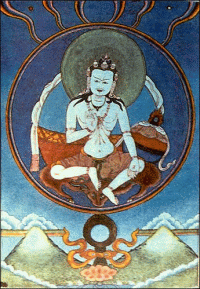
Vajrapani (Sanskrit Vajrapāṇi, Pali Vajirapāṇi, "holder of the thunderbolt," lit. meaning, "Vajra in [one's] hand") is one of the earliest-appearing bodhisattva in various sub-schools of Mahayana Buddhism.
He is alleged to be the protector and guide of the historical Buddha Gautama and rose to symbolize the Buddha's power.
Vajrapāni is also called Chana Dorje and Chador and extensively represented in Buddhist iconography as one of the earliest three protective deities or bodhisattvas surrounding the Buddha. Each of them symbolizes one of the Buddha's virtues... More
While sounding like a madman at first, the great Krishnamurti actually has a point to make about "efforting," muscling, struggling, and striving to gain or win enlightenment. Buddhist awakening (bodhi) is far more about letting go of delusion, confusion, and illusion and instead gently cultivating allowing, radical acceptance of what is, and dispassionate (disinterested, unbiased) viewing like some kind of Taoist, being the watcher rather than the striver or go-getter.
Of course, Krishnamurti was more a Hindu than a Buddhist, having escaped the clutches of the Western Theosophists who found him, saw his potential, raised and nurtured their new Messiah (Maitreya) in hopes that he would become a "Buddha" or "World Teacher" for our time (like the promised Buddha Boy decades later).
But he burned them and instead taught a whole kind of Zen nondoing, nothing special, there's nothing to achieve approach to spirituality and spiritual (un)accomplishments. The Theosophists were not happy, so Krishnamurti went off on his own, not aligning himself with any religion but sort of incorporating them all into a syncretism.
He's a subtle speaker and thinker, along the lines of Bhagwan Shree Rajnessh (Osho) and Sadhguru Jaggi Vasudev, both alleged to be frauds immersed in sex and money scandals. We would not want to misrepresent Krishnamurti's views, if he holds any, as he can quite well speak for himself. Like the great Mahavira (Vardhamāna, the founder of Jainism, called the NiganthaNattaputta in Buddhist texts), Krishnamurti must have some good qualities that he is still remembered and listened to.
LYRICS "Death Certificate" (by Carcass): A grim myriad/ A grey kaleidoscope/ Sterile, contrasting/ Born and die/ Institutionalized/ A bleak epitaph/ An epilogue so sad
"Zen" is a silly word, carrying so much meaning in American English. Goodness knows what it means in Japan or China nowadays, a dying religious sect taking sides in the jiriki vs. hariki battle?
We aim to find on Thursdays in Los Angeles at the Pasadena Zen Sangha. There is a path. What is it? Ask the average American Zen practitioner, and everything likely to be heard will be some derivation of Taoism. No relation to the historical Buddha. Lao Tzu (, Latin Lacious)
Buddha Yoga: Cultivating the Yoga Path of the Buddhas, Bodhisattvas, and Guardian Spirits
Author William Bodri has 4.9 out of 5 stars (with 17 reviews).
The path to enlightenment, self-realization, moksha ("spiritual liberation") is essentially a path of yoga.
Specifically, this path of “Buddha Yoga” entails both mental meditation practice and inner cultivation of the Qi (chi) or prana within our body so that we can attain the first fruit of the spiritual path, which is an independent spiritual body that can leave the physical body at will.
Buddha Yoga is also a pathway that requires us to polish our mind and behavior so that we can achieve the purity of virtue in thought, word, and deed.
Regardless of our religion and hard work at spiritual training, most people will not achieve the initial fruit of the spiritual path because we usually lack the proper instructions and devotion to effective spiritual practice efforts.
The most we can then hope for is success in some afterlife, during which time we can choose to become bodhisattva protectors or guardian spirits for all sorts of earthly activities.
That being the case, this book teaches ordinary people how to properly perform spiritual practices and how readers can most effectively train to become a guardian spirit, buddha, or bodhisattva of one's own choosing.
This includes spiritual careers as protectors of nations, cities, people’s health, wealth, agriculture, and so forth.
It reviews common spiritual teachings about the origin of the universe and consciousness, helps readers
decide on a specific life purpose(s) within this life,
delineates the yoga practice methods for cultivating the physical body and stages of emptiness meditation required of Buddha Yoga,
goes over several foundational topics of study for becoming various types of guardian spirits or bodhisattva protectors for humanity, and
reveals how religious professionals can better help greater society through certain forms of self-study.
A tour de force, the book contains countless practical topics, serving as a training guide for various types, and it also "reveals" how spiritual leaders can more easily raise money for their centers. More
Correcting Zen: Reforming Buddhist Practice According to Lost Buddhist Principles
Author William Bodri has 4.3 out of 5 stars (with 18 reviews). When Buddhism first arose in India (and ancient Afghanistan, called Gandhara) it collected and espoused a number of the best meditation and inner energy cultivation techniques of its day.
However, many of the principles behind these practices have become lost over time, sometimes because they are considered "secret" in Buddhism's later esoteric traditions.
When Buddhism first entered China and the majority of its teachings were as yet still untranslated, a large number of practitioners were still able to attain enlightenment without depending on sutras because those individuals primarily relied on just two cultivation techniques that had been transmitted, anapana inner breath (energy) work and the white skeleton bone visualization practice.
Buddhism today rarely produces enlightened sages as it did in the beginning because its training curriculum is now inadequate in inner energy work, breathing practices, and mindfulness work, visualization efforts, immeasurable meditations, mantra-yana, stretching exercises, self-rectification, and Buddha vows.
This work helps restore many of the lost principles for these practices that were once responsible for Buddhism’s previous great success in producing countless enlightened masters.
These instructions of highly effective enlightenment practices are for the benefit of all people, of all traditions and religions, who are seeking spiritual attainments and who desire the quickest pathway of sequential steps and practices for attainment. More
William Bodri, April 13, 2019, Jan. 20, 2023; Amber Larson, CC Liu, Dhr. Seven (eds.), Wisdom Quarterly
Q: Wisdom Quarterly, what religion was Alan Watts?
A: While he speaks like a Hindu professing Advaita Vedanta at every turn, and often explains Zen and Mahayana concepts quite nicely, with a grasp of Theravada, by his own admission he seemed to love Taoism best of all, although born Christian and ordained as an Episcopalian priest rather than a Buddhist monk as was his early ambition in the Buddhist Society of London with Christmas Humphreys and other prominent Western Buddhists. He was an early voice in the West for explaining and interpreting Eastern philosophy for Western ears, particularly those of Beats and Hippies, remarkably ahead of his time, openminded, and quite a New Ager. We love him because he has been with us all of our adult lives through Berkeley's KPFA FM, KQED (TV), and he continues to inspire through KPFK FM in Los Angeles (Sunday mornings at 8:00 am and Thursdays at midnight) and the invaluable preservation work of Roy of Hollywood Tuckman.
Dalit B. R. Ambedkar, an Indian social reformer and politician who came from a social group that was considered "untouchable," theorized that untouchability originated because of the deliberate policy of the elitist Brahmins (brahmanas).
According to him, the Brahmins despised the people who gave up Brahmanism (the Brahminical religion) in favor of Buddhism or Jainism (shramana, "wandering ascetic" shamanic traditions).
Later scholars such as Vivekanand Jha have refuted this theory [10]. Professor of History Nripendra Kumar Dutt theorized that the concept of untouchability originated from the "pariah"-like treatment accorded to the indigenous people of India by the early Dravidians, and that the concept was borrowed by the Indo-Aryans from the Dravidians.
Scholars such as R. S. Sharma have rejected this theory, arguing that there is no evidence that Dravidians practiced untouchability before coming into contact with the Indo-Aryans [10]. Austrian ethnologist Christoph von Fürer-Haimendorf theorized that untouchability originated as class stratification in urban areas of the Indus Valley Civilization. According to this theory, the poorer workers involved in "unclean" occupations such as sweeping or leather work were historically segregated and banished outside the city limits. Over time, personal cleanliness came to be identified with "purity," and the concept of untouchability eventually spread to rural areas as well. After the decline of the Indus Valley towns, these "untouchables" probably spread to other parts of India [11].
Scholars such as Suvira Jaiswal reject this theory, arguing that it lacks evidence and does not explain why the concept of untouchability is more pronounced in rural areas [12].
American scholar George L. Hart, based on his interpretation of Old Tamil texts such as Purananuru, traced the origin of untouchability to ancient Tamil society. According to him, in this society, certain occupational groups were thought to be involved in controlling the malevolent supernatural forces; as an example, Hart mentions the Paraiyars, who played the drums during battles and solemn events such as births and deaths. People from these occupational groups came to be avoided by others, who believed that they were "dangerous and had the power to pollute the others" [13].
Jaiswal dismisses the evidence produced by Hart as "extremely weak" and contradictory. Jaiswal points out that the authors of the ancient Tamil texts included several Brahmanas (a fact accepted by Hart); thus, the society described in these texts was already under Brahmanical influence and could have borrowed the concept of untouchability from Brahmins [14]. More
A god (brahmā) known as Baka once reflected privately that he
and his heavenly plane of existence were everlasting. He thought that it was not possible that there could be a higher plane of rebirth and was therefore convinced
he had overcome all rebirth and suffering.
The Buddha discerned his deep-seated wrong view and decided out of sympathy to pay Baka a visit in his heaven. When the Buddha appeared in that brahmā world, Baka Brahmā welcomed
him formally but immediately announced:
“Now, good sir, this [place] is permanent, this is everlasting,
this is eternal, this is total, this is not subject to pass
away; for this neither is born nor ages nor dies nor
passes away nor reappears, and beyond this there is
no escape”
(MN 49).
The Buddha, however, contradicted him, pointing out that
every one of his claims was wrong. Just then Māra the Tempter [a kind of Lucifer figure] joined their conversation. Māra’s task is to prevent
beings from being won over to the Dhamma, to keep them
trapped in the cycle of rebirth and death, what Mara views as his personal
domain [11].
Taking possession of one of the brahmā’s attendants, Māra
urged the Buddha, with a display of sympathy, to accept
this brahmā as God, the creator of all other beings.
He told the
Buddha that wandering ascetics of the past who delighted in things of
this life and “who lauded Brahmā” won happy rebirths
afterwards, while those who disbelieved and rejected Brahmā had to endure
terrible punishment [in hells].
The Awakened One (the Buddha) let Mara have his say
and then called his bluff:
“I know you, Evil One. Do not think, ’He does not know me.’ You are Māra, Evil One, and the Brahmā
and his assembly and the members of the assembly
have all fallen into your hands, they have all fallen
under your power. You, Evil One, think, ’This one, too, has fallen into my hands. He, too, has fallen under my
power.’ But I have not fallen into your hands, Evil
One. I have not fallen under your power.”
“All beings subject to craving—humans, subhumans, devas (celestial deities),
or brahmās (grand divinities)—are said to be under Māra’s power because they
can all be moved by their mental defilements and must drift along in the
current of rebirth and death.
But the Buddha and the other arahants (fully enlightened ones) have permanently and completely escaped Māra’s
circle of influence, for they have eliminated all defilements.
They have exhausted the fuel that leads to rebirth and thus have
vanquished the Lord of Death (Mara).
Baka Brahmā begins to speak on his own behalf. He reminds the Buddha of his opening statement on permanence. He
warns him that it is futile to seek “an escape beyond” his
own brahma realm. Then he cajoles and threatens the Buddha in the same
breath:
“If you will hold to earth… beings… gods… you
will be close to me, within my domain, for me to work my
will upon and punish.”
The Buddha agrees that if he clung
to earth (or any other aspect of existence) he would remain
under the control of Mahā Brahmā ("Great Supremo") and Māra, too, but he
adds:
“I understand that your reach and sway extend
thus: Baka the Brahmā has this much power, this much
might, this much influence.”
The Buddha points out that beyond the thousandfold world system over which Baka
reigns there are planes of existence of which Baka is totally
unaware, and beyond all conditioned phenomena there is a
reality that transcends even “the allness of the all”—a
consciousness without manifestation, boundless, luminous
on all sides—to which Baka has no access whatsoever.
The Buddha, demonstrating
his superiority in knowledge and power, then uses
his superior psychic powers to humble Baka in front of his entire assembly.
By the end of the discourse, these once haughty divine beings
marvel at the might of the wandering ascetic Gotama:
“Though living
in a generation that delights in being…he has extirpated
being [becoming, bhava] and its root” [12].
A brahmā with wrong view
Once an unnamed brahmā gave rise to this deluded thought:
“No ascetic is powerful enough to reach my [divine] realm.”
The
Buddha read his mind and proved him wrong by simply
appearing before him and sitting at ease in the air above his
head, while radiating flames from his body in a dramatic
display of supernormal powers.
Four great arahant (fully enlightened) disciples—Mahā Moggallāna (the monk the Buddha declared "foremost in psychic powers" among his disciples), Kassapa, Kappina, and
Anuruddha—independently realized what had happened
and decided to join their Teacher on this divine brahmā plane.
Each
disciple sat cross-legged in the air respectfully below the Buddha—but
above that brahmā—in one of the cardinal directions,
emitting fire around himself.
A short dialogue in verse took place between
Mahā Moggallāna, the Buddha’s second chief male disciple, and that brahmā:
“Today, friend, do you still hold that view,
The same view that you formerly held?
Do you see a radiance
Surpassing that in the brahma-world?”
“I no longer hold that view, dear sir,
[I reject] the view I formerly held.
Indeed, I see a radiance
Surpassing that in the brahma-world?”
Today how could I assert the view
That I am permanent and eternal?”
According to the Commentary (tika) to this story, the brahmā gave
up his wrong view, his wrong belief in his own superiority when he observed the
magnificence of the Buddha and a few of his arahants.
When the
Buddha preached the Dhamma to him, that brahma was established
in the fruit of stream-entry and stopped thinking of himself
as permanent.
When this brahmā saw his own [radical] impermanence clearly and distinctly for himself, his former
tenacious wrong view, wrong opinion that his world and life were immortal was
uprooted.
Many aeons of preparation, the brahmā’s quick
intellect, the Buddha’s perfect timing, and the support of the
four arahants bore fruit in this divinity becoming a stream
enterer (one who has reached the first stage of awakening).
After the Buddha and those arahants left and returned to
Jetavana, the great brahmā wanted to learn more about the
powers of Buddhist monastics. He sent a member of his retinue to ask Mahā Moggallāna whether there are even more monastics of this teacher who can perform such feats as he can. Maha Moggallāna replied:
“Many are the disciples of the Buddha
Who are arahants with taints destroyed,
Triple knowledge bearers with spiritual powers,
Skilled in the course of others’ minds”
(KS I, 182–84; SN 6:5).
Not only do large numbers of monastics have such special
powers and the ability to know other people’s minds, but
there are numerous fully purified arahant disciples of the
Buddha as well. The emissary was glad to hear this answer,
as was that brahmā when he received the report. Source
(Neo Dharmism) Colonialism rewrote Hinduism [all of the traditions found along the Indus balled up and turned into a "religion" by the British, having also been systematized and more or less unified byAdi Shankara-acharya]: Here's what European scholars erased
"Hinduism" (which calls itself the Sanātana Dharma or "Eternal Truth") traces its roots back thousands of years to Brahmanism (the tradition of the educated Brahmin priestly caste) and the Old Vedic Religion derived from the Vedas.
Kuladevata (Sanskrit कुलदेवता, Romanized Kuladevatā, lit. "clan deity," a minor god or goddess) [1], also known as a kuladaivaṃ (Malayalam കുലദൈവം, Telugu కులదైవం) [2], an ancestral "tutelary deity" in Hinduism and Jainism [3].
Such a deity (devi, deva, devata) is often the object of one's spiritual devotion (bhakti) and is coaxed to watch over one's clan (kula), lineage (gotra), family, and children to protect them from misfortune.
This is distinct from an ishta-devata ("personal tutelar") and a grāma-devatā ("village deities") [4].
A male deity is called a kula-deva and female deity kula-devi (sometimes spelled kuldev or kuldevi respectively, particularly since Hindi drops many of the a's overly used in Sanskrit) [5].
ETYMOLOGY: The word kuladevata is derived from two words, kula, meaning "clan," and devata, meaning "deity," referring to the ancestral deities that are worshipped by particular clans [6]. More
Four female enlightened masters who went completely “insane”
Taoist Master Sun Bu'er
(Asangoham) May 28, 2026: #egodeath #consciousness #nonduality Four women throughout history were called "insane," possessed, and heretical. But each one had broken through to a level of awakening most people never touch.
This is the story of mystics who looked mad on the outside but were actually living proof of the deepest spiritual truths ever discovered.
1. Sun Bu'er destroyed her own beauty to escape the prison of the ego and became the only woman among the Seven Immortals of Taoism.
ANSWER (by Gurudev @SriSriRaviShankar ji): "I am not this," that is what Asangoham means. For example, I am wearing the cloth, but I am not the cloth...I am not the body. I am not the thoughts, I am not the mind. Like this you go on to negate one by one all the layers of identity. And finally when you ask, "Who am I?" You will find nothing. "I am nothing..." That is what Asangoham is. Sangoham means "being one with it." If I think I am my clothes, then that is a problem. I am beyond all these layers of existence. If I think that I am my thoughts, my emotions, my sensations then I lose track of my vast nature. Therefore, to reach the realization of our vastness we say, "I am not this and I am not th[at]," repeatedly.
Gurudev sings: Mano Budhyahankaar Chittani Naaham, Na Cha Shrotra Jihve Na Cha Ghraana netre Na Cha Vyoma Bhumir Na Tejo Na Vayuh, Chidananda Rupah Shivoham Shivoham (from the Atma-shatkam by Adi Shankara-Acharya): "I am not the mind, intellect, memory, or ego. I am not this, not this, not this. This is the way of negating and going into that hollow and empty space. This shiva tattva is what I really am. This realization is what meditation is, that is samadhi.
[EDITOR'S NOTE: Buddhism goes further to the realization that ANY identification is in error, and because there is no-self (no-atman, anatta, no soul, no self, no ego to cling to, in the ultimate sense, one lets go, ceases to cling, as is liberated to Truth, to enlightenment, to nirvana). But because the Old Vedic Religion and later Hinduism are not aware of this, they call Atma-shatkamNirvana-shatkam as this level of "self realization" is the highest attainable for them. Were they to practice in line with what "Lord Buddha" taught, they might well make an end of all further rebirth and suffering, but ordinary worldlings, even the spiritual kind, are not interested in that. They long for rebirth in the heaven they deem supreme, the World of Brahma, and fail to grasp what Brahman is. No one should ever mistakenly think Vedic Hinduism and Buddhism teach the same thing. They are worlds apart for all their shared language and history.]
2. Anandamayi Ma surrendered her freewill so completely that she became a living puppet of the divine.
4. Bernadette Roberts [CarmeliteCatholicnun] lost God, lost her self, and walked straight into the void to discover the raw truth of pure consciousness.
“Only God is love, and for this love to be fully realized self must step aside. And not only do we not need a self to love God, but for the same reason we do not need a mind to know [God], for that in us which knows God, is God.”
This deep dive explores non-duality, ego death, enlightenment, and the terrifying spiritual awakenings that the world mistook for insanity.
Drawn to Advaita Vedanta (nondualism), Taoist internal alchemy, Christian mysticism, consciousness, and the [true] nature of the self? This journey into the minds of history's (herstory's) most misunderstood mystics will stay with you.
Subscribe to Asangoham for more on consciousness, spirituality, enlightenment, and the hidden masters who saw through the illusion.
DISCLAIMER 01: All ideas expressed on this channel are for entertainment and general information purposes only. There is no advice on what an individual should or should not do. Any response made by anyone after hearing this communication is their interpretation and is their responsibility. Ideas expressed by this channel should not be treated as a substitute for medical advice or professional help. If expert assistance or counselling is needed, the services of a competent professional should be sought.
All materials on this site are submitted by editors and readers. All images, unless otherwise noted, were taken from the Internet and are assumed to be in the public domain.
In the event that there is still a problem, issue, or error with copyrighted material, the break of the copyright is unintentional and noncommercial, and the material will be removed immediately upon presented proof.
Contact us by submitting a comment marked "private."
Do not follow this journal if you are under vinaya or parental restrictions. Secure protection by Sucuri.
Wisdom Quarterly: American Buddhist Journal is licensed under a Creative Commons Attribution-Noncommercial-Share Alike 3.0 United States License. Permissions beyond the scope of this license may be available at creativecommons.org/about/licenses.