
(Natasha Yehenara) Did the Buddha actually say this? The mystery of the Mahayana sutras [that displaced authentic historical Buddha texts with Hindu syncretism and a Brahmin-subverted movement to push the Buddha out and bring back the Old Vedic Religion]
Showing posts with label schism. Show all posts
Showing posts with label schism. Show all posts
Saturday, July 11, 2026


Monday, April 13, 2026
Buddhism split: Mahayana emerged
(Buddha's Wisdom) Heretical new texts turn the historical Buddha Shakyamuni's Dharma (Doctrine) on its head, infusing it with the Old Vedic Religion of the Brahmins, Taoism, Hinduism, and later thought, sometimes directly opposing what Gautama Buddha taught about nirvana and samsara and many other things, including the Ten Perfections (reduced by Mahayana to six) and the 31 Planes of Existence (reduced to six)...
Tuesday, July 16, 2019
How to meditate on July 16 (Ajahn Chah)

 |
| J.D. Salinger publishes seminal novel The Catcher in the Rye, July 16, 1951. See below. |


Meditating

In the beginning, just concentrate on allowing the mind to be calm and peaceful. Whether sitting in a chair, riding in a car, taking a boat ride, or wherever you happen to be, get proficient enough in meditation that you can enter a state of peace at will.
When you get on a train and sit down, quickly bring your mind to a state of peace. Wherever you are, you can always sit. This level of proficiency indicates that you’re becoming familiar with the Path. Once calm, investigate. Utilize the power of this peaceful mind to investigate what you experience.
At times it’s what you see; at times what you hear, smell, taste, feel with the body, or think and feel in the heart.
Whatever sensory experience presents itself -- whether we like it or not -- take that up for contemplation.
Simply know what you are experiencing. Don’t project meaning or interpretations onto those objects of sense awareness. If it’s good, just know that it’s good. If it’s bad, just know that it’s bad. This is conventional reality. Good or evil, it’s all impermanent, disappointing (unfulfilling), and impersonal (not self).
It’s all undependable, uncertain, in flux. None of it is worth being grasped or clung to.
July 16, 1951: A teenager is expelled from school and travels to New York City to spend a few days wandering around. Out of this deceptively simple plotline, J.D. Salinger weaves an archetypal tale of teenage angst in The Catcher in the Rye, a novel published today that will be hailed and censored in equal measure. More
July 16, 1054: The conflict between the Latin West and Greek East divisions of the Christian church heats up when a Papal writ of excommunication is placed by Western Roman legates on the altar of the Hagia Sofia, the holy site of the Christian East. It's the first major crack that will end in a total break some 100 years later.
Wednesday, September 24, 2014
"The Bodhisattva Ideal"
Dhr. Seven and CC Liu, Wisdom Quarterly; Buddhist Publication Society (BPS.lk)
 |
| Buddhist devotion of the Hindu-influenced Mahayana movement (Kazempson/flickr) |
.
 The Bodhisattva Ideal: Essays on the Emergence of Mahayana brings together six essays listed below on the origin and history of the bodhisattva ideal and the emergence of the Mahāyana.
[A bodhisattva is an "enlightenment being" or a "being bent on gaining supreme enlightenment," that is, buddhahood. And Mahayana is the "Great Vehicle" school, sometimes also referred to as Northern Buddhism].
The essays approach the subject from different perspectives -- scholarly examinations of the terms in the Nikayas and Agamas (ancient collections of sacred Buddhist texts) to the relationship of the bodhisattva ideal and the arhat ideal (personal enlightenment).
This division is explored within the broader context of the social environment in which Mahayana formed and further developments that lead to the formulation of the full-fledged bodhisattva path.
As such, this collection of essays provides a good overview for a wider Buddhist readership of the history of changes that eventually led to the emergence of the Mahayana.
 |
| Mahayana Buddhist images Buddha, Kwan Yin, arhats (Pauloslachevsky/flickr) |
THE SIX ESSAYS
- “Arahants, Buddhas and Bodhisattvas” (famed American scholar-monk Bhikkhu Bodhi)
- “The Bodhisattva Ideal in Theravāda Theory and Practice” (Jeffrey Samuels)
- “Bodhi and Arahattaphala From Early Buddhism to Early Mahāyāna” (Karel Werner)
- “Vaidalya, Mahāyāna, and Bodhisatva in India: An Essay Towards Historical Understanding” (Peter Skilling)
- “The Evolution of the Bodhisattva concept in Early Buddhist Canonical Literature” (Bhikkhu Anālayo)
- “Orality, writing and authority in South Asian Buddhism: Visionary Literature and the Struggle for Legitimacy in the Mahāyāna” (David McMahan)

- Available from Buddhist Publication Society
- $5.50 (US), 275 (Rs) Sri Lankan rupees
- Tel: +94 81 2237283
Fax: +94 81 2223679
e-mail: bps@bps.lkBuddhist Publication Society
P.O. Box 61, 54 Sangharaja Mawatha
Kandy, Sri Lanka
- NASA's probe MAVEN enters orbit around Mars [home planet of the Chinese] to study atmosphere
- Chinese e-commerce company Alibaba Group raises US$25 billion on the New York Stock Exchange, in the largest ever initial public offering
- Fluorine is an extremely reactive chemical element with atomic number 9 and a highly toxic bomb making material used in pharmaceuticals (fluoxetine/Prozac), aluminum, and poisons. Steer clear of it in toothpaste (fluoride) and everywhere else or suffer the consequences to the pineal gland
- National Party, led by John Key, wins majority in the New Zealand general election
- Ongoing: Ebola outbreak – Islamic State of Iraq and the Levant
Friday, July 20, 2012
"Killing Buddha" - the movie (video)
Ashley Wells, Dhr. Seven, CC Liu, Wisdom Quarterly
 There is a horrific Mahayana Buddhist expression that -- going against the very heart of Theravada Buddhist sentiment -- runs: “If you see the Buddha on the road, [blank] him.”
There are, after all, only five heinous deeds with fixed karmic results: (1) intentionally harming a buddha, (2) matricide, (3) patricide, (4) killing an arhat, (5) or causing a schism in the Sangha.
The consequence is rebirth in the most dismal subhuman plane of existence (avici) in the very next rebirth. Cultivating the intention to perform one of these unimaginable acts is mental karma that goes on to become a verbal act of encouraging others. What does it mean?
It is meant to be facetious, ironic, and shocking: “Do not follow teachers; do not set up others on a pedestal; depend on yourself; be a light/island (dipa) unto yourself, taking no teacher other than the Dharma itself as an idol or savior.”
An American famous for creating “What the Bleep Do We Know?” is setting her sights on Buddhism. Betsy Chasse was perplexed by the message “You are the one you've been waiting for.” But it came to her through what has become a Mahayana commandment of sorts:
“Embrace Nothing. If you meet the Buddha, k*ll the Buddha… only live your life as it is, not bound to anything.” This saying is attributed to iconoclastic Linji, the 9th century founder of the Linji School of Chán (Chinese jhana) Buddhism.
The Next "What the Bleep?!"
 Chasse wants help. She is asking the public (through crowdfundinglive.com) to participate in this project at any level. Watch videos from the set, look at behind the scenes footage, chat online with the cast and the film makers, and more. She is exchanging these enticements for funding.
(CFL) Betsy Chasse, co-writer/producer of "What the Bleep Do We Know?!," on her latest independent film, "Killing Buddha."
 There is a horrific Mahayana Buddhist expression that -- going against the very heart of Theravada Buddhist sentiment -- runs: “If you see the Buddha on the road, [blank] him.”
There are, after all, only five heinous deeds with fixed karmic results: (1) intentionally harming a buddha, (2) matricide, (3) patricide, (4) killing an arhat, (5) or causing a schism in the Sangha.
The consequence is rebirth in the most dismal subhuman plane of existence (avici) in the very next rebirth. Cultivating the intention to perform one of these unimaginable acts is mental karma that goes on to become a verbal act of encouraging others. What does it mean?
It is meant to be facetious, ironic, and shocking: “Do not follow teachers; do not set up others on a pedestal; depend on yourself; be a light/island (dipa) unto yourself, taking no teacher other than the Dharma itself as an idol or savior.”
An American famous for creating “What the Bleep Do We Know?” is setting her sights on Buddhism. Betsy Chasse was perplexed by the message “You are the one you've been waiting for.” But it came to her through what has become a Mahayana commandment of sorts:
 |
| Linji the shocking iconoclast |
Linji's famous sayings
“Followers of the Way [of Chán], if you want to get the kind of understanding that accords with the Dharma, never be misled by others. Whether you're facing inward or facing outward, whatever you meet up with, just kill it! If you meet a [fully awakened] buddha, kill the buddha. If you meet a patriarch, kill the patriarch. If you meet an arhat, kill the arhat. If you meet your parents, kill your parents. If you meet your kinfolk, kill your kinfolk. Then for the first time you will gain emancipation, will not be entangled with things, will pass freely anywhere you wish to go” (Burston Watson, 1999, The Zen Teachings of Master Lin-Chi: A Translation of the Lin-chi lu, p. 52).
“Those who have fulfilled the 10 stages of bodhisattva-practice are no better than hired field hands; those who have attained the enlightenment of the 51st and 52nd stages are prisoners shackled and bound; arhats and non-teaching buddhas are so much filth in the latrine; bodhi and nirvana are hitching posts for donkeys” (Ibid., p. 26).
The Next "What the Bleep?!"
 Chasse wants help. She is asking the public (through crowdfundinglive.com) to participate in this project at any level. Watch videos from the set, look at behind the scenes footage, chat online with the cast and the film makers, and more. She is exchanging these enticements for funding.
Tuesday, January 18, 2011
Schism in the Sangha (Order)
Wisdom Quarterly

The first major schism was between the new north and old south (buddhanet.net).
 Upali said to the Buddha: "Venerable sir, 'Schism in the Order, schism in the Order,' it is said -- to what extent can the Order be divided?"
 Deeds are called "karma" because they are intentional. But that intention (cetana) does not regard the result so much as the motivation. For example, if someone's feelings are hurt, it could be because of their misunderstanding or our cutting remarks. What motivated us to say what we did?
The first major schism was between the new north and old south (buddhanet.net).
Most "bad" karma has no fixed way of turning out. It will turn out badly, but exactly how is impossible to know with certainty. But we can certainly know in general.
Harm done to oneself and others -- on account of the intention to harm (or motivations based on greed, delusion, and/or fear) -- will bring "suffering." That is, the karmic results (called phala and vipaka) will be unwelcome, unwished for, painful, distressing, not what we wanted, not what we aimed for.
There is, however, a totally different kind of "bad" karma that does have a fixed result. The Buddha spoke of five such heinous deeds. One such heinous act is causing a schism in the Order.
Schism in the Order
Updated from F.L. Woodward translation (Pali Text Society)
Gradual Sayings, Book of the Tens, Chp. 9, No. 35
 Upali said to the Buddha: "Venerable sir, 'Schism in the Order, schism in the Order,' it is said -- to what extent can the Order be divided?"
"Herein [that is, in this Teaching and Training or Doctrine and Discipline], Upali, monastics proclaim:
- not-Dharma as Dharma
- Dharma as not-Dharma
- not-Discipline as Discipline and
- Discipline as not-Discipline.
"They proclaim what was not said by the Wayfarer* as being his words and uterances. And they proclaim what was said and uttered as not being his words and utterances.
"They proclaim what was not practiced by the Wayfarer as being his practice and the reverse. And they proclaim what was not ordained by the Wayfarer as being ordained by him and the reverse.
"On these ten grounds they break up and separate [the Sangha; according to the commentary, "they pull down and disintegrate the company, set it aside"], they pass separate ordinances and proclaim a separate obligation [Patimokkha, "monastic code of discipline].
To this extent, Upali, the Order gets divided."
*As noted before, "Wayfarer" (Tathagata, Welcome One, Accomplished One) refers not only to the Buddha himself but to those consummate individuals (arhats) who have completed the Noble Eightfold Path and reached the safety and security of enlightenment. Such a person is a welcome blessing, an incomparable "field of merit" for the world, and also is one who done away with and is no longer bound by samsara.
Karma ("Intention")
 Deeds are called "karma" because they are intentional. But that intention (cetana) does not regard the result so much as the motivation. For example, if someone's feelings are hurt, it could be because of their misunderstanding or our cutting remarks. What motivated us to say what we did?
When motivated by greed, anger, delusion, or fear, karma is classified as unskillful karma (simply because it produces unwelcome results when it matures for us, which has little to do with the immedate reaction we get. Actions motivated by their opposites are skill because, when they mature, they will produce welcome results.
The explanation, "I never intended to hurt anyone's feelings, just doing my job" does not make it non-karma because the result was an "unintended" consequence. We ourselves make the karma profitable or unprofitable by our internal motivation, not others by their re-actions (which are actions they are heirs to as karma they are accumulating).
This is why it is said that "mind is the forerunner of all conditions" (Dhp. 1). Before manifesting as mental habits, words, or bodily actions, defining-intentions are formed in the mind. We are wise to bear in mind when learning or reading about Buddhism that terms are distorted by English language limitations. Therefore all enlightened beings, none more so thatn buddhas, advise us to purify our minds -- that is, to cleanse them of the three defiling poisons: greed, hate (which includes fear), and delusion (which includes wrong view).
Karma: Actions, Imponderables, and Orders
Seven Dharmachari & Amber Dorrian (Wisdom Quarterly, ongoing Karma Class series)

Karma (intentional action capable of bearing welcome and unwelcome results) is one of the most important and difficult subjects in Buddhism. The Buddha was originally called a Karmavadin (a teaching of the efficacy of action).

Karma (intentional action capable of bearing welcome and unwelcome results) is one of the most important and difficult subjects in Buddhism. The Buddha was originally called a Karmavadin (a teaching of the efficacy of action).
Most "bad karma" has no fixed way of turning out. If and when it matures, it will turn out badly. Exactly how is impossible to know with certainty. But we can certainly know in general.
Harm done to oneself and others -- on account of the intention to harm (or motivations based on greed, delusion, and/or fear) -- will bring "suffering." That is, the karmic results (called phala and vipaka) will be unwelcome, unwished for, painful, distressing, not what we wanted, not what we aimed for.
Karmic results should not be confused -- as happens 99 percent of the time with people talking about karma in Buddhism -- with immediate results. As if karma were "common sense," intuitively satisfying, or bound to some linear logic we want to impose on reality! It is not.

The "working out of karma" is one of the Four Imponderables*
For example, when one steals, the immediate result is a gain, but the karmic result is a terrible loss. When someone kills, nothing happens to that person right now, except maybe some PTSD, or court, or in some cases jail. So people seeing the killer pass away comfortably, rich, well respected, and apparently peacefully think that nothing came of the killing.
If only people were there to see the fruition -- the death(s), the misery, the future lives cut short, the sickliness, not to mention any psychological resultants rooted in that deed... -- people would never again think to say "nothing comes of killing (except what we see immediately)."
So when does karma mature, come to fruition, bear its results? It does so as soon as it gets the opportunity, as soon as it finds suitable circumstances. In this sense, karma is analogous to seeds, not all of which sprout and grow, but all of which are limited to doing so only when they meet the proper circumstances and conditions.
 Will everyone therefore experience all the results of all the things they've done in this and innumerable past lives? No, not everyone. Those who become enlightened release themselves from samsara. And karma can bear results only in samsara. A liberated one is no longer the heir to the results of past deeds (even though they have never exhausted themselves) because, like seeds tossed on a barren field, they are no longer capable of coming to fruition. They are obsolete (ahosi-karma).
 The happy news is that the opposite is true for "good karma." What intentions make actions "good"? When mental, verbal, or physical deeds are rooted in compassion (adosa), unselfishness (alobha), wisdom (amoha), or courageousness (adosa), they bear welcome, pleasing, profitable results. Again, this is not to say that it will be pleasing to do good (such as restraining oneself). But that immediate displeasure is not the result of
There is, however, a totally different kind of "bad" karma that does have a fixed result. The Buddha spoke of five such heinous deeds. The deeds are deeds (karma) because they are intentional, but not because of their intended result. They are intentional because they are motivated by greed, anger, delusion, or fear. That is, they are not incidental or accidental. They're purposeful, given birth in the mind before manifesting as words or bodily actions.
Ninety-nine percent of the time people misunderstand what "intention" (cetana) means, confounding it with our English sense of the word, ignoring that it's an imperfect translation. Again, "intention" does not mean one intended or did not intend a particular result, like the breaking up of the Order. What constitutes "karma" is willful action, volitional action, motivated action. Motivated by what? Motivated by any of these very general roots (categories or classes) of karma:
- non-greed (selflessness, generosity, want to help oneself and others)
- non-hatred (loving-kindness, compassion, altruistic joy, equanimity)
- non-delusion (insight, wisdom, understanding, knowledge, learning)
- non-fear (courage; psychologically, fear is a manifestation of hatred)
- greed (selfishness, stinginess, lust, avarice, hoarding. discontent)
- hatred (aversion, annoyance, disliking, fear [yes, fear], sadness)
- delusion (wrong view, ignorance, misperception, misunderstanding)
- fear (aversion, resistance, disgust, motivation to avert, cowardice)
Heinous karma fruits immediately after this life in worlds-of-woe, the most unfortunate destinations, in tormented states. And it is believed, to the limits of our understanding, nothing can be done to intervene or alter the consequences. (There are five niyamas,** or "orders of things" that make it this way).
Most good and bad deeds have disproportionate results as it is. But heinous karma is all out of proportion with what one intended or realized would happen. Such deeds include causing a "schism" in the monastic Order, the Sangha, which is meant to preserve the Buddha's teaching, to practice it, and to advise and set an example.
But what does it mean, "schism in the Order"? Fortunately, Upali asked the Buddha about it.
*The Four Imponderables
A.IV.7 (based on Wings of Awakening translation) (Lord-Jim/Flickr.com)
These Four Imponderables are not to be pondered (speculated about). Anyone who persisted in pondering them would come unhinged and experience vexation. What are the four?
- The sphere of a Buddha's influence (Buddha-range of the Buddhas, i.e., the range of powers a Buddha develops as a result of becoming a perfectly enlightened teacher)...
- The jhana-range of one absorbed in jhana (the range of powers that one may develop from meditative absorption]...
- The results of karma...
- The [first moment, purpose, etc., of the] universe...
These Four Imponderables, if pondered (and persisted in, speculated about), lead to madness and vexation.
**The Orderliness of Things (Five Orders)
Based on nutshell explanation by Ven. Narada Thera (accesstoinsight.org)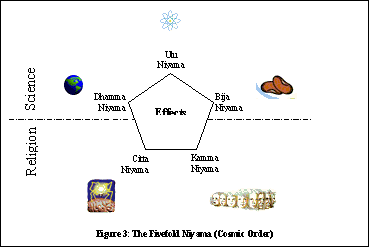 (honsing.com)
According to Buddhism, there are Five Orders or processes (Niyamas) that operate in the physical and mental realms:
- Karma Niyama, order of action and result: such as good and bad actions producing corresponding desirable and undesirable results.
- Utu Niyama, physical order (inorganic matter): such as seasonal phenomena.
- Bija Niyama, seed or genetic order (organic matter): such as rice being produced from rice-seed, sweet taste from sugary plants; cells, genes, and heredity may be ascribed to this order.
- Citta Niyama, order of mind: such as processes of consciousness (citta vithi), psychic power, perception.
- Dhamma Niyama, order of phenomena: the natural phenomena occurring at the birth of a Bodhisatta in his last birth, gravitation, and so on.
[The Buddhist term dhamma is tricky. It is best translated as "things" or "phenomena," which can include the Dharma (Doctrine or Teachings) though it is usually distinguished from it by capitalization. The Buddha's Teachings point at the Truth.]
Every mental or physical phenomenon can be explained by these five all-embracing Orders, which are lawful processes in themselves. Karma is only one of the Orders that prevail in the universe. It is a "law" (orderly process) in itself without a governing law-giver. "Laws of nature," such as gravitation, need no law-giver. They operate in orderly ways within their own fields or domains without the intervention of any external independent ruling agent.
Friday, May 8, 2009
The Dalai Lama/Dorje Shugden Controversy
Documentary in three parts (Part 2, Part 3)
Unpleasant facts within the Tibetan community are easily forgotten. Therefore, this documentary is of historical importance.
For centuries the deity Dorje Shugden has been worshipped by the greatest and most important Buddhist masters, many of whom are among the most respected in Tibetan history. This includes the Dalai Lama's own teacher, Kyabje Trijang Dorje Chang.
If the Dalai Lama thinks that all of the great masters were mistaken, he denies them their qualification. They would not be great masters.
- Question: If the great masters have worshipped this deity for centuries, were they all wrong?
- Dalai Lama: "Wrong! Yes, wrong!"
The Dalai Lama's criticism and defamation of his own Root Guru created the schism of the Gelug order of Tibetan Buddhism and conflicts within the Tibetan community.
Dorje Shugden practitioners are currently experiencing ostracism and oppression in India and throughout the world due to the Dalai Lama's ban on their practices.
Subscribe to:
Posts (Atom)






















































