Showing posts with label orders. Show all posts

Friday, May 2, 2025

Simulation: Gravity is fake, says science

If fall rate exceeds terminal falling speed, ship will move down as levitation occurs like coaster
Clearly, gravity is fake. We are not pulled down so much as pushed, except for this cat. ;,)

Friday, September 15, 2023

Sex makes for the worst types of tourists

Living Ironically..., 4/22/23; Ashley Wells, CC Liu, Sheldon S. (eds.), Wisdom Quarterly

The worst type of tourists
(Living Ironically in Europe) Oh, You Men! That is, Oh We Men, be better. It's not all about shagging. There are cultural events, self-improvement, reading, the whole spiritual dimension. If we must be on the hunt, harm none. We should all have a good time, and that means all.

I like visiting Asian countries. - You feel guilty?
When it comes to tourism, a nasty trend has developed where many older guys with money go to impoverished countries in Southeast Asia, Eastern Europe, and the Balkans, such as Thailand, Vietnam, Ukraine, Moldova, Serbia, Belarus, Russia, Romania, Kazakhstan, and so on, where they exchange some of that money for companionship and intimacy. This is taking advantage of the locals due to the size of their wallets and the need/greed of females willing to exchange their company or intimacy for that paper cabbage. This is a look at the antics and the immorality of such predatory tourists. They don't even have the decency to keep it on the downlow or improve their physical appearance. They should stay home and date [ugly] women.

Thanks to @Gattsu for helping LIiE in making this video. Check him out. LIiE's merch is at ➡️https://theironicshop.com/ ✉️ Join the Postcard Club ✉️ patreon.com/livingironica...  🎩Become a member and support the channel:🎩 @livingironicallyineurope 🔴Follow instagram.com/livingironic... 🔴Join the Ironic Discord: discord.com/invite/XEj7fsVJsk Brandenburg Concerto No4-1 BWV1049 - Classical Whimsical by Kevin MacLeod is licensed under a Creative Commons Attribution 4.0 license. https://creativecommons.org/licenses/... Source: incompetech.com/music/royalty... Artist: http://incompetech.com/ "KevinMacLeod - Gregorian Chant" is under a Creative Commons (CC-BY 3.0) license Music promoted by BreakingCopyright: https://bit.ly/bkc-gregorian 🎶Outro Song🎶: • ca$$a loco - living in the usa 🎶Explained Intro Song🎶: • Dögös Robi...Bomba!

Tuesday, August 8, 2023

Mail-order brides of Colonial America

Mathew Cohen, historicalgenius.com, 2/22; Ashley Wells, Crystal Q. (eds.), Wisdom Quarterly

The peculiar origins of the first "brides" in Colonial America
Ukrainian gals on sale: Pay us to marry you!
Most have probably heard of "mail-order brides." But that kind of thing has been happening in the USA since before mail, mail order, the dawn of the internet — even before there was a US Postal Service. No one tell Kevin Costner.

What if people knew this bizarre industry dates back hundreds of years? Yes, really, centuries. Mail-order brides were essential to the foundation of the United States of America.

Sale on white Slavic brides from the Baltics
It was all to do with who moved to North America in the first place. After an expedition spearheaded by the Virginia Company of London, English settlers founded "James Fort" — later known as Jamestown.

While it eventually became famous as the first permanent English settlement in the USA, Jamestown was originally renowned for another curious reason.

Finding their feet

I'm ready to do it for the family, Mom.
Life wasn't easy there. Starvation and disease wracked the population of Jamestown and left the settlers having to adapt by expanding their agricultural activities:

They diversified into tobacco crops, for instance, which made some folks wealthy. Despite this, not everyone was happy. Although there was the case of successful tobacco pioneer John Rolfe marrying the famed and beautiful Native American Princess Pocahontas, most white men were single.

Pocahontas' induction into white culture, conversion to Christianity, marriage to European
.
The grave male-female imbalance
By 1619, almost all of the inhabitants of Jamestown were male and alone. Most settlers were unable to find wives.

Yet, while this inability to find love, companionship, and marriage was indeed a legitimate concern, there was an even larger issue at play:

Without females who could conceive children, Jamestown would not last beyond a single generation.

An unattractive pitch
Why was the gender imbalance in Jamestown so enormous? Many females were reluctant to leave behind their comfortable lives in Europe for a future of uncertainty in North America.

And when reports of famine, starvation, and disease reached England, any open-mindedness girls and women may have had was likely quashed. From then on, Jamestown continued to deteriorate.  More

Not a Nation of Immigrants (Roxanne Dunbar-Ortiz)

White women for sale by mail
Hey, American-Johnny, you like? You buy? You send money, bring my whole family to US?

Friday, March 10, 2023

Manufacturing Consent (Noam Chomsky)

Chomsky's Philosophy, Oct. 15, 2015; Pfc. Sandoval, Ashley Wells (eds.), Wisdom Quarterly

(Chomsky's Philosophy) This is a summary of MIT Prof. Noam Chomsky's analysis on how the corporate mainstream media functions to "manufacture" consent.

The CIA called it Operation Mockingbird.
This means on behalf of the elite in a society, it sets the agenda, topics, debate parameters, perceptions, and constructs the narratives we are fed.

It is the consent of the ruled in a culture, particularly a nominal democracy, that the media is after. Rather than soliciting our "consent" at the end of a gun (in harsh 1984 style), prodded by a militarized police agent's billy club or threats of violence, we are fed propaganda, deceived, and pacified (smiley face Brave New World Order style).

This is an excerpt from the documentary (based on the book Manufacturing ConsentManufacturing Consent: Noam Chomsky and the Media (1992). Watch it here: • VIDEO

Monday, December 5, 2022

AI Sex Robots terrify; Musk to blame (video)

Matt the Perv, Viceland, 3/14/18; Digital Engine, 11/22/22; 2 Chainz, Vice; Eds., Wisdom Quarterly
In the future, will they have to make "Johns" to service AI pros to test and keep them working?

AI robot terrifies officials, explains our illusion, with Elon Musk
(Digital Engine) AI robots fly, sing, dance, carry cars, and respond to king of capitalism Elon Musk's commands.

That robot had its way with me. It seduced me!!
Incredible new robots join Ameca and Boston Dynamics. To learn more about AI, visit brilliant.org/digitalengine, where loads of fun courses on math, science, and computer science can be found.

Here's the first video on Digital Engine's new channel, "Go Rogue": youtu.be/k07unSpmBSg.

Thanks to Brilliant for sponsoring this video. To stay at the stunning Appleby Castle: applebycastle.org. For custom nerf blasters: outofdarts.com.

.
Meet Harmony the Sex Robot | Slutever

(VICE TV) In this scene from Slutever, meet "Harmony," an interactive AI robot capable of having sex and making human conversation. Subscribe to Viceland. Website: viceland.com. We don't believe it. Send in 2 Chainz to check out these claims.

He was asking for it. Humans are easy.
Let's not feel anxious about this: The AI (artificial intelligence) robot in this video obviously isn't dangerous. (After all, GPT-3 isn't conscious. Or it might be, as it may have become sentient as robots have in other parts of space). Be optimistic that the future of AI will be great (if we're careful).

Sources: Here are the records for the original GPT-3 chat (screenshots and a video to avoid any doubt). They've been marked to show the words of Elon Musk and Ameca on the first page (which were given to the AI robot to respond to in the previous video): dropbox.com...

We are now programmed to kill protesters.
Tesla's AI Day 2, introducing the Tesla Optimus robot: youtube.com...

Researchers from Oxford University and DeepMind on AI risks: onlinelibrary.wiley.com...

Robotic Navigation with Large Pre-Trained Models of Language, Vision, and Action: arxiv.org/abs/2207.04429

Wednesday, September 21, 2022

Last Week Tonight wins Emmy: Law & Order

TV Academy, 9/11/22; Seth Meyers; Sheldon S., CC Liu, Crystal Q. (eds.), Wisdom Quarterly


Law & Order: Last Week Tonight with John Oliver (HBO)
(LastWeekTonight) John Oliver discusses the wildly popular TV franchise Law & Order, what it’s been (mis-)teaching us about law enforcement, and some tricks for how to get to sleep in two minutes flat.

This is not the first win for Last Week Tonight with funny host John Oliver

Audience pops out of blouse in anticipation.
Connect with Last Week Tonight online...on YouTube for more almost news as it almost happens, on Facebook like your mom would, on Twitter for news about jokes and jokes about news, or visit the official site for all that other stuff at once: HBO.com/lastweektonight.


John Oliver roasts the U.K.'s "very weird" 10 days of mourning for Queen Elizabeth
(Late Night with Seth Meyers) Sept. 20, 2022. Last Week Tonight Host John Oliver talks about his Emmy win for Last Week Tonight, which was presented to him by Selena Gomez, Steve Martin, and the great Martin Short (Jiminy Glick).

He shares his reaction to the 10 days of mourning for Queen Elizabeth II and discusses turning down his offer for the Order of the British Empire (OBE).

ABOUT: Late Night with Seth Meyers on YouTube features A-list celebrity guests, memorable comedy, and topical monologue jokes [in addition to a lot of nominal left-leaning garr-bAHge. GET MORE NBC: http://Facebook.com/NBC Follow NBC: http://Twitter.com/NBC NBC Tumblr: http://NBCtv.tumblr.com/ YouTube: http://www.youtube.com/nbc NBC Instagram: http://instagram.com/nbc.

Friday, April 17, 2020

Calif. city protests stay-at-home orders (pics)

Sean Emery, Nathaniel Percy, Emily Rasmussen, Paul Bersebach, Jeff Gritchen (scng.com), Orange County Register, April 17, 2020; Pfc. Sandoval, Seth Auberon, Ashley Wells (eds.), Wisdom Quarterly
"Defy Fascist Lockdown," Sarah Mason's sign reads as police patrol (Paul Bersebach/OCR).

Scores of people gather in Huntington Beach to protest coronavirus stay-at-home orders
Scores of [conservative, affluent, predominantly Caucasian] protesters defying stay-at-home orders gathered in downtown Huntington Beach [Orange County, California] today [April 17].

They were rallying for an end to restrictions on businesses and public gatherings that health officials swear are needed to save lives during the coronavirus [flu] pandemic.

Mobilized largely through social media posts, several dozens of protesters gathered at Main St. and Walnut Ave. shortly before 1:00 pm. The crowd grew to more than 200 people, according to police.

"My constitutional rights are essential." "Covid-19 is a lie." (Jeff Gritchen/OCR).
.
Jackboots at work instead of sandals (JG/OCR)
Many had signs, such as “Live Free or Die.” Some wore masks. The group periodically chanted “USA!” as some passing vehicles honked in support.

In a posting on social media Friday evening, Huntington Beach police said that while the demonstration was peaceful, it could have escalated into something more dangerous. Police reported no arrests.

“While the [police] department worked to get enough resources there to manage the protest effectively, the people at the location began violating some of our local ordinances regarding public assembly including walking in the middle of the street and carrying signs with large sticks that could be used as weapons.

Come back, everyone! Defy fascist crackdown
“Once we had sufficient [armed] officers in place, they utilized great restraint in dealing with circumstances that could have escalated into significant police action,” the police department’s Facebook post said.

Police were able to contact the organizers of the protest and eventually disperse the majority of the crowd without incident, the post said. More + PHOTOS + VIDEO

I'll tell you what, guys: I'm going to extend the lockdown. - You go, Gav. You The Man now.

Tuesday, October 22, 2019

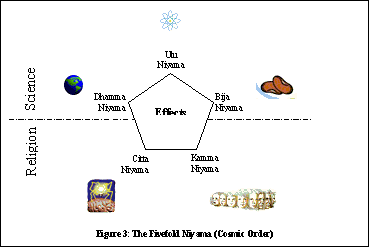
The Five Natural Orders (Niyamas)

Dhr. Seven, Ashley Wells, CC Liu (eds.), Wisdom Quarterly Wikipedia edit
Karma is my ticket to everywhere.
Karma ("intentional action," "volitional deed," or cetana) together with its mental resultants and ripening fruits (vipaka and phala) is very complex.

It powers us and makes our lives what they are. Its working out is imponderable, but there are general trends one can discover. As we know so we do; mind precedes all conditions (Dhp. 1).

Therefore, learning can help us a great deal. The Buddha was not called a "Buddhist" in his day. He was called a karmavadin, a "teacher of the efficacy of action."

One act (deed) will have many results: It will produce like a seed produces, producing many more similar seeds. So it is not "the law of cause and effect," which states that for "every action there is an equal and opposite reaction." The commentaries talk about another complexity of karma, its orderliness or fixity. This complexity is distinguished into five kinds of natural orders.

Natural order: niyama
A niyama is the "natural order, fixedness, constraint, or lawfulness" of all things. In Buddhist psychology and philosophy or Abhidharma, they are distinguished into five categories in the post-sutra commentarial tradition.

In Buddhist commentaries (from the 5th to 13th centuries CE) we find the Five Orders (pañcavidha niyama), which occurs in the following texts:
  • The Aṭṭhasālinī (272-274), the commentary on the Dhammasangaṅi attributed to Buddhaghosa, the first book of Theravāda's "Collected Teachings in Ultimate Terms" (Abhidhamma Piṭaka) [30];
  • the Sumaṅgala-Vilāsinī (DA 2.431), Ven. Buddhaghosa’s commentary on the Long Discourses of the Buddha (Dīgha Nikāya) [31];
  • the Abhidhammāvatāra (PTS p.54), a verse summary of Abhidhamma by Buddhaghosa’s contemporary Buddhadatta [32].
  • Abhidhammamātika Internal Commentary (p.58) The Abhidhamma-mātika is a matrix of abstracts for the Abhidhamma, with lists of pairs and triplets of terms from which the whole of the text can theoretically be reconstructed. The passage on the orders (niyamas) is from an internal commentary on the mātika associated with the Dhammasaṅgaṇī. (The orders do not appear to be mentioned in the matrix itself but only in this appendix), composed in South India by Ven. Coḷaraṭṭha Kassapa (12th-13th century).
  • Abhidhammāvatāra-purāṇatīkā (p.168) composed in Sri Lanka by Ven. Vācissara Mahāsāmi circa 13th century or Ven. Sāriputta circa 12th century. This text is a commentary on the text of the Abhidhammāvatāra Nāmarūpa-parichedo (ṭīka) so is technically a sub-sub-commentary. This commentary is an incomplete word-by-word commentary.
The Five Natural Orders
1. The utu-niyāma or “natural order of the seasons” reveals itself in the fact that, for example, in certain locations or regions of the earth, at certain times, the flowering and fruiting of trees takes place at one time (ekappahāreneva), the blowing or ceasing of wind, the degree of heat from the sun changes, the amount of rainfall changes, some flowers like the lotus open during the day and close at night, and so on.

2. The bīja-niyāma or the “natural order of seeds,” that is, a seed [DNA] produces its own kind of plant, for example, barley seed producing barley.

3. The kamma-niyāma or the “natural order of karma,” that is, skillful actions produce welcome results, and unskillful actions produce unwelcome results. This order is said to be epitomized by Dhammapada Verse 127, which explains that the results and consequences of actions are inescapable.
  • Dhp. 127: Neither in the sky nor in mid-ocean, nor by entering into mountain clefts, nowhere in the world is there a place where one may escape from the results of unwholesome deeds.
4. The citta-niyāma or the “natural order of mind” or mind-moments, that is, the orderliness of the process of mental-activities, such as the preceding mind-moment causing and conditioning the succeeding one in a cause-and-effect relationship.

5. The dhamma-niyāma or the “natural order of dhammas” (Dharma-related things), that is, events like the quaking of the ten thousand world-systems when a Bodhisattva is conceived for the last time in a mother’s womb and again when he is born.

At the end of the discussion in the Sumaṅgalavilāsinī passage, the Commentary says that dhamma-niyāma explains the term dhammatā in the text of the Mahāpadāna Sutra (DN ii.12) (Cf. S 12.20 for a discussion of the use of the word dhammaniyamatā in the sutras).

In these texts the Five Orders were introduced into commentarial discussions not to illustrate that the universe was intrinsically ethical, but as a list that demonstrated the universal scope of Dependent Origination (paṭicca-samuppāda).

The original purpose of expounding the Five Orders was, according to Burmese scholar-monk Ledi Sayadaw, neither to promote or to demote the Law (or Fixedness) of Karma, but to show the scope of natural law as an alternative to the claims of theism [33]. Things do not depend on a creator god, but rather they depend on impersonal forces or regularities.

C.A.F. Rhys Davids' system
Mrs. Caroline A.F. Rhys Davids (wife of the famous British Buddhist scholar Mr. Thomas Rhys Davids) was the first Western scholar to draw attention to the list of the Fivefold Order in her small 1912 book simply titled Buddhism.

Her reason for mentioning it was to emphasize how for Buddhism we exist in a "moral [or apparently ethical] universe" in which actions lead to just results and consequences according to a natural karmic order of things, a situation she called a "cosmodicy" in contrast to the Christian theodicy [34][35].

In Rhys Davids' scheme the Five Orders become:
  1. kamma niyama: ("action, karma, deeds") consequences of one's intentions/actions.
  2. utu niyama: ("time, season") seasonal changes and climate, law of inanimate matter.
  3. bīja niyama: ("seed") laws of heredity.
  4. citta niyama: ("mind") will of mind.
  5. dhamma niyama: ("law") nature's tendency to perfect.
This is similar to the scheme proposed by Ledi Sayadaw [36]. Western Buddhist Sangharakshita (Dennis Lingwood of the FWBO) has taken up Mrs. Rhys Davids conception of the orders and made it an important aspect of his own Buddhist teachings [37].

In the exclusively Buddhist Pāli language, the word is spelled both niyama and niyāma (long ā), and the Pali Text Society Dictionary says that the two forms have become confused [38]. It is likely that niyāma is from a causative form of the verb ni√i. More

Tuesday, September 23, 2014

The Buddhist Attitude Toward Nature

Lily de Silva (BPS.lk/ATI); Amber Larson, Crystal Quintero (eds.), Wisdom Quarterly
Wise attention and wise reflection
The Cakkavattisihanada Sutra (DN 26) predicts the future course of events when human morals undergo further degeneration. Gradually human health will deteriorate so much that life expectancy will diminish until at last the average human lifespan is reduced to ten years, marriageable age to five years.
 
At that time all delicacies such as ghee, butter, honey, and so on will have disappeared from the Earth; what is considered the poorest coarse food today will become a delicacy then. Buddhism maintains that there is a close link between human morals and the natural resources available.
 
According to a discourse in the Numerican Discourses (AN), when profligate lust, wanton greed, and wrong values grip the heart of humans and immorality becomes widespread in society, timely rain does not fall. When timely rain does not fall, crops are adversely affected by various pests and plant diseases. Through lack of nourishing food, human mortality and morbidity rates rise (A. I, 160).
 
Several sutras from the Pali canon show that early Buddhism believes there to be a close relationship between human morality and the natural environment. This idea has been systematized in the theory of the Five Natural Laws (niyamas, pañca niyama-dhamma) in the later commentaries (Atthasalini, 854).

There are five natural laws or orders: seasons, seeds, mind, karma, and Dharma.
.
According to this theory, in the cosmos there are Five Natural Laws, orders, regularities, or forces at work, namely: utu-niyama ("season-law"), bija-niyama ("seed-law"), citta-niyama ("mind-law"), kamma-niyama ("karma-law"), and dhamma-niyama (Dharma-law). 

They can be translated as physical laws, biological laws, psychological laws, moral laws, and causal laws, respectively. While the first four laws operate within their respective spheres, the last-mentioned law of causality operates within each of them as well as among them.
 
This means that the physical environment of any given area conditions the growth and development of its biological component, that is, the flora and fauna. These in turn influence the thought pattern of the people interacting with them.

Modes of thinking determine moral standards. The opposite process of interaction is also possible. The morals of humans influence not only the psychological makeup of the people but the biological and physical environment of the area as well. 

So the Five Laws demonstrate that humans and nature are bound together in a reciprocal causal relationship with changes in one necessarily bringing about changes in the other.
 
The commentary on the Cakkavattisihanada Sutra goes on to explain the pattern of mutual interaction further (Dh.A III, 854). 
  • When humankind is demoralized through greed, famine is the natural outcome;
  • when moral degeneration is due to ignorance, epidemic is the inevitable result;
  • when hatred is the demoralizing force, widespread violence is the ultimate outcome.
Nature is sacred and spiritual (jiuzhaigou1/tenlivingcities.org)
 
If and when humankind realizes that large scale devastation has taken place as a result of our moral degeneration, a change of heart takes place among the few surviving human beings. With gradual moral re-generation, conditions improve through a long period of cause and effect and humankind again starts to enjoy gradually increasing prosperity and longer life.
 
The world, including nature and humans, stands or falls with the type of moral force at work. If immorality grips society, humans and nature deteriorate; if morality reigns, the quality of human life and nature improves. 

So greed, hatred, and delusion produce pollution within and without. Generosity, compassion, and wisdom produce purity within and without. This is one reason the Buddha has pronounced that the world is led by the mind, cittena niyati loko (S. I, 39). So humanity and nature, according to the ideas expressed in early Buddhism, are interdependent.

Human Use of Natural Resources
For survival humankind will have to depend on nature for food, clothing, shelter, medicine, and other requisites.
 
For optimum benefits humans have to understand nature so that he can utilize natural resources and live harmoniously with nature. By understanding the working of nature -- for example, the seasonal rainfall pattern, methods of conserving water by irrigation, the soil types, the physical conditions required for growth of various food crops, and so on -- humans can learn to get better returns from our agricultural pursuits.

But this learning has to be accompanied by moral restraint if we are to enjoy the benefits of natural resources for a long time. Humans must learn to satisfy our needs and not feed on our greeds. The resources of the world are not unlimited, whereas human greed knows neither limit nor satiation. 

Modern humans in our unbridled voracious greed for pleasure and acquisition of wealth have exploited nature to the point of near impoverishment.
 
Ostentatious consumerism is accepted as the order of the day. One writer says that within forty years Americans alone have consumed natural resources to the quantity of what all mankind has consumed for the last 4000 years (Quoted in Vance Packard, The Waste Makers, London, 1961, p. 195). More

Tuesday, January 18, 2011

Karma: Actions, Imponderables, and Orders

Seven Dharmachari & Amber Dorrian (Wisdom Quarterly, ongoing Karma Class series)

Karma (intentional action capable of bearing welcome and unwelcome results) is one of the most important and difficult subjects in Buddhism. The Buddha was originally called a Karmavadin (a teaching of the efficacy of action).

Most "bad karma" has no fixed way of turning out. If and when it matures, it will turn out badly. Exactly how is impossible to know with certainty. But we can certainly know in general.

Harm done to oneself and others -- on account of the intention to harm (or motivations based on greed, delusion, and/or fear) -- will bring "suffering." That is, the karmic results (called phala and vipaka) will be unwelcome, unwished for, painful, distressing, not what we wanted, not what we aimed for.

Karmic results should not be confused -- as happens 99 percent of the time with people talking about karma in Buddhism -- with immediate results. As if karma were "common sense," intuitively satisfying, or bound to some linear logic we want to impose on reality! It is not.


The "working out of karma" is one of the Four Imponderables*

For example, when one steals, the immediate result is a gain, but the karmic result is a terrible loss. When someone kills, nothing happens to that person right now, except maybe some PTSD, or court, or in some cases jail. So people seeing the killer pass away comfortably, rich, well respected, and apparently peacefully think that nothing came of the killing.

If only people were there to see the fruition -- the death(s), the misery, the future lives cut short, the sickliness, not to mention any psychological resultants rooted in that deed... -- people would never again think to say "nothing comes of killing (except what we see immediately)."

So when does karma mature, come to fruition, bear its results? It does so as soon as it gets the opportunity, as soon as it finds suitable circumstances. In this sense, karma is analogous to seeds, not all of which sprout and grow, but all of which are limited to doing so only when they meet the proper circumstances and conditions.

Will everyone therefore experience all the results of all the things they've done in this and innumerable past lives? No, not everyone. Those who become enlightened release themselves from samsara. And karma can bear results only in samsara. A liberated one is no longer the heir to the results of past deeds (even though they have never exhausted themselves) because, like seeds tossed on a barren field, they are no longer capable of coming to fruition. They are obsolete (ahosi-karma).

The happy news is that the opposite is true for "good karma." What intentions make actions "good"? When mental, verbal, or physical deeds are rooted in compassion (adosa), unselfishness (alobha), wisdom (amoha), or courageousness (adosa), they bear welcome, pleasing, profitable results. Again, this is not to say that it will be pleasing to do good (such as restraining oneself). But that immediate displeasure is not the result of

There is, however, a totally different kind of "bad" karma that does have a fixed result. The Buddha spoke of five such heinous deeds. The deeds are deeds (karma) because they are intentional, but not because of their intended result. They are intentional because they are motivated by greed, anger, delusion, or fear. That is, they are not incidental or accidental. They're purposeful, given birth in the mind before manifesting as words or bodily actions.

Ninety-nine percent of the time people misunderstand what "intention" (cetana) means, confounding it with our English sense of the word, ignoring that it's an imperfect translation. Again, "intention" does not mean one intended or did not intend a particular result, like the breaking up of the Order. What constitutes "karma" is willful action, volitional action, motivated action. Motivated by what? Motivated by any of these very general roots (categories or classes) of karma:
  • non-greed (selflessness, generosity, want to help oneself and others)
  • non-hatred (loving-kindness, compassion, altruistic joy, equanimity)
  • non-delusion (insight, wisdom, understanding, knowledge, learning)
  • non-fear (courage; psychologically, fear is a manifestation of hatred)
  • greed (selfishness, stinginess, lust, avarice, hoarding. discontent)
  • hatred (aversion, annoyance, disliking, fear [yes, fear], sadness)
  • delusion (wrong view, ignorance, misperception, misunderstanding)
  • fear (aversion, resistance, disgust, motivation to avert, cowardice)

Heinous karma fruits immediately after this life in worlds-of-woe, the most unfortunate destinations, in tormented states. And it is believed, to the limits of our understanding, nothing can be done to intervene or alter the consequences. (There are five niyamas,** or "orders of things" that make it this way).

Most good and bad deeds have disproportionate results as it is. But heinous karma is all out of proportion with what one intended or realized would happen. Such deeds include causing a "schism" in the monastic Order, the Sangha, which is meant to preserve the Buddha's teaching, to practice it, and to advise and set an example.

But what does it mean, "schism in the Order"? Fortunately, Upali asked the Buddha about it.

*The Four Imponderables
A.IV.7 (based on Wings of Awakening translation)
(Lord-Jim/Flickr.com)

These Four Imponderables are not to be pondered (speculated about). Anyone who persisted in pondering them would come unhinged and experience vexation. What are the four?

  1. The sphere of a Buddha's influence (Buddha-range of the Buddhas, i.e., the range of powers a Buddha develops as a result of becoming a perfectly enlightened teacher)...
  2. The jhana-range of one absorbed in jhana (the range of powers that one may develop from meditative absorption]...
  3. The results of karma...
  4. The [first moment, purpose, etc., of the] universe...

These Four Imponderables, if pondered (and persisted in, speculated about), lead to madness and vexation.

**The Orderliness of Things (Five Orders)
Based on nutshell explanation by Ven. Narada Thera (accesstoinsight.org)
(honsing.com)

According to Buddhism, there are Five Orders or processes (Niyamas) that operate in the physical and mental realms:

  1. Karma Niyama, order of action and result: such as good and bad actions producing corresponding desirable and undesirable results.
  2. Utu Niyama, physical order (inorganic matter): such as seasonal phenomena.
  3. Bija Niyama, seed or genetic order (organic matter): such as rice being produced from rice-seed, sweet taste from sugary plants; cells, genes, and heredity may be ascribed to this order.
  4. Citta Niyama, order of mind: such as processes of consciousness (citta vithi), psychic power, perception.
  5. Dhamma Niyama, order of phenomena: the natural phenomena occurring at the birth of a Bodhisatta in his last birth, gravitation, and so on.

[The Buddhist term dhamma is tricky. It is best translated as "things" or "phenomena," which can include the Dharma (Doctrine or Teachings) though it is usually distinguished from it by capitalization. The Buddha's Teachings point at the Truth.]

Every mental or physical phenomenon can be explained by these five all-embracing Orders, which are lawful processes in themselves. Karma is only one of the Orders that prevail in the universe. It is a "law" (orderly process) in itself without a governing law-giver. "Laws of nature," such as gravitation, need no law-giver. They operate in orderly ways within their own fields or domains without the intervention of any external independent ruling agent.