
Saturday, January 24, 2026


Sunday, September 22, 2024
Hinduism's creator God isn't Brahma?

 |
| Space devas wrestle giant naga (dragon) for the glory of the space gods |

 |
| America's greatest Hindu: Julia Roberts |
 |
| Fun during Holi near vimana ashram temple |
 |
| Vimanas (UFOs) inspire Hindu temple designs |
 |
| This "mothership" vimana is biggest ashram |
- forms (bodies, material bases, whether subtle or gross);
- feelings
- perceptions
- formations
- consciousness(es).
 |
| Don't eat your fellow earthlings. Go vegan. |
 |
| What does Julia Roberts know that we don't? |
- Rate of biological aging is accelerating in young people leading to medical issues
- What is matter? Matter vs. mass explained
- Treating depression with psilocybin or escitalopram found to result in different hierarchical brain reconfigurations
- The story of Hugh Everett III, the father of the multiverse and parallel worlds
- Coastal cleanup volunteer shares sad reality hidden among Hawaiian beaches: This plastic comes from all around the world
- Researchers solve the mystery of human wrinkles formation
- Reality doesn't care what you think: Why [objective] facts trump perception [Do they? We react to our perceptions not to reality]
- What is space made of? An astrophysics expert explains all the components from radiation to dark matter found in the vacuum of [empty] space
- Christian voters don't care about Donald Trump's religious beliefs: Poll
- A group of women lowered their biological age by an average of 5 years in just 8 weeks here's how
- Einstein's tutor review Emmy Noether in space-and-time
- Scientists discover secrets of ancient burial chamber 5x heavier and 1,000-years-older than Stonehenge
- Scientists use fainting to uncover new insights into the neuroscience of consciousness
- Archaeologists found the lost remnants of a Maya civilization hiding in the jungle
- The fastest microscope in the world has been created and it can see electrons moving
- Life on earth just maybe got older than everyone decided it was
- Underwater mountain discovered with 20 never before seen species
- Study links near-death experiences to vivid dream phenomena like lucid and precognitive dreams
- An empty world a time traveler another dimension, liminal spaces, the reality in between
- VIDEO: Life after death (#shorts)
- Coma: a significant proportion of unresponsive patients are actually conscious (so go talk to them and hold their hand)
- VIDEO: 17 creepiest discoveries in the forest
 |
| Hinduism and Buddhism in Indonesia, the remnants of Indian empire, now mostly Muslim |
 |
| Did Brahmins and Sri Shankara finally adopt the Buddha's ultimate message of the impersonal nature of all phenomena, particularly everything related to the atman (soul, self, ego, being)? |
- Mohan Praveen (video, Sept. 20, 2024); Dhr. Seven, Pat Macpherson COMMENTARY, Wisdom Quarterly
Wednesday, April 22, 2020
Koans vs. "Stoner Thoughts" (cartoons)

 |
| I've never been stoned, but I'm totally a Stoner. |
IMPONDERABLE: "incomprehensible, unthinkable, surpassing thought, beyond rational comprehension, impenetrable, transcending the limits of thinking; not to be pondered or be driven mad."
 |
| Stoner Thought meme collection (pinterest) |
 |
| Control Your Thoughts (Zen Toons) |
 |
| When is the Eternal Now? (Stivers) |
 |
| Positive outlet? (Rino Piccolo) |
11. Which came first, the plant or the seed?

Monday, April 20, 2020
"Stoner Thoughts" on 4/20

 |
| Whoa, man, what a trip! (trippy clipart) |
- How many Lowe's would Rob Lowe rob if Rob Lowe could rob Lowe's?
- What if there were no hypothetical questions?
- Why is the word abbreviation so long?
- If you're waiting on a waiter, doesn't that make you the waiter?
- If tomato is a fruit, does that make ketchup a smoothie?
- Sex workers in Japan will get a bailout because that country has a more enlightened view of sex work. Not a stoner thought, just true.
- Do nudists have any private parts or just public parts?
- Did you know "up" for something and "down" for something means exactly the same thing?
- Last month 90 thousand travelers went through LAX Airport, where last year 2.1 million went through, so if the Wright Brothers were time travelers who came back today and looked up, would they say, "We developed flight, and you didn't do anything with it!"?
- If a dyslexic is reading a book about a dog, does he think he's reading a Bible?
- Shouldn't buildings be called builts?
- Why do doctors call it a practice? You're still practicing?!
If you're a guard at the Samsung Store, are you a "Guardian of the Galaxies"?
Koan practice comic (Ioanna Salajan) - "I'm sorry" and "I apologize" have the exact same meaning, unless you're at a funeral. lol!
- Do you realize the word bed looks like a bed?
- What if your name were Tony but spelled like Bologna (baloney)?
- "Faded AS" is the same backward and forward. (It's not, but a stoner won't know).
- If someone dies in a living room, is it still called a living room?
- Why do we drive on parkways and park on driveways?
- What if we're all dying, and everything is just our lives flashing before us?
- Was "Dazed and Confused" Woody Harrelson's first movie? (No, he wasn't in it. It was Matthew McConaughey's first movie playing the character "Wooder.")
- Nothing is on fire; fire is on things.
- If you smoke pot on a boat, is it then called seaweed?
- If we see water, do fish see air or, like, when they swim to the shore, is that the beach for them?
- If you put on a sweater when it's hot, soon you'll become a sweater.
- If humans get hemorrhoids, do astronauts get asteroids?
- ॐ मणिपद्मे हूँ (ཨོཾ་མ་ཎི་པ་དྨེ་ཧཱུྃ)

Monday, February 10, 2020
The Four Imponderables (sutra)
 |
Rodin's Le Penseur ("The Thinker," one of a series of similar sculptures involved in the similarly imponderable Mandela Effect) sits pensively as if on a porcelain throne (norton.org). |
 |
| My monkey mind only makes things worse. |
- The range of influence of a buddha is imponderable... [2]
- The range of influence of a person absorbed (jhana) in meditation… [3]
- The origin [and so on] of the world is imponderable on which it is wise not to dwell as repeatedly doing so would bring about unhinged-madness and wearisome-vexation if one were to try.

Wednesday, March 19, 2014
There was no "Big Bang" (audio)
 |
| A first point, a first cause, a prime move(r) -- the Big Bang is no better than positing an all-powerful God who did it, yet we fool ourselves by using words to say nothing. |
- Play in computer's media player
- Download this episode (MP3, 10.27 MB)
- About the show, Archives, Playlists
 |
| Buddhist cosmology: 31 Planes of Existence |
There is no sensible or meaningful first cause, and one would become deranged pondering such a question. It is one of the Four Imponderables in Buddhism -- which not only would never lead one to enlightenment but would certainly, if persisted in, drive one to madness. Here is a simple analogy to see why: A professor starts drawing a circle on a chalkboard, and after the 33rd loop asks the class,
 |
| Count chalk loops or watch me pole dance. |
"Wherever you first placed the chalk," they answer.
 |
| A better bang to find |
 |
| Hmm, maybe lines and symbols? |
Friday, March 30, 2012
How to Win the Lottery in 3 Steps
 One of the most important karmic elements is to be happy in the happiness of others who win (mudita). Warning: these simple instructions contain two imponderables, the working out of karma and the range of someone absorbed in jhana.
 $640 MEGA MILLION - Why do things happen? That is the central question motivating Wisdom Quarterly. Perhaps the question is better understood as, Why do things really happen?
Common wisdom answers, "God knows." The uncommon explanation of this statement is: karma. But it would be easier to understand "God" (Maha Brahma) than to get a handle on karma. Experiencing nonduality is relatively easy, and that will mean feeling like GOD (Brahman) through the Divine Abidings (Brahma Viharas). Brahma figuratively means "supreme" or divine, a superlative for ultimate.
You have to be in it to win it
While not technically true, it helps. (Couldn't you, wouldn't you find it or come into possession if it is meant to be?) Karma means intentional action. The important karma in this case is in the past, for it cannot happen that one would win the lottery (or mega millions by virtue of gambling and "luck") and hold on to such riches without the karmic support for doing so.
At some time in the past, whether proximate or remote, one has to have performed some intentional action of a superlative sort. Due to the number of past lives in our past, nearly all humans will have a cache of merit (punya). Will it be enough? If it is not, one can win as a part of a group and have her or his cut be commensurate with the quality of the deed coming to fruition (phala). Most karma takes time to ripen, but its result can technically be experienced opportunistically at any time after the seed is planted.
This being the case, how will it be brought forward. Think only good thoughts -- either in memory or out of faith (saddha) in the good done any from this moment back. For example, in the past I did such and such. Or in the present, at this very moment, I am cultivating the intention to make this a better world with the winnings: What would make it better?
Normally meritorious deeds can be done any time anyway. So this will require a higher order of profitable karma. What is the gift that excels all gifts? The Dharma excels all gifts. It is certainly the most valuable. But here riches are defined more broadly. The value one is aspiring towards is material and of a much lower order. Giving or intending to give in kind is more important.
More important still is the purity of consciousness generating this intention. Concentration is the way to purity. The mind absorbed on a single object is, by virtue of exclusion, temporarily purified, freed of mental defilements and effluents (inflows and outflows).
With all this theory in mind: Here is the way to win in three easy steps.
 "Karma: It's everywhere you're going to be."
STEP 1. Be ready to withdraw a great deal of good karma that would have served you very well in the future. You will not have it because you are spending it here to be rich for no very good reason during this very, very brief lifespan. At the end of this life, all the money will be lost. (You can't take it with you, and you can't keep from going). The only way to "hold" onto it will be to give it away. If you are not willing to give it away, you will surely lose it. If you intend to cling to it, since it is certain to go, you are better off without it. If you are generating the karma now, remember: Mental karma is very powerful as is verbal. So delight in appreciation, admiration, approval, and applaud those who by right and honest means have gained as much wealth as you imagine.
- (The problem is obvious. We want a kajillion, and the only people we can think of with that kind of money are the scum of the Earth, the One Percent, thieves robbing this world blind by dishonest capitalist means. So the rich, of the present or the past, need to be admired, appreciated with mudita, sympathetic or altruistic joy, and by doing so one will share in their store of karma for having become rich while engaged in right livelihood.)
 STEP 2. Concentrate on a single thing -- not the money or the diversity of how it will be spent. Focus on an absorbable object of meditation. Enter the absorption, emerge while standing in line, ask for a ticket using either an INSPIRED number, one divined by some means unseen external agents are able to manipulate in your favor, or LET THE MACHINE PICK. Greed stands in the way of winning, and most people will simply choose their baby's birthday or other drivel while thinking they are being original. The number that is going to come up is not set, it is matched with the one having been chosen, so let the machine decide.
WARNING: An insightful Buddhist nun, whose wisdom had gone beyond, observed that if one were to become rich as a human on Earth, that would be a tragedy. Asked why, she explained that that person's karma came to fruition at a time and in a place where at best one could only enjoy the money for 120 years, likely much less. By contrast, if that same karma had come to fruition during rebirth in a superhuman state, that would benefit the individual for much longer with much finer strands of sensual pleasure to access. If it ripened outside of the sensual realm, in the fine material world, the benefit would be exponentially and inconceivably superior to anything in the sensual sphere. Be happy if no one wins because the $640 million will become more like $1 billion a week later. And these instructions will prove fruitful for some with more time to cultivate samma samadhi, right concentration. And our greed and depravity during times of economic uncertainty will have a chance to come into sharper relief. The winner, there is only one, will instantly become twice as rich as Willard Mitt Romney but have only 1/45th the riches of a Koch Brother with very few prospects of doing anything but losing it. Remember, riches beyond imagination are only three steps away, and the key is karma.
Tuesday, January 18, 2011
Karma: Actions, Imponderables, and Orders

Karma (intentional action capable of bearing welcome and unwelcome results) is one of the most important and difficult subjects in Buddhism. The Buddha was originally called a Karmavadin (a teaching of the efficacy of action).

The "working out of karma" is one of the Four Imponderables*
 Will everyone therefore experience all the results of all the things they've done in this and innumerable past lives? No, not everyone. Those who become enlightened release themselves from samsara. And karma can bear results only in samsara. A liberated one is no longer the heir to the results of past deeds (even though they have never exhausted themselves) because, like seeds tossed on a barren field, they are no longer capable of coming to fruition. They are obsolete (ahosi-karma).
 - non-greed (selflessness, generosity, want to help oneself and others)
- non-hatred (loving-kindness, compassion, altruistic joy, equanimity)
- non-delusion (insight, wisdom, understanding, knowledge, learning)
- non-fear (courage; psychologically, fear is a manifestation of hatred)
- greed (selfishness, stinginess, lust, avarice, hoarding. discontent)
- hatred (aversion, annoyance, disliking, fear [yes, fear], sadness)
- delusion (wrong view, ignorance, misperception, misunderstanding)
- fear (aversion, resistance, disgust, motivation to avert, cowardice)
*The Four Imponderables
A.IV.7 (based on Wings of Awakening translation) (Lord-Jim/Flickr.com)
These Four Imponderables are not to be pondered (speculated about). Anyone who persisted in pondering them would come unhinged and experience vexation. What are the four?
- The sphere of a Buddha's influence (Buddha-range of the Buddhas, i.e., the range of powers a Buddha develops as a result of becoming a perfectly enlightened teacher)...
- The jhana-range of one absorbed in jhana (the range of powers that one may develop from meditative absorption]...
- The results of karma...
- The [first moment, purpose, etc., of the] universe...
These Four Imponderables, if pondered (and persisted in, speculated about), lead to madness and vexation.
**The Orderliness of Things (Five Orders)
Based on nutshell explanation by Ven. Narada Thera (accesstoinsight.org)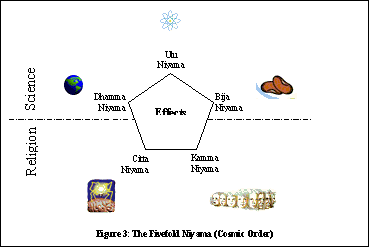 (honsing.com)
According to Buddhism, there are Five Orders or processes (Niyamas) that operate in the physical and mental realms:
- Karma Niyama, order of action and result: such as good and bad actions producing corresponding desirable and undesirable results.
- Utu Niyama, physical order (inorganic matter): such as seasonal phenomena.
- Bija Niyama, seed or genetic order (organic matter): such as rice being produced from rice-seed, sweet taste from sugary plants; cells, genes, and heredity may be ascribed to this order.
- Citta Niyama, order of mind: such as processes of consciousness (citta vithi), psychic power, perception.
- Dhamma Niyama, order of phenomena: the natural phenomena occurring at the birth of a Bodhisatta in his last birth, gravitation, and so on.
[The Buddhist term dhamma is tricky. It is best translated as "things" or "phenomena," which can include the Dharma (Doctrine or Teachings) though it is usually distinguished from it by capitalization. The Buddha's Teachings point at the Truth.]
Every mental or physical phenomenon can be explained by these five all-embracing Orders, which are lawful processes in themselves. Karma is only one of the Orders that prevail in the universe. It is a "law" (orderly process) in itself without a governing law-giver. "Laws of nature," such as gravitation, need no law-giver. They operate in orderly ways within their own fields or domains without the intervention of any external independent ruling agent.
Thursday, December 25, 2008
The Buddha of Indo-Iran
Zoroastrianism supplanted Buddhism in ancient India, which extended into Persia. Eventually Zoroastrianism gave way to Islam and Iran (Aryan) invasions spread throughout the middle country (northern India). The waves of military conquests and successions of kings melts into repetitive history in the Mahabharata and other Indian classics. The Bodhisatta ("Buddha-to-be") arose out of this milieu and went in search of enlightenment as a stranger in a strange land in what today is Bihar State.
He consummated his six year odyssey in Bodhgaya and spent most of the remainder of his life teaching in ancient India's two largest cities, Savatthi and Rajagaha. His message, however, has reverberated throughout the world. It influenced the Greeks and therefore Western civilization, adopting the guise of each culture it blended with.
He is often called the Light of the East. But his range of influence is one of the Four Imponderables. Rare is a human life; rarer still is meeting with the Buddha-Dharma. The opportunity to practice is precious, encouraging every good thing until we realize the "end of suffering" (nirvana).
Monday, July 28, 2008
Bliss and Magic (through Jhana)

The Four Imponderables: The Buddha warned that one might become unhinged and mentally imbalanced by pondering any of these four unfathomable things:
- The range of a Buddha (the extent of the influence of a Buddha from the development of the Ten Perfections).
- The range of one absorbed in jhana (the power one might obtain from the meditative absorptions)
- The incomprehensibly complex working out of the consequences of karma (volitional actions)
- A first moment, initial cause, or purpose for the universe

The importance of the meditative absorptions (jhanas) can therefore hardly be overstated. In Sanskrit, the word "absorption" is dhyana, in Pali, jhana. Throughout the Pali Canon, the Buddha defines Right Concentration (samma samadhi) as entering the first Four Jhanas.
Jhana did not develop in a Buddhist context but was prevalent in the Indian subcontinent before the Buddha in various yogic systems of spiritual training. In Jainism, an ancient religion of extreme asceticism and ahimsa (non-harming) that developed alongside Buddhism and survives today in India, it is called Samayika. This is in the Prakrit dialect, somewhat akin to the Pali word Shamatha (Serenity), referring to the practice of developing the absorptions.
He became a buddha by realizing that rather than asceticism and self-mortification, jhana was the path. The Five Mental Hindrances were the problem, and they absent in jhana. As he gained meditative stability, he developed the factor of mindfulness. This combination gave rise to insight, enlightenment, and liberation overnight.
Unless one is liberated (nirvana), the positive karmic result of mastering the jhanas is rebirth in successively more exalted celestial planes. (See WQ article on the 31 Planes of Existence for detailed explanation). The negative karmic result of unprofitably wielding such power is hard to fathom because rebirth into heaven does not preclude future rebirth elsewhere.
Suggested reading

























































