This is actually the anatomy of the brain embedded in Michelangelo's art. In the God's left arm is the Goddess of Wisdom Sophia marked with red circle (Michelangelo's Creation of Adam)
Chiasm in Michelangelo's Sistine Chapel brain
(Vuecrypte) Once you see it, you'll never unsee it
CHRISM (also called myrrh, myron, and holy anointing oil) is a consecrated oil used in many forms of Christianity:
Catholic, Eastern Orthodox, Oriental Orthodox, Assyrian, Nordic Lutheran, Anglican, and Old Catholic churches in the administration of some sacraments and ecclesiastical functions.
Jesus Christ is called "Christ" because he is said to have been "anointed" the "Anointed One" (kristos) like the "king of heaven" or "prince of peace" would be by his monarch sky-father when Christian divinities are viewed as Greco-Roman-European ideals of imperial rulers.
What was Jesus really "anointed" with, his own internal cerebrospinal fluid or DMT-containing, melatonin, and other hormone-containing pituitary and pineal gland exudation?
The English chrism derives from Koine Greek via Latin and Old French. In Greek, khrîsma (χρῖσμα) was originally the verbal noun ("[the act of] anointing," "unction") of "anoint" (χρίειν) [1].
By extension, along with khrîma (χρῖμα), khrîstai (χρῖσται), and later khrísma (χρίσμα), it came to be used for the anointing oil or ointment itself.
Khrísma came into Latin as chrisma, which appears in the works of Tertullian.
We need a Jesus for Rome
This was adopted directly into Old English as crisma, which developed into Middle English crisme and various related spellings [1].
In Old French, the original Latin was conflated with cramum ("cream"), developing into cresme, which was also borrowed into Middle English around 1300 as "creme" and various related spellings.
The spelling chrism after the Latin original was generally adopted in the 16th century, after which "cream" came to be restricted to its present meaning [1]. More
(Unframed) Nobody noticed Michelangelo hid something in the palm of Mary.
[Is it really the Gnostic apostle-wife Mary Magdalene, rather than the idealized Virgin Mother Mary? Mary Magadalene was deleted from the post-Gnostic Christian tradition. And it became a heresy to say anything nice about Mary Magdalene or anything that might promote the sacred feminine or female divinity because it works against a patriarchy trying to establish all-male control.]
They Just Found a Hidden Vault Beneath Angkor Wat — And It Changes History Forever
Temple at the center of Angkor: Angkor Wat
(The Explorer) Oct. 24, 2025: How could one of the world’s most beautiful temples be hiding something so dark under it? Cambodia's Angkor Wat has been a sign of peace and perfection for hundreds of years, but new scans have just shown a secret vault that has been locked for 900 years. It isn't gold or wealth inside. It is something much scarier. Why stay put to see what it is? What's below Angkor Wat will make everyone question everything we thought we knew about history.
This video explores the "Aztec" [a modern made-up name invented in the USA] mythology surrounding Aztlan, the claimed ancestral origin of the people who would build Tenochtitlan, the site of modern Mexico City.
Was Aztlan a real place or a fictional narrative meant to give meaning to a greater truth about outsiders looking for a place to belong in Mesoamerica? It delves into the symbolism behind their journey and how it shaped their search for a new home and history.
Thousands of people are marching in cities across California, standing up for migrant families and demanding dignity—which is reminiscent of something ancient.
Way before national borders, ICE raids, and Trumpian walls, the ancestors of the Mexica—the original "Mexicans," the tribal people we now label “Aztecs”—were wandering the desert looking for a sign.
They were turned away by those who were already settled.
This story of Aztlán has been passed down for generations. This episode digs into what it really means.
Was Aztlán a real place? A metaphor? A strategy? Why ask?
For a lot of us—especially those of us who are Mexican American—this isn’t just about the past.
It’s about identity, memory, and what it means to belong.
In this episode:
• The legend of Aztlán and why it still matters
• What the codices, scholars, and even conspiracy theorists have to say
• Why this ancient story still hits hard in a world where people are still being turned away at borders.
Let’s explore the Mexica migration, how “Aztecs” came to be, what the codices say, and how this all connects to today—because this isn’t just myth. It’s about who we are and how we got here.
If anyone is Mexican American, Latinx, Chicano, Hispanic, or has ever asked, “Where do I really come from?”—this one’s for you.
TIMESTAMPS
0:00 Exile or Origin?
0:30 Why We Tell These Stories
0:45 A Lost Paradise
1:52 “Aztecs” vs. Mexica
2:48 The Command: Leave Paradise
5:37 The Journey: Sacred Wandering
7:43 Where was (or IS) Aztlán?
10:07 Aztlán: Truth or strategy?
12:26 From the fringe: Atlantis, aliens, and conspiracies
13:15 What do viewers think?
13:58 Share a story
ABOUT: Andrew Colon tells stories about myths, legends, histories, and mysteries from Latin America and the Caribbean. He does this so those of us with roots here know where we come from—and so that those who don’t can finally learn what we were never taught in school.
Everything on this channel is researched and rooted in culture. It uses AI-generated images to help visualize ideas, but the story, its meaning, and the message are real.
Watch or listen
to full playlist:
• THE VAULT! The Mysteries of Latin America...
Spotify:
open.spotify.com/show/12rJLlk...
Apple Podcasts:
podcasts.apple.com/us/podcast...
Instagram: @andycolonvo
Join the list: andy@andycancun.com. Help spread the word: Like this video if it hit home. Share it with someone who should see it. Subscribe for more stories rooted in Latin America. #mexicanhistory #AztecOrigins #Latinx #Aztlan #mexicanamerican #mesoamerican
📚 Resources mentioned in this episode
Codex Boturini – 16th-century Aztec codex depicting the migration from Aztlán to Tenochtitlán.
Codex Aubin and Codex Mendoza – additional sources for Mexica migration and history.
Eduardo Matos Moctezuma, Muerte a filo de obsidiana – Reflections on Mexica mythology, symbolism, and interpretation of Aztlán as a cultural metaphor.
Miguel León-Portilla, The Broken Spears: The Aztec Account of the Conquest of Mexico – essential reading for Nahua voices and historical memory.
Camilla Townsend, Fifth Sun: A New History of the Aztecs – groundbreaking modern retelling based on Nahuatl sources.
Susan Gillespie, The Aztec Kings: The Construction of Rulership in Mexica History – insight into how the Mexica used myth and memory to legitimize political power.
Juan Miguel Zunzunegui – Mexican historian and social commentator who discusses the northern desert origins of the Mexica in his videos and books.
David Carrasco, City of Sacrifice: The Aztec Empire and the Role of Myth in History – explores how myth shaped Mexica society and migration narratives.
Mexican flag symbolism – origins of the eagle, cactus, and serpent from Mexica prophecy.
Mexcaltitán, Nayarit – real island city thought by some scholars to be the inspiration for Aztlán.
La Quemada (Zacatecas) and Sierra de San Luis (Chihuahua) – archeological sites linked to Chicomoztoc, the "Place of the Seven Caves."
Uto-Aztecan Language Family – linguistic evidence tying Nahuatl to Indigenous peoples in the American Southwest (Hopi, Pueblo, etc.)
Andrew Colon, July 1, 2025; Crystal Quintero, Pfc. Sandoval (eds.), Wisdom Quarterly
Ancient Aliens: The Forbidden Zones of the World (S10, E10) | full episode
(HISTORY)
May 21, 2025: Due to [mostly American and CIA-funded] warfare, instability, and inaccessibility, there are specific regions of the world that are off-limits to exploration.
See more in Season 10, Episode 10, "The Forbidden Zones."
Watch full episodes and stay up to date on all favorite shows on The HISTORY Channel website at history.com/schedule.
#AncientAliens
We capture, kidnap, take captive visiting ETs with help from other ETs as part of our SSPs.
Captive ETs at Sandia Labs in New Mexico
(Gaia) April 9, 2025: The Secret Space Programs (SSP) are willing to extract information by any means necessary, but is there a limit?
Sébastien Martin, a perception-based intelligence specialist (remote viewer), exposes the secretive depths of Sandia Labs, revealing the dire conditions of humanoid beings incarcerated within glass cells.
Surrounded by gas chambers and deprived of their telepathic abilities, these captive space beings endure a distressing environment, manipulated and observed as mere subjects for human analysis (overseen by more powerful ETs).
As Martin unveils the harsh realities faced by humanoid ETs, one must question: In the SSP’s relentless pursuit of technological advancement, has all morality been sacrificed?
ABOUT: Gaia offers the largest resource of consciousness expanding videos. Answer life's deeper questions and go beyond the mainstream narrative with Gaia— a member-supported media network of truth seekers and believers empowering an evolution of consciousness. Explore over 8,000 ad-free, streaming titles that challenge modern paradigms and allow you to manifest the reality that defines our being.
Experience Gaia in English, Spanish, German, or French. Gaia offers original, dubbed, and subtitled content in these languages. Join hundreds of thousands of members in 185 countries in awakening your consciousness. Connect with Gaia: Visit Gaia WEBSITE: https://www.gaia.com/ Like Gaia on FACEBOOK: / gaia Like Gaia Unexplained on FACEBOOK: / gaiaunexplained Like Gaia Yoga on FACEBOOK: / yogaongaia Follow Gaia on YOUTUBE: / gaiavideo Follow Gaia on TWITTER: / yourmothergaia Follow Gaia on INSTAGRAM: / wearegaia Follow Gaia on TIKTOK: / we_are_gaia #Gaia. See 8,000+ Films, Shows & Classes on Gaia. Start Free Trial - https://cs-link.gaia.com/4i4DCRf.
(ReligionForBreakfast)
Feb. 20, 2025: Korean Shamanism (Musok with its trance mansins) is a dynamic religious tradition rooted in spirit mediation (not meditation), ritual healing, and ancestral veneration to appease the spirits all around.
(The Spiritual Press) Here is a lecture by Alan Watts which goes into depth about Buddhism in its various forms, as well as touching on
karma,
rebirth (commonly spoken of as reincarnation as if it were the same thing when it is not due to the impersonal nature of what is really happening as one reappears after passing away in whatever world or plane one has previously arisen in),
and other belief systems, particularly Vedic Brahmanism now commonly referred to as Hinduism, to contrast and compare in context.
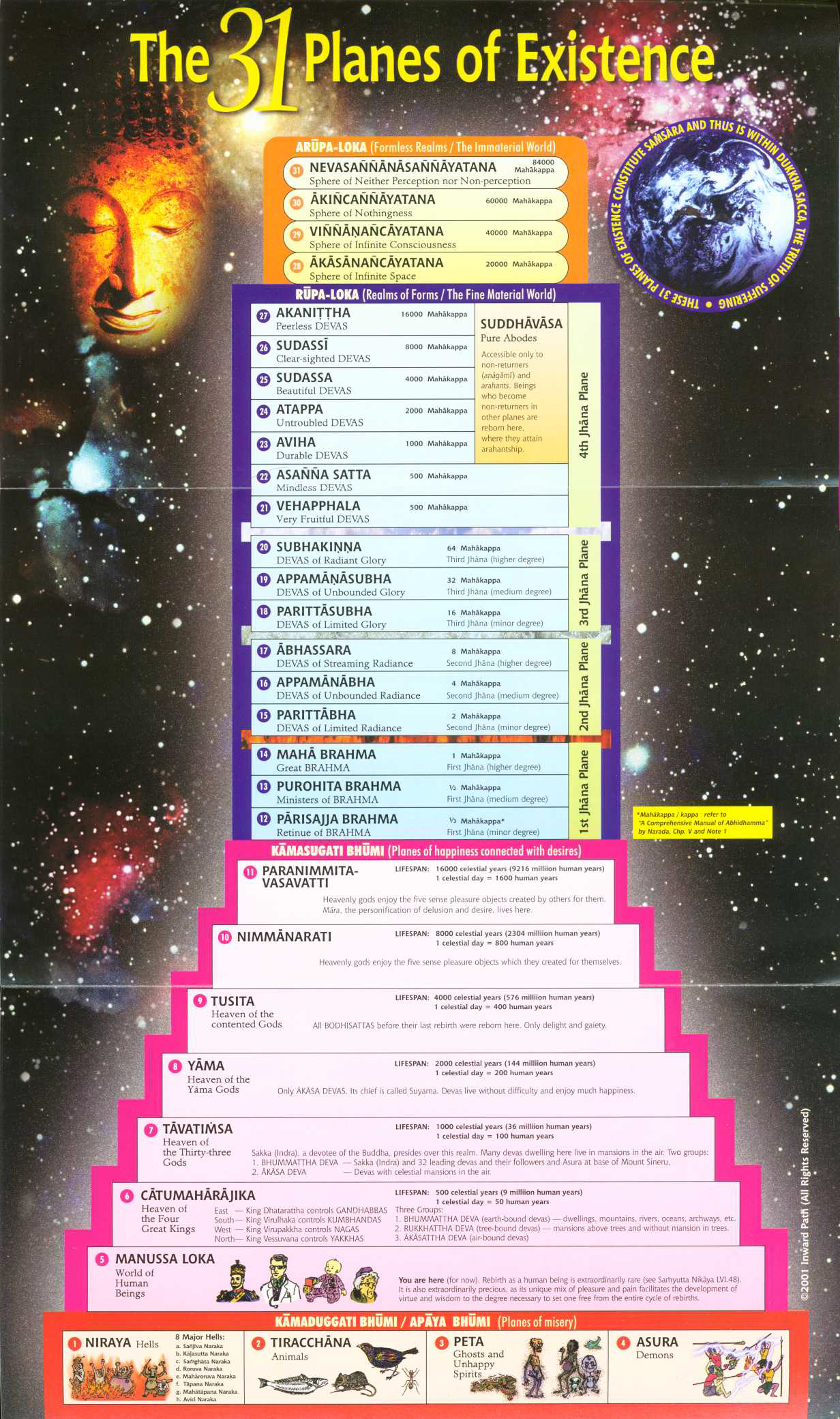
Samsara in pictures: 6 general worlds
The "Buddhism" being described is actually just Mahayana Buddhism, rightly stating that it is actually a form of Hinduism (stripped for export), which is not what the historical Buddha (Shakaymuni, Siddhartha Gautama) actually taught but what the Brahmin priestly caste made of it after he attained to final nirvana. Theravada Buddhism and the many defunct Early Buddhist schools are not explained, as they represent only ten percent of Buddhists today, with 90% following the later developments that simply go back to the dominant Brahminical view that preceded the Buddha's great enlightenment (mahabodhi). While Theravada Buddhists consider themselves the original Teaching or Early Buddhism, it is not because they are a surviving "Hinayana" ("Lesser Vehicle") school but because it is a back-to-basics movement with respect to the historical figure's actual teachings, not later developments watered down as Hinduism or Vedic Brahmanism as modern Hindus and ancient Brahmins might prefer.
Alan Wats via The Spiritual Press (video), March 16, 2022; Eds., Wisdom Quarterly (text)
(AP via C2C) UFOs (now UAPs) are once again the talk of Congress. On Wednesday (Nov. 14, 2024), the U.S. House of Representatives is holding yet another hearing on the UFO phenomenon with the specific goal of pulling back the curtain of government secrecy surrounding the topic
Organized by the Oversight and Accountability Subcommittee, the gathering is tantalizingly titled "Unidentified Anomalous Phenomena: Exposing the Truth." To that end, the two-hour hearing features testimony from witnesses who share knowledge and insights on UFO events and programs that, they contend, are being hidden from the public by the powers that be.
Retired Navy Rear Admiral Tim Gallaudet recounts a 2015 incident during which, while overseeing a strike group exercise, he received a secure email "from the operations officer of Fleet Forces Command."
Labeled "urgent," the communique cautioned that "we are having multiple near-midair collisions" with unidentified objects and "if we do not resolve it soon, we will have to shut down the exercise."
Eerily, Gallaudet said, the email vanished from his inbox the following day with the topic never being broached by the operations officer nor their superior. He indicated that "this incident disturbed me" throughout the rest of his time in service, which ultimately led him to becoming an advocate for greater government transparency about the topic of UAPs.
Among other witnesses at the hearing was former Pentagon Intelligence Officer Luis Elizondo, who decried what he described as "grave misdeeds against loyal civil servants, military personnel, and the public" brought about by "excessive secrecy" aimed at concealing "the fact that we are not alone in the cosmos."
Meanwhile, journalist Michael Shellenberger told the subcommittee about an alleged government program known as "Immaculate Constellation," which his sources revealed to him, though its existence has been denied by the Pentagon.
Finally, former NASA Associate Administrator for Space Policy and Partnerships Michael Gold argued for further study of the phenomenon by the space agency.
As one might imagine, members of the subcommittee had an array of questions for the witnesses concerning their respective testimonies. Some representatives understandably expressed consternation that the subject remains shrouded in secrecy as the phenomenon could represent a serious national security threat.
As opposed to previous Congressional UFO hearings, the gathering was similar to last summer's Subcommittee on National Security, the Border, and Foreign Affairs event in that it did not shy away from the possibility that UAPs may represent some kind of non-human intelligence.
When asked if this might be the case, Gallaudet and Elizondo argued that there is "strong evidence" for it, while Gold mused that we "don't know, but we must find out."
Among the more remarkable moments during the lengthy hearing, which constitutes a must-watch for any serious student of the UFO phenomenon, was Representative Anna Paulina Luna asking if UAPs could be "living craft" in light of how they seemingly maneuver in ways that would kill an occupant piloting the vehicle.
In response, Elizondo observed that such a scenario cannot be ruled out, given the nature of biological diversity.
Meanwhile, in perhaps the most eyebrow-raising exchange, Representative Lauren Boebert brought up "rumors" of a "secretive project within the Department of Defense" involving the creation of human-ET hybrids.
Alas, none of the witnesses could speak to the veracity of the claim that [hybrids are being created, which] has been bandied about in UFO circles for decades.
While the hearing was not the blockbuster disclosure event that UFO enthusiasts have sought for decades, the gathering could be viewed as another incremental step towards that ultimate goal with all of the witnesses expressing their unwavering belief that the government is "hiding the truth" from the American people.
For their part, the representatives commendably treated the subject with the kind of seriousness that many have long argued the phenomenon deserves.
What happens next is anyone's guess, though, given the nature of the subject and the attention that Wednesday's hearing received, it is a safe bet that the gathering is not the last time that Congress investigates the UFO mystery in hopes of finally finding definitive answers.
On the barren, cold expanses of Mars, a discovery has rocked the scientific world. The recent Mars rover unmanned mission has uncovered mud formations that tell tales of wet and dry spells spanning millions of years.
Could this revelation enhance the argument for life having existed on Mars? According to the research paper titled "Sustained wet-dry cycling on early Mars" published in the prestigious peer-reviewed journal Nature, the answer looks promising.
At the core of this breakthrough is the discovery of distinctive hexagonal patterns. These shapes, as scientists understand them, emerge when regions experience extended periods of wetness followed by prolonged dryness.
While it's been acknowledged that Mars holds remnants of dried rivers, lakes, and even seas -- a testament to its once wet environment -- the finding that Mars underwent wet-dry cycles multiple times potentially revolutionizes our understanding of the planet's past and its suitability for life.
Related stories: New study sheds light on origins of life on Earth
New discovery substantially rewrites history of life on Earth, scientists find Origins of Life?
Scientists create RNA molecule that follows Darwinian evolution
[Is or was there life on Mars? Of course there was and is, and the U.S. government knows it, and Andrew D. Basiago told us all about it, as did Enterprise Mission Hoagland, and the NASA photos before being smudged, scrubbed, and deleted. The humanoid life is now underground because of the atmosphere, but it is inhabited. And it may also have interdimensional beings, too.]
William Rapin, the lead researcher of the study and a distinguished scientist at the French National Center for Scientific Research in Toulouse, France, commented, “We now have for the first time vestiges of times that could have been conducive to the origin of life.” More: NASA's Curiosity Rover may have found evidence of life on Mars
In tonight's sky on the Celestial Channel, there will be a full super moon rising in the east as well as a comet visible to the human eye in the western sky.
A full moon is "super" when it appears larger in the sky, said to be because it is closer to Earth (Bhumi, Tierra, Gaia) than usual.
A comet is a comet because, like a meteor, it zips through the sky with a burning tail of ice particles following behind it. Why it does this is unclear since, in the vacuum of space, what friction would there be to pull it apart? Maybe it's just centripetal or centrifugal force hurling it, as well as gravity and space wind and the ever-popular "black matter" (which almost certainly doesn't exist but which mathematical models of the universe say must exist).
The show over Los Angeles and San Francisco should (or would) be spectacular at Sunset Beach (if it weren't for all the cloud cover, marine layer, fog, and mist that has suddenly come about). Oh, would that the weather gods would change their mind and hit the MTG Button to clear it long enough for us to see the show! But they may have set it just so to block the show, as the often do with big celestial events.
It's time to head to the Griffith Observatory and/or Caltech to see the stars through tubes with magnifying glasses.
Grab a coat and head outside this evening, as the night sky is set to put on an extra special show — the full Hunter's supermoon and Comet Tsuchinshan-ATLAS. The moon and C/2023 A3 or simply Comet A3 are both visible for viewers in the northern hemisphere.
Catch both celestial events early in the evening, so no need to stay up late.
Comet A3 has been capturing headlines all week and will gradually get dimmer as the week progresses. The next time this comet will pay us a visit is in 80,000 years, so missing it isn't an option.
Thankfully, supermoons are a bit more common—Wednesday's moon is the third in a series of four occurring this year. This supermoon is extra special, however, as it will be the biggest and brightest of the series.
Comet Tsuchinshan-Atlas makes an appearance in the western night sky near the Dry Creek Trailhead in Boise, Idaho on October 14, 2024. Both the comet and a near-full supermoon will be visible across the U.S. tonight. Kyle Green/AP
When is the next supermoon?
The next full supermoon will occur on Thursday, October 17. The moon will technically reach its fullest at 7:26 a.m. ET, but will appear full from Wednesday until Friday. The next supermoon in the series of four is just a month later, on November 15.
Tonight, the moon will rise at 5:46 p.m. ET and will set at around 7:15 a.m. Thursday morning local time on the East and West Coast.
How Often Does a Supermoon Occur?
According to NASA, supermoons happen three or four times a year.
You'd be forgiven for thinking supermoons aren't so super after the succession of them that have graced the skies these past few months. But that's just how they come—consecutively.
Supermoons occur consecutively because the moon's elliptical orbit around Earth remains roughly fixed as both the Earth and moon revolve around the sun. However, the orbit's orientation lags slightly due to the sun's gravitational influence, causing the moon's perigee (closest point to Earth) to shift.
It takes about 411 days for the Moon's perigee to align with the same position relative to the sun, creating a cycle of larger and smaller full Moons every 14 lunar months. A supermoon happens whenever a full moon coincides with its perigee, which can occur multiple times in succession.
During this supermoon, the moon will be 220,055 miles from Earth, the closest a full moon will get this year. That means t will appear the biggest and brightest of the lot, or, in other words, it will be the most "super."
Steam rises from cooling towers of a power plant as the moon rises near Senftenberg, Germany, on October 15, 2024. The moon will be extra big and bright on Wednesday as the Hunter's supermoon graces the skies. Matthias Schrader/AP
"The term 'supermoon' is a vague, non-scientific term, and so different people define it in different ways," Darren Baskill, a physics and astronomy lecturer at the University of Sussex in the U.K., previously told Newsweek.
"One common definition is to say that we have a supermoon when the moon is within 90 percent of its average distance away from the Earth—but which average distance? Some say within 90 percent of the average Earth-moon separation for that particular month, while others say within 90 percent of the average Earth-moon separation for that entire year," Baskill said.
"There is no overall consensus. Depending on which of those definitions you use, you can have three or four supermoons per year."
When To View Comet A3 and the Supermoon
While Comet A3 is past its brightest as it heads back out into the outer reaches of the solar system, it's still visible with the naked eye for the next few nights. The best time to view the comet is about 45 minutes after sunset in the western sky.
"Comet A3 Tsuchinshan-ATLAS is fading quickly, with reports showing that it is halving in brightness every single day as it travels away from both the sun and us here on Earth," Baskill said. "But the good news is that as it does travel away from the sun, it is moving into higher, darker skies, which is at least slightly in our favor."
The moon is also at its best in the early evening as it pops up above the horizon. The reason for this is thanks to an optical illusion, which makes the moon appear even larger when nearby buildings and landscape are in the foreground.
The full moon does make the sky a little brighter, which can make the comet harder to spot, so binoculars or a telescope are recommended if you have them. Heading away from sources of light pollution, such as cities, will also help make the comet visible in all its glory.
As the comet moves away from us, it's getting higher in the sky, which means its visible for longer and is easier to see if buildings or hills are blocking your view.
To view both the supermoon and the comet you will, of course, need clear skies, so keep an eye on your local weather forecast. Below is a map from the National Weather Service showing the expected percentages of cloud cover across the U.S. tonight.
Sky cover forecast for the contiguous U.S., Wednesday, October 16. Clear skies will be needed to catch a glimpse of the comet and supermoon in tandem.
Have a tip on a science story that Newsweek should be covering? Have a question about supermoons or comets? Let Newsweek know via science@newsweek.com.
Fairies (mystic devas, "shining ones") are ETs or extradimensionals of Celtic and Irish lore.
Irish "Divine Tribe of Danu" with Reptilian Naga
What is the mystic technology strange heavenly, hellish, extraterrestrial, and extradimensional deva ("shining one") beings seem to have left behind or gotten giants to erect? They are strange kurgans, tumuli, barrows, what in Buddhism are stupas, pagodas, cetiyas, and chortans (stone structures built atop anomalous energy vortices or lines). The US is full of them in the Northeast, where America's Stonehenge sits in Salem, New Hampshire.
The deva or "shining one" Lord Shiva said he
came from a rocky planet and brought some of it.
Ancient Aliens: Galactic visitors leave mystic technology | full episode
(HISTORY) Sept. 18, 2024: Did ancient Druids travel to New England and New York's Hudson Valley centuries ago, bringing with them the beliefs and technologies of their alien mentors, the "Shining Ones" [devas involved in the Buddhist Scythian/Shakyian tradition of tumuliand kurgan-pagodas, cetiyas, and chortans, Irish Aos sidhe, fay, Tuatha de Danann] of Irish mythology? See more in Season 14, Episode 7, "The Druid Connection." #ancientaliens
One of the most striking features of Buddhism, which began in Central Asia and proto-India, are the architectural features known as stupas -- which bear a striking similarity to the much older tradition the Buddha was following from Central and North Asia: tumuli, kurgans, barrows, burial mounds. Where they are place, what is put in them, and what they were used for is mysterious.
Long ago, our UCLA Professor of Buddhism Dr. Robert E. Buswell, Jr. told the class an amazing story. He had been a Zen monk in Korea (at Songgwang-sa, Cholla Namdo), living an austere life, and a Theravada Thai Buddhist monk in Thailand then disrobed and went on to become a doctoral student and professor. He detailed the long hours of meditation sesshins, how little they ate, how they slept on straw mats in the hall, which were then rolled up for a day of sitting zazen. It was the real thing, not our silly notions of Zen as wandering about navel gazing and pondering koans. One day he was surprised that to break the monotony of this season of intensive practice, when half of the monks went on extra duty cooking, warming, cleaning, and providing support, and the other half did nothing but meditate. Perhaps not understanding Korean as fluidly as he would go on to do, the monks were laughing -- if memory serves, and memory of old college lectures is not the most reliable source of information -- as they attempted to stick a straw from the broom in his scalp. Why? There was nowhere for it to go. He tried many times. They all smiled or laughed.
Zen austerities during sesshin included these things that left us rapt in class, particularly one aspiring Angeleno wanting nothing more than to move to India and become an extreme ascetic to gain the path and win enlightenment right away:
They would wake up at 3:00 or 4:00 in morning
Go to a water pump, dip two fingers in salt to brush their teeth
Go sit on reed mats and stiff cushions for the morning sit
Eat a meal of boiled rice, daikon radish they grew, a slice of ginger, and if they were lucky a sprinkle of sesame seed
Then go to meditate more, for 18 hours a day
If someone started to nod off, the Zen master might bring out swords for meditators to lean their chins on (and no one would ever fall asleep)
It was cold outside, and the zendo was warmed from the wooden floor by some creative technology from the kitchen or furnace room circulating heat under the boards.
Sesshin is, of course, an intensive, so it wasn't always like this. During the rest of the year they might chop wood, carry water, grow vegetables (mainly daikon), go on alms, rake leaves, and be mindful all day long.
(Prof. Buswell's great insight was that the Zen monastic experience is not a bunch of iconoclastic Beat poets sitting around, drinking tea, puffing pipes, writing haiku, pondering koans, and playing the flute under cherry blossom trees. They were all very learned in the texts and other studies and were in this monastery to practice beyond words. As Americans we think Zen is the easiest of all the Buddhisms because it's just "whatever," anything we want it to be. But that is not how it is in serious Asia, where this tradition is the way of "meditation" (which is what jhana, dhyana, Chan, and Zen, or Seon in Korean, mean). So with all this meditating, it's no wonder one would be more sensitive to subtle energies and architectural emanations:
When they went on their walking tour, they were headed for a stupa (솔도파, soldopha, a stone burial mound housing the Buddha's and other enlightened individuals' sacred relics or sharira). When they arrived, he reported that meditation went much better, more plunging into "Zen," which literally means jhana or "meditative absorption." His meditation was disturbed when the monks gathered around him, handed him the straw, and now it went into a pore in his scalp. The pore opened large enough to stand the straw on end. He was surprised as there had been no way to do it, to stand it, previously. The class asked, "Why, what changed, what does it mean?"
Discussing this story just now, it occurs that the "pore opening" was an assumption. The straw may have stood on end all by itself without sitting into an enlarged pore. It was just necessary, hearing the story, to imagine that it went into a little hole that opened like a third eye. But imagine an electrified field buzzing with static cling raising the straw. That makes more sense for such a strange tale. Who knows? Someone, ask Prof. Buswell: buswell@humnet.ucla.edu
"Casual Conversation with a Zen Master" (Sept. 20-21, 2024, 7:00 pm) will feature a talk by Ven. Pomnyun, a Zen Buddhist monk, peace activist, humanitarian assistance expert, and environmentalist: international.ucla.edu
He didn't seem to know other than it was just a tiny paranormal proof that meditation near these ancient Buddhist stone structures is different. Being near sharira (remains, ashes, colorful silica, glassy beads, gems from the sacred pyre) is different, and that's why they are honored. Maybe stupas (circumambulation mounds) are built on ley lines, over vortices, near portals? Maybe building them creates a portal or energy anomaly?
Sure, it could have been psychosomatic, but that seems unlikely since he didn't know what the straw was meant to do or represent in the first place. Imagine, as a hypothetical example, that it is impossible for you to get into full lotus. You just can't, never have been to from too much sitting in chairs and not doing yoga. Then you go to a stupa and suddenly slip into the posture without much effort. What changed? You weren't trying to get into it. It just came naturally. These are trivial things, but they're concrete.
UCLA with Prof. Buswell's office on upper left
Those Korean Zen Buddhist monks knew meditation would be different around the kurgan/stupa. Surely anyone who hangs around these ancient structures will eventually experience something odd. We dash in during the day, laughing and horsing around with friends, body hair rise and tingle, we giggle, run out, take a picture, and wonder why and how they were built. And we think we know the first thing about them? It's like going to Lake Titicaca to the portal rock with a doorframe carved in it for no apparent reason. Slapping the rock, taking a picture, and going away we think we know anything about what that place can do and why it was built.
Watch all new episodes of Ancient Aliens, Fridays at 9/8c, and stay up to date on all favorite shows on The HISTORY Channel website at http://history.com/schedule.
All materials on this site are submitted by editors and readers. All images, unless otherwise noted, were taken from the Internet and are assumed to be in the public domain.
In the event that there is still a problem, issue, or error with copyrighted material, the break of the copyright is unintentional and noncommercial, and the material will be removed immediately upon presented proof.
Contact us by submitting a comment marked "private."
Do not follow this journal if you are under vinaya or parental restrictions. Secure protection by Sucuri.
Wisdom Quarterly: American Buddhist Journal is licensed under a Creative Commons Attribution-Noncommercial-Share Alike 3.0 United States License. Permissions beyond the scope of this license may be available at creativecommons.org/about/licenses.


.jpg)