
Showing posts with label indus valley civilization. Show all posts
Showing posts with label indus valley civilization. Show all posts
Monday, February 2, 2026


Tuesday, December 30, 2025
Humans did NOT build Great Tartaria
 |
| Were the "Tartarians" giants compared to us? |

- Greater Tartaria, Tartary?
- On January 6, 1858, The Raftsman Journal published an intriguing article called Antiquities in America, discussing many of the ruins and structures [found] around this continent that have not been discussed by official history... Source: onenewspage.com
There are real "giants" living in Dubai, Middle East?

Thursday, August 7, 2025

Thursday, April 10, 2025
Graham Hancock: Yoga in Mohenjo-daro
Graham Hancock: Yoga in Mohenjo-daro

 |
| Pashupati seal impression |

It is likely much older than this division of the Hindu trinity. It shows an advanced yoga pose, a lotus position with heels touching and facing upwards.
 |
| Lord Shiva (Sivakempfort) |
#grahamhancock #mohenjodaro #shiva #pashupati #podcast
- Indigenous Aryanism of India
- GrahamHancock.com via Journey With The Mystics, Feb. 9, 2025; Dhr. Seven, Pat Macpherson (eds.), Wisdom Quarterly
Thursday, October 24, 2024
Code Breaking: Indus script deciphered?
Breaking the Code: Deciphering the enigma of the Indus script with Yajnadevam

#indusscripts #history #culture #news18 n18oc_india News18. Mobile App: onelink.to/desc-youtube. #news18 #culture #history
Monday, October 7, 2024
Nukes over Mohenjo-Daro (ancient India)
Scientists discovered a lost civilization in the desert that vaporized and turned to glass

Could their end have come about by a sudden catastrophe rather than gradual decline?
Evidence of vitrified (glass-ified) structures and skeletal remains suggests a powerful superheated force swept through this metropolis of the Indus Valley Civilization (IVC), which also included neighboring Harappa. Explore the theory: Was Mohenjo-Daro atomically vaporized, leaving melted nuclear ruins?
Uncover archeological clues like scattered skeletons of people who died on the spot, still holding hands and evacuating, and enigmatic "glass beads." What caused this devastation? A natural disaster? An ancient weapon mentioned in the Vedas?
Discover the unsettling possibilities surrounding this ancient city's destruction and history's first use of atomic weapons on a civilian population, even before the war crimes the USA committed in Japan, Bikini Atol, and the Nevada and underground test sites, which are still making people sick.
#MohenjoDaro #Archaeology #IndusValleyCivilization #AncientMysteries #Ancienthistory #Discovery #Pakistan #lifesbiggestquestions #lbq. For business inquiries, please contact lifesbiggestquestion@gmail.com. Life's Biggest Questions
Saturday, August 17, 2024
ET, Buddhist, Hindu mandalas, mantras

 |
| Thought instruments: Monks, why do you say mantras and draw mandalas so much? |
Ancient Aliens: Indecipherable Alien Codes (sky devas traveling in vimanas)
 |
| Turn the speaker on and see how well we drew it. |

Watch favorite episodes of Ancient Aliens on The HISTORY Channel website at history.com/schedule.
#AncientAliens
- German scientist Ernst Chladni who wrote Discoveries in the Theory of Sound (Entdeckungen über die Theorie des Klanges, 1787)
- Cymatic patterns are like Tibetan Buddhist sand mandalas
- Are mandalas the cymatic signatures of soundwaves?
- Dhr. Seven, Pat Macpherson (eds.), Wisdom Quarterly
Thursday, June 6, 2024
India elects Modi: world's largest democracy
 |
| I admire Aryan Hitler, it's true, but I'm nothing like Trump. I don't know why people say so. |
Indian elections: Last Week Tonight with John Oliver (HBO)
 |
| Vote for me or there will be trouble. Namaskar. |

UPDATE: Narendra Modi has fearmongered and bribed his way into a third consecutive term. Trump must be very happy to hear it
Thursday, February 22, 2024
What if humans are NOT earth's first? (PBS)
PBS Space Time, 12/7/23; Eds., Wisdom Quarterly Nagas in the News
What if humans are NOT earth's first civilization? | Silurian hypothesis


Life on this earth is very ancient, going back hundreds of millions of years, according to the Forbidden Archeologist Michael Cremo, Buddhist and Vedic records, and others in Europe and hidden here and there waiting to be discovered and explained away as anomalies.
 |
| Buddhist Sakka is Saint Michael |
We are the first, insists PBS. (They don't want to get labelled woo-woo or nuts, after all). Although how sure are we, really? The Silurian hypothesis, which asks whether pre-human industrial civilizations might have existed, is a real thing.
Who were the Reptilians (the Nagas of Buddhist, Hindu, and Jain lore) or the "dragons" of the Bible?
Enjoy 10% OFF and free worldwide shipping on all Hoverpens with code PBS: North America and other countries: bit.ly/pbs_novium, UK and Europe: bit.ly/pbs_noviumeu.
To support a local PBS station, go to: to.pbs.org/DonateSPACE. Sign up on Patreon to get access to the Space Time Discord: pbsspacetime.
Wednesday, January 17, 2024
Indians: Harappans (Indus Valley Civilization)
Namit Arora, The Wire, 1/5/24; Pat Macpherson, Dhr. Seven (eds.), Wisdom Quarterly
Indians | Ep 1: The Harappans | A Brief History of a Civilization

In this 10-part web series, Namit Arora tells the story of Indians and our civilization by exploring some of our greatest historical sites, most of which were lost to memory and were dug out by archeologists.
He will also focus on ancient and medieval foreign travelers whose idiosyncratic accounts conceal surprising insights about us Indians.
All along, Arora surveys India’s long and exciting churn of cultural ideas, beliefs, and values — some that still shape us today, and others that have been lost forever.
The series mostly mirrors — and often extends — the contents of his book, Indians: A Brief History of a Civilization. The bibliography appears below.
Episode 1: The Harappans
The ruins of the Harappan (aka Indus Valley) Civilization were unearthed a mere 100 years ago. And what a discovery it was!
It greatly expanded India's civilizational past. The Harappans built the first cities in the Indian Subcontinent and a material culture that included advanced urban design, city-wide sanitation, and the first indoor toilets in the world.
In this episode, Namit Arora explores its mature period, 2600–1900 BCE, at sites across western [Proto-]India and Pakistan.
He compares it with other Bronze Age civilizations in Mesopotamia and Egypt and considers what distinguishes the Harappans from others — such as a much flatter social class hierarchy and no clear evidence of temples, priests, big statues, palaces, weapons of war, or standing armies.
He looks at Harappan lifestyles and the stories that emerge from surviving artifacts: pottery, seals, figurines, toys, jewelry, sartorial fashions, social organization, dietary norms and discusses their metallurgy, tools, textiles, ships, trade, and burial customs.
Their monumental work was the city itself, a marvel of engineering. In the excavated city of Dholavira in Gujarat, the narrator wanders its streets and homes laid out on a grid-like plan and looks at their achievements in water harvesting, storage, and drainage systems, as well as what may be the first stadium anywhere in the world!
Arora also examines the languages the Harappans likely spoke, their undeciphered script, theories about their demise, and how their legacy still shapes us today.
PARTIAL BIBLIOGRAPHY/FURTHER READING
- Abraham S., et al (editors), Connections and Complexity, New Approaches to the Archaeology of South Asia, Left Coast Press, 2012
- Bisht, R.S., Excavations at Dholavira 1989–2005, ASI, 2015
- Bisht, R. S., 'How Harappans honoured death at Dholavira', Proceedings of Conference held at L.M.U, L.A, USA, 2011
- Farmer, Steve, et al, The Collapse of the Indus-Script Thesis: The Myth of a Literate Harappan Civilization, Electronic Journal of Vedic Studies (EJVS), Vol. 11, Issue 2, 2004
- Green, A.S. Killing the Priest-King: Addressing Egalitarianism in the Indus Civilization, J Archaeol Res 29, 153–202 (2021)
- Green, A.S, Why Are Archaeologists Unable To Find Evidence For A Ruling Class Of The Indus Civilization?, Eurasia Review, 23 June 2023
- Habib, Irfan, The Indus Civilization, Tulika Books, 2002 Joseph, Tony, Early Indians, Juggernaut, 2018
- Kenoyer, J.M., Ancient Cities of the Indus Valley Civilization, OUP, 1998
- McIntosh, Jane R., The Ancient Indus Valley: New Perspectives, ABC-CLIO, 2007
- Parpola, Asko, The Roots of Hinduism, OUP, Kindle Edition, 2015
- Petrie, Cameron A., et al. ‘Adaptation to Variable Environments, Resilience to Climate Change: Investigating Land, Water and Settlement in Indus Northwest India’, Current Anthropology, 2017 Possehl, Gregory L., The Indus Civilization: A Contemporary Perspective, AltaMira, 2002
- Robinson, Andrew, The Indus: Lost Civilizations, Reaktion Books, Kindle Edition, 2015
- Shinde, Vasant S., et al., Archaeological and anthropological studies on the Harappan cemetery of Rakhigarhi, India, Plos One, February 21, 2018
- Thapar, Romila, et al, Which of Us Are Aryans?, Aleph Book Company, 2019
- Wright, Rita P. The Ancient Indus: Urbanism, Economy, and Society, Cambridge, 2010
- + Several scholarly articles and notes on Harappa.com
Join The Wire's YouTube membership and get exclusive content, member-only emojis, live interaction with The Wire's founders, editors and reporters and much more. Memberships to The Wire Crew start at Rs 89/month. @thewirenews
Friday, August 11, 2023
Before humans, there were others on Earth
Ridddle, Aug. 11, 2023; Sheldon S., Seth Auberon, CC Liu (eds.), Wisdom Quarterly
The advanced civilization that existed before humans

Ancient Aliens: The potential alloy of Atlantis (S12, E2) | History
(Insane Curiosity) Nagas (Silurians) are reptilian humanoids on and in Earth
Reptilian Silurians (serpents)?


See your content and weren't given credit in the right manner? Please let Insane Curiosity know at lorenzovareseaziendale@gmail.com who will correct it immediately.
Ancient Aliens and other great HISTORY shows: histv.co/SubscribeHistoryYT. Find out more about the show and watch full episodes: po.st/AncientAliens. #AncientAliens
#eldddir_space #eldddir_earth #eldddir_homo #eldddir_animals
#eldddir_disaster #eldddir_ocean #eldddir_bombs #eldddir_future #eldddir_tech #eldddir_jupiter #eldddir_mars #eldddir_spacex #eldddir_rockets #eldddir_space
Monday, July 31, 2023
Buddhism in Ancient Gandhara (Afghanistan)
Khyentse Foundation, Nov. 10, 2022; Dhr. Seven, Pat Macpherson (eds.), Wisdom Quarterly
 |
| The golden face of the Scythian Prince Siddhartha, the Buddha (Mes Aynak, Afghanistan) |
The Goodman Lectures: Buddhism in Ancient Gandhara and Recent Manuscript Discoveries

Several major collections of Buddhist manuscripts from ancient Buddhist Gandhara (present-day northern Pakistan and eastern Afghanistan [both of which were parts of India before Partition in 1947]) have come to light over the past three decades.
The oldest of these are the Gandhari [language] manuscripts, which date from approximately the 1st century BCE to the 3rd century CE, making them the earliest Buddhist manuscripts yet found.
After a historical survey of Buddhism in Gandhara (Central Asia), including local artistic innovations and the importance of the region in the spread of Buddhism to Central Asia and China, this lecture highlights:
- recent manuscript discoveries,
- the impact they are having on our understanding of Buddhism,
- the new technologies that make collaboration and digital repatriation possible.
The views expressed in the Goodman Lectures are those of the speakers and do not necessarily reflect the views of Khyentse Foundation.
For more information, visit: khyentsefoundation.org/the-go..., khyentsefoundation.org/events.
Sunday, July 30, 2023
Escape to Reality: Nirvana (video)

This video will make you question your existence: Prepare to be amazed!

NOTE: Sri Shankara, the systematizer and founder of "Hinduism" as a British-style "religion" (combining many disparate spiritual traditions long existing in India, including Raja Yoga and Brahmanism, claiming to be rooted in the ancient pre-Indian Vedas of the Indus Valley Civilization), was not the originator of the analogy of the elephant and blind men. The historical Buddha gave this analogy. If Sri Shankara retold the tale, he was using the Buddha's wisdom. But Sri Shankara was against the Buddha and Buddhism, regarding it as a foreign teaching (dharma) that came to India. In his effort to systematize an indigenously Indian religion or Eternal Dharma, he subordinated Buddhism to play a minor role as a kind of incarnation of Vishnu tradition (as happened to Krishna and Christ).
Escape to Reality: "Life or Death?"
Wheel 45/46. Escape to Reality: Buddhist Essays (BPS.lk) edited by Wisdom Quarterly

In his address delivered at Oslo when he was awarded the
Noble Peace Prize, the great humanitarian Dr. Albert
Schweitzer spoke for all humanity when he said:
“Let us
face the facts. Man has become a superman. Not only has he
innate physical forces at his command but, thanks to science
and to technical advancement, he controls the latent forces
of nature. But this superman suffers from a fatal
imperfection. He has not raised himself to that superhuman
level of reason which should correspond to the possession
of superhuman strength.”
This is the Great Showdown. The
latent forces of nature that humans now control will
destroy us as readily as they will serve us. They are
mindless and efficient, like a razor: It is for humans to decide
whether to shave — or cut our throats. The razor does not care.
It waits, supremely indifferent.
Can we raise ourselves to
that superhuman level of reason necessary for our survival
on this planet? Are we mature enough to realize that we
cannot destroy each other any longer without destroying
ourselves?
This sensual world is a world of delight -- a realm within the Sensual Sphere (Kama Loka). But the strands of pleasure are better for the sensual devas above us and even better in the Fine Material Sphere above this region. This sphere is full of desire, pursuit, and pleasure but also much disappointment and suffering. Higher worlds have more pleasure with less struggle (though, ultimately, things still fail to fulfill and end craving).
Yet, how many of us are able to give up these lesser pleasures for greater ones? Could we stop clinging to this sensual existence for the tremendously more blissful nirvana? It's not likely. (Why? It's because we do not see the danger inherent in our predicament).
We are like monkeys, grasping some lump of salt inside through a small opening. Thus holding onto it, our hand has become a greedy fist that cannot pull out of the coconut. The coconut is fastened to a tree, and the hunter (Mara) is coming to collect us. And still we can't let go. What the?
Are We Grown Up?
The Buddha's advice? "If, by renouncing some lesser happiness, one may gain a greater one, let the wise person renounce the smaller out of consideration for the larger" (The Dhammapada).
The capacity to renounce a small, immediate happiness in order to secure some greater, more distant happiness is a mark of maturity.
Few children have it, and those who do are really more mature than many adults. It means clear vision, sound judgment, and self-control, all of which are sings of a truly adult mind.
Many people go through life without ever growing up. We find it impossible to resist the temptation of immediate pleasures.
Under the wise guidance and control of some mentally more mature person, we may forego such pleasures and pursue a line of action that yields greater happiness in the long run. But it is not of our own independent choice.
Given the necessary opportunity and freedom to decide for ourselves, we will fritter away our time and energy in the pursuit of the moment’s pleasures, letting the future look after itself.
For such people, a theistic religion is a great help. It serves as a steadying and guiding influence. Most people are like children who need a wise parent, a parent who rewards virtue and punishes vice, who encourages honest endeavor and discourages laziness.
But, as Ingersoll once said, in nature there are no rewards or punishments. There are only consequences.
A person who plants a fruit tree, tends it carefully, and waits patiently, is not “rewarded” when at last it bears fruit. One may die before that happens, or the fruit may be indigestible because of some change in one's personal chemistry. But the fruit appears all the same, not in order to reward but because that is the way of nature.
It is the same when a person trains a puppy badly and it grows up into a surly dog. The dog may or may not bite one, and if it does happen, it will not be as a “punishment.” It will merely be a consequence of bad training.
To the Buddhist, all phenomena are consequences, including all personal phenomena. However pleasant or painful they may be, one does not regard them as the rewards or punishments dispensed by some Supreme Being.
One accepts them as the results of one's own karma (past deeds), one's own past physical, verbal, and mental actions.
One stands on one's own feet and molds one's own destiny [though often quite unaware of one's own power to create one's fate], in this and in countless future lives.
It is a religion for adults. For this very reason, it does not appeal to those who lack mental maturity. It is too free, too unsheltered. But to the mature, it is the only reasonable and acceptable way of life.
Accepting this doctrine (Dharma) of personal responsibility, the Buddhist faces life fairly and squarely. One can pursue the slight happiness offered by this world (and sphere) of the senses, or if one has clear vision, sound judgment, and self-control, one can forego such happiness and seek something infinitely higher.
What is this “something”? It is mental progress, clearer and ever clearer vision, sounder and ever sounder judgment, greater and ever greater mastery over self, until at last, as an enlightened being (arhat), one reaches the very zenith of mental evolution and attains nirvana.
This is the Way taught by all buddhas. It is not an easy road or a short one. Most of us have far to go. But we must all go on that road sometime, and the sooner we start, the sooner we will reach the ultimate goal.
Let us not wait for many more lifetimes before we start. Let us not fool ourselves that if we wait patiently, trusting in some Supreme Being, our reward will be eternal bliss.
Let us not hang about, like grubby children, expecting a parent or governess to wash us, undress us, and tuck us safely into bed. If we do, we shall wait indefinitely. More
Tuesday, May 23, 2023
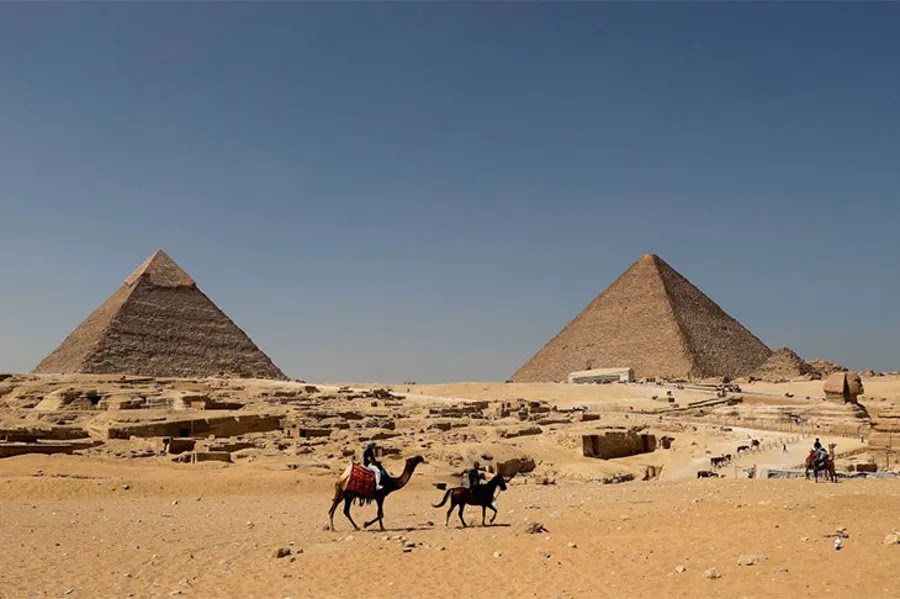
How Egypt built pyramids: Gregg Braden
Family Guy; Gregg Braden, Next Level Soul Podcast, April 27, 2023; Eds., Wisdom Quarterly

 From 1979 to 1991, Braden worked as a problem-solver during times of crisis for Fortune 500 companies, including Cisco Systems, where he became the first technical operations manager in 1991.


Join this channel to support the work being done to help awaken the world: @nextlevelsoul
 |
| Graham Hancock has set the world on fire with his documentary that the powers have to stop |
Gregg Braden: NEW evidence! The shocking TRUTH about how they built the pyramids!

He continues problem-solving today as he merges modern science and the wisdom of our past to reveal real-world solutions to the issues that challenge our lives.
His research has led to 15 film credits and 12 award-winning books now published in over 40 languages.
Braden is a member of the American Association for the Advancement of Science (AAAS) and is active with visionary organizations, including the HeartMath Global Coherence Initiative and The Arlington Institute.
He has presented his discoveries in over 30 countries on six continents and has been invited to speak to The United Nations, Fortune 500 companies, and the U.S. military.

The United Kingdom’s Watkins Journal lists Braden among the Top 100 of “the world’s most spiritually influential living people” for the seventh consecutive year, and he is a 2020 nominee for the prestigious Templeton Award, established to honor “outstanding individuals who have devoted their talents to expanding our vision of human purpose and ultimate reality.”
Enjoy this conversation with Gregg Braden.
Timecodes:
- 0:00 - Episode teaser
- 1:02 - Who built the pyramids?
- 6:28 - Where does the ancient civilization come from?
- 10:55 - How were the stones created?
- 20:20 - How are pyramids dated?
- 29:15 - Gregg Braden's discovery about the pyramids
- 34:11 - What was happening in the Pleistocene?
- 41:17 - Is there a mother civilization?
- 49:23 - The implications of advanced technology and what it would mean to our world today.
- 55:27 - Why the past is so important and why we need to know it?
- 56:47 - Spirituality/divinity
- 1:10:30 - Gregg Braden's work
DISCLAIMER:
The views and opinions expressed in this podcast are those of the guests and do not necessarily reflect the views or positions of Next Level Soul, its subsidiaries, or any entities they represent.
🌟 Listen to the podcast:
Apple Podcasts ➡️ nextlevelsoul.com/apple
Spotify ➡️ nextlevelsoul.com/spotify
Google Podcasts ➡️ nextlevelsoul.com/google
#nextlevelsoul #science #consciousness #story #thepyramids
Watch Gregg Braden's FREE video event: The New Human Story: Awakening Your Evolutionary Potential for Self-Healing
👉 nextlevelsoul.com/gregg-braden...
Watch free course: Unlock Your Mythical Power with the Wisdom of the Ancient Egyptian Goddess Seshet
👉 nextlevelsoul.com/free-Wisdom...
Watch Gregg Braden's first NLS interview here
👉
• How Differently W...
All links to today's guest's books and official site:
👉 nextlevelsoul.com/239
Wednesday, March 22, 2023
Indus Valley, Vedic, South Indian Civilizations
 |
| The lovely and massive Buddha statue in Enlightenment Grove, Bodh Gaya, Bihar, India. |
The oldest settlements in South India: The Keeladi excavations

What did the recent excavations at Keeladi (aka Keezhadi) and other places along the Vaigai and Porunai (Thamirabarani) rivers reveal?
For a long time, it was believed that South India had no ancient urban civilizations like in the north [where the Indus Valley Civilization and the Vedic Civilization thrived near Gandhara, now in parts of Pakistan and Afghanistan, which were formerly parts of the Indian Empire].
While the Sangam Period (dated 300 BCE–300 CE) literature talks of a sophisticated Tamil civilization, there was no concrete archeological proof to back it up…until the path-finding/groundbreaking Keeladi excavations that started in 2015.
A series of digs carried out by the Archaeological Survey of India in a little village near Madurai unearthed artifacts dating back at least to the 6th century BCE [the time of the Buddha].
This included pottery fragments with graffiti marks very similar to the Indus Valley Civilization script.
But Keeladi isn’t the first or only place to offer evidence of ancient settlements in Tamil Nadu.
Adichanallur, Korkai, Pallavaram, Attirampakkam, and many more sites have produced an array of amazing artifacts over the last 100 years or so, including the oldest human tool to be ever discovered in India -- a hand-axe that was discovered in Pallavaram, part of present-day Chennai.
It’s only in recent years that the pieces of the jigsaw have started coming together. Archeologists believe that many more exciting discoveries, possibilities, and answers are waiting to be found at this site.
#keeladi #keezhadi #Adichanallur #Korkai #sangamliterature #Porunai #thamirabarani #Vaigai #IndusVallley #indusvalleycivilisation #VediCivilisation #anicientcivilisations #madurai #Agaram #Pallavaram #Egmore #southindianhistory #indianhistory #chennai #storytrails #storiesofindia #tamilnadutourism
Produced in partnership with:
- Saint-Gobain: saint-gobain.com/en (@SaintGobainTV)
- Tamil Nadu Tourism: tamilnadutourism.tn.gov.in (@TamilnaduTourismOnline)
- The Egmore Museum, Chennai
Editing credits: Studio A, Chennai
Music, Sound Design, Mix & Master: Vishwi (vishwimusic.com)
IMAGE CREDITS: To view attributions for images used in this video, click on this link - storytrails.in/culture/the-ol...
To experience more such stories of India, visit storytrails.in.
ABOUT: Storytrails is an award-winning organization that showcases India through her stories, through story-based walking tours, audio tours, local experiences, videos, blogs, podcasts, and online learning programs.
Follow work on facebook.com/storytrails, instagram.com/storytrails, linkedin.com...
Like the video, love the book: The Temple of Treasures and Other Incredible Tales of Indian Monuments. Find out more here: storytrails.in/books. Write with feedback and suggestions: contact@storytrails.in
Friday, January 6, 2023
Forbidden Archeology: Vedas, Indus Valley Civ.
The 5th Kind, Jan. 5, 2023 Dhr. Seven, Pat Macpherson (eds.), Wisdom Quarterly
This changes everything! Hidden history of Vedic knowledge and the Indus Valley Civilization


It will feature Michael Cremo, Linda Moulton Howe, Caroline Cory, Barbara Lamb, and many other amazing presenters. Special thanks to Neil Gaur @portaltoascension for this collaboration.
Check out PTA on YouTube (youtube.com/channel...). Were there Vedic designs inside Indus Valley Civilization sites? Is there any archeological evidence that humans like us have been present on earth for millions [even hundreds of millions] of years? Were humans like us on earth 20 million years ago?
- Website 5thkind.tv
The Puranas: Vedic history tells a version of human history that is much, much older than the one currently accepted by mainstream science.
Michael Cremo is a journalist, whistleblower, and researcher of human origins and an international authority on archeological anomalies (out of place artifacts).

The Forbidden Archeologist: Human Devolution, Forbidden Archeology's Impact, and the Hidden History of the Human Race was co-authored by Richard Thompson. His published works are highly endorsed by academics and researchers around the world.
Michael Cremo has been invited to present his research in some of the leading scientific institutions of the world. The royal institution of London, the Russian Academy of Science, the Moscow Department of Anthropology, the Indian Institute of Science, and many others.
He has also appeared widely on television shows such as the History Channel’s “Ancient Aliens” and the Gaia TV series “Ancient Civilizations.”
Michael Cremo’s work in archeology and research of the ancient Sanskrit writings of India (and proto-India) has revealed a long and mysterious history of human origins, spirituality, and paleocontact.
Find more information about him, his research, and his published works by visiting his website mcremo.com.
Subscribe to:
Posts (Atom)






















































