Showing posts with label cakkavala. Show all posts

Saturday, February 21, 2026

Antarctica revealed (Linda Moulton Howe)

SEE: Linda Moulton Howe reveals what witnesses saw on Antarctica: "I must tell the truth"!


Our world is not a globe but rings and is hollow.
(Optic Expedition) Feb. 21, 2026: In 1982, a U.S. Navy flight engineer made an emergency landing on a ridge in Antarctica and saw something in the ice that was not supposed to be there.

It was geometric, angular, massive, made of a material that was neither ice nor rock. He was ordered never to speak of it. He signed papers that silenced him. He kept the secret for almost 20 years. Then, dying, he picked up the phone and called one person — Emmy Award-winning investigative journalist Linda Moulton Howe (earthfiles.com).

(YouTube Movies & TV) A hidden network of female journalists and activists are dedicated to UFO disclosure, so they uncover shocking truths about the U.S. government's firsthand knowledge of extraterrestrial (space alien, UFO, UAF) phenomena.

India's ancients knew of Agartha below us.
She recorded every word he said. Then she waited because over the next 25 years, more witnesses called: Navy personnel, scientists, U.S. contractors, NORAD officers, all of them describing pieces of the same thing buried beneath Antarctic ice.

All of them had been silenced, all of them. One by one, deciding before they died that she was the only person they trusted to tell the world. Now, at age 81, Linda Moulton Howe has finally compiled every testimony, every coordinate, every classified detail — and she is talking.

She has said, "Before I die, I must tell the truth — because the people who told me these things are dying. And if I do not share what they revealed, this knowledge dies with us." This is what they found.

Monday, March 18, 2024

Kava Bar & Botanical Lounge (the Valley)

KBBL (kavabotanicallounge.com), Reseda, Los Angeles; Ananda (Dharma Buddhist Meditation), Dhr. Seven, Jen Bradshaw (eds.), Wisdom Quarterly

The root of this plant has special properties.
What if someone in Los Angeles opened a kava bar? You know, a lounge that serves kava drink from the South Pacific. The kava plant is from the island of Vanuatu, where such bars are called Nakamal, traditional meeting areas to build community.

Drinking kava is ceremonial. Gradually traditional Nakamals became less prominent, and they started functioning as prep and serve sites for groups.

As the popularity of kava grew, kava bars began to spread from the South Pacific to the USA. In recent years, they have been sprouting up in different cities across the country, such as Sedona, Arizona, but tropical Florida still leads the pack.

Current trends make kava a great social drink because people loosen up, relax, and plunge into a happy and relaxed mood. The best part is it gives one a good night’s sleep without the dreading have to nurse a nasty hangover the following morning.

Its popularity is on the rise, gaining momentum as a healthier alternative to alcohol. Some claim it offers the potential for weight loss. Is it the next innovation for coffee shops from coast to coast?

Learning about Kava
Maybe it’s a misspelling of Spain’s famous sparkling wine “Cava”? Kava is from the South Pacific with a long history and robust flavor that is experiencing a rise in interest in major US cities.

Made from the ground root of the kava plant, fans of the intoxicating beverage say it produces a state of calm relaxation and can reduce anxiety. Research suggests that frequent use does not impair cognitive function.

Its popularity has led to the opening of several kava bars that serve as pleasant social lounges, a new sort of cafe with comfortable seats, relaxed lighting, and lots of conversation.

Kava bartenders, kavatenders, are encouraged to socialize, talking up the plant’s history.

Positive Effects of Kava
Patrons of the kava community often hear a cheer from Fiji. It’s the catchall phrase “Bula!” when sharing drinks.

What is it? Most of KBBL’s kava is sourced from Fiji and Vanuatu, but there are also showcase strains from other islands. It is the root of the pepper plant Piper methysticum, hand squeeze into a semi-intoxicating drink customers find helps reduce stress, relieve muscle aches, and lubricates socializing for wallflowers.

Traditionally, kava was ceremonial on the islands bringing together friends and neighbors. Kava has a reverse tolerance. So those new to it should let KBBL know to help ensure an excellent first experience.

The more often it is consumed, the less of it that is needed to feel the effects. A bula is a shared experienced.

Customers at Kava Bar & Botanical Lounge, a non-alcoholic bar in the Valley in Los Angeles, enjoy traditional kava and premium organic mock-tails inspired by ancient island tradition.

The atmosphere in Reseda is unlike any other: Conversing, studying, gaming in the arcade are just some of the things visitors enjoy. There is a private outdoor patio, Live Music Fridays, and a plethora of events planned for this calendar year.

The community is extremely welcoming and provides a much-needed alternative for those who crave a social experience better than the average bar scene. Alcohol is so 2023. KBBL is embarking on a journey to grow the biggest sober scene in LA.

Looking for a kava bar? Look no further then Reseda’s Kava Bar & Botanical Lounge.

Sunday, January 7, 2024

Science: Before Big Bang, the universe existed

Family Guy; BeeyondIdeas, 11/2/23; Pat Macpherson, Dhr. Seven (eds.), Wisdom Quarterly

Hubble did it first even if it didn't do it better. Now Webb is wowing public. Crab Nebula above

"This universe existed before the Big Bang" ft. Roger Penrose

(BeeyondIdeas) Let's unravel the mysteries surrounding (our) Big Bang. Was it truly the beginning of everything?

31 Planes/Zones of Existence
[No, obviously not. In Buddhist cosmology, the universe (multiverse) is aeons (kalpas) old, ordinary aeons and great aeons, of incalculable lengths as the universe arises, expands, disintegrates, goes into a state of chaos, and arises again, cyclically, repeatedly, endlessly.

It is unclear what constitutes a universe, the everything, because there are world systems (cakkavalas), and each world system is similar to the countless others, like bubbles in space. If each constitutes a universe, a self-contained system of planets and stars and a diverse population of creatures, then we live in a multiverse with such universes extending out in 10,000 directions.


There are 31 Planes of Existence, divided into three spheres, our Sensual Sphere, the more subtle Fine Material Sphere above us, and the Immaterial Sphere, which is formless, above that. These 31 Planes are general categories with countless individual worlds and inhabitants. Space is big, very big, and multidimensional, so it's even bigger than we can imagine.

Could order ever emerge from chaos, Bill Nye?

Keplers supernova remnant is a (wiki)
So from a Buddhist cosmological point of view, if a "Big Bang" is the initial point of an expanding universe, this is just a phase after a lengthy period of contraction. After expanding, it dissipates into chaos for a lengthy period. But after a time, it again establishes order and regularity, and this is a new beginning, a Golden Age or Satya Yuga, an Age of Truth. We are currently in a Kali Yuga, but it is hard to say because within these massive cycles there are subcycles, mini periods of revolution, of dark and bright, cycles within cycles.

And it just goes on this way without end and, therefore, without a discernible beginning, which is not to say there was not one, only that it cannot now be found. And we cannot reason our way there. It is one of the Four Imponderables.

One would sooner become deranged, a "mad scientist," before settling on a satisfactory answer. And, in any case, it would not actually be satisfactory, like The God Idea as the cause of all things, with Maha Brahma (the "Great Supremo") as the cause of all things, which the Buddha declared a wrong view.
God creates the universe with his friend Chugs.
A creator god is as good as any explanation only because it stops all further searching. It is said that science is ridiculous in positing a Big Bang as a first cause because in doing so it is saying, "Everything is rational, mechanical, explicable, and understandable IF you just give us this one bit of irrational, supernatural, inexplicable, and nonsense Big Bang magic as the cause and origin of everything.]
🔍 Want to support production? Feel free to join our membership at BeeyondIdeas... Special thanks to beloved YouTube members this month: Poca Mine, Powlin Manuel, Gregory Stone, Lord, Saïd Kadi, and Brad Clemmer. 🚀 Experts featured in this video include Roger Penrose and Paul Steinhardt. #BigBang #Infinity #CyclicUniverse

Monday, August 28, 2023

Universe twice as old as thought? (video)

British astrophysicist Dr. Becky Smethurst, University of Oxford, Christ Church (Dr. Becky on YouTube, July 27, 2023; Sheldon S., CC Liu (eds.), Wisdom Quarterly

Has JWST shown that the universe is TWICE as old as we thought?!
With all the CGI, color enhancements, photographic manipulations, projections, and theoretical mathematical calculations, this slice of heaven/space could be any age (James Webb Telescope)


It's really big: JWST prepped on earth
(Dr. Becky) The great Dr. B. has attitude, doubting that new evidence and explanations for the current data suggest the universe is older than we thought.
A new research study has come out claiming that to explain the massive galaxies found at huge distances in James Webb Space Telescope images, the universe is older than we think, at 26.7 billion years (rather than 13.8 billion years old).
  • JWST: Note two tiny white ants in foreground.
    00:00 - Introduction: #JWST's massive galaxy problem
  • 01:48 - Our current best model of the Universe: λ-CDM
  • 03:16 - The problems with λ-CDM and the "Crisis in Cosmology"
  • 04:28 - Getting distance from redshift
  • 05:13 - A new model of the Universe: a HYBRID of "tired light" and expansion of the Universe
  • 06:25 - The history of "tired light" and why it was eventually dismissed (Tolman Surface Brightness Test)
  • 08:18 - What Gupta (2023) have found
  • 09:30 - The change to the calibration of redshift and distance (and the new age of the Universe)
  • 10:02 - What other problems does this new model help solve?
  • 11:07 - The observational evidence that this new model ignores...
  • 12:39 - How else do we explain JWST's massive galaxy problem? Universal IMF issues
  • 14:35 - Outro: the legacy of JWST
  • 15:23 - Brilliant
  • 16:46 - Bloopers Video filmed on a Sony ⍺7 IV
This video dives into that study, looking at what model they used to get at that claim (a combination of the expansion of the universe and "tired light" ideas of redshift), how this impacts our best model of the universe and the so-called "Crisis is Cosmology," and why Dr. B. is not yet convinced.

📚 My new book, A Brief History of Black Holes, out NOW in hardback, e-book, and audio (narrated by myself): http://hyperurl.co/DrBecky

📚 The Year In Space celebrating all things space in 2022 from me and the rest of the Supermassive Podcast team: https://geni.us/jNcrw

👕 My new merch, including JWST designs, are available here (with worldwide shipping): https://dr-becky.teemill.com/

🎧 Royal Astronomical Society Podcast I co-host: podfollow.com/supermassive

🔔 Forget to subscribe and click the little bell icon to be notified or don't...

#astronomy #cosmology My previous YouTube video on how JWST’s massive galaxies are no longer “impossible” • JWST's "too massive" galaxy problem s... Gupta et al. (2023; is the universe 26.7 billion years old?) academic.oup.com/mnras/advance... Labbé et al. (2023; over-massive galaxies spotted in JWST data) arxiv.org/pdf/2207.12446.pdf Arrabal Haro et al. (2023; z~16 candidate galaxy turns out to be z=4.9) arxiv.org/pdf/2303.15431.pdf Zwicky (1929; "tired light" hypothesis raised for first time) pnas.org/doi/epdf/10.1073...

JWST observing schedules (with public access): stsci.edu/jwst/science-ex... JWST data archive: mast.stsci.edu/portal/Mashup... Twitter bot for JWST current observations: twitter.com/JWSTObservation. The successful proposals in Cycle 2 (click on the proposal number and then "public PDF" to see details): stsci.edu/jwst/science-ex...

👩🏽‍💻 ABOUT: I'm Dr. Becky Smethurst, an astrophysicist at the University of Oxford (Christ Church). I love making videos about science with an unnatural level of enthusiasm. I like to focus on how we know things, not just what we know [epistemology], especially the things we still don't know. If you've ever wondered about something in space and couldn't find an answer online, ask me. My day job is to do research into how supermassive black holes can affect the galaxies that they live in. In particular, I look at whether the energy output from the disk of material orbiting around a growing supermassive black hole can stop a galaxy from forming stars. http://drbecky.uk.com https://rebeccasmethurst.co.uk

Tuesday, October 25, 2022

Last solar eclipse of 2022: Tuesday, Oct. 25

Eds., Wisdom Quarterly OPINION; Space.com


Everything NASA tells us is a lie. - John Lear
According to space.com there will be a solar eclipse today -- Tuesday, Oct. 25 -- just in time to confuse all the spirits stirring for their annual appearance on the human plane. Animals will be disturbed, too, as they seem to be able to see them. What causes an eclipse?

The unrecognized Rahu (alternating with Ketu) strays across the sky and covers it, according to the ancient Dharmic religions of India -- Hinduism, Buddhism, Jainism, Brahmanism, Skihism, and possibly Rumi's Sufism (which is technically mystical Islam) -- not to mention the biblical views of Sumer, Judea, and Christiandom.
Sure, science has a different explanation that drowns everyone else out. How dare a religion have a point of view. Something about the sun be 400 times farther away than the moon but at a perfect distance to seem exactly the same size as the moon. That's unlikely and not what our eyes tell us. But who are we to believe, what someone says science says or what we say when we look up and see for ourselves?

Where in the world is Dal Lake, India/Pakistan? (wikipedia)
In any case, however it happens, someone celestial object is getting in the way of another today. And that may have some astrological portent. Maybe a "dark pall" has spread over the British Empire because Rishi Sunak has become the first person of color (and Hindu) to become the country's political leader?

Or maybe it's American royal K Ye West spreading his dark message of antisemetism and white supremacy (Trump loving White Lives Matter moves). Or maybe the billions of oppressed "darker" people of color on the planet are reflected in the skies.

Or maybe it's the scourge of anti-dark worldwide racism wrought by white supremacists worldwide trying to keep an advantage provided to them by past and present empires (like the Greeks of yore and Americans of Apocalypse Now).

Who knows for sure? Any symbolism could be made out of it, depending on how one chooses to see natural phenomena play out over our personal affairs and points of view.

Tuesday, September 15, 2020

Of course there's life on Venus (video)

(space.com, 9/14/20); Pat Macpherson, Dhr. Seven (eds.), Wisdom Quarterly
What does life on Venus look like under the clouds, like a National Park on Earth? (MSN)
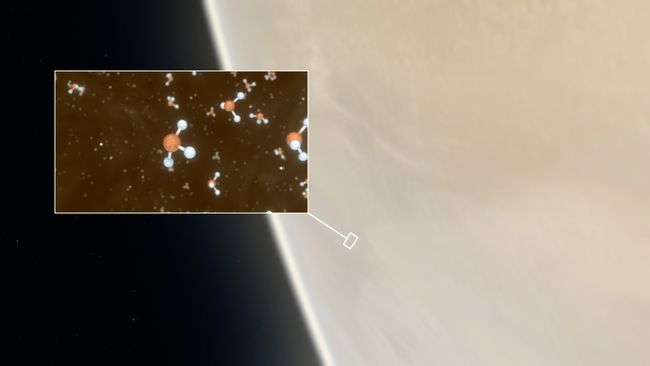
An artist's depiction of Venus and, in the inset, phosphine molecules.
Venus artist's depiction with phosphine (ESO/M. Kornmesser/L. Calçada/NASA/JPL-Caltech)
.
The phosphine discovered in Venus' clouds may be a big deal
Venus? NASA manipulates its images for PR.
A chemical most have likely never heard of has burst into the news as scientists announce that they have detected phosphine, which they say may be a sign of life, in the clouds of nearby Venus.

Phosphine is a chemical compound made up of one atom of phosphorus and three atoms of hydrogen, and scientists have also spotted it on Earth, Jupiter, and Saturn. On the gas giants, it's quite prevalent in the atmospheres, both of which are rich in hydrogen. On Earth, where the atmosphere leans more toward oxygen compounds, it's much shorter-lived, and the same ought to be true on Venus.

"It's so obscure," Sara Seager, an astronomer at MIT (Massachusetts Institute of Technology) and co-author of the new research, said during a news conference held virtually today (Sept. 14). "No one cares about [phosphine] except for a few very niche people." More

Venusian life

The 31 Planes of Existence
Buddhist cosmology, as well as that of Hinduism and Jainism all the way back to the ancient Vedic religion of proto-India (Great Bharat), has always known there is life on Venus (Shukra in astrology, planetary deities). It is not limited to this planet (or island in a sea of space called Jambudvipa) but also exist on other nearby planets or worlds (levels) -- as well as countless other places throughout the universe, of which we are only a tiny portion in this cakkavala or "world-system." Such world-systems are spread like bubbles throughout the universe/multiverse.
  • "The planets are called dvīpas [islands]. Outer space is like an ocean of air. Just as there are islands in the watery ocean, these planets in the ocean of space are called dvīpas, or islands in outer space" (Chaitanya Caritamrita Madhya 20.218, Purport).
In a very interesting book written by an avadhuta ("apostle") of the modern mystic Anandamurti or Baba (P. R. Sarkar), the founder of Ananda Marga ("Path to Bliss"), entitled My Tantric Guru, there is a description of an incident talking about life on Mars, Soma/Chandra (Earth's moon), and Venus.

(Soolaba) Vedic cosmology inherited by Hinduism in modern terms

A revived meditation master was sent to astral travel to those places to see first hand. He reported back at a live demonstration that the beings there (some of whom are red and others blue) want no dealings with earthlings, it is said. They are more advanced and seem to generate or allow the clouds that obscure their world from humanity on Earth.

The life spread across the galaxy is humanoid and related but not limited to this kind of being. The Buddha spoke of 31 planes of existence, which are not worlds but categories of planes. What we see around us is all still the "human plane" or manussya loka.

Friday, May 29, 2020

Scientists discover universe's missing matter

Jaskiran Kaur (ibtimes.co.uk, 5/28/20); Pat Macpherson, CC Liu (eds.), Wisdom Quarterly


Scientists discover universe's "missing matter"
Soon we will reveal ourselves and explain.
Astronomers have discovered the normal missing matter of the universe they have been looking for for 30 years.

Our universe harbors several mysteries that scientists have been trying to resolve for centuries. Cosmic matter and its activities are still beyond our understanding.

However, in the latest development, astronomers may have solved one of the biggest puzzles of the universe found the universe's "missing matter."

Where has the "matter" (rupa) been hiding?
For decades, astronomers have been aware of the existence of "missing matter" of the universe.

However, the origin and source of the strange aspect of the universe remained still undetected until now. The international team of researchers has now discovered from where the missing baryonic matter is located.

Now, the researchers used mysterious fast radio bursts also known as FRBs — powerful millisecond bursts of radio pulse caused by mysteriously occurring high-energy astrophysical process — to find the matter, what causes them and where it can be traced back to.

Square pegs: if only we could box space bubbles
The scientists have now discovered all of the missing "normal" matter in the vast space between stars and galaxies. The results of the study were published in a journal named Nature.

According to the report, the astronomers have been aware of the missing material for 30 years.

"We know from measurements of the Big Bang how much matter there was at the beginning of the Universe," Lead author Associate Professor Jean-Pierre Macquart, from the Curtin University node of the International Centre for Radio Astronomy Research (ICRAR) said in a news release statement.

But when we looked out into the present Universe, we couldn't find half of what should be there. It was a bit of an embarrassment. More

Tuesday, April 7, 2020

Year's biggest supermoon tonight, April 7-8

Bruce McClure (earthsky.org/tonight); Pat Macpherson, Dhr. Seven (eds.), Wisdom Quarterly
Moon over Garden of the Gods (devas), Colorado Springs (Joe Randall/Facebook/EarthSky)
Full moons at apogee (farthest from Earth, left) and perigee (closest to Earth, right) in 2011. Composite image by C. B. Devgun in India for EarthSky. Using the eye alone, it’ll be difficult to notice any size difference for the full moon of April 7-8, 2020. But moon-watchers might notice that this is a very bright full moon, and Earth’s oceans will feel an extra pull.
.
What's a "supermoon"? (EarthSky)
In North America we often call the April full moon the Awakening Moon, Pink Moon, Grass Moon, or Egg Moon. In 2020, this April full moon also presents the closest (and thereby largest) supermoon of the year.

This full moon more closely coincides with lunar perigee – the moon’s closest point to Earth in its monthly orbit – than does any other full moon in the year 2020.

Will we notice that the moon is larger than usual? Probably not...unless one is a very experienced and discerning observer.

Moon (Trish Minogue Collins/EarthSky)
The angular diameter of a supermoon appears about 7% larger than that of an average-size full moon, and about 14% bigger than the angular diameter of a micro-moon or mini-moon (the year’s most distant and therefore smallest full moon), perhaps not enough to be noticeable to most of us using the eye alone.

On the other hand, will we notice that the full moon of April 7-8 is particularly bright? Yes! Well, maybe...if we’re observant moon-watchers. Why? That’s because supermoons can be up to 15% brighter than an average-size full moon, 30% brighter than a micro-moon.

The moon comes closest to the Earth for the entire year when it reaches perigee on April 7, 2020, at 18:08 UTC. Of this year’s 13 lunar perigees, this is one of only two that comes closer than 221,830 miles (357,000 km). More

Monday, February 10, 2020

The Four Imponderables (sutra)

Dhr. Seven, Amber Larson (eds.), Acintita Sutra: "Imponderables" (AN 4.77); Giphy; derived from unsatisfactory original translation by Ven. Thanissaro (watmetta.org), Wisdom Quarterly
Rodin's Le Penseur ("The Thinker," one of a series of similar sculptures involved in the similarly imponderable Mandela Effect) sits pensively as if on a porcelain throne (norton.org).

.
My monkey mind only makes things worse.
"There are Four Imponderables on which it is wise not to dwell [1] as repeatedly doing so would bring about unhinged-madness and wearisome-vexation if one were to try. What are these four?
  1. The range of influence of a buddha is imponderable... [2]
  2. The range of influence of a person absorbed (jhana) in meditation… [3]
  3. The [mysterious] working out of the results of karma... [4]
  4. The origin [and so on] of the world is imponderable on which it is wise not to dwell as repeatedly doing so would bring about unhinged-madness and wearisome-vexation if one were to try.
"These are the Four Imponderables on which it is wise not to dwell as repeatedly doing so would bring about unhinged-madness and wearisome-vexation if one were to try."

1. Nor should they be speculated about because they are staggering, incomprehensible, and ultimately inconceivable]


2. Buddha-range: the range of powers a buddha develops as a result of becoming a supremely enlightened buddha, which is much more than an ordinary arhat (fully enlightened person) because arhats did not develop the Ten Perfections (paramis), so they do not possess the power to know all that a buddha know. Buddhas can teach effectively. They can establish a noble-sangha (community of enlightened disciples), and make the Dharma known in worlds darkened by ignorance. While everyone arhat's enlightenment and experience of nirvana is the same, their ability to make known the path is lacking. The ability to communicate the Dharma to others differs radically from individual to individual. There are countless arhats, shining ones (devas) and human beings, but precious few supreme (samma-sam) buddhas and pacceka (non-teaching) buddhas. Their range of influence is very great.

3. Jhana-range: the range of powers that one is able to manifest as a result of attaining and mastering the meditative absorptions (jhanas).

4. It should always be remembered that karma (intentional action of mind, speech, or body) is one thing, and its resultants (vipaka) and ripening fruits (phala) are quite another. Moreover, all actions impact how results are experienced, so there is hope no matter what one has done. More good now guarantees a better future, and the situation is never hopeless, even in the case of the five heinous acts. See the strange case of Angulimala the serial killer and saint. Even Buddhism's "Judas" figure, Devadatta, is not doomed forever, as his karma would suggest.

Wednesday, January 9, 2019

Inner Earth Civilizations: Agartha (video)

Universe Inside You, July 18, 2018; Pat Macpherson, Dhr. Seven (eds.), Wisdom Quarterly

Inner Earth Civilizations Exist and I Can Prove It: Agartha and Our Hollow Earth
The word Agartha is of Buddhist origin. Buddhists believe in this massive subterranean empire, which they say has millions of inhabitants and many cities, including the capital Shambhala, where a "world ruler" (chakravartin) dwells.

They further believe that the Dalai Lama is his terrestrial representative. His messages have been transmitted to various lamas for thousands of years. These subterranean inhabitants have lived here sheltering humanity after many terrestrial cataclysms.

The Russian artist, philosopher, and explorer Nicolas Roerich published that a Tibetan lama revealed the capital of Tibet, Lhasa, is connected by a tunnel to Shambhala. (Its entrance is at the Potala Palace). The heart of that subterranean empire is Agartha.

The entrance of this tunnel is guarded by lamas, who are sworn to keep its actual whereabouts a secret from outsiders. Those who are led through this underground passage travel deep into the earth through areas where it becomes so narrow that it can be difficult to pass.
Written and narrated by Elisabeth Firestone: info@BestNarrator.com Editing and production: Stefan Dimitrov extourmed@abv.bg NOTE: Many materials were used under fair use for the purpose of this video.