Drukpa Kunley (1455–1529), also known as Kunga Legpai Zangpo, Drukpa Kunleg (Tibetan འབྲུག་པ་ཀུན་ལེགས་, brug pa kun legs), and Kunga Legpa, the Madman of the Dragon Lineage (Tibetan འབྲུག་སྨྱོན་ཀུན་དགའ་ལེགས་པ་, 'brug smyon kun dga' legs pa), was a Tibetan Buddhist lama, missionary, and poet in the Drukpa Kagyu lineage of the [Himalayan Bon sorcery-influenced] Vajrayana Buddhist Mahamudra tradition [1].
He was trained at Ralung Monastery under siddha Pema Lingpa. However, by the age of 25, he had returned his monastic [Vinaya] vows [2] to take a wife, whose name was Tsewang Dzom (tshe dbang 'dzom) [3]. He is often counted among the Nyönpa ("Mad Ones"). He is considered to have been a reincarnation of Saraha [4]. More
The Enlightenment Trap: Obsession, Madness and Death on Diamond Mountain
(Audiobook) Author Scott Carney has 4.3 out of 5 stars (with 137 reviews). The 2023 edition of The Enlightenment Trap includes two new chapters, photography, and updated total revision.
In 2012, 38-year-old Ian Thorson's search for spiritual transcendence ended in tragedy on a remote Arizona mountaintop. His wife, a woman anointed as a goddess by an eccentric Buddhist community, held him in her arms as he slowly died from dehydration and dysentery.
For Scott Carney, a journalist and anthropologist who lived in India for six years, Thorson's death was just the most recent iteration of an unspoken epidemic that connected intensive meditation and mental instability.
The Enlightenment Trap explores how Tibetan Buddhism in the West morphed from its roots in the Himalayan foothills into a fundamentally new American religion. For Thorson, the entry point into this new faith was Geshe Michael Roach, the supreme spiritual leader of Diamond Mountain University.
Carney unravels the cult-like practices of Diamond Mountain to illuminate the uniquely American tendency to mix and match Eastern religious traditions like LEGO pieces. The result is that for some, enlightenment is a synonym for almost god-like powers, and achieving it can become more important than life itself.
Aided by Thorson’s private papers and cutting-edge neurological research, the book reveals the profound impact of intensive meditation on the brain.
Carney exposes stories of miracles and black magic, sexualized rituals and tantric rites from former Diamond Mountain acolytes. The Enlightenment Trap is a gripping work of investigative journalism that reveals how the path to enlightenment can be riddled with danger.
We're all Mahayana, Universalism, and we all love Holy Mother Kwannon, right JP?
(Asangoham) Vajrāyāna Buddhism, also known as Tantric Buddhism or Esoteric Buddhism, first developed in proto-India and later spread to China, Tibet, Nepal, and Bhutan.
I'll be the pope, you all be my bishops.
Vajrāyāna Buddhism was first introduced to Tibet in the 8th century AD.
This makes it the last school of Buddhism to spread beyond India.
The main figure responsible for the introduction and establishment of Buddhism in Tibet was the Indian master Padmasambhava, also known as Guru Rinpoche.
Padmasambhava arrived in Tibet in the 8th century at the invitation of the Tibetan King Trisong Detsen.
Padmasambhava spread the teachings of [Vedic Brahmanism-infused] Vajrāyāna Buddhism throughout Tibet, and it has been the dominant form of Buddhism in the region ever since.
The CIA says we'll be working together, Greta. - Yah, okay, and what about the climate?
.
Vajrāyāna Buddhism has its roots in Mahāyāna Buddhism.
Vajrāyāna, however, introduces the use of visualization, mantra, and ritual practices to achieve enlightenment in a single lifetime.
Vajrāyāna Buddhism uses visualization, or the creation of mental images of deities, mandalas, and other spiritual symbols, to access the wisdom and power of the deity.
This is known as deity yoga, and it is one of the main practices of Vajrāyāna Buddhism.
One main reason that this became a primary practice of Vajrāyāna Buddhism is because of the [indigenous] Bön religion, which existed in Tibet long before Buddhism arrived.
The Importance of Bön to Vajrāyāna Buddhism
The Bon Treasure Discoverer, Tibetan animism
Bön [animism, shamanism, black magic] is a religion that has been practiced in Tibet for over a millennium.
Today, it exists alongside Vajrāyāna Buddhism, and many of its beliefs and practices have been incorporated into Vajrāyāna.
Bön makes use of rituals and magic to contact and access the power of deities and spirits.
Bön believes in a spiritual dimension known as the dngos-po or "pure realm." This realm is believed to be inhabited by enlightened beings who have achieved spiritual liberation [or at least the Hindu version of it].
It is believed that by connecting with these enlightened beings through visualization and meditation, they can gain access to the wisdom and blessings of the pure realm.
Score: Motion Array x Epidemic Music x Original Score
DISCLAIMER 01: All ideas expressed on this channel are for entertainment and general information purposes only. There is no advice on what an individual should or should not do. Any response made by anyone after hearing this communication is their interpretation and is their responsibility. Ideas expressed by this channel should not be treated as a substitute for medical advice or professional help. If expert assistance or counselling is needed, the services of a competent professional should be sought.
DISCLAIMER 02: All materials in these videos are used for entertainment purposes and fall within the guidelines of fair use. No copyright infringement intended. If you are, or represent, the copyright owner of materials used in this video, and have an issue with the use of said material, please send an email to doseofquotes02@gmail.com.
(EN - Clemens Kuby) The documentary Reincarnation: Looking for a Sign by Clemens Kuby shows the death of Jamgon Kongtrul, the search for his rebirth, and how we find out whether it is he whom we lost four years earlier.
With this documentary film, life is no longer a singular phenomenon between conception and death, but a continuum on a spiritual- and consciousness-level. This completely takes away the horror and finality of death. To experience this real case of rebirth (not as a feature film but in real life) gives this unique documentary an inspiring power that amazes and leads us to ponder.
Efforts to recover lost [Tibetan] spiritual teachings
This film tracks the extraordinary journey of 40-year-old Lelung Rinpoche, one of Tibetan Buddhism’s three principal tulkus (reborn teachers, reincarnations), as he sets out to gather the lost teachings of his tradition and return to his homeland, Tibet.
For the past seven years, Lelung Rinpoche has been living in North London, in the garden shed of one of his students. He runs a Dharma or teaching center, which is attended by British followers.
Now a British passport holder, he embarks on a mission to find previous incarnations of Lelung’s Vajrayana teachings and those who hold the key to unlocking their secrets.
HBO's Mr. Show imagines a tulku in Indiana
His fascinating odyssey takes him to India, Mongolia, and China as he tries to find a way back home to Tibet. Along the way the rinpoche meets some of Tibetan Buddhism’s most senior teachers, including the Tibetan prime minister in exile.
This documentary follows Lelung Rinpoche as he takes on the most daunting of tasks: to recover lost spiritual teachings before they disappear forever while taking the right steps on his own path towards enlightenment.
“An enlightening documentary”
- Mike Mulvihill (The Times)
Directed by Robert Wilkins. Produced by Simon Wheeler. Narrated by Hermione Norris.
Dr. Robert Thurman (Tibet House US, May 27, 2018); Dhr. Seven, Amber Larson, Pat Macpherson (eds.), Wisdom Quarterly
Is time travel possible? Explained by Prof. Thurman
This talk was recorded during the 2016 Force For Good Class Series at Tibet House US in New York City. "A Force For Good" is a Tibet House US course to further the Dalai Lama’s contemporary world initiatives, from his American Institute of Buddhist Studies and Mind & Life Institute science dialogues (Universe in a Single Atom) and his creation of Abhidharma 2.0 through the “Science for Monks” programs, his “secular ethics” (Ethics for the New Millennium and Beyond Religion), nonviolent approach to conflict resolution, including Nobel Peace Laureate activities to seek dialogue and a win-win reconciliation with China in the face of the ongoing ethnicidal policies in Tibet (Freedom in Exile and Man of Peace: The Illustrated Life Story of Tibet’s Dalai Lama) and along with his emphasis on positive activism (A New Reality: Charter of Universal Responsibility).
This video is apart of the Tibet House US Digital Archives and is brought by the generosity of Tibet House's membership community. To watch more videos please visit tibethouse.us. Full Access begins at $2 a month. Connect with Tibet House US + Menla Online: twitter, facebook, twitter.com/menla, facebook.com/menlaretreat.
(Fame World) The Dalai Lama is not enlightened by his own admission, but Westerners and Tibetans prefer to think of him as a selfless, all-wise Yoda character, which "Star Wars" creator Lucas based on his tutor, particularly his speech quirks and odd syntax patterns. "Compassion in Exile: The Story of the 14th Dalai Lama," spiritual leader of Tibet in exile
Blasphemy or anti-China?
An inspiration to many as a messenger of peace, the 14th Dalai Lama is a man who has dedicated his entire life towards preserving the rich Tibetan culture.
He resides in the foothills of India's Himalayas, in a hilltop station called Dharamsala, where teaches the importance of love, forgiveness, and care for the benefit of all rather than living in resentment for what the militant Communist Chinese did, which forced him to secretly side with the CIA and serve them as an asset and operative, according to American historian Michael Parenti.
The Dalai Lama does not blame China so much as he blames an internal Tibetan group for the trouble, due to their worship of an inimical deity. These Tibetans protest him whenever they can. This is known as Dorje Shugden Controversy.
Critic Stephan Molydeaux on the Dalai Lama system of Tibet. What Molydeaux does not know, besides basic Buddhism, is that speaking of others' faults is bad karma in Mahayana.
Born Lhamo Dondrub (his name as a lama being Tenzin Gyatso), he was officially recognized as the 14th "Dalai Lama" on Nov. 17th, 1950 when he was just 15 years old.
Now known as "His Holiness" as a boy he was taken to Tibet's capital of Lhasa, to the Potala Palace in 1940, where he began his monastic education as well as Vajrayana training.
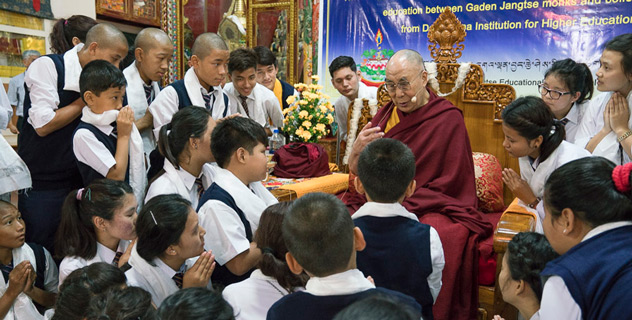
Photo-op for the Dalai Lama with children
The palace is a sort of "Vatican East," once a store of imperial Tibetan "Vatican records" priceless to Vajrayana/EsotericBuddhism, a Mahayana school peculiar to the Himalayan region and practiced in Bhutan, Mongolia, Nepal, parts of China and Russia, and even reaching Southeast Asia.
By 1950, when Tibet was under the influence of Chinese military, the current Dalai Lama was 16 and was called upon to be the head of state of the Tibetan people, a god-king or Buddhist pope and secular ruler to the Tibetan people, once a powerful empire spreading influence from Mongolia to Bangladesh.
In 1959, during the first Tibetan Uprising (see), the Dalai Lama fled to India along with his small escort and later took up residence in Dharamsala, a guest of China's enemy-neighbor, India. He met with the then Prime Minister of India, Pt. Jawaharlal Nehru, who agreed to provide shelter to Tibetan refugees escaping communist China.
According to official records, only about 60 Gyatso monks fled with the Dalai Lama to India. Today, the monastic community in India has grown to a population of about 500 monks. Know more about the world; subscribe.
The Dalai Lama and his court are guests of India, living in the Himalayan Dharamsala.
The first day of the
14th Dalai Lama's three-day teaching on Tsongkhapa's Concise Treatises on
the Stages of the Path to Enlightenment and an overview of Tantra from
Tsongkhapa's Stages of the Path of Mantrayana at the request of a
group of Korean Buddhists at the main Tibetan temple in Dharamsala, India from
August 25-27, 2013. In Tibetan followed by English translation.
The Power of Forgiveness
The Dalai Lama on forgiveness, University of Limerick, Ireland, 2011
This is an overview of the entire Tibetan Buddhist or Vajrayana "path to awakening." It begins with a study
of the life story of the historical Buddha Gautama, known as the "Sage of the Shakya Clan" (Shakyamuni) and opens to the lam-rim or graduated path
to enlightenment. If only there were some way to learn what Lisa Simpson could not when she went in search of spiritual truth beyond the borders of "religion." She found what Richard Gere, Lenny, Carl, and the Dalai Lama had already found.
Lisa, you can want stuff! Wisdom and all kinds of happiness here and now.
Discovering Buddhism
Learning Vajaryana/Mahayana Buddhism at home (fpmt.org)
Each Discovering Buddhism module consists of teachings, meditations and practices, readings,
assessment questions, and a short retreat.
Students may do some or all
of these component parts of each course, as they wish and are interested.
Those who complete all of the components receive a completion card for that
course. When all 14 modules have been completed, students receive
a certificate of full completion.
This awards the satisfaction
of having completed a very comprehensive engagement with the Vajrayana/Mahayana path to
enlightenment. It is symbolic of one's commitment
to spiritual awakening. Rejoice deeply when you receive it!
The courses do not need to be completed in order, and Module 14,
Special Integration Experiences should be started as early as possible
in the program, as it takes some time to complete. Module 14 includes practice retreats available at many FPMT centers.
Each Discovering Buddhism at Home module contains audio recordings of teachings and meditations given by qualified Western teachers, and a text CD containing the course materials and written transcripts of the audio teachings. Packages are available in... More
The tulku Jalue Dorjee, an American-born "Little Buddha" (m.startribune.com)
COLUMBIA HEIGHTS, Minnesota - It's morning time, and a little [4-year-old] boy with a shaved head and a face shaped like the moon chants a Tibetan prayer.
His high-pitched voice echoes inside the Columbia Heights bedroom that his father has transformed into a lavish prayer room. In here, the 4-year-old forsakes his cartoons and toys to study scripture and learn to pray the Buddhist way.
Big for his age, he looks bigger still perched on an ornate chair draped in crimson and saffron robes. "Only for lamas [gurus]," explains his father, Dorje Tsegyal, sitting cross-legged on the floor at his son's feet. Jalue Dorjee, you see, is believed to be no ordinary boy.
According to the highest authorities of the Tibetan Buddhist order, he is the reincarnation of the speech, mind, and body of a lama, or spiritual guru, who died in Switzerland six years ago. Jalue is said to be the eighth appearance of the original lama, born in 1655. His discovery in 2009 is considered an honor and a blessing for his working-class parents. But it comes with a hefty price.More plus VIDEO
In a laboratory tucked away off a noisy New York City street, a soft-spoken neuroscientist has been placing Tibetan monks into a car-sized brain scanner to better understand the ancient practice of Buddhist meditation.
But could this unusual research not only unravel the secrets of leading a harmonious life but also shed light on some of the world's more mysterious diseases?
Zoran Josipovic, a research scientist and adjunct professor at New York University, says he has been peering into the brains of monks while they meditate in an attempt to understand how their brains reorganize themselves during the exercise.
Since 2008, the researcher has been placing the minds and bodies of prominent Buddhist figures into a five-tonne (5,000 kg) functional magnetic resonance imaging (fMRI) machine.
The scanner tracks blood flow within the monks' heads as they meditate inside its clunky walls, which echoes a musical rhythm when the machine is operating.
Dr. Josipovic, who also moonlights as a Buddhist monk, says he is hoping to find how some meditators achieve a state of "nonduality" or "oneness" with the world, a unifying consciousness between a person and his/her environment.
Zoran Josipovic looking at brain scans on a computer. The study specifically looks at the default network in the brain, which controls self-reflective thoughts.
"One thing that meditation does for those who practice it a lot is that it cultivates attentional skills," Dr. Josipovic says, adding that those harnessed skills can help lead to a more tranquil and happier way of being.
"Meditation research, particularly in the last 10 years or so, has shown to be very promising because it points to an ability of the brain to change and optimize in a way we didn't know previously was possible."
When one relaxes into a state of oneness, the neural networks in experienced practitioners change as they lower the psychological wall between themselves and their environments, Dr. Josipovic says.
And this reorganization in the brain may lead to what some meditators claim to be a deep harmony between themselves and their surroundings.
Shifting attention Dr. Josipovic's research is part of a larger effort better to understand what scientists have dubbed the default network in the brain. More
"Samsara" is a spiritual love-story set in the majestic Himalayan landscape of Ladakh, India on the border of Tibet. It is a quest, one man's struggle to find spiritual enlightenment by renouncing the world and one woman's struggle to find enlightenment through love and life in the world. Their destinies turn, twist, and come to a surprise ending.
Other movies exhibiting the culture and beauty of Tibet, illegitimately taken over by the Chinese empire, include:
Why are we Americans obsessed with football and football commercials? American football is stylized war, that's clear enough. So like the former British empire and their soccer obsession, which turned to indivdualistic cricket (like our baseball), we watch, we root, and come to expect that that's the way to resolve differences.
It is said that 51% of the ratings for the Super Bowl are accounted for by the commercials (and the half-time entertainment). Super Bowl ads are some of the most expensive on the boobtube -- because so many people are watching. And drunk. And mindlessly munching on acrylamides, MSG, and rancid trans fats. (You know, Lays, Pringles, Doritos).
I think our obsession stems from something I once saw on "Planet of the Apes." All empires keep people distracted with "the games," and you can't take that away from them. The all-important games!
Think Rome and the Coliseum.
Think Greece and the Olympics.
Think Maya and ball-through-ring/losers-sacrificed-for-losing.
It makes us competitive. It makes us singleminded. It makes us ruthless. But the Buddha advised we steer clear of the "teachings of the vicious." Instead, there's noninjury, helping, caring -- things we all love to receive but aren't so keen to give.
Better than all the celebrating on Super Bowl Sunday would be the bliss associated with a cleansed heart, a clear mind -- what we're trying to achieve with toxic booze (you know how many impurities are in there besides the alcohol?) -- focusing on the first absorption. We are what we eat and take in. Piti and sukha are "rapture and joy" unknown to couch potatoes. And it's why we sit. That reliable happiness, serenity, and energy leads to enlightenment.
Buddhist football obsession: The Cup (Phorpa) is a celebrated breakthrough film by Tibetan lama Khyentse Norbu. Prayer, meditation, rituals, soccer? World Cup soccer-fever sweeps into a remote Himalayan Buddhist monastery. Centuries-old traditions are threatened — the young novice-monks will do just about anything to watch the final match. This poses a unique challenge to the venerable lamas in charge. An inspiring tale of colliding cultures, midnight escapades, and daring secret plots. And it's a true story. Filmed on location at Chokling Monastery.
(BleacherReport) - In Buddhism there are the Four Truths. Mark and I were experiencing all four at the hands of Joe Montana, Jerry Rice, and a roomful of Buddhists.
1. There is suffering. (Certainly, the Broncos and we were). 2. There is a cause for suffering. (In our case, it was the 49ers and these Buddhists). 3. There is a cessation of suffering. (The game couldn’t end fast enough!) 4. There is a way to the cessation of suffering. (We were thinking of leaving early).
Suddenly, in the middle of the game — I think it was 4:00 (time and therapy have washed away many aspects of this day) — every Buddhist in the room got up, went into another room, bowed down (to the West, I presume), and started chanting and banging a little gong. More>>
Do Macho Ads Defuse Homoeroticism of the Games? In the background, much like the Trocks, the players are in tutus. After years of homophobic ads broadcast to subconsciously defuse the homo-eroticism of the games, this spot is a welcome departure, if a shameless rip-off.
All materials on this site are submitted by editors and readers. All images, unless otherwise noted, were taken from the Internet and are assumed to be in the public domain.
In the event that there is still a problem, issue, or error with copyrighted material, the break of the copyright is unintentional and noncommercial, and the material will be removed immediately upon presented proof.
Contact us by submitting a comment marked "private."
Do not follow this journal if you are under vinaya or parental restrictions. Secure protection by Sucuri.
Wisdom Quarterly: American Buddhist Journal is licensed under a Creative Commons Attribution-Noncommercial-Share Alike 3.0 United States License. Permissions beyond the scope of this license may be available at creativecommons.org/about/licenses.