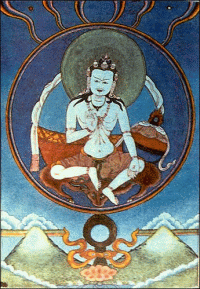
Machig Labdrön (Tibetan མ་གཅིག་ལབ་སྒྲོན་, sometimes referred to as ཨ་སྒྲོན་ཆོས་སྒྲོན or Ahdrön Chödron་) [1], the "Singular Mother Torch from Lab" (1055–1149) [2].
Machig Labdrön was the renowned 11th-century Tibetan tantricBuddhist master and yogini who originated several Tibetan lineages of the Vajrayana practice of Chöd (Tibetan གཅོད་).
Nyingma scholar Khenchen Palden Sherab Rinpoche states that the Chöd tradition developed by Machig Labdrön is "a radical synthesis of the Prajnaparamita tradition and tantra guru yoga that 'cuts' through the ego" [3].
Historical texts portray Machig Labdrön as the originator of the Chöd lineage, which she developed in Tibet.
This was confirmed in her own lifetime by Indian Brahmin priests and others, and Machig Labdron's creation of the Chöd lineage is not doubted by its modern practitioners [4].
The influences of other practices on Chöd are debated. Some posit Machig Labdron may have come from a YungdrungBön [black magic shaman] family, a position that contradicts historical records [5].
Other Buddhist teachers and scholars offer differing interpretations of the origins of Chöd. Not all of them agree that Chöd has Bön shamanistic roots [6]. More
Tibetan tantric dream yoga (milam) In the yoga of dreaming (rmi lam), the yogi and yogini learn to remain aware (lucid dream) during the states of dreaming and use this skill to practice yoga in the dream... The Yoga of the Dream State is a suite of advanced tantric daily practices (sadhana) of the entwined Mantrayana (Vajrayana) lineages of Dzogchen (Nyingmapa, Ngagpa, Mahasiddha, Kagyu, and Bönpo). It consists of tantric processes and techniques in the trance bardos [liminal spaces] of dream and sleep or the Six Dharmas of Naropa, the "dream body" and the "bardo body" being identified with the "vision body" (yid lus)...
Did the 14th Dalai Lama really ask an underage little boy, a minor, to "suck my tongue" in front of cameras (unlike how he must usually do it, in private and behind closed doors)? - Yes. Is that a problem? It's a cultural thing! He has a right to make out with minors. Who are we to judge?
Tara (Sanskrit तारा, tārā, Standard Tibetan སྒྲོལ་མ, dölma), Ārya Tārā ("Noble Tara") is also known as Jetsün Dölma (Tibetan rje btsun sgrol ma, "Venerable Mother of Liberation"). She is an important female buddha in Vajrayana and Mahayana Buddhism.
Our reading of Mahayana Buddhism, of which Vajrayana is a sub-school, suggests that the MOST powerful Buddhist goddess is actually Kwan Yin (Guanyin, a female manifestation of Avalokiteśvara) Bodhisattva. She is queen or in any case certainly the most powerful, for she looks on and hears the cries of the world with utmost compassion, a kind of Virg Yin Mary(not Jewish or Essene Miriam so much as the ultimate goddess in Gnostic Christianity, Mary Magdalene).
If Theravada Buddhism made much of personifying qualities through transcendent goddesses (devis), our vote for the Ultimate Goddess right alongside Kwan Yin (Guanyin) would certainly be the glorious Prajnaparamita of Java, Gnostic Sophia, the personification of the Perfection of Wisdom. And we wouldn't stop there. Maha Pajapati Gotami, Yasodhara (aka Bimba Devi, Rahulamata, Bhaddha Kaccana, Sundari Kaccana, etc.), Khema Theri, Uppalavanna Theri, and Queen of [Tusita] Heaven Maya would serve as the raw basis for building up goddesses, venerable enlightened Buddhist women in history.
[Earlier traditions hold to the view, one of five niyamas, that while females are of course equally capable of arahantship, full enlightenment, as well as many other accomplishments, literal buddhas only arise as males. Why this would be, or why any of the niyamas are true in and of themselves, is not explained. 5. dhamma-niyāma "the constraint of dhammas (things, phenomena)," namely, such events as the quaking of the 10,000 world-systems at the conception of a bodhisatta conception in his mother's womb and again at his birth (partition from that womb). At the end of the discussion Sumaṅgalavilāsinī passage, the Commentary states that dhamma-niyāma explains the term dhammatā in the text of the Mahāpadāna Sutta (DN ii.12) (Cf. S 12.20 for a discussion of the use of the word dhamma-niyamatā in the Pali canon sutras.
It should always be borne in mind that no individual is an actual sex but fluid because one can be reborn as any of the three genders -- male, female, pandaka. How many genders are there? The answer could easily be more than three because pandaka can be variously defined as pervert, eunuch (pansexual as the word is understood in the East not as we use it in the West), hermaphrodite, bi, gay, asexual, intersex, transgender, transsexual, crossdresser, etc.)
The Dalai Lama, who is Tibetan Vajrayana joked about this in one of his PR movies, declaring something like: "Of course a woman can become a buddha...she just has to be reborn as a man first" then laughing. People popularly regard him as the "Pope of Vajrayana Buddhism," though he is not; he's not even the pope of Tibetan Buddhism because the non-Gelug schools do not regard him as the pontiff but rather a useful political leader, a kind of temporal king who made it to the world stage with more than a little help from the CIA. This topic of gender should be questioned, debated, and explored as it seems awfully unfair and denigrating to femalehood, but might it be the case, as a Hindu priest once told our college Comparative Religion class that the reason a being, a gandhabba seeking rebirth in a human body, is reborn as a female rather than a male at any given rebirth is due to the level of attachment, affection, and clinging present in that relinking moment. If that is the case, we have all been and will all be females, so placing femininity one down from masculinity is a bad strategy that will turn around and bite us. Likewise, all females reborn as humans, as rare and difficult as it is to ever secure a human rebirth, will also experience what it's like to be a male. And we say with no confusion, it's not all it's cracked up to be.]
Humans love to carve ideal attributes in stone.
She may appear as a female bodhisattva (a "being bent on full or supreme enlightenment," the two not being the same thing, one being an arhat, the other a buddha) in Mahayana Buddhism [1].
In Vajrayana Buddhism, Green Tara is a female buddha who is a consort of the Cosmic Buddha Amoghasiddhi.
Tārā is also known as a savioress who hears the cries of beings in saṃsāra (the interminable round of rebirth and suffering) and saves them from worldly and spiritual danger [2].
In Vajrayana, she is considered to be a buddha, and the Tārā Tantra describes her as "a mother who gives birth to the buddhas of the three times [past, present, and future]" who is also "beyond saṃsāra and nirvāṇa" [3].
Earlier tradition distinguishes nirvana as being nothing like samsara, and since all we have ever known is the latter, anything else could be considered nirvana. Some do not like this definition as it seems to define nirvana, which many feel is ineffable, indescribable, and incomparable even though the historical Buddha Siddhartha Gautama did indeed define and describe it.
Tārā is one of the most important female deities in Vajrayana (Esoteric Buddhism) and is found in apocryphal sources like the Mañjuśrīmūlakalpa and the Guhyasamāja Tantra [4].
Key Indic Vajrayana texts that focus on Tārā include the Tantra Which Is the Source for All the Functions of Tārā, Mother of All the Tathagatas (Sanskrit Sarva-tathāgata-mātṛtārā-viśva-karma-bhavanāma-tantra) and Tārā's Fundamental Ritual Text (Tārāmūlakalpa) [5, 3].
Both Green and White Tārā remain popular meditation deities or yidams in Tibetan Buddhism, and Tara is also revered in Newar Buddhism.
Tārā is considered to take on many forms or emanations, while Green Tara emanates 21 Tārās, each with different attributes—colors, implements, and activities such as pacifying (śānti), increasing (pauṣṭika), enthralling (vaśīkaraṇa), and wrathful (abhicāra) [2].
Green Tara (or "blue-green," Sanskrit Samayatara or śyāmatārā) remains the most important form of the deity in Tibetan Buddhism [6, 7].
A practice text entitled Praises to the 21 Taras is a well known text on Tara in Tibetan Buddhism within Tibet, recited by children and adults, and is the textual source for the 21 forms of Green Tārā.
The main Tārā mantra is the same for Buddhists and Hindus: oṃ tāre tuttāre ture svāhā. It is uttered by Tibetans and Buddhists who follow Tibetan culture as oṃ tāre tu tāre ture soha. The literal translation would be "Oṃ O Tārā, I pray O Tārā, O Swift One, So Be It!" More
Mahayana exalts itself and condemns a scarecrow stick figure of its own creation, the Hinayana, no school of which remains, the last being the Sarvastivada
Save oneself or save everyone else? Buddhism's most dangerous question
(Buddha's Wisdom) May 6, 2026: ⚡ FOR 2,000 YEARS BUDDHISM HAS BEEN FIGHTING ITSELF...AND NO SIDE HAS WON YET. Is personal enlightenment (arahantship) selfish?
Buddhism's two greatest paths ideals, that of the Arhat and that of the Bodhisattva, have been locked in the most consequential debate in Buddhist history since the first century CE.
What began as a philosophical disagreement between Mahāyāna and [Hinayana schools until they were all destroyed and] Theravāda Buddhism [arose]. It became something far more dangerous: a 2,000-year argument about what "liberation" (vimutti, moksha) actually means, who it's for, and whether saving oneself first is an act of wisdom or an act of cowardice.
TIMESTAMPS
00:00 The [apocryphal] trial of Śāriputra [where Ven. Sariputra, male disciple "foremost in wisdom," comparable to Ven. Khema, female disciple "foremost in wisdom" used as a stick figure to represent first the Hinayana ("Lesser Vehicle"), a pejorative epithet, and later the Theravada ("Teaching of the Elder Enlightened Disciples of the Historical Buddha") to attack them with Brahminical and Hindu residues on what the Buddha Taught]
02:01 The debate we've been building to
04:19 The prosecution — Mahāyāna's real case
08:10 The defense — the sentence that stops everything
13:19 The trap — who is taking this infinite vow?
18:26 The real wound — self-view in spiritual clothing
24:01 The dissolution — each path guards the other
29:19 The same mountain
🔍 DISCOVER
Why the [apocryphal Mahayana invented discourse] Vimalakīrti Sūtra placed the arhat (Pali arahant) ideal on trial
How the Lotus Sūtra reframed personal liberation through the One Vehicle (Ekayana) teaching
Why Theravāda’s strongest defense begins with one simple fact: the Buddha called himself an was called an arahant
How the Diamond Sūtra complicates the bodhisattva vow through no-self (anatta) and emptiness (shunyata)
Why Vajrayāna Buddhism refuses to take sides in this debate...and what that refusal reveals about both paths simultaneously
📚 SOURCES AND FURTHER READING: (with affiliate links)
Primary [Mahayana] Buddhist texts: Vimalakīrti Sūtra (Vimalakīrtinirdeśa Sūtra) — Robert Thurman translation recommended https://amzn.to/3QTtGSD
Diamond Sūtra (Vajracchedikā Prajñāpāramitā Sūtra) — Red Pine translation recommended https://amzn.to/3OP9Mro
Primary [Theravada] texts: Majjhima Nikāya (Collection of "Middle Length Discourses" from the Pali canon) — Ariyapariyesanā Sutta (MN 26) — Bhikkhu Bodhi translation https://amzn.to/4dcS2y9
Pāli canon — Nikāya (collection of) discourses on the brahma-vihārās ("Four Divine Abidings" of loving-kindness, compassion, sympathetic joy, and equanimity or dispassionate looking on)
Scholarly and Modern Resources
Paul Williams — Mahāyāna Buddhism: The Doctrinal Foundations https://amzn.to/4evxKCq
Bhikkhu Bodhi (translator) — The Middle Length Discourses of the Buddha https://amzn.to/3OMwqkd
Étienne Lamotte — The Teaching of Vimalakīrti
Peter Harvey — An Introduction to Buddhist Ethics https://amzn.to/42e1RH9
Rupert Gethin, The Foundations of Buddhism https://amzn.to/4d5IG7h
🙏 Exploring Buddhism, Theravāda, Mahāyāna, the arhat path, the bodhisattva vow, Buddhist enlightenment (bodhi), no-self (anatta), and Buddhist philosophy for the first time? Maybe subscribing to Buddha’s Wisdom would be helpful. The Buddhist Schools Series goes deeper every video. 📱 Join community on Instagram (buddhaswizdom), Facebook (buddhaswizdom), X (x.com/BuddhasWizdom), Spotify (open.spotify.com/show/5ndnBU5...), TikTok (buddhas.wisdom). ☕ Support the channel: buymeacoffee.com/buddhaswisdom, paypal.me/buddhaswisdom. #Buddhism #Arhat #Bodhisattva #Theravada #Mahayana #BuddhistPhilosophy #Enlightenment #BuddhistDebate #Vajrayana #DiamondSutra #VimalakiriSutra #BuddhistSchools #Dharma #BuddhasWisdom #nirvana #BuddhistSchools #NoSelf #LotusSutra. How this was made auto-dubbed audio tracks for some languages were automatically generated. More
Vajrayāna (Sanskrit वज्रयान, lit. "Diamond Vehicle" or "Thunderbolt Vehicle"), otherwise known as Mantra-yāna ("Mantra Vehicle"), Guhya-mantra-yāna ("Secret Mantra Vehicle"), Tantra-yāna ("Tantra Vehicle"), Indo-Tibetan Buddhism, Tantric Buddhism, and Esoteric Buddhism, is a vehicle (yāna) in the larger Mahāyāna Buddhist tradition.
It emphasizes esoteric practices and rituals aimed at rapid spiritual awakening. Emerging between the 5th and 7th centuries CE in medieval India [1, 2], Vajrayāna Buddhism incorporates a range of techniques.
These include the use of mantras (sacred sounds), dhāraṇīs (mnemonic codes), mudrās (symbolic hand gestures), mandalās (spiritual diagrams), [yoga asanas (spiritual positions, "seats," postures)], and the visualization of deities (devas) and buddhas. More
Yamabushi (山伏, one who prostrates oneself on the mountain) are Japanese mountain ascetic hermits [1]. They are generally part of the syncretic Shugendō religion,* which includes Tantric [Vajrayana] Buddhism and the indigenous Shinto [2].
Their origins can be traced back to the solitary yamabito ("wild hill people") and some hijiri (聖) ("wandering Buddhist ascetics and renunciants") of the eighth and ninth centuries [3].
According to American writer Frederik L. Schodt:
"These positively medieval-looking nature worshipers carry metal staves and conch shells and wear straw sandals and sometimes a hemp cloth over-robe with the Heart Sutra written on it. They follow a mixture of esoteric or tantric Buddhism mixed with Shinto, the native animistic religion of Japan" [4]. More
Kundalini: The Evolutionary Energy in Man by Gopi Krishna HAS 4.7 out of 5 stars with 230 reviews: Coiled like a snake at the base of the spine, "Kundalini" is the spiritual force that lies dormant in every human being. Once awakened, often through meditation and yogic practices, it rises up the spinal column and finds expression in the form of spiritual knowledge, mystical vision, psychic powers, and ultimately, "enlightenment." [This is not real enlightenment or bodhi as defined in Buddhism, but what other traditions consider "enlightenment."]
This book is the classic first-person account of Gopi Krishna, an ordinary Indian householder who, at the age of 34, after years of unsupervised meditation, suddenly experienced the awakening of kundalini during his morning practice.
The story of this transformative experience, and the author's struggle to regain balance amid a variety of powerful psychic and physiological side effects, forms the core of the book.
[This condition afflicts an estimated 100 or so Westerners a year who visit India and go "crazy" from either exposure to energies, the Himalayas, the Moon, mystics, god beings (possibly extraterrestrial or interdimensional), artifacts, or dedicated practice... It has happened to two young blond Americans we know of and one we met who, like Gopi Krishna, regained stability, earned an advanced degree, and tries to counsel victims to bring the chakras back into balance and stabilize this energetic kundalini force. One really can make it back to normal.]
His detailed descriptions of his dramatic inner experiences and symptoms such as mood swings, eating disorders, and agonizing sensations of heat—and of how, with the help of his wife, he finally stabilized at a higher level of consciousness—make this one of the most valuable classics of spiritual awakening available. More
*Shugen-dō (修験道, lit. "the Way [of] Trial [and] Practice," the "Way of Shugen or Gen-practice") [1] is a syncreticEsoteric Buddhist religion, a body of extreme ascetic practices that originated in the Nara Period of Japan, having evolved during the 7th century from an amalgamation of beliefs, philosophies, doctrines, and ritual systems drawn primarily from
The final purpose of Shugen-dō is for practitioners to find supernatural power and save themselves and the masses by conducting religious training while treading through steep mountain ranges. Practitioners are called Shugenja (修験者) or Yamabushi(山伏, lit. '"Mountain Prostrator"') [2]. More
*Acid was called "LSD-25," referring to a standard dosage of 25 micrograms (mcg, μg) because it is very potent per tab or tablet (blot, dot, drop, etc.). This would make three double tabs about 150 mcg. But ask Riley or see Sidney Cohen (1959), "The therapeutic potential of LSD-25," A Pharmacologic Approach to the Study of the Mind, p. 251–258.
TARA: The most powerful Goddess in Buddhism — and why she refused to be reborn as a male
(Buddha's Wisdom) Dec. 7, 2025: ⚡ THE BUDDHIST GODDESS WHO ANSWERS BEFORE WE FINISH PRAYING. Tara is Buddhism's most powerful female deity [of course, most would argue that designation actually belongs to Bodhisattva Kwan Yin (Guanyin, Chenrezig, Kwannon) the Goddess of Compassion].
But Tara's not just a goddess, she's a fully enlightened buddha who defied every monk who ever told her to become a man.
Born from the compassionate tears of Avalokiteshvara [who was transformed into the feminine deity Kwan Yin], Green Tara took a sacred vow to remain female forever and save beings faster than any other enlightened being in Buddhist history.
[Buddhist "history" is much older than it is ever given credit for because the historical Buddha spoke of at least 28 previous supremely awakened buddhas in this great aeon and countless before that in the endless cycle of time or three ages of past, present, and future. Much of what Shakyamuni Buddha, born Prince Siddhartha Gautama, taught he either discerned on the spot or recalled from casting his mind back to how previous buddhas had handled various situations.]
From Tibetan warriors carrying her image into battle to modern practitioners calling her name in life-or-death emergencies, Tara represents the radical feminine power that [some male-centric element, likely a monastic one or a worldwide influence and push to bury the divine feminine in Abrahamic and Dharmic religions like] Buddhism tried to hide for centuries.
This is the untold story of Tara: the "Female Buddha" who can move faster than fear.
⏱️ TIMESTAMPS:
00:00 The Sea Legend
01:57 Chapter 1: The Tear That Became a Revolution
05:45 Chapter 2: The 21 Faces of Protection
10:17 Chapter 3: What Makes Tara Unlike Any Other Buddhist Deity
13:55 Chapter 4: The Night She Saved Tibet
17:56 Chapter 5: When You Actually Need Her
23:12 Why Tara Still Matters Today
DISCOVER:
How Tara was born from Avalokiteshvara’s tear and why her vow changed Buddhism forever
How Green Tara saved an 11th-century Indian master traveling to Tibet and changed Tibetan Buddhism forever
The 21 Taras and the legends behind their protective powers (including the Eight Great Fears)
Why Tara answers prayers instantly, while the historical Buddha taught the slow [systematic] path of gradual enlightenment
Why Tara is experiencing a global renaissance today
"In Praise of the Twenty-One Taras" (traditional liturgical text)
"The Biography of Atisha Dipankara" (11th century Tibetan sources)
"The Praises to the Twenty-One Taras" by Sūryagupta
Tibetan Buddhist canonical texts on Tara's origins and manifestations
Scholarly resources:
"Tara: The Feminine Divine" by Bokar Rinpoche
"In Praise of Tara: Songs to the Saviouress" translated by Martin Willson
"The Cult of Tara: Magic and Ritual in Tibet" by Stephan Beyer
Historical accounts of Atisha's journey to Tibet (1042 CE)
Studies on feminine enlightenment in Vajrayana Buddhism
Cultural Context:
Traditional Tara sadhana [daily] practices across Tibet, Mongolia, Nepal, and Bhutan
The Eight Great Fears in Buddhist iconography
The relationship between Avalokiteshvara and Tara in Mahayana texts
Modern applications of Tara practice in contemporary Buddhism
ABOUT: Buddha's Wisdom brings ancient Buddhist teachings to life through compelling storytelling, historical deep dives, and philosophical explorations. From forgotten masters to revolutionary ideas, it uncovers the wisdom that transforms lives.
🙏 SUBSCRIBE FOR MORE BUDDHIST WISDOM. Enjoy deep dives into Buddhist history, mythology, and philosophy? Subscribe and turn on notifications to catch all new episodes. #Tara #Buddhism #GreenTara #FemaleBuddha #TibetanBuddhism #BuddhistGoddess #Avalokiteshvara #BuddhistTeachings #Enlightenment #TaraMantra #BuddhistHistory #SpiritualPractice #TwentyOneTaras #VajrayanaBuddhism #BuddhistWisdom #Buddha
(Lama Yeshe Wisdom Archive) A hidden ritual. A sacred promise. A transmission into a buddha's transcendent compassionate wisdom. A corn field transformed.
In 1980, HH the Dalai Lama received a humble request from a revered Tibetan monk in America: Perform the Kalachakra initiation—a powerful tantric ritual never before held outside of India or Tibet—in the heart of rural Wisconsin.
What followed was nothing short of miraculous. In just a few months, the lama's devoted students overcame local resistance, built a temple from the ground up, and transformed a Midwestern cornfield into a site of ancient wisdom and spiritual awakening, attracting over 1,000 spiritual seekers from around the world.
Captured on film then locked away in Smithsonian vaults for over 40 years, this long-lost footage resurfaces to reveal a story of transformation to buddhahood, and a moment when time, space, and a sacred initiation converged in the unlikeliest of places.
This story of the 1981 Kalachakra is told through the voices of distinguished scholars and the initiates who participated in the 1981 Kalachakra and through personal interviews of the Dalai Lama, filmed in 1981, throughout the preparation and the event.
The Dalai Lama’s Gift is a cinematic meditation on faith, legacy, and the power of one sacred encounter to ripple across generations.
2O24 | US | English | 76 minutes. DIRECTOR/PRODUCER Ed Bastian. Co-PRODUCER Sharpa Tulku, Catherine Wyler, Jennifer Beman. EDITOR/WRITER Jennifer Beman. MUSIC: Nawang Khechog, Three Dog Night, Daniel Moore. ART AND ANIMATION: Pema Namdol Thaye.
ABOUT: Lama Yeshe Wisdom Archive. Bringing the teachings of Lama Yeshe and Lama Zopa Rinpoche and the "Kalachakra - Wheel of Time" transmission. Visit at LamaYeshe.com.
All materials on this site are submitted by editors and readers. All images, unless otherwise noted, were taken from the Internet and are assumed to be in the public domain.
In the event that there is still a problem, issue, or error with copyrighted material, the break of the copyright is unintentional and noncommercial, and the material will be removed immediately upon presented proof.
Contact us by submitting a comment marked "private."
Do not follow this journal if you are under vinaya or parental restrictions. Secure protection by Sucuri.
Wisdom Quarterly: American Buddhist Journal is licensed under a Creative Commons Attribution-Noncommercial-Share Alike 3.0 United States License. Permissions beyond the scope of this license may be available at creativecommons.org/about/licenses.