Showing posts with label reflection and cultivation of friendliness. Show all posts

Thursday, July 9, 2026

Krishnamurti: Don't become enlightened

(Krishnamurti Foundation Trust) Becoming enlightened is a horrible idea | Krishnamurti
  • Syncretism: Theosophy
    While sounding like a madman at first, the great Krishnamurti actually has a point to make about "efforting," muscling, struggling, and striving to gain or win enlightenment. Buddhist awakening (bodhi) is far more about letting go of delusion, confusion, and illusion and instead gently cultivating allowing, radical acceptance of what is, and dispassionate (disinterested, unbiased) viewing like some kind of Taoist, being the watcher rather than the striver or go-getter.
The Great World Teacher or Jiddu?
Of course, Krishnamurti was more a Hindu than a Buddhist, having escaped the clutches of the Western Theosophists who found him, saw his potential, raised and nurtured their new Messiah (Maitreya) in hopes that he would become a "Buddha" or "World Teacher" for our time (like the promised Buddha Boy decades later).

But he burned them and instead taught a whole kind of Zen nondoing, nothing special, there's nothing to achieve approach to spirituality and spiritual (un)accomplishments. The Theosophists were not happy, so Krishnamurti went off on his own, not aligning himself with any religion but sort of incorporating them all into a syncretism.

The gymnosophist Mahavira
He's a subtle speaker and thinker, along the lines of Bhagwan Shree Rajnessh (Osho) and Sadhguru Jaggi Vasudev, both alleged to be frauds immersed in sex and money scandals. We would not want to misrepresent Krishnamurti's views, if he holds any, as he can quite well speak for himself. Like the great Mahavira (Vardhamāna, the founder of Jainism, called the Nigantha Nattaputta in Buddhist texts), Krishnamurti must have some good qualities that he is still remembered and listened to.

What ever happened to the Hare Krishnas?

Wednesday, November 27, 2024

Giving Buddhist Gratitude (Lion's Roar)

"Grrr!" like a lioness roaring for American Buddhism

The Spiderman theme is such a catchy earworm to get stuck in your head that it's good to convert it into these season-appropriate lyrics:

How can you be so happy?
Gratitude, gratitude
Does whatever a spider could
Spins a web any size
Catches thanks just like flies
Look out, here comes some gratitude!

Is it strong? Listen, Bud:
It's got super-magnetic suds
Can it spring from a thread?
Take a look overhead
Hey there,
There goes that gratitude!

In the chill of night
At the scene of a crime
Like a streak of light
It arrives every time!

Gratitude, gratitude
Friendly neighborhood gratitude
As for fame, it's ignored
Action (karma) is
Its reward
To it
Life is a great big bang up
Wherever there's a hang up
You'll find some
GRATITUDE!

Fake Buddha quote gone good -- a wise teaching

Gratitude (Lion's Roar)

Gratitude is a crucial part of Buddhist spiritual practice, helping practitioners to live mindfully, compassionately, and peacefully, with a heart opening attitude of gratitude.

In Buddhist Pali terms, "gratitude" is kataññutā (or kataveditā), literally, “to have a sense of what was done [for us, for our benefit],” gratefulness.

It is more than just a feeling or a verbal expression of thanks. It is an important part of spiritual practice. Practicing gratitude can help us cultivate mindfulness, compassion, an awareness of the interconnectedness of all beings and things, and a peaceful, open-hearted attitude toward life and our fellows all around us.

Buddhism and gratitude are connected in a variety of ways, including:
  • Appreciation for life [particularly our chance at this human life, which was brought about by our past karma, which had to have been good to produce this result and which was helped by others because there are just as many or more bad influences in the universe]
What a teacher can do for students, I have done.
Buddhism emphasizes the extreme preciousness — both the rarity and grand opportunity — of being reborn as a human being. Why? It is because this rebirth offers the potential for quick spiritual growth and enlightenment here and now. Buddhist practitioners incorporate gratitude into daily life, expressing thanks for, among other things, food, shelter, clothing, and the opportunity to cultivate wisdom (insight) and compassion (boundless loving kindness that seeks to alleviate the suffering of others).
  • Appreciation for others
The contemporary American Theravada Buddhist teacher Ven. Thanissaro (Geoffrey DeGraff) notes that the Buddha pointed out that there are two kinds of people who are hard to find in the world, “The one who is first to do a kindness, and the one who is grateful and thankful for a kindness done.” This is the Buddha saying that because they are rare, we should be both kinds.
Mindfulness

Ever mindful, wakeful, present in this moment
Buddhism places a strong emphasis on being fully present in this moment with awareness and non-judgment. Practicing mindfulness helps us attune to the beauty and richness of each moment, the ever-present NOW, fostering a sense of gratitude for presence and, by extension, for life itself.

Impermanence
Contemplating radical impermanence — one of Buddhism’s “Three Marks of Existence” — can lead to a sense of gratitude for the opportunities and joys that arise and even for life’s unwelcome challenges.
Letting go/Generosity
I'd never let go of my beautiful hair except for...
Generosity (non-clinging), a core Buddhist practice and the first of the Ten Perfections or paramis (and later Six Perfections or paramitas in Mahayana writings), involves giving without expectation of return. Engaging in giving cultivates a sense of gratitude for our ability to help and support others, and for what it means when someone does the same for us.

Loving-Kindness (Metta)
Making love at insightla.org with Trudy & Co.
Metta-bhavana
, or universal "loving-kindness meditation" (cultivating agape) is a practice of sending thoughts of gratitude and goodwill to oneself and others -- building up to a universal expression covering ALL beings, even the ugly, mean, foul, enemy, antagonistic, bad ones (who often turn out, in the long run, to be great and precious teachers whether we realize it or not). When we experience the profound emotion of LOVE of this kind (boundless, infinite, unbiased, and unlimited), we feel deep gratitude for all life and all that this life gives us. More: Gratitude in Buddhism | Buddhism A–Z

Wednesday, November 20, 2024

Do people come into our lives by chance?


Zen story: People do NOT come into our lives by chance: Zen wisdom
(Miracles In Motion) April 15, 2024:  On this journey steeped in wisdom, motivation, and Zen history, we examine a spiritual path of personal growth. Through the fusion of personal and spiritual growth, we discover the transformative power of human connections on the path to individual development and enlightenment.

Let's dive into seven inspirational stories enriched by the profound wisdom of Zen and Buddhist traditions, exploring how these ancient Eastern philosophies can inspire our inner growth.

It is an exploration of Zen advice and little gems of wisdom to nourish a winning mind, promoting emotional balance and mental well-being. Let's analyze the spiritual motivation behind each significant encounter, offering enlightening insight for personal spiritual growth on our search for wisdom.

If we venture into stories of spiritual awakening to reveal how each chapter of our lives contributes to our journey as a whole, we may find a book that was worth living.

On a journey of self-discovery and emotional intelligence, we embrace the beauty of human connections as well as the ugliness to gain depth of growth. The goal is to discover what every encounter, every experience, has to offer as a precious piece of the puzzle that is our life.

In this way we illuminate our own path with spiritual awareness, which can motivate our progress.

Please feel free to share experiences and thoughts in the comments. #zenstory #zenwisdom, dare to do motivation channel, mindfulness, motivational video

Monday, March 11, 2024

Metta is agape: loving unconditionally

LaKeisha Fleming, reviewed by Sabrina Romanoff, PsyD (verywellmind.comMarch 8, 2024); Ven. Sujato (SuttaCentral.net); expanded by Amber Larson and Dhr. Seven (eds.), Wisdom Quarterly
.
I mean, I eros you. - WHAT?! - I mean, I agape!
Imagine turning to your date and saying, "I love you." That person turns and says, "Ugh, whaddya mean?" The whole world stops, and your next few words will make or break everything.

The ancient Greeks had seven words for what we in English ambiguously term "love":
  1. eros
  2. philia
  3. erotoropia or ludus
  4. storge
  5. philautia
  6. pragma
  7. agápe.
All of them have different meanings with origins going back to about the seventh century B.C.E., says Dr. Marie-Claire Beaulieu, Ph.D. associate professor of classical studies at Tufts University. But the distinctions are relevant to our modern world. More

The Buddha on the benefits of metta (love)
Ven. Sujato (trans), Mettā Sutta (AN 11.15) edited by Dhr. Seven, Wisdom Quarterly
.
Love's a turnstile that requires no token (J Frank)
[The Buddha:] “Meditators, one can expect 11 benefits when the heart’s release by love has been practiced, cultivated, and developed, made a vehicle and a basis, kept up (persisted in), consolidated, and properly implemented. What are they?
Love is a light that gives 'n gives.
  1. One sleeps at ease.
  2. One wakes happily.
  3. One is not beset by bad dreams.
  4. Humans love one.
  5. Non-humans love one.
  6. Deities (devas) protect one.
  7. One cannot be harmed by fire, poison, or blade. [This is true when one enters or is in absorption because of the imponderable range of influence and power of the absorptions (jhanas).]
  8. One's mind quickly enters absorption (stillness, immersion, samadhi).
  9. One's face is clear and bright.
  10. One passes away with a clear and contented mind/heart.
  11. If one penetrates no higher [to the supramundane attainments through insight meditation], one will be reborn in a brahmā (divine) realm [if one enters and maintains one of the absorptions as one passes away, and which one will determine the world was is reborn in].
One can expect these 11 benefits when the heart’s release by love (metta/agape) has been practiced, cultivated, and developed, made a vehicle and a basis, kept up, consolidated, and properly implemented.” Source

Agape love: The art of loving unconditionally
An ancient concept for modern relationships
.
I love you, Human. I'll just sit here like you do.
Our companion animal dog means everything. He’s cute and cuddly and always there when we need him, so we love him. But it’s not the same way we love our sister, or how we love our spouses.

And it’s definitely not the way we love to listen to music, watch TV, football, or read a good book.

In fact, in the West, it seems only the Greek language, derived from the Ancient Greek language, has different words that speak to these different types of love.

I may look innocent, but...LOL
Eros love [cupidity] focuses on passion [and] is wrapped in attraction and desire. Storge love is a brotherly [fraternal] love, where affection is reciprocal. In Ludus, love, fun, and adventure are its purpose, combined with physical attraction,” explains clinical psychologist Aura De Los Santos [whose name, interestingly, means "Subtle-Light of the Saints"].

Agape love, however, is less focused on us and more focused on those around us. “Agape [metta, maitri, altruistic universal friendliness] love goes beyond physical attraction and desire because it thinks of others first. It does not focus on what it will receive but always satisfaction in giving and seeing how others feel,” De Los Santos states.

“In one of his works, the Greek philosopher Plato refers to the different types of love, with agape love being the most selfless and unconditional type of love.”

Agape love goes beyond physical attraction and desire because it thinks of others first.
— AURA DE LOS SANTOS, CLINICAL PSYCHOLOGIST

Often, agape love is referred to as the highest form of love because of its selfless ideals. It’s a historic concept for love that has endured to have a lasting impact.
Understanding agape love

i luv u not as much as my coffee
First used in the 1600s, agape (pronounced \ah-gah-pay\) is a Greek word that means “[universal, altruistic] love, charity.”

Agape love is used heavily in Buddhism, where it is called metta (boundless friendliness) and made much of by the Buddha as an antidote to one of the Poisons of the Mind called dosa, aversion, hatred, animosity, fear).

In Christianity it describes “the love of God for [humanity] and the love of [humans] for God.” [In Hinduism, the Sanskrit maitri means "all-welcoming friendliness."]

Disciples, love one another.
The word agape became synonymous with a meal associated with the Lord’s supper that was held by early Christians. They called the meal a “love feast” [1].

Keeping with its original purpose of charity and unselfish giving, agape’s definition has grown.

“Agape love is unconditional, never dependent on reciprocity [receiving in return], and given freely in the most challenging times," states Domenique Harrison, MPH, LMFT, LPCC.
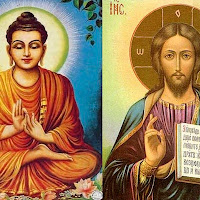
Two religions, one message: love everyone.
"The provider of agape love gives selflessly, expansively, and intentionally for the vitality of the receiver. Individuals who provide agape have a felt sense of loving responsibility and devotion [to] the receiver; they do not expect anything in return for their love," she explains.

While many kinds of love can have similar characteristics, the traits of agape love are unique: Agape love is filled with kindness [with metta most often being translated into English as "loving-kindness"] and wants only the best for the other person. Agape love accepts others unconditionally, with no expectations of being reciprocated.

Buddhism's Goddess of Compassion is a transformed Vedic Avalokiteshvara, a Mother Mary.
This would be tremendous merit if these monastics achieve absorption or any of the four stages of awakening. To give even to an ordinary person is merit; to give to a moral person is more powerful; to give to noble person (stream enterer to arhat) is merit stored up for many lives. See The Workings of Karma by the awakened Pa Auk Sayadaw).
.
Who is the greater beneficiary, giver or receiver?
Agape love sacrifices for the good of the other person. It can sometimes even be viewed as a thankless type of love. Agape love is not envious, proud, or boastful. Agape love is patient, giving others grace. It doesn’t hold grudges.

“Agape is a way to love someone that accepts and embraces the wholeness of each person without reservation,” notes Dr. Daniel Boscaljon, Ph.D., executive coach and founder of the Healthy Workplace Academy.
  • What is Greek for self-love? Biblical Onanism?
    [COMMENTARY: The key difference between Buddhist and Christian views of karma (the idea that "we reap what we sow") is that in Christianity it is God noticing and rewarding, whereas in Buddhism it is an impersonal law of the universe, as if we or the universe notice and we and the universe bring forth fruit of seeds previously sown. "God" by many Christians is understood to just be a way of personalizing and making comprehensible the transcendent, the imminent, the incomprehensible. Like, imagine a GOD so great, a Brahman (the Reality behind all of the illusion) as the Vedas and Hinduism would say, that works itself out, and in that sense, that GOD is not separate from us or the ego or the selfish sense-of-separation we call "I." Then not being different, Thou art that and That thou art (Tat Tvam Asi). So what is altruism in right view but self-love and love for other and the very same thing? And Jesus (Issa) said, "Love the other and hate yourself," right? The good rabbi said no such thing. He said, "Love the other just as you love yourself." Well, if I don't love myself first, how shall I love another? Probably as well as I love myself, which isn't well at all because I thought I was supposed to hate myself (and sacrifice with resentment and expectations) to love others better.
  • I better dig two ditches bcuz I want you to lose.
    There's a better view, a secular Western philosophical tenet dubbed "enlightened self-interest." It means realizing that helping others is helping ourselves. Any good guru will tell you it is us we are releasing when we forgive. Ask Jesus. Ask Krishna (the All Attractive), Vishnu (the Preserver), Brahma (the Creator), Mohammed (the Prophet), even Shiva (the Destroyer) knows it. Even a selfish person (the "I") might already realize it. In selfishness, I keep all the seeds and reap all the fruit and keep all the seeds from that fruit and get all the more fruit during the next reaping. No one else gets anything except that they beg it from me. I become a King Monsanto, King of Kings, and no one eats unless they pay me! I'll sure be popular then, won't I? Actually, until disaster strikes, even long before then, everyone will hate me.
  • I don't know. Both of you make so much sense.
    Instead, thinking ahead, I give seeds to everyone. And everyone had fruit, and everyone gave, and whenever disaster struck for anyone, we helped one another and were all strong. There was always fruit even when I didn't raise a finger of effort to plant any, and back then our collective "orchards" were called the Great Forest. Oh yeah. That's how nature works. And it is in my enlightened self-interest to help my neighbor and do unto others as I would have it done to me. Oh, maybe that's why the world calls that the Golden Rule. Everyone likes gold.
  • Ah, the religions agree: love, love, love
    This is summarized not only by the Buddha in many ways singing the praises of metta (universal friendliness) in this direction, in that direction, in every direction, all ten thousand directions, but very tersely in a nice Jewish story where a rabbi will win a convert if he can explain the whole of The Law (Halakha, all 613 Commandments that Judeo-Christianity turned into a handy stone tablet of Ten of the biggies to rule and oppress the subjects of the Holy Roman Empire), "The Way to Behave," in brief. The wise rabbi does: "What is hateful to you, don't do that. That's the whole of the Law; the rest is commentary" (The Forward). See Judaism’s Golden Rule (aish.com). Or the slogan, "Whatever you yourself like, treat others that way" serves as a shorthand so we always know what to do in any situation.]
Kwan Yin (Guanyin, Kwannon)
"It's intimate, able to recognize and appreciate someone’s wholeness — even if that person can’t."

The entire mindset behind agape love is selfless sacrificial service [called seva in Hinduism and Sikhism] to others.

While it may seem a lofty ideal, striving to exhibit this type of love can have a positive impact on our relationships, on our environment, and on society at large.
The impact of agape love
Modern Christianity emphasizes the God as Love message more than the Old Testament did.

Agape is skillful karma with happy results.
We don’t live in an ideal world. That is, our circumstances are less than ideal here. This is not the world of Platonic forms. We are, according to Buddhism, on the lowest of the 31 Planes of Existence (see right) that can be considered "good." It's a precarious place to be. It's all downhill below this, as regards rebirth, with unfortunate beings reborn on and falling into subhuman planes: ghosts, animals, demons, hellions (when all 31 are reduced to 6 general categories, adding humans and light beings or devas above us even though there are many more worlds than this would suggest).

People are human, and even the most disciplined, selfless individuals have rough days. But if we’re striving to think of others, trying to be considerate, kind people who exercises friendliness and even compassion (Buddhist karuna), and someone who works to show others agape (altruistic) love, it can have a positive impact on us physically, emotionally, and mentally.
.
Selfishness is not good, but self-love is.
“Agape love improves physical well-being because it eliminates much of the unneeded stress caused by repression and rigidity,” says Dr. Boscaljon.

“Because they experience agape love for themselves, it leads to a deep sense of true acceptance and belonging that leads to mental wellness,” he adds.

“The practice also improves someone’s emotional well-being, offering a sense of deep connection and meaningful belonging to each situation.”

Research backs this up, showing that being kind and helping others improves your mental health [2.]

We feel good when we can genuinely help someone else. That altruistic feeling shows up in many ways in our everyday lives.

Cultivating agape love

Avalokita hears the cries of the world
The popular “pay it forward” idea, where we’re in a fast-food line and pay for the person behind us without their knowledge, is a relatable example of agape love in action.

Watching a person in the grocery store line struggle to pay for his or her items and stepping up to provide payment with no motive other than wanting to help, is a gesture that shows agape love.

Putting aside what we’re doing to listen to someone who is going through a hard time or who is lonely is an act that demonstrates agape love.

When we extend that type of generosity into our relationships — whether it’s our friends, associates, parents, siblings, or significant other — it can have a revolutionary impact that extends beyond us.

From...Depression to Hope
“A commitment to agape love can absolutely transform one’s relationship with [oneself] or others,” Dr. Boscaljon states.

“The power of respectful acceptance overcomes feelings of guilt, shame, and hopelessness in one’s own life. It enhances a sense of communion and community. It can then extend this to others in meaningful and empowering ways,” he concludes. Original unedited version: verywellmind.com

Sources
  1. Online Etymology Dictionaryagape.
  2. Happy to help? A systematic review and meta-analysis of the effects of performing acts of kindness on the well-being of the actor. Journal of Experimental Social Psychology. 2018;76:320-329.
  • Verywell Mind uses only high-quality sources, including peer-reviewed studies, to support the facts within articles.
AUTHOR: LaKeisha Fleming is a prolific writer with over 20 years of experience writing film and television scripts, magazine articles and digital content. She is passionate about parenting and family as well as destigmatizing mental health issues. Her book, There Is No Heartbeat: From Miscarriage to Depression to Hope, is authentic, transparent, and provides hope to many.

Tuesday, August 28, 2018

Most important skill for interacting with people

Medium.com/thrive-global; Ashley Wells, Crystal Quintero (eds.), Wisdom Quarterly
Here. Happy birthday. I got you sparklers instead of candles (Allef Vinicius/Unsplash)
 
I have to stop living in a cave. Seriously.
One sentence reveals the secret to connecting with other people.
 
“When you meet someone, treat them as if they were in serious trouble:…and you will be right more than half the time.”
—Henry Eyring

Every person you meet, no matter how happy they appear on the outside, is dealing with serious challenges in their life.
 
Life is freaking hard.

Some of the people you meet are going through bitter and bone-chilling challenges. And for the most part, you have no clue. You just pass them at work, in the grocery store, or even at family gatherings.
 

In the book The 7 Habits of Highly Effective People, Dr. Stephen Covey tells the story of being on a train one day.

While on the train there were two very noisy kids causing a disturbance to everyone around them.

Covey noticed that the father was doing nothing about it. So after a period of restraint he approached the father [and said]:
“Sir, your children are really disturbing a lot of people. I wonder if you couldn’t control them a little more?”
The man lifted his gaze as if to come to a consciousness of the situation for the first time and said softly,
“Oh, you’re right. I guess I should do something about it. We just came from the hospital where their mother died about an hour ago. I don’t know what to think, and I guess they don’t know how to handle it either.”
I don't care what people think of me or Dad.
Can you imagine what I felt at that moment?

My paradigm shifted: Suddenly I saw things differently, I felt differently, I behaved differently. My irritation vanished.

I didn’t have to worry about controlling my attitude or my behavior; my heart was filled with the man’s pain. Feelings of sympathy and compassion flowed freely.

Everything changed in an instant.
 

Living More Compassionately
If you treat every person you meet like they are dealing with a serious challenge, you’ll be right more than half the time. If you entreat people with love, kindness, empathy, and discernment, they will appreciate you so much. More
























