Showing posts with label Roman. Show all posts

Monday, April 28, 2025

Who's next Pope? Trump or Peter the Roman?

No girls allowed! Promise, Peter, my Rock? - I promise, Savior, no girls allowed (wiki).

Who will be the next pope? Some of the top possible candidates

Hey, can I be the next pope? - Get real, Don. -
C'mon, Jorgie, who cares? Can I be 
Antipope?
(CBS News) April 26, 2025: Who will be the next pope? Here's a look at some of the top possible papal candidates as the cardinals prepare for the papal conclave (Latin for "with key," i.e., "behind locked doors"), which will take place in early May, likely after Cinco de Mayo. They promise to start on May 7, 2025.
Who is "Peter the Roman"?
Archbishop Peter (Erdo) the Roman?
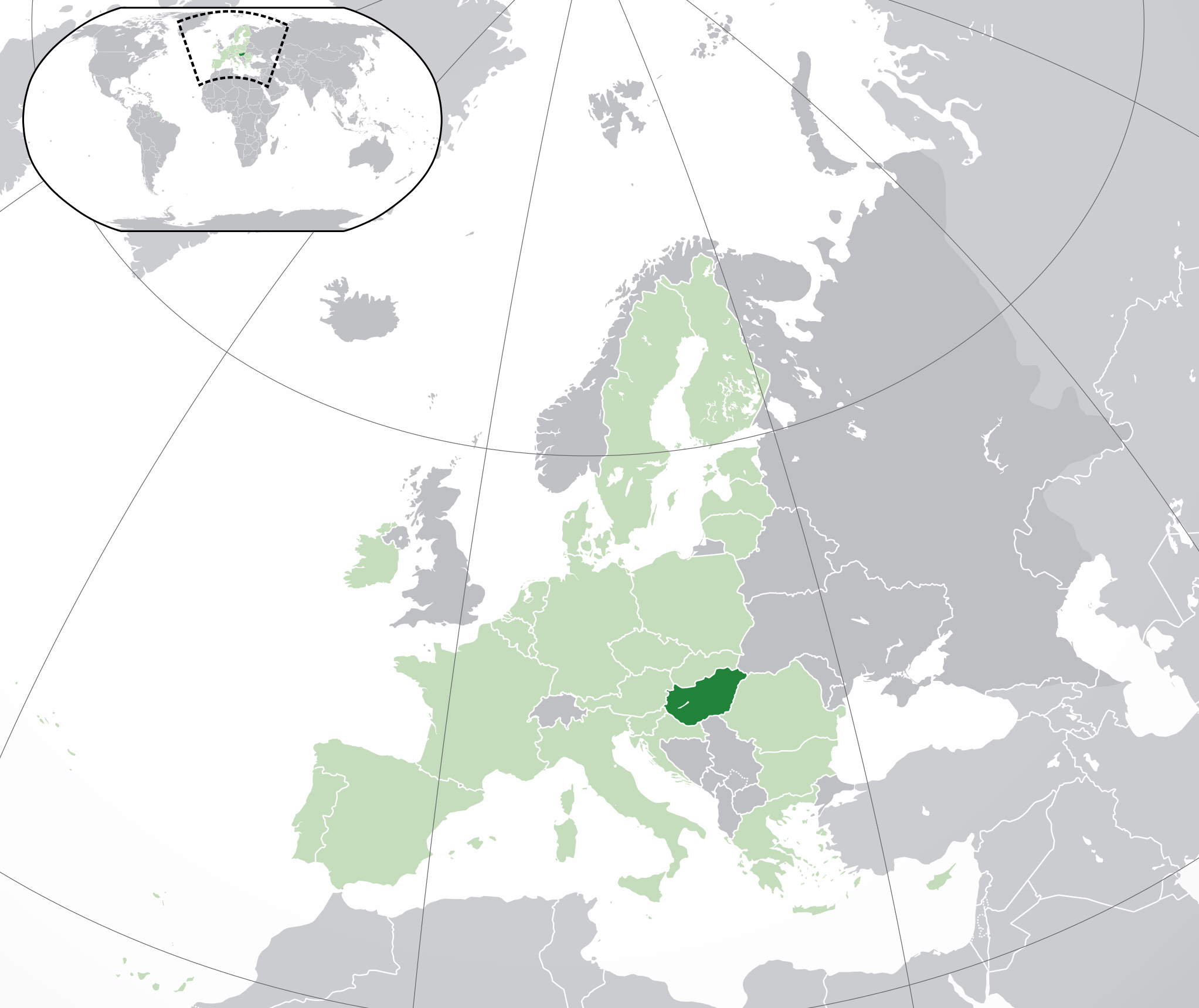
Hungary is a landlocked Central European country not far from Italy (ancient Rome). Spanning much of the Carpathian Basin, it is bordered by Slovakia to the north, Ukraine to the northeast, Romania to the east and southeast, Serbia to the south, Croatia and Slovenia to the southwest, and Austria to the west.

Hungary lies within the drainage basin of the Danube River and is dominated by great lowland plains. It has a population of 9.6 million, consisting mostly of ethnic Hungarians and a significant Romani minority.

I'm not the Devil. I'm Pope
Hungarian is the official language; it is among the few in Europe that lies outside the Indo-European family of languages [13].

Budapest is the country's capital and its largest city, the dominant cultural and economic center [14, 15]. Prior to the foundation of the Hungarian state, various peoples settled in the territory of present-day Hungary, including the Romans, Celts, Huns, Germanic peoples, Avars, and Slavs.

Hungarian statehood is traced to the Principality of Hungary, which was established in the late 9th century by Álmos and his son Árpád through the conquest of the Carpathian Basin [16, 17].

King Stephen I ascended the throne in 1000 and forcibly converted his realm into a Christian kingdom.

Map of Hungary, next to Italy = Rome
The medieval Kingdom of Hungary was a European power, reaching its height in the Late Middle Ages [18]. More Could anyone from modern Hungary be reasonably referred to as a "Roman"? If so and such a person bore the name "Peter," that would make that man "Peter the Roman" for predictive purposes, making Saint Malachy close enough in his ancient prediction.


COMMENTARY
Buddy knows this Rat' is Pope Benedict, right?
The funniest thing about the upcoming papal conclave is the FACT that anyone can be installed as pope. One only has to have been confirmed as a Catholic after First Communion, which doesn't actually mean one has to be a Catholic, just in official records. One could be confirmed now, before beginning. One could be the most popular kind of Catholic: Lapsed. Unlapse or say you're back. Oh, yeah, though -- most Catholics don't qualify. Boys only. It's an Old Boys' Club. It's the original corporation, all top-down hierarchy and a strict Patriarchy. Even though it can be anyone, the cardinals always pick a fellow cardinal. Go figure.
  • Prophecy of the Popes: Petrus Romanus (aka a dark skinned "Peter the Roman"?) Says who? Says Irish Catholic Saint MalachyProphetia Sancti Malachiae Archiepiscopi, de Summis Pontificibus (the "Prophecy of Saint-Archbishop Malachy, concerning the Supreme Pontiffs")
Fake white supremacy masks for Western church
Never mind the Virgin Mary. Like the name of a ship, most of which are by convention named after females, she's just for show. Anyway, it has already been decided, and this conclave business is all for show. Heard about the smoke? The color of it will tell if it's black or white. Isn't that a lovely imperial Roman custom? Who knew the Holy (See) Roman Empire (religious arm), as part of the Ring of Power and the Empire of the City, still ruled the world alongside Washington DC (military arm) and London's high-street (financial arm)?

Why do they say Francis was fake? (rense.com)
CBS News 24/7 is the self-aggrandizing anchored streaming news service from CBS News and Stations that is available free to everyone with access to the internet and is the destination for breaking news, live events, original reporting and storytelling, and programs from CBS News and Stations' top anchors and correspondents working locally, nationally, and around the plane of the earth. It is available on more than 30 platforms across mobile, desktop, and connected TVs for free, as well as CBSNews.com and Paramount+ and live in 91 countries.
  • CBS News, April 26, 2025; Eds., Wisdom Quarterly

Wednesday, March 26, 2025

DNA: origin of Indo-Euro languages


6,500-year-old DNA reveals origin of Indo-European languages spoken by half the world

Thousands of years ago, a group of hunter-gatherers roamed the steppes of southern Russia, hunting in its rivers and across its vast grasslands. They lived in a world without settlements, without writing, and without essential technology like the wheel. Yet, their language would one day become the foundation for nearly half the world’s spoken tongues, from English (British) and Spanish (Latin) to Hindi (Sanskrit) and Persian (Aryan and Indo-Iranian languages).
Who were these people? And how did their language spread so far and wide? A landmark pair of studies may finally have uncovered answers hidden in ancient DNA. By analyzing genetic material from over 400 individuals across Eurasia, researchers have traced the origins of Indo-European languages to a group known as the Caucasus-Lower Volga (CLV) people, who lived around 6,500 years ago.

This discovery not only solves a centuries-old linguistic puzzle but also reveals how the CLV people’s descendants — the nomadic Yamnaya culture — carried their language across continents, shaping the course of human history.

The hunt for the first Indo-European speakers

For decades, linguists and archeologists have debated the origins of Indo-European languages. Some argued that early farmers in Anatolia (modern-day Turkey) spread the language as they expanded their agricultural practices.

Others pointed to the Yamnaya, a nomadic herding culture that roamed the steppes of Russia and Ukraine around 5,000 years ago, as the likely pioneers of the root language.

Research led by geneticist David Reich of Harvard University bridges these theories. By analyzing DNA from ancient skeletons, the researchers found that the CLV people, who lived between the Caucasus Mountains and the lower Volga River, were the ancestors of both the Yamnaya and the early Anatolian farmers. Around 6,000 years ago, some CLV groups migrated west, mixing with local hunter-gatherers to form the Yamnaya culture.

Others moved south into Anatolia, where they interbred with early farmers and gave rise to languages like Hittite, the oldest known Indo-European language that we have written records of.

“We’ve been on the hunt for this for many years,” Reich told the New York Times. “This is the first time we have a genetic picture unifying all Indo-European languages.”

Genetic reconstruction of the ancestry of Pontic-Caspian steppe and West Asian populations points to four key locations. Credit: Nature. (© ZME Science).

The Yamnaya, researchers believe, thanks to their high mobility and herding practices, became the primary vector for spreading Indo-European languages across Europe and Asia.

“They spread from the steppes north of the Black and Caspian seas all the way to Mongolia on one side and as far as Ireland on the other — 6,000 kilometers!” David Anthony, an anthropologist and co-author of the study, told Harvard Gazette.

The discovery of the CLV people as the missing link in the Indo-European story marks a turning point in a 200-year-old quest. Earlier genetic studies had shown that the Yamnaya carried steppe ancestry into Europe and Asia, but the origins of their language remained unclear.

The new research reveals that the CLV people not only contributed to the Yamnaya genome but also to the ancestry of Bronze Age Anatolians. Previously, the absence of steppe ancestry among the Hittites had puzzled researchers. The new study shows that the Hittites likely inherited their language from the CLV people who migrated to Anatolia, rather than from the Yamnaya.

“The Caucasus-Lower Volga group therefore can be connected to all Indo-European-speaking populations,” said Dr. Ron Pinhasi, a researcher at the University of Vienna and co-author of the study. “They are the best candidate for the population that spoke Proto-Indo-European.”
 
Yamnaya culture at its largest expansion (© ZME Science)

Not everyone is convinced though. Some linguists, like Paul Heggarty of Pontifical Catholic University of Peru, argue that the first Indo-European speakers were early farmers in the Fertile Crescent, not hunter-gatherers in southern Russia.

“Genes don’t tell us anything about language, period,” said Mait Metspalu, a population geneticist at the University of Tartu in Estonia. Still, origin or not, the significance of the Yamnaya culture cannot be denied.

A remarkable people
Yamnaya People: Characteristics, Culture, Migrations | Early European history and religion
.
The Yamnaya, descendants of the CLV people, revolutionized life on the steppes with their herding practices and use of wheeled wagons. Their superior technology most likely supercharged the spread of their language across vast regions through trade and conquest.

“I don’t think we can even imagine what it was like for other people to see a wagon coming,” said Anthony. “It was moving across the landscape, creaking and groaning, pulling a ton of equipment. People had never seen anything like it before.”

The Yamnaya also left behind a lasting legacy in their burial practices. Both the CLV and Yamnaya cultures buried their dead in large earthen mounds called kurgans, which have provided a wealth of archaeological and genetic data. “Suppose the Yamnaya had cremated their dead,” said Nick Patterson, a co-author of the study. “Chances are, we wouldn’t even know about this crucial culture in human history.”

As the debate over the origins of Indo-European languages continues, one thing is clear: The story is far more complex — and far more fascinating — than anyone imagined.

“There’s all sorts of mixtures and movements from places that these myths never imagined,” said Reich. “And it really teaches us that there’s really no such thing as purity.”

The findings appeared in the journal Nature. This story originally appeared on ZME Science. More

Sunday, December 22, 2024

'Christmas' before Christianity (video)


Watch this video before Christmas and life will change forever
(Agrippa's Diary) Dec. 22, 2024: Christmas is a modern celebration deeply rooted in ancient pagan rituals and esoteric traditions symbolizing the eternal cycle of death [moving toward he light], darkness, and rebirth. Its customs echo practices from ancient civilizations like Babylon, Egypt, and Rome, which honored the victory of light over darkness, the renewal of life, and the promise of spiritual transformation. [After all, in Christianity, one has to die first to get to heavenly paradise or misery unutterable.] These traditions, from the evergreen tree as a symbol of eternal life to the feasts of Saturnalia and the rebirth of Sol Invictus, reflect humanity’s enduring relationship with the cycles of nature and the cosmos. Over time, these themes were woven into Christian narratives, where Christ became the light of the world, mirroring the sun’s return after the winter solstice.

⌛ CHAPTERS:
  • 0:00 Introduction
  • 01:43 Marduk, Chaos, and the First Celebration of Light
  • 03:44 Osiris, Horus, and the Return of Light
  • 05:38 Saturnalia, Sol Invictus, and the Birth of the Unconquered
  • 08:00 Christ, the Sun, and the Sacred Light
  • 10:38 Amanita Muscaria and the Origins of Santa Claus
  • 13:48 Conclusion and Practical Advice for Honoring the Christmas Ritual
  • 16:03 Outro
🗝 Join Agrippa's Inner Sanctum: agrippasinnersanctum 🎓 Check out products (courses and consultations): stan.store/Agrippa 🙏 One-time donations via PayPal: paypal.com/donate/?hosted... ☕ Donate a Coffee: ko-fi.com/agrippasdiary ₿ Donate Bitcoin: bc1qrrf874td2xn29yp93q483s9nft7frqlh0uaht6 🪙 Donate Ethereum: 0xfcCEff0d835cc46e1BC24189a9ac6358708C09D5 🎦 Subscribe to Vox Occulta: @voxocculta 📷 Follow Agrippa's Diary on Instagram: agrippasdiary 📱 Follow Agrippa's Diary on TikTok: agrippasdiary 🌐 Follow Agrippa's Diary on X: x.com/agrippasdiary 📋 Link to the Transcript: https://www.patreon.com/posts/watch-t...
 
🎶 Music used in the video: 1. "In the Heart of this Ancient City" by CO.AG Music 2. "The Coliseum" by CO.AG Music Licensed under Creative Commons: https://creativecommons.org/licenses/...

🎓 SOURCES
  • Roll, Susan K. Toward the Origins of Christmas. Peeters Publishers, 1995
  • St. Augustine, Sermon 192, in St Augustine: Sermons on the Liturgical Seasons, translated by Sr Mary Sarah Muldowney. Catholic University of America Press, 1984
  • Kelly, Joseph F., The Origins of Christmas, Liturgical Press Forsythe, Gary (2012).
  • Time in Roman Religion: One Thousand Years of Religious History. Routledge Bradshaw, Paul (2020).
  • "The Dating of Christmas". In Larsen, Timothy (ed.). The Oxford Handbook of Christmas. Oxford University Press
  • Hijmans, Steven, "Sol Invictus, the winter solstice, and the origins of Christmas," in: Mouseion III (2003), pp.379-380
  • Allegro, John M. & Irvin, J. R. (2009). The Sacred Mushroom and the Cross: A Study of the Nature and Origins of Christianity Within the Fertility Cults of the Ancient Near East Hoffman, Michael (2006)
  • "Wasson and Allegro on the Tree of Knowledge as Amanita King, J. C. (1970). A Christian View of the Mushroom Myth The Immortality Key: The Secret History of the Religion with No Name Hardcover – September 29, 2020, by Brian C. Muraresku (Author), Graham Hancock (Foreword, Contributor)
🤝 Contact Information: Email: agrippasdiary@gmail.com Instagram: @agrippasdiary

📜 Disclaimers: The voice used on this channel is a highly edited AI-generated voice that contains samples from my own voice and samples inspired by the voice of Sir Christopher Lee, for who I hold a tremendous amount of respect and appreciation, and it is used for educational purposes. Thanks for the support! #spirituality #christmas #religion

Monday, June 10, 2024

Why do only 2% of people have green eyes?

The green eyes of Afghanistan were made famous by Afghan Girl Sharbat Gula
Green eyed Pashtun girl from Afghanistan, the Buddha's birthplace (ancient Gandhara)

What's the origin and reason for green eyes?

  • 0:00 Green Eyes
  • 1:11 The Green-Eyed People of China
  • 1:43 Genetics and Origins of Green Eyes
  • 6:22 Reason for Green Eyes
How to get green eyes greener: Makeup?
When and where did green eyes first develop and for what reason? Now green eyes are the rarest eye color, with only 2% of the entire world’s population having them.

As a general breakdown of eye color worldwide: Brown eyes: 70 to 80% Blue eyes: 8 to 10% Hazel eyes: 5% Amber eyes: 5% Gray eyes: 3% Green eyes: 2%.

People of European descent represent the largest share of those with green eyes -- but green eyes are not exclusive to them [seeming to originate in ET races and arising in hybrid human races] -- and they are most common in northern, western, and central Europe, more specifically, Ireland, Scotland, and other parts of northern Europe have the highest share of people with green eyes.
She was an innocent Afghan girl, 1984
Iceland is one, with around 8–10% of men and 18–21% of women having them, and in the Netherlands, 6% of men and 17% of women have green eyes.

In Europe more broadly, they're found in around 8 percent of the population. Among European Americans, green eyes are most common among those of Celtic and Germanic ancestry, at about 16%.

Even though they’re most common in Europe, people with green eyes can be found all over the world, even as far as remote parts of China. Liqian, a remote village in Western China, is known for its high percentage of people with green eyes and blond hair.
Yuezhi descended people, Liqian, China (theapricity.com)
One myth suggests they’re descended from Roman soldiers who got lost in China, but this is unproven. DNA results from 2010 that analyzed these villagers did indicate that they are almost two thirds of Caucasian origin [ignoring a potential ET connection], potentially lending support to this mundane Roman theory, but it’s still debated.
  • How to classify Yuezhi descended people of Liqian village, China? Are they "white" if they look it? Liqian is a small region in Gansu province in China where many locals have striking European features. Some locals have been told that they are descendants of a "lost Roman legion." They have tried to build a tourist industry around their looks, but their genetics more strongly supports ancestry from Scythians, Tocharians, or other Steppe Indo-European groups. They also have very hawk-like aquiline noses (theapricity.com).
Cause
Now what causes green eyes? Initially, scientists used to believe that eye color in general was decided by two genes — one from each parent. Now they know as many as 16 genes influence the amount of melanin produced by the iris, with the OCA2 and HERC2 genes heavily involved in eye color.

Melanin absorbs light, so irises with high amounts of melanin appear darker. These genes however interact in complex ways, and science is still trying to fully work out how this all works.

Stress ruins: Man on right is Sharbat Gula now.
Sources: Vision Centre: Green Eyes (Pictures, Genetics & Facts) (visioncenter.org) Keyser, C., Bouakaze, C., Crubézy, E. et al. Ancient DNA provides new insights into the history of south Siberian Kurgan people. Hum Genet 126, 395–410 (2009). doi.org/10.1007/s00439-009-06... Eye color - Wikipedia Why Green Eyes Are 'Actually Really Rare', According To Experts (newsweek.com) Ulivi S, Mezzavilla M, Gasparini P. Genetics of eye colours in different rural populations on the Silk Road. Eur J Hum Genet. 2013 Nov;21(11):1320-3. doi: 10.1038/ejhg.2013.41. Epub 2013 Mar 13. PMID: 23486544; PMCID: PMC3798846. Most Attractive Eye Color | 1-800 Contacts (1800contacts.com) Green Eyes: The Most Attractive Eye Color? (allaboutvision.com) DNA tests show Chinese villagers with green eyes could be descendants of lost Roman legion | Daily Mail Online Genetic tests may prove theory of China's lost Roman legion - smh.com.au/world/genetic... Melanin https://en.wikipedia.org/wiki/Melanin Rayleigh scattering - Wikipedia Iris (anatomy) - Wikipedia Silk Road - Wikipedia Creative Commons Imagery: JCS File:Goldene Kamera 2012 - Scarlett Johansson 3.JPG - Wikimedia Commons Creative Commons Attribution 3.0 Unported license. CC BY 3.0 Deed | Attribution 3.0 Unported | Creative Commons Velivieras File:Eye colors map of Europe.png - Wikimedia Commons Creative Commons Attribution-Share Alike 4.0 International license. CC BY-SA 4.0 Deed | Attribution-ShareAlike 4.0 International | Creative Commons

Saturday, March 30, 2024

Jesus ordained as a Buddhist monk: BBC

Jesus of Nazareth: Historical figure or Jewish-Roman imperial myth?
What Christians get wrong about Jesus Christ and their own faith

Jesus was a Buddhist monk | BBC documentary
Jesus' seamless robe (Christian Faith Guide)
(Brian Oblivion) From Minute 38 on comes the interesting part. This British Broadcasting Corporation (BBC 4) documentary examines the question "Did Jesus Die?"

It looks at various ideas around this question until Minute 25, where this examination of ideas takes a very logical and grounded turn with surprising conclusions that demonstrate:

The "Three Wise Men" were Tibetan Buddhist monks who (were in search of a tulku) found Jesus and came back for him about the time of puberty.
Western Buddhist monk Dhammadipa
After being trained in a Buddhist monastery [Hemis Gompa, Ladakh] he spread the Buddhist philosophy, survived Jewish persecution in Palestine and crucifixion in the Roman Empire (Israel), and escaped to Kashmir, Afghanistan.

This part of Kashmir is near the birthplace of the Buddha, known as ancient Gandhara in Central Asia, with its capital now in Pakistan (after the 1947 Partition of India).

There he died an old man at the age of 80 [and his corpse was entombed in the Jewish-style with its distinct orientation with Buddhist-style footprints marking his burial site.

That grave is now covered by an Islamic grave it of another person, making excavation difficult without stirring up a great deal of trouble.

See the scholarship of Holger Kersten and Nicolas Notovitch for the details and written evidence.
  • BBC 4 documentary via Brian Oblivion (YouTube, 12/19/11); Pfc. Sandoval, Dhr. Seven, Pat Macpherson (eds.), Wisdom Quarterly

Thursday, March 28, 2024

Oldest Goddess: The Origins of VENUS

Venus encourages ancient orgy (Joachim Anthonisz)


Venus a Vishnu figure, rising from the sea as Aphrodite (mythology)


Our Oldest Gods: The origins of Venus
(Crecganford) Venus (Aphrodite, Inanna, Astarte...[maybe even to Radha, Saraswati, and Vishnu) is one of the oldest and most beloved deities of all time.

Syncretism
From her earliest beginnings arising from the communities of Neolithic farmers to her evolution into the ancient Greek Goddess Aphrodite, to her eventual worship as the Roman Goddess Venus, this video goes on a journey through time and across cultures.

Podcast: ► Spotify: open.spotify.com/show... Social media: ► Twitter: crecganford ► Instagram: crecganford ► Facebook Fan Page: crecganford Patreon: ► crecganford. Contact: ► Send mail to: hello@crecganford.com ► Business enquires: biz@crecganford.com (for business inquiries ONLY).

References
Allegory: Cupid, Mars, Time, Venus (Guernica)

  • Black, Jeremy and Green, Anthony. 1992. Gods, Demons, and Symbols of Ancient Mesopotamia. British Museum Press.
  • Puhvel, Jaan. 1989. Comparative Mythology. John Hopkins University Press.
Explore podcast's  84 episodes: Crecganford Podcasts of all the videos
  • Crecganford, Feb. 4, 2023:; Pat Macpherson, Dhr. Seven (eds.), Wisdom Quarterly

Monday, November 6, 2023

Dr. Fran: Bible, atheism, God's wife Asherah

Dr. Fran, Ryan Kohls, Aug. 25, 2023; Ashley Wells, Sheldon S. (eds.), Wisdom Quarterly

DR. FRANCESCA STAVRAKOPOULOU on the Bible, Jesus, death threats, God's wife Asherah (Queen of Heaven?), New Atheism, and that guy Jordan Peterson
(Ryan Kohls) This is an in-depth interview with atheist Professor of Hebrew Bible and Ancient Religion at Exeter University, England, author of God: An Anatomy. For a transcript and more go to: whatiwannaknow.com/francesca-stavrakapoulou.

Timecodes
  • 0:00 - Intro
  • 0:50 - Stavrakopoulou: An Anatomy
  • 2:04 - Being an atheist Biblical scholar & response to critics
  • 5:35 - What is the Bible?
  • 7:47 - What is the most misunderstood thing about the Bible?
  • 9:15 - Contradictions in the Bible
  • 12:00 - How are is an atheist biblical scholar?
  • 12:53 - Biases of Christian biblical scholars
  • 15:03 - Probability of Moses/Abraham/Noah's existence
  • 18:00 - Did people in biblical times believe in existence of Abraham/Moses?
  • 21:02 - Did Jesus Christ really exist?
  • 23:00 - Other Jesus-esque figures who existed at the same time
  • 24:22 - Why/how did Christianity become a global phenomenon?
  • 27:14 - Death threats and why some Christians are afraid to study biblical history
  • 29:51 - Antisemitic tropes about God of Old Testament vs. New Testament
  • 33:53 - When did Christians start believing the Bible was infallible?
  • 37:50 - Role of Enlightenment in biblical infallibility theory
  • 40:31 - God's forgotten body and the book God: An Anatomy
  • 47:13 - God's wife Asherah and roots of patriarchy/sexism
  • 51:30 - New Atheists (Dawkins, Harris) and their perspective on the Bible/religion
  • 54:52 - Jordan Peterson, modernity, and Judeo-Christian values
  • 56:55 - Humanism and Prof. Stavrakopoulou's worldview

Monday, July 24, 2023

Angels: The 9 Ranks of Shining Ones (devas)

HochelagaGeneralist Papers, 4/27/23; Dhr. Seven, Pat Macpherson (eds.), Wisdom Quarterly
(Hochelaga) Here's a shocking Bible truth: Biblically accurate angels ("messengers") are very creepy.

Buddhism calls the various ranks of angels ("messengers") devas
The devas of Dharmic religions
 or literally "shining ones," but their classifications vary depending on the plane of existence they are found on. Messengers are just one lowly rank known as
gandharvas (Pali gandhabbas), whereas the higher-ranking gods, demigods, and godlings are called akasha-devas (celestial-deities) and brahmas (divinities). For some strange reason they are all, as a class, just "light beings." Some live on earth as woodland fairies (nats) and dryads, or walk among humans as shapeshifters and messengers, or reside at the tops of large trees in miniature palaces in the air. The king of the gods (devas) is a being named Sakka (Sakra, Indra, which, interestingly, seems to share a name with the Scythians or Indo-Sakas of Sakastan, the Buddha's clan, Indo-Scythians, where Scythian, Shakya, and Saka are essentially equivalent terms, and the Buddha epithet is Shakyamuni, "the Sage of the Shakyas"), equivalent to the Catholic St. Michael, who is only king of the devas in the Realm of the Thirty-Three and the Realm of the Four Great Sky Kings, the two lowest "heavens" in the Sensual Sphere.

The 9 Ranks of Angels
(The Generalist Papers) According to some groups within the Abrahamic religions, there are many different types of angels. Let’s look into the angelic hierarchy put forward by the Medieval Catholic Church.

SOURCES
  • Summa Theologica by Thomas Aquinas (translated by Fathers of the English Dominican Province).
  • On the Celestial Hierarchy by Pseudo-Dionysius the Areopagite
  • Angelic Spirituality: Medieval Perspectives on the Ways of Angels by Steven Chase

Music: Scheming Weasel, Arcadia, and Dreamy Flashback by Kevin MacLeod (incompetech.com) licensed under Creative Commons: By Attribution 4.0 License (creativecommons.org/licenses). Grab Atlas VPN for just $1.99/mo + 3 months extra before the BIG DEAL expires. PATREON: patreon.com/generalistpapers.

Biblically accurate angels are creepy
(Hochelaga) July 31, 2020. Ever wonder why angels described accurately in the Bible look so creepy? Instead of angelic humanoids of great beauty, the Bible depicts bizarre animal-human hybrids (chimeras), fiery winged beasts, and wheels made of eyes. It's uncertain, but most believe that they are descendants of mythical beasts across the ancient Near East. #creepy #angel #bible #biblical

Biblical texts:

MESSENGERS
  • Exodus 11:4–5
  • 2 Samuel 24:16–17 2
  • Kings 19:35
CHERUBIM
  • Genesis 3:24
  • Exodus 25:18–22
  • Psalm 99:1
  • Ezekiel 1:1-14
  • Ezekiel 10
SERAPHIM
  • Isaiah 6:1-8
OPHANIM
  • Ezekiel 1:15-21
Sources