
Showing posts with label bark cloth. Show all posts
Showing posts with label bark cloth. Show all posts
Saturday, August 26, 2023


Friday, October 7, 2022
Enlightened nun "Beautiful Curly-Hair"
G.P. Malalasekera (Pali Proper Names); Amber Larson, Dhr. Seven (eds.), Wisdom Quarterly

Ven. Bhaddā-Kundalakesā was an enlightened elder nun or
It was then his turn, and he asked her, "One, what is that?" (The meaning of this was probably, "State any one fact that is true for everyone.")

 |
| Black and Buddhist (Faith Adiele) |
therī (one who has gone forth for at least ten rains retreats).
She was deemed "foremost in swift intuition" among the nuns (comparable to Bahiya of the Barkcloth among the monks).
She was reborn in the family of a treasurer of wealthy Rājagaha, the royal city ringed by seven hills where the Buddha frequently stayed at Vulture's Peak.
On the same day as she was born, a son was born to the king's chaplain under an astrological constellation favorable to highway robbers, who was therefore called Sattuka.
One day, through her balcony lattice, beautiful Bhaddā saw Sattuka being led by the city guard to execution on a charge of robbery. She at once fell in love with him and refused to live without him.
Her father, out of his love for her, bribed the guard to release Sattuka. He ordered him bathed in perfumed water, and brought him home, where Bhaddā, decked in jewels, waited upon him.
Sattuka soon began to covet her expensive jewels and conceived of a lie to steal them. He told her that he had made a vow to the deity of Robbers' Cliff that, should he escape execution, he would bring the deity an offering in thanks.
She trusted him and, and putting together an offering, went with him arrayed in all her lovely ornaments. On arriving at the top of the cliff, he told her of his real purpose. She, undaunted, begged him to let her embrace him just one more time. He agreed to this. Then, pretending to embrace him from behind, she pushed him over the cliff.
The deity of the mountain praised her presence of mind, saying that men were not in all cases wiser than women.
Unwilling to return home after what had happened, she joined the Order of the White Clad Niganthas [Jains, as the founder Mahavira allowed female ascetics before the Buddha accepted nuns].
As she wished to practice extreme austerities (tapas) as penance, they yanked her hair out with a palmyra wood comb. Her hair grew back in close curls, so they called her Kundala-kesā ("Curly-hair").

.
Unsatisfied with the doctrine (dharma) of the Niganthas, she left them, and going for guidance to various teachers, she became very proficient in philosophical discussion and eager to debate.
She would enter a village and, making a heap of sand at the gate, set up a tree branch of rose apple saying, "Whoever wishes to debate me, let him trample on this branch."
One day, Sāriputra -- the Buddha's chief disciple declared "foremost in wisdom" -- seeing the branch outside of Sāvatthi's gate, asked some children to trample it.
Bhaddā then went to Jetavana accompanied by a large crowd of spectators she invited to be present at the debate.
Sāriputra suggested that Bhaddā should first ask him questions. To all of these he replied skillfully until she fell silent.
 |
| Would that there were a teacher so wise as me. |
Unable to answer, she asked him to be her teacher. But Sāriputra sent her to the Buddha, who taught her. He added verses, stating that it were better to know one single stanza bringing calm and peace than 1,000 verses bringing no profit.
At the end of this sutra, Bhaddā attained full enlightenment, and the Buddha himself ordained her as a nun afterward.
In the time of Padumuttara Buddha, she had heard him teach and declare as foremost among nuns one whose intuition was swift (khippābhiññā). She vowed that this rank should one day be hers.
Later, when Kassapa was Buddha, she was one of the seven daughters of Kikī, King of Benares, and was named Bhikkhadāyikā (v.l. Bhikkhudāsikā).
For 20,000 years she remained celibate and built a dwelling for the Monastic Order (A.i.25; AA.i.200ff.; ThigA.99ff.; Ap.ii.560ff).
The DhA. account (ii. 217 ff.) differs in various details. There Bhaddā is shut up by her parents at the top of a seven storied building with only a single woman to wait on her, for "girls when young, burn for men!"
It was thus that she saw the robber.
In the "Verses of the Enlightened Nuns or Therīgāthā (Thig.vss.107-11) are included several verses spoken by her when she had been a wandering ascetic Jain nun for 50 years, wandering about in Anga, Magadha, Kāsi, and Kosala, living on the people's alms.
Tuesday, February 11, 2020
Backstory: Bahiya's sudden enlightenment
G.P. Malalasekera, encyclopedia entry in Dictionary of Pali Proper Names (and PTS) derived from the Commentaries; Dhr. Seven, Pat Macpherson, Amber Larson (eds.), Wisdom Quarterly

 |
| But, Bahiya, this is the time for gathering alms. |
Bāhiya Dārucīriya or "Bahiya of the Barkcloth" suddenly reached full enlightenment. How? The Commentaries (tika) give the backstory.
Bahiya was born in a householder's family Bāhiya (identified as Bhārukaccha in AP.ii.476), which led to his name.
He engaged in trade, voyaging by ship. Seven times he sailed down the Indus River and across the sea, and seven time returned home safely.
On his eighth trip, however, while on his way to the "Golden Land," Suvannabhūmi, he was shipwrecked. He saved his life by floating ashore on a plank of wood, reaching what he thought was an island which was in fact peninsular Suppāraka.
Having lost all his clothes, he made himself a bark garment (daruciriya), and went about, alms bowl in hand, in Suppāraka.
People, seeing his austere garment and struck by his ascetic demeanor, paid him great honor. They offered him costly robes and many other luxuries, and when he refused them his fame increased. Because of his bark garment, he was known as Dārucīriya.
He came to believe that he had attained full enlightenment, but a devata (a "shining one," said to be a brahma from the Pure Abodes or Suddhāvāsa, who had been a celibate companion in the supreme life during the time of Kassapa Buddha, according to the Commentary, MA.i.340), reading his thoughts and wishing him well, pointed out to him his error.
 |
| What is the road to nirvana? (NG) |
Bāhiya followed him and pleaded to be taught something for gaining enlightenment. Twice he asked, and twice the Buddha refused, saying that it was not the time for teaching. But Bāhiya insisted, saying that life is uncertain and that the Buddha or he might pass away before it was time for teaching.
The Commentaries say that Bāhiya was too excited by his meeting with the Buddha and that the Buddha wished to give him time to regain his composure, hence his refusal.
But then the Buddha came to know of Bahiya's impending death and also of his potential (upanissaya) for full enlightenment. He was to attain in this very life due to his past karma (a pacchimabhavika).
But then the Buddha came to know of Bahiya's impending death and also of his potential (upanissaya) for full enlightenment. He was to attain in this very life due to his past karma (a pacchimabhavika).
 |
Map showing ancient western trade routes serviced by this historical ancient Indian port. The gateway city of Bharakuccha is named on the map as Barigaza on the Gulf of Khambhat. The inhospitable mountains and deserts to the north of the Erythraean Sea suggests its importance in trade with ancient Axum, Egypt, Arabia, and the sea-land trade routes via the Tigris-Euphrates Valley and Ancient Rome. More
|
.
 |
| Oh yeah, first to reach...eat my dust, ladies! |
The Buddha then taught him the optimal method of regarding all sen
se experiences -- namely, as mere (impersonal, disappointing, impermanent) experiences and nothing more.
se experiences -- namely, as mere (impersonal, disappointing, impermanent) experiences and nothing more.
Even as he listened, Bāhiya became an arhat, and the Buddha seeing this went on his way. Shortly after, Bāhiya was gored to death by a cow with a calf (like the story of Pukkusāti and the others*).
The Buddha on his way back, seeing Bahiya's body lying on the dung heap, directed the monastics to prepare it, cremate it, and erect a sacred burial mound (tope, thūpa, stupa) over the relics.
In the assembly he declared Bāhiya to be "foremost among those who instantly comprehend the truth" (khippābhiññānam) (A.i.24; Ud.i.10).
 |
| Let's climb this rock to practice or die trying. |
Bāhiya's resolution to attain to this eminence was made in the time of Padumuttara Buddha when he heard the Buddha declare a wandering ascetic foremost in instantaneous comprehension.
In the time of Kassapa Buddha, when the Buddha's teachings were fading from the minds of humans, Bāhiya was one of seven wandering ascetics who climbed a massive rock and determined not to leave it until they had attained their goal of spiritual liberation.
Their leader became an arhat, and the second a non-returner (anāgāmī) -- passing away to rebirth in the Pure Abodes (Suddhāvāsa). The rest were reborn in this age as Pukkusāti, Kumāra Kassapa, Dabba-Mallaputta, Sabhiya, and Bāhiya.
Although Bāhiya had kept the precepts in previous rebirths, he had never given a bowl or a robe to a monk. For this reason the Buddha did not, at the end of his instruction, ordain Bahiya by saying "ehi bhikkhu pabbajā" to him.
The Buddha knew that Bāhiya had insufficient merit to obtain divine robes (from devas). Some say that he was once a brigand and had shot a non-teaching fully self-enlightened one (pacceka buddha) with an arrow and had taken possession of that pacceka buddha's alms bowl and robe.
Bāhiya was killed while searching for a proper robe to receive ordination (UdA.77ff.; AA.i.156ff.; DhA.ii.209ff.; Ap.ii.475ff).
*The violent cow that gored Bāhiya was the same one that murdered Pukkusāti, Tambadāthika the Public Executioner, and Suppabuddha (2). (It is said that the cow was possessed by a yakkhini or yakshi, a female-ogre or inimical spirit; see her story at DhA.ii.35f). Source
Sunday, February 9, 2020
The Fast Way to Enlightenment: Bahiya Sutra
John D. Ireland translation, Bahiya Sutra: "About Bahiya" (Verses of Uplift, Udana 1.10, PTS: Ud 6); G.P. Malalasekera; Pat Macpherson, Dhr. Seven, Amber Larson (eds.), Wisdom Quarterly

 |
| Samsara is long and wearisome. Wake up. |
At that time Bahiya of the Barkcloth (Bahiya Daruciriya) was living by the seashore at Supparaka. He was respected, revered, honored, venerated, given homage, and provided with the requisites of a wandering ascetic.
Now while he was in seclusion, this reflection arose in the mind of Bahiya of the Barkcloth: "Am I one of those in the world who are arhats (full enlightenment) or who have entered the path to arhatship?"
Then a deva who was a former blood relative of Bahiya of the Barkcloth understood that reflection in Bahiya's mind. Being compassionate and wishing to benefit him, he approached and said:
"Bahiya, you are neither an arhat nor have you entered the path to arhatship. You do not follow that practice whereby you could be an arhat or enter the path to arhatship."
"Bahiya, you are neither an arhat nor have you entered the path to arhatship. You do not follow that practice whereby you could be an arhat or enter the path to arhatship."
"Then who in the world, including the devas, are arhats or have entered the path to arhatship?"
"There is, Bahiya, in a far country a town called Savatthi. There the Blessed One now lives who is the Arhat, the Fully Enlightened One. That venerable, Bahiya, is indeed an arhat and teaches Dharma for the realization of arhatship."
Bahiya of the Barkcloth, profoundly stirred by the words of that deva, then and there departed from Supparaka. Stopping only for one night everywhere (along the way), he made it to Savatthi where the Blessed One was staying in the Jeta Wood.
At that time a number of wandering ascetics were walking up and down in the open air. Bahiya of the Barkcloth approached them and said: "Where, reverend sirs, is the Blessed One now living, the Arhat, the Fully Enlightened One? We wish to see that venerable who is the Arhat, the Fully Enlightened One."
At that time a number of wandering ascetics were walking up and down in the open air. Bahiya of the Barkcloth approached them and said: "Where, reverend sirs, is the Blessed One now living, the Arhat, the Fully Enlightened One? We wish to see that venerable who is the Arhat, the Fully Enlightened One."
"The Blessed One, Bahiya, has gone for almsfood among the houses."
 |
| The Buddha had golden skin and a bright aura |
On seeing the Blessed One, Bahiya approached, fell down with his head at the Blessed One's feet, and said:
"Teach me Dharma, venerable sir! Teach me Dharma, Sugata, for my good and happiness for a long time."
Upon being spoken to in this way, the Buddha responded: "It is an unsuitable time, Bahiya. We have entered among the houses for almsfood."
But a second time Bahiya said: "It is difficult to know for certain, revered sir, how long the Blessed One will live or how long I will live. Teach me Dharma, venerable sir! Teach me Dharma, Sugata, so that it will be for my good and happiness for a long time!"
A second time the Buddha responded: "It is an unsuitable time, Bahiya. We have entered among the houses for almsfood."
But a third time Bahiya insisted: "It is difficult to know for certain... Teach me Dharma, Sugata, so that it will be for my good and happiness for a long time!"
- 'In the seen will be merely what is seen;
- in the heard will be merely what is heard;
- in the sensed will be merely what is sensed;
- in the cognized will be merely what is cognized.'
 |
| In the seen, Bahiya, let there be only the seen. |
"When, Bahiya, you are not 'with that' then you will not be 'in that.' When, Bahiya, you are not 'in that' then you will be neither here nor there (beyond) nor in between the two. Just this is the end of all suffering."
Now through this brief teaching of the Dharma of the Blessed One, the mind of Bahiya of the Barkcloth was immediately freed from the taints without grasping. Then the Buddha, having taught Bahiya with this brief instruction, went on his way.
Not long after the Blessed One's departure, a mother cow with a young calf mauled Bahiya of the Barkcloth and killed him. When the Blessed One, having walked in Savatthi, was departing the town and returning from alms round with a number of monastics, he saw Bahiya of the Barkcloth dead on the road.
 |
| A stupa for the Buddha, Topdara, Afghanistan |
"Very well, revered sir," they replied to the Blessed One. And taking Bahiya's body, they put it on a litter, carried it away, cremated it, and made a sacred mound for it.
Then they returned to the Blessed One, bowed, sat respectfully to one side, and said: "Bahiya's body has been cremated, revered sir, and a sacred mound has been made for it. What is his destiny, what is his future birth?"
Then they returned to the Blessed One, bowed, sat respectfully to one side, and said: "Bahiya's body has been cremated, revered sir, and a sacred mound has been made for it. What is his destiny, what is his future birth?"
"Monastics, Bahiya of the Barkcloth was wise. He practiced according to Dharma and did not trouble me by disputing about Dharma. Monastics, Bahiya of the Barkcloth has attained final nirvana [final liberation following full enlightenment]."
Then, on realizing its significance, the Buddha pronounced this inspired utterance:
Where neither water nor earth
Nor fire nor air can gain a foothold,
There gleam no stars, no sun sheds light,
There shines no moon, yet there no darkness reigns.
When one, a sage, has come to know this
With certainty through one's own wisdom, one is
Freed from [worlds of] form and formlessness and is
Freed from pleasure and from pain.
This inspired utterance was spoken by the Blessed One, so I did hear.
Monday, March 4, 2019
"Period. End of Sentence" (video)
Cheryl Diano, Feb. 18, 2019; Ashley Wells, Crystal Q., Wisdom Quarterly
 A Southern California teacher and her students were recently vying for Oscar gold [and they got it!] Their unique documentary is getting a lot of buzz. Here's a piece put together for Veronica Miracle.
Period. End of Sentence
A Southern California teacher and her students were recently vying for Oscar gold [and they got it!] Their unique documentary is getting a lot of buzz. Here's a piece put together for Veronica Miracle.Friday, December 21, 2018
In the seen, let there be only the seen (sutra)
Maurice O'Connell Walshe (trans.), Malunkyaputta Sutra (SN 35.95) edited and updated by Dhr. Seven, Ellie Askew, Ananda (D.M.I.), Wisdom Quarterly

 |
| Grasshopper, what would you have me say? |
[The Buddhist monk Ven. Malunkyaputta ("Mel") once requested of the Buddha:]
"Venerable sir, it would be good for me if the Blessed One would teach me in brief a doctrine so that,
having heard it, I might dwell withdrawn, secluded (from all distractions and sense desires), full of energy, ardent, and
resolute."
"Well now, Mel, what am I to say to the younger monastics if
you -- a frail, aged, and venerable man far gone in years, at the end of your
life -- ask for instruction in brief?"
"What do you think, Mel? Objects cognizable by the eye,
not seen, that you have not seen before, that you do not see now, and
do not wish to see -- have you any desire, lust, or fondness for them?"
"No, indeed, venerable sir."
- [The same is then said regarding sounds, scents, flavors, tangibles, and mental objects.]
"Well then, Mel, in things seen, heard, otherwise sensed (muta, smelled, tasted, or touched), or
cognized:
"Then, Mel, there will be no 'thereby'* for you.
- *This is almost impossible to translate adequately because, literally, there is no agent here, no "seer," "feeler," or "knower." "There will be no 'thereby' whereby one will be lustful, hateful, or deluded (SA [SN commentary])."
"Having no 'thereby' you have no 'there.'*
- *If there is no agent (i.e., no "self") then there is nowhere such an agent can be located. "You will have no 'there'": you will not be bound "here" nor attached "there," i.e., with regard to the seen, heard, otherwise sensed, or cognized (SA).
"Having no 'there,' Mel, there will be for you neither this world, nor the next, nor anywhere in between.* That in itself is the end of suffering."
- *"You will realize that [in an ultimate sense] nothing [no "self" or "ego" of any kind] is really reborn."
"Indeed, venerable sir, I understand in full the meaning of what the Blessed One has stated in brief."
Forms perceived cause loss of mindfulness,
If we dwell on their endearing charms,
Passion grips the heart, and feeling flows,
Clinging has us firmly in its grip:
So emotions rise and grow in strength,
Of diverse kinds, all based on what was seen.
Some of greed and some of hate born —
Grievously they all afflict the human heart,
Heaping up his store of pain and disappointment:
Thus for such a person nirvana's far away.
- [The same is said for sounds, scents, tastes, tangibles, and thoughts (objects of mind).]
Seeing forms retains one's mindfulness,
Not in passion's grip, simply feels,
On such a one, clinging cannot get any hold.
If one just observes the things one sees,
Not reacting to their shape or form,
One will pull down the pile, not build it up.
Mindfully proceeding on one's way,
Heaping up no store of pain or disappointment:
Then for one nirvana's very near.
- [The same is said for sounds, scents, tastes, tangibles, and thoughts (mind objects).]
"Indeed, venerable sir, I understand in full the meaning of what the Blessed One has stated in brief."
- [This would mean that Mel has become enlightened to at least the first stage (stream entry) by understanding and penetrating the impersonal nature of all existence, the Five Aggregates clung to as self. Indeed, the Buddha confirms Mel's words. In due course, Mel/Ven. Malunkyaputta becomes fully enlightened, an arahant.]
Sunday, November 30, 2014
The Buddha's Teaching in Brief
Maurice O'Connell Walshe, Malunkyaputta Sutra (SN 35.95) edited by Wisdom Quarterly
Sutra: Teaching in Brief
 |
| A monastic, having purified the heart/mind, reflects on the teaching and awakens. Here a meditator is seen in the jungle, Songkla, Thailand (Bird_beckman77 Homam Alojail/flickr). |
.
 |
| Enlightenment fast! (bigeyedeer) |
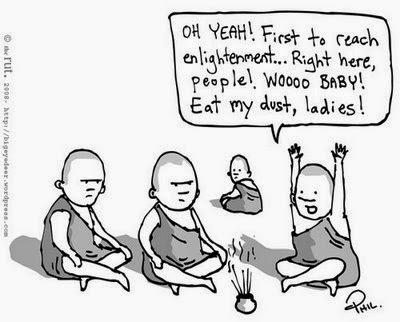
The briefest teaching that led to sudden enlightenment was delivered by the Buddha to Bahiya of the Barkcloth (Bāhiya Dārucīriya), an old ascetic who traveled a long, long way to ask the Buddha to teach him the Dharma. But Bahiya came at an inopportune time, and the Buddha asked him to wait. Bahiya asked and asked again, and the Buddha perceived that it would be fruitful to disregard his regular schedule and teach Bahiya in brief. But what he taught him was enigmatic, perplexing, hard to unravel. Bahiya understood it and became an arhat, a full enlightened person almost on the spot by reflecting on the teaching. Here the same teaching is given to elderly Ven. Malunkyaputta with a little more being said.
 |
| Light dawns (leyinkeu/flickr). |
[Ven. Malunkyaputta once asked the Buddha:] "It would be well for me, venerable sir, if the Blessed One would teach me in brief the Dharma so that having heard it I might dwell alone, in seclusion [with mind and body withdrawn in meditation, free sensual desires and distractions], unwearied, ardent, and resolute."
"Well now, Malunkyaputta, what am I to say to the younger monastics if you -- a frail, aged, venerable person, far gone in years, at the end of your life -- ask for instruction in brief?"
"What do you think of this, Malunkyaputta? Objects cognizable by the eye, not seen, which you have never seen before, which you do not see now and do not wish to see -- have you any desire, lust, or fondness for them?"
"No indeed, venerable sir."
[The Buddha then asks the same with regard to the other five senses and their objects: sounds, scents, flavors, tangible things, and mental objects.]
"Well then, Malunkyaputta, in things seen, heard, otherwise-sensed [muta, i.e., smelled, tasted, or touched], or cognized: in the seen there will be only the seen, in the heard only the heard, in the otherwise-sensed only the sensed, in the cognized only the cognized... Then, Malunkyaputta, there will be no 'thereby' for you.
- "Thereby"? This is almost impossible to translate adequately. There is no agent, i.e., no "seer," "feeler," "knower." "There will be no 'thereby' whereby one will be lustful, hateful, or deluded (SA [SN commentary])."
"Having no 'thereby' you have no 'there.'
- If there is no agent (i.e., no "self"), then there is nowhere such an agent can be located. "You will have no 'there'": You will not be bound or attached "there," i.e., with regard to the seen, heard, otherwise-sensed, or cognized (SA).
 |
| "Whoa the individual ego does not exist. I am so freakin' enlightened. (MarkStivers.com) |
"Having no 'there,' Malunkyaputta, there is for you neither this world, nor the next, nor anywhere in between. [That is, you will realize that nothing is really reborn.] That in itself is the end of all suffering."
- [Nirvana is the end of all suffering when one knows and sees it, directly experiences it, and realizes that the Truth has always been true and is liberating from all delusion, from all suffering.]
"Indeed, venerable sir, I understand in full the meaning of what the Blessed One has stated in brief."
Forms perceived cause loss of mindfulness,
If we dwell on their endearing charms,
Passion grips the heart, and feeling flows,
Clinging has us firmly in its grip:
So emotions rise and grow in strength,
Of diverse kinds, all based on what was seen.
Some of greed and some of hatred born --
Grievously they all afflict the heart of a person,
Heaping up a store of pain and woe:
Thus for that person nirvana's far away.
[Similarly for sounds, scents, tastes, tangibles, thoughts.]
One who's not inflamed by things one sees,
[Similarly for sounds, scents, tastes, tangibles, thoughts.]
One who's not inflamed by things one sees,
Seeing forms retains mindfulness,
Not in passion's grip, simply feels,
On this person clinging cannot get a hold.
If one just observes the things one sees,
Not reacting to their shape or form,
One will pull down the pile, not build it up.
Mindfully proceeding on one's way,
Heaping up no store of pain and woe:
Then for that person nirvana's very near.
[Similarly for sounds, scents, tastes, tangibles, thoughts.]
"Indeed, venerable sir, I understand in full the meaning of what the Blessed One has stated in brief."
[The Buddha confirms Malunkyaputta's words; in due course Malunkyaputta becomes an arhat, that is, a fully enlightened individual.]
Monday, June 9, 2014
The Buddha and King P. (sutra)
G.P. Malalasekera (Dictionary of Pali Names), Dhr. Seven, Amber Larson, CC Liu (eds.), Wisdom Quarterly, as taught to us by the noble Czech-born scholar-monk Ven. Dhammadipa
 |
| The Buddha as a king Maitreya Jampa, Boudhanath, Kathmandu, Nepal (fedMin/flickr) |
 Once, far to the west of Magadha (India), there was a discontented royal. From a distance he befriended an Indian king. They had never met, but they grew close as they exchanged gifts, and news, and outlooks on the world.
King Pukkusāti lived west of the Indus river in modern Taxila, Pakistan (which until 1948 was India next to Afghanistan). His friend was the Buddha's famous royal patron, King Bimbisara, who ruled Magadha.
 |
| Gold Buddha, Bodh Gaya, India (Chandrasekaran) |
King Pukkusati heard of the Buddha's teachings and was so moved that he determined to begin meditating in his private quarters. His success in achieving the absorptions led him to renounce, then he was overcome with a longing to meet the Buddha.
He cut his hair and beard and became a wandering ascetic (shramana), like Prince Siddhartha had. And like Siddhartha, he crossed the Indus river into India. Before he could reach the Buddha, however, he stopped for the night and was given lodging in a potter's shed at the house of Bhaggava the potter in Rājagaha, the capital of King Bimbisara's kingdom.
 |
| Buddha, Taxila Museum (Amir Taj) |
The Buddha knew he was coming and arrived at the guest quarters in the potter's house after the king. The Buddha asked to be allowed to share it, and Pukkusāti -- having no idea that this was the Buddha -- readily agreed. They sat together for some time meditating in silence. The Buddha was impressed at the king's ability to meditate so deeply, apparently entering the absorptions.
When he emerged and was still meditating, the Buddha taught him the Dhātu-vibhanga Sutra (hear it below). The former king, now a wandering ascetic, immediately recognized that this could only be his professed teacher, the Buddha. At the end of the sutra, having had a noble attainment, he begged his forgiveness for not having paid him due honor when they met.
He then beseeched the Buddha to confer on him the higher ordination of a fully gone forth Buddhist monastic. The Buddha said yes and sent him to procure a proper alms bowl and saffron robe. On the way, however, Pukkusāti was gored to death by a mad cow.
When this seeming tragedy was reported to the Buddha, he explained that Pukkusāti was a non-returner and had therefore been spontaneously reborn [i.e., immediately, without the intervention of parents, but based instead solely on the power of karma] in the Pure Abodes (MN.iii.237 47).
- The Pure Abodes are five special planes of existence in Buddhist cosmology (see graphic below). They are only open to non-returners, that is, those who have attained the third stage of enlightenment but pass away before full enlightenment. If one were fully enlightened, there would be no rebirth or disappointment (dukkha) at all. These unique planes from which there is no falling back, unlike all other "heavenly" worlds within the sensual, fine-material, and immaterial spheres. The heavens (sagga) are not immaterial planes. Most are composed of subtle material form, four are formless, and six are sensual within our own sphere the Kama Loka. (See graphic below for full listing of all these worlds).
In this context, Pukkusāti is spoken of as a "son or offspring of good family," "nobly born" (kulaputta, iii.238); see also J.iv.180 and DhA.ii.35.
 |
| Buddhist treasures being smuggled out of formerly Buddhist Pakistan and parts of Pashtun-dominated Afghanistan, which together once formed Gandhara, India, on the frontiers of ancient Shakya territory, the Buddha's hometown (BigStory.AP.org). |
Sutra explanation
Derived from the Commentary
 |
| Indo-Greek Buddha coin (as.miami.edu) |
In his comments on the Dhātuvibhanga Sutra, the great Buddhist commentator Buddhaghosa gives a long account of Pukkusāti (MA.ii.979 ff.). Compare it to the story of King Tissa of Roruva (ThagA.i.199ff.).
King Pukkusāti had been the king of Takkasilā (Taxila), a contemporary of King Bimbisāra (himself a stream enterer) of about the same age. A friendly al)liance was established between the two kings through merchants who traveled between their countries for purposes of trade.
Over time, although the two kings had never seen each other, there grew between them a deep bond of affection. King Pukkusāti once sent King Bimbisāra a gift of eight priceless garments in lacquered boxes. This gift was accepted at a special meeting of the entire court. King Bimbisāra wishing to return the favor but having nothing to match of a material nature, sent what he considered most precious:
He conceived of the idea of acquainting King Pukkusāti with the knowledge that there had appeared in the world of Three Jewels (ratanāni): the Buddha (Teacher), the Dharma (Teaching), and the Sangha (the intensively Taught).
So he had inscribed on a golden plate, four cubits long and a span in breadth, descriptions of these Three Jewels and of various tenets of the Buddha's Dharma -- such as the Four Foundations of Mindfulness (satipatthānā), the Noble Eightfold Path, and the 37 Requisites of Enlightenment.
This plate was placed in the innermost of several special caskets made of various precious materials and was taken in procession on the back of the state elephant to the frontier of King Bimbisira's kingdom. Similar honors were paid to it by the chiefs of other clan territories (janapadas rather than "countries") all the way along the route to Takkasilā.
 |
| Pukkusati's probable route: Afghan border policeman, Gosha district, Nangarhar, Pakistan border May 2, 2013 (Reuters/VOANews.com) |
When King Pukkusāti, in the solitude of his inner chamber, read the inscriptions on the plate, he was filled with boundless joy so much so that he decided to renounce the throne and the world.
He cut off his long hair and beard, donned fine robes like the coarse ones used by wandering ascetics of the day, and left the palace alone amid the lamentations of his subjects. They loved him and wanted him to say and lead them.
 |
| The Buddha (dharmadeshana) |
He traveled the 192 leagues to the wealthy city of Sāvatthi, passing the gates of Jetavana, "Jeta's Grove," the famous Buddhist monastery where the Buddha frequently resided. But having understood from King Bimbisāra's letter that the Buddha lived in King Bimbisara's capital, Rājagaha, at Vulture's Peak monastery, he neglected to inquire if the Buddha was Jetavana. He continued his travels onward 45 leagues farther to Rājagaha, only to find that the Buddha was all the while residing in Sāvatthi.
As it was then evening, he sought lodging in Bhaggava's house. The Buddha, with his divine eye, saw what was in store for Pukkusāti. So traveling on foot from Sāvatthi, he reached Bhaggava's house at sundown. He awaited his opportunity to engage Pukkusāti in talk after a long period of meditation, which was fortuitous because it made the former king's mind and heart malleable and trainable.
When the Buddha taught him the "Analysis of the Elements Discourse" (Dhātu-vibhanga Sutra) -- which deals with the six major elements of earth, water, fire, air, space, and consciousness -- he was able to intuitively grasp and benefit from it, becoming a stream enterer then a non-returner very soon reborn fully enlightened.
"Analysis of the Elements Sutra" (Dhātuvibhanga Sutta). Meditate on this with headphones, pausing as needed, as the Buddha guides Pukkusati through the deepest levels of meditation, beyond the four material and four immaterial meditative absorptions (jhanas). Hearing this, Pukkusati was enlightened and became a non-returner, who was reborn in the Pure Abodes, where he attained nirvana without ever having to return from that world (MN 140).
 After his untimely death -- which is explained in the Commentary as not being a natural or accidental occurrence -- Pukkusāti was reborn in a Pure Abode (suddhavasa) called the Avihā world where, together with six others, he became an arhat at the moment of his rebirth (see S.i.35, 60, for the names of the others and the remarkable story that led to this unusual immediate enlightenment).
Mad cow? The "cow" that killed Pukkusāti is explained, as so often happens in these strange situations, as having been a yakkhinī who was reborn a cow in 100 times. In her final rebirth as a cow, she killed, in addition to Pukkusāti, Bāhiya Dāruciriya (Bahiya "of the Barkcloth," famous in the sutras for becoming enlightened after hearing the briefest teaching of the Buddha), Tambadāthika, and Suppabuddha the leper (DhA.ii.35).
What is so remarkable about Pukkhusāti and the others who attained when reborn in the Aviha world is that they were some of the seven monks who, in the time of Kassapa Buddha, decided to abstain from eating until they should attain arhatship. They went to live on the top of a mountain and kicked down the ladder that had used to climb up to the top on.
The senior ascetic attained arhatship, the second became a non-returner, but the remaining five died of starvation -- after refusing the others' offers of food to sustain them in their practice. But they were proud and had made no such agreement to accept alms from those who had succeeded while fasting. The five were reborn in the Tusita world, a very exalted plane of existence.
In this age they became, respectively, Pukkusāti, Kumāra Kassapa, Bāhiya Dārucīriya, Dabba Mallaputta, and Sabhiya (Ap.ii.473; DhA.ii.212; UdA.81; but see MA.i.335, where only three are mentioned (Pukkusāti, Bāhiya Dārucīriya, and Kassapa).
Tuesday, January 1, 2013
Two Enlightened Buddhist Kings
Dhr. Seven, Ven. Chandananda, Wisdom Quarterly based on G.P. Malalasekera (aimwell.org), Dictionary of Pāli Proper Names (Pukkusati); Bhikkhu Bodhi (audio); Wirajhana-eka (art)
 |
| The Buddha teaching in the superior space world of Tusita, Kushan Dynasty carving, Gandhara, Pakistan (wikicommons) |

At the time of the Buddha, far to the west, there lived a king in Afghanistan named Pukkusati or Pushkarasarin.
At that time what is now known as Afghanistan and Pakistan were part of India's frontier lands. Gandhara was located on the grand northern main road (Uttarapatha) and was a center of international commerce. It was an important channel of merchandise and communication with ancient Iran and Central Asia.
Pukkusati's story begins much, much earlier when, together with Bahiya of the Bark Cloth, he strove to gain enlightenment under a previous buddha named Kassapa.
A wealthy king in Gandhara in the middle of the sixth century BC, Pukkusati was a contemporary of another more famous Buddhist king to the east, a great patron of the Buddha: King Bimbisara of Magadha.
- [Along with Dr. Ranajit Pal, Wisdom Quarterly contends that Shakyamuni Buddha ("the Sage of the Shakya clan") was from ancient Afghanistan. The capital was Kapilavastu, part the rich Shakyan people's territorial holdings, on ancient India's northwest frontier. Others in the region -- Gandharas, Kurus, Kambojas, and Bahlikas -- were cognate people, and all had Iranian affinities.[Note 20] According to Dr. T.L. Shah, Gandhara and Kamboja were two neighboring provinces of one empire.[21] Gandhara was often linked politically with the neighboring regions of Kashmir and Kamboja (Wiki).]
Spiritual Quest
 |
| Why do good sons and daughters set out from home-life to homelessness? (K8rry/flickr) |
The young spiritual seeker had been King of Takkasilā (Taxila, formerly India, now part of Pakistan) when King Bimbisāra ruled Magadha from Rajgir (Rajagaha) -- the site of Vultures Peak, where the Buddha frequently stayed -- having left his home country as Siddhartha the spiritual seeker from the vicinity of Gandhara.
A friendly alliance was established between
the two kings by merchants who traveled between
the two territories to trade. In time,
although they had never met in person, there grew up between
them a deep bond of affection.
 King Pukkusāti once sent to King Bimbisāra a gift of eight priceless garments in lacquered caskets. This gift was
accepted at a special meeting of the king's entire court. Bimbisāra, who was a stream enterer devoted to the Buddha and therefore not nearly as materialistic as he had once been, wanted to send something precious to Pukkusāti. But what could possibly demonstrate his affection for his friend?
King Pukkusāti once sent to King Bimbisāra a gift of eight priceless garments in lacquered caskets. This gift was
accepted at a special meeting of the king's entire court. Bimbisāra, who was a stream enterer devoted to the Buddha and therefore not nearly as materialistic as he had once been, wanted to send something precious to Pukkusāti. But what could possibly demonstrate his affection for his friend?
He conceived of an idea. What if he acquainted Pukkusāti with the
appearance in the world of the Three Jewels:
Buddha, Dharma, and Saṅgha?
 Bimbisara had a giant beaten golden plate. It was
four cubits long and a span in breadth. Inscribed on it were descriptions of these Three
Jewels and of various tenets of the Buddha’s teachings and meditation instructions such as the Four Foundations of Mindfulness, the Noble Eightfold Path, and the 37 Requisites of
Enlightenment.
Bimbisara had a giant beaten golden plate. It was
four cubits long and a span in breadth. Inscribed on it were descriptions of these Three
Jewels and of various tenets of the Buddha’s teachings and meditation instructions such as the Four Foundations of Mindfulness, the Noble Eightfold Path, and the 37 Requisites of
Enlightenment.
The plate was placed in the innermost of several
nested caskets made of various precious substances. It was taken in procession on
the back of the state elephant to the frontier of Bimbisira’s
kingdom. Similar honors were paid to it by the chiefs of other
territories, through which lay the route to Takkasilā.
In the solitude of his chamber where by nature (owing to practice in past lives) he would resort to meditate in peace, Pukkusāti read the inscription on the
plate. He was so filled with boundless joy that he decided to renounce the
world.
 Like Prince Siddhartha before him, he cut off his hair, donned the saffron robes of a wandering ascetic, and left
the palace alone amid his weeping subjects. He traveled
the 192 leagues to the prosperous city of Sāvatthi, passing the gates of Jetavana.
Like Prince Siddhartha before him, he cut off his hair, donned the saffron robes of a wandering ascetic, and left
the palace alone amid his weeping subjects. He traveled
the 192 leagues to the prosperous city of Sāvatthi, passing the gates of Jetavana.
Having understood from Bimbisāra’s letter that the Buddha was at Rājagaha,
he did not inquire about him in Jetavana. Instead he traveled on 45
leagues more to Rājagaha, only to find that the Buddha was all the
time in Sāvatthi.
It was evening, so he took lodging in the potter Bhaggava’s
house. The Buddha, with his psychic eye, saw what was in store for
Pukkusāti. So he traveled by foot from Sāvatthi and reached Bhaggava’s
house at sundown. Waiting for his opportunity -- since Pukkusāti thought nothing of this young wanderer until he saw how well he meditated through the last watch of the night, far outstripping the king's advanced ability to attain absorption (jhana) -- the Buddha was silent.
Then when the fellow family clan member (kulaputta, M.iii.238; J.iv.180 and DhA.ii.35) Pukkusati was ready to listen and take it in, he taught him the CLASSIFICATION OF THE ELEMENTS.
- AUDIO: Dhātu-vibhanga Sutra (Bhikkhu Bodhi)
 The wanderer Pukkusāti was already at Bhaggava's house occupying the guest quarters, the potter's shed or workshop. The Buddha asked to be allowed to share it, to which Pukkusāti agreed.
They sat together for some time meditating in silence. Only then did the Buddha teach the Dhātu-vibhaṅga Sutta, and it was only after it that Pukkusāti recognized the Buddha.
He begged pardon for not having paid him due honor; he then requested to have the higher ordination of a Buddhist monk conferred on him.
The Buddha consented and sent him to procure a requisite alms bowl and robe. But like Bahiya of the Bark Cloth, on the way Pukkusāti was gored to death by a cow. [Cows do this and it frequently happens that they are protecting their young or possessed by some yakkha.]
- The cow is said to have been a yakkhinī who was a cow in one hundred rebirths. In her last birth as a cow, she also killed Bāhiya of the Bark Cloth, Tambadāthika, and Suppabuddha the leper (DhA.ii.35).
When this was reported to the Buddha, he explained that Pukkusāti was a non-returner (third stage of enlightenment) who had now been been reborn in the highest Pure Abode (aviha) never more to return (M.iii.237 47).
Commentarial literature
 In his comments on the Dhātu-vibhaṅga Sutra, Buddhaghosa gives a long account of Pukkusāti (MA.ii.979 ff. Cp. the story of Tissa, King of Roruva, ThagA.i.199f.)
After his untimely death by cow, Pukkusāti was born in the Pure Abodes where, together with six others, he became fully enlightened right at the moment of his rebirth. (See S.i.35, 60 for the names of the others).
The commentary explains that Pukkhusāti was one of seven monks at the time of the former Buddha Kassapa who decided to abstain from eating until they attained enlightenment. To avoid being disturbed, they moved to the top of a mountain plateau and kicked down the ladder used to climb up.
The senior monk attained the final goal, the second became an non-returner, but the remaining five refused offerings of food from the two who attained, and they died of starvation. They were reborn in the space world known as Tusita, a superior Sense Sphere world.
In this age they became, respectively, Pukkusāti, Kumāra Kassapa, Bahiya Dārucīriya, Dabba Mallaputta, and Sabhiya (Ap.ii.473; DhA.ii.212; UdA.81; but see MA.i.335, where only three are mentioned Pukkusāti, Dārucīriya, and Kassapa).
The senior monk attained the final goal, the second became an non-returner, but the remaining five refused offerings of food from the two who attained, and they died of starvation. They were reborn in the space world known as Tusita, a superior Sense Sphere world.
In this age they became, respectively, Pukkusāti, Kumāra Kassapa, Bahiya Dārucīriya, Dabba Mallaputta, and Sabhiya (Ap.ii.473; DhA.ii.212; UdA.81; but see MA.i.335, where only three are mentioned Pukkusāti, Dārucīriya, and Kassapa).
Subscribe to:
Posts (Atom)

























































