Showing posts with label dialogue. Show all posts

Thursday, July 11, 2024

Slo-Mo Battle: Eckhart Tolle vs. Ram Dass


A dialogue with Ram Dass and Eckhart Tolle
(Baba Ram Dass) Let's spend an evening with gurus Ram Dass (former Harvard hippie Dr. Richard Alpert, Ph.D.) and Oprah's spiritual teacher Eckhart Tolle (author of The Power of Now), as these two [Hindu-style] teachers engage in an open conversation about spiritual "awakening" [by which they seem to equate Advaita Vedanta principles or samadhi states with actual permanent liberation] and the transformation of consciousness.
  • [The Buddha taught that samma samadhi, "right concentration or stillness," while very beneficial and leading to saintly qualities is not nearly enough for the attainment of actual awakening (bodhi) and liberation (nirvana). It may seem a fine distinction, but the Buddha's whole reason for teaching was to establish the Dharma in the world that had been lost for thousands of years or much long, in spite of the fact that we had the Vedas and Brahmanism and Indian teachers all of that time. If those things had been enough to bring people to enlightenment, he would have had no reason to establish "right view" and a "path of purification" that leads to a real/permanent state of moksha or "liberation." While Hinduism literally uses the exact same words -- nirvana, moksha, samadhi, karma, and the like, they mean very different things in the Teachings of the historical Buddha. Mahayana Buddhism, on the other hand, seems to have bought into the Hindu definitions and acts as a kind of popular sect of Hinduism more than as a form of Buddhism. But the average person will never know this without studying it deeply. Indeed, other religions have "salvation" and "liberation," but it is only because they are defining those words differently. From an Early Buddhist standpoint, the terms are being misapplied to impermanent states, to forms of rebirth in heaven or in the company of Brahma, as if one would stay there forever and therefore be free of samsara when someone was actually still fully immersed in the problem the Buddha found a final solution to.]
Host Tami Simon (Sounds True) referees (or mediates the conversation). Filmed in Maui, Hawaii, on October 28, 2011, posted on May 19, 2014.


People don't see it: Alan Watts on life's [Mahayana-Hindu] secret awakening
(T&H - Inspiration & Motivation) Dec. 27, 2021: Here is a brief, inspirational, and profound speech on life's illusions and secret awakening by Alan Watts. Original audio sourced from: Alan Watts - The Works. Speaker: Alan Watts, "Enlightenment or awakening is not the creation of a new state of affairs but the recognition of what already is," Alan Watts (1915–1973). #AlanWatts #TheSecret #T&HInspiration


ABOUT: The Love Serve Remember Foundation is dedicated to preserving and continuing the teachings of Ram Dass and his guru Neem Karoli Baba. Website: ramdass.org. Instagram: babaramdass, Facebook: babaramdass, Twitter: babaramdass.

Thursday, October 20, 2022

Alan Watts: What is Reality, what is Emptiness?


Alan Watts: "Reality" is not what we think (Is this a simulation?)
(T&H - Inspiration & Motivation) Alan Watts, the greatest Western translator of Eastern philosophy, gives different ways of looking at our world -- the way it really is as distinct from our commonplace distortions -- in one of his great lectures on reality versus maya (illusion). #simulation #reality #maya

Wednesday, December 13, 2017

cHappy cHanukah! (video)


Remember when actor Adam Sandler did The Chanukah Song(s)? That was funny. What is Hanukkah (חֲנֻכָּה‎)? It is a gift-giving Jewish holiday used like Xmas commemorating the rededication of the Holy Temple (Second Temple) in Jerusalem at the time of the Maccabean Revolt against the Seleucid Empire.

Hanukkah is observed for eight nights and days, starting on the 25th day of Kislev according to the Hebrew calendar, which may occur at any time from late November to late December on the common Gregorian calendar. 

It is also known as the Festival of Lights -- like Diwali in India -- and the Feast of Dedication. The festival is observed by lighting the candles of a candelabrum with nine branches, called a Hanukkah menorah (or hanukkiah). More

Buddhist Jewish Dialogue

Emory University Professor Geshe Lobsang Tenzin Negi, Ph.D. and Rabbi David Ingber from New York discuss differences and similarities between the Buddhist and Jewish paths. Additional commentary comes from The Drepung Loseling monks, Aspen Chapel, Aspen, Colorado, 2016.

News of the Day (Democracy Now!)


How Buddhism informed my Judaism: Rabbis Shmuly Yanklowitz, David Almog

Monday, July 3, 2017

Independence Day: "A Journey into Buddhism"

Elizabeth J. Harris, A Journey into Buddhism (2005) edited by Wisdom Quarterly; Javedan TV
Massive statue of the Buddha-to-come, Maitreya, high up in the Himalayas, dressed as a Central Asian king (like Prince Siddhartha was, having come from Saka Land (Afghanistan and its environs), Diksit Monastery (itissemriaticles.files.wordpress.com)

 
Our flag used to stand for everything good.
In November 1992, David Craig, head of Religious Broadcasting for the World Service of the BBC, and Rev. Martin Forward, interfaith officer for the Methodist Church in Britain, visited Sri Lanka to gather material on Buddhism for a series of programs to be broadcast during a focus on South Asia.
 
I helped plan their program and was also asked to prepare a few talks for the World Service's daily "Words of Faith" spot....

The themes of the talks are rooted in my journey, as a Christian, into Buddhism.

In the mid-1980's I felt the need to "let go" of my own religious-conditioning to enter the world of another spiritual tradition. It grew from a conviction that people with an interest in religion should not remain imprisoned within one framework but should explore others.

Universal rainbow Buddhist flag
The choice of Buddhism and Sri Lanka was a natural one for me. Buddhism's emphasis on meditation and non-violence touched my own interests as a Christian, and a visit to Sri Lanka in 1984 had left me with the feeling that my link with the island was not finished.
 
I originally intended to be in Sri Lanka for one year. One year, however, became seven and a half. My aim throughout was not only to study Buddhism but to practice it. I did not consider myself involved in an "interfaith dialogue" although I'm sure some perceived my actions in this way.

I wanted to enter Buddhism on its own terms, as a human being rather than as a Christian. The subjects of all the talks printed here arise from the personal journey of discovery that resulted.

The Buddha and Jesus (bizarro.com)
They draw on conversations with Buddhist friends, travel to different parts of the country in times of civil war (between insurgent Hindu separatists and a Theravada Buddhist majority), the experience of meditation, and my reading of the ancient Pali language texts.

Most importantly, they reflect the concerns that developed as the interests I brought from Britain encountered Buddhism and Sri Lanka:
  • the relationship between non-attachment and outgoing compassionate action;
  • the practical meaning of anatta (no soul, not self, egolessness) and its implications;
  • the benefit of sati (mindfulness practice) for the individual and society;
  • the resources Buddhism can offer those working for social justice and inter-ethnic or inter-religious harmony;
  • the question of a woman's role in society.
My journey into Buddhism was not always an easy one, and of course I could not let go of my Christian conditioning completely. But it has brought me to a stage when I can say with utter sincerity that I revere the historical Buddha and take guidance (sarana) in his teachings, the Dharma.

I remain a Christian, one who seeks to follow the self-sacrificial path of Jesus of Nazareth, but I also feel quite at home in a Buddhist meditation center.

These talks, I hope, will show that this is possible. I dedicate them to all the Sri Lankan friends who have brought me to a deeper understanding of the heart of Buddhism.
-Elizabeth Harris, June 1994
1. What is Mindfulness?
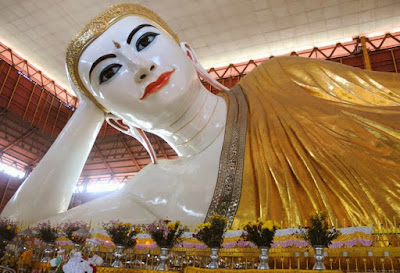
The Buddha reclines into final nirvana between two sal trees, his skin all golden.
.
FREE Buddhist Dictionary
Once I told an academic in Sri Lanka that I practiced a Buddhist form of meditation. Flippantly, he asked whether I was able to levitate. That's not an uncommon reaction. It confuses meditation with self-induced "trance" or making the mind blank, something that is unrelated to everyday life. But to arrive at such confusion is a mistake. True Buddhist meditation is a vigorous form of mind-training that can transform thought, speech, and action.

In the Theravada Buddhist tradition -- still found in Burma, Sri Lanka, Thailand, Cambodia, and Laos -- the practice of mindfulness or "bare attention" is very important. When sitting in meditation, perhaps aware of the breath as it touches the rim of the nostrils, thoughts inevitably enter the mind.

Usually these thoughts relate to oneself in the past or the future. Recent conversations replay themselves. Decisions yet to be made thrust themselves forward. Reactions of dislike to bodily pains arise. And occasionally, images freed from a deeper level of our being move slowly upwards.

Meditation's an internal process not a pose.
When thoughts and feelings arise in meditation, they are simply observed. They are not repressed or pushed aside, but neither are they to be allowed complete freedom to proliferate. Their arising and passing is noted without censure or praise.
 
When I first began to meditate I discovered that thoughts and feelings are fluid, ever changing, often uncontrollable, frequently illogical and irrational. It was a painful realization, since I had assumed my mind was under my direct control. But it was also the beginning of self-knowledge, the beginning of knowing how my mind worked and the doorway to modifying conditioned and negative patterns of reaction in my own life.
 
At one meditation center in Sri Lanka, high up in the mountains surrounded by tea estates, the first session begins at 5:00 in the morning. I had to get up by candlelight, pull on warm clothes, and cross the grass to the meditation hall, under a sky often brilliantly full of stars. One morning, I was gazing at the dark, silvered beauty of the sky when I heard steps below me. At that moment, I caught my mind saying, "Go on into the meditation hall so that they can see you were up first."

Now I can sit keeping "mind" in perspective.
Normally, I would have hurried into the hall to show my punctuality and zeal, but on that occasion I noted the thought, recognized the element of competition, and consciously refused to act on it. I stayed for several more moments rapt in the pre-dawn stillness, feeling the cool air against my skin, and I was certainly not the first to settle my cushions before the silent, candle-lit image of the Buddha.

And I know it was the practice of sati, of mindfulness, which made that moment of insight into my own competitive egotism possible, insight into a childish wish to impress, to be top of the class.
 
Meditation of this kind is hard work. It has nothing to do with making the mind a blank, though it can lead to peace and calm when the racing mind stills and there is only the present moment. One monk who taught me put it this way: "Meditation is the ultimate practice of non-violence. Suffering, pain, and feelings of anger are not suppressed but faced, confronted, and transformed." TO BE CONTINUED More

Thursday, October 6, 2016

Colombia rejects peace; Pres. gets Nobel Prize

Amy Goodman (DemocracyNow.org, UPDATED); Seth Auberon, CC Liu, Wisdom Quarterly
Colombian president wins Nobel Prize for Peace Accord after peace loses nat'l referendum
Colombia peacetreaty2In Colombia, voters have rejected a peace agreement between the government and the nation’s largest rebel group in a shocking turn of events that threatens to prolong the nation’s 52-year-old civil war. By a razor-thin vote of 50.2 to 49.8 percent, Colombians rejected the peace deal hammered out with the FARC guerrilla movement and signed just days ago by Pres. Juan Manuel Santos. It was a stunning upset for a referendum that was expected to pass overwhelmingly. DN! speaks to Mario Murillo, a longtime Colombian activist and author of Colombia and the United States: War, Unrest, and Destabilization. More

Saturday, January 28, 2012

How to understand Buddhism (animation)

Alan Watts; Something's Happening (KPFK.org); Wisdom Quarterly; Khmer animation
"The Journey from India, Part II" (Alan Watts audio)

The teaching of Buddhism is a dialogue, according to Alan Watts. It is a dialectic, an expert pedagogy (upaya, a "skillful means" of teaching).

So what we understand as the "teachings of Buddhism" are not the teachings. They are merely the opening gambit of a dialogue between individuals.

What the Buddha says to someone depends on what he knows that person's capacity to understand is. As we listen in we may be confused.

The Buddha is not speaking in absolutes so much as he is administering exactly the medicine this person needs to be cured of delusion and the suffering that comes with it.


"Buddhism," rather than teaching dogma, is a path of practice to directly realize the liberating-truth the Buddha himself had found. What he knew, we can know. Less useful is belief or faith when insight-knowledge and wisdom are what set us free.

The Buddha's message is consistent, but that only emerges over time. He taught for 45 years. In any specific instance, what he is teaching may sound like a paradox or, worse, a tautology (some self-evident piece of circular logic).

However, when we recognize the dialectic pattern, it suddenly makes sense. It is perfect just as it is -- so long as it is grasped properly.

Buddhism has developed and become something different, the growth of a seed the Buddha planted. Some later schools may have gone too far afield, but they tend to return. Nagarjuna's "Middle Way" (Madyamika) philosophy brought this method of dialogue to an extreme in an attempt to counter clinging to views.

Theravada, the earliest existing Buddhist school, has a threefold division of the Dharma. Beginning as a living oral tradition, it was eventually written down. Then commentaries also had to be written down to explain what was missing in the absence of a living dialectic.

Many sutras may seem unbearably monotonous. This is because what was written down was for chanting to be listened to, not read the way we read books. The written parts were lists, formulas, rote memorization and mnemonic devices for oral teaching.

The real reason the Buddha singles out desire (tanha, craving) is not merely dialectical, as Watts suggests. Desire is NOT the ultimate cause of suffering, ignorance is. And enlightenment is the ultimate solution. Craving is one of the proximate causes. But it is the weak link in the chain of Dependent Origination. The Buddha saw it. He recognized it as an escape from suffering, because wisdom can uproot craving when what we crave is seen as it truly is. We can see it and uproot it with insight (vipassana). Willpower, rationalizing, and psychological suppression do not work. Serenity and insight do work.

The unbroken oral tradition remains, but it is rare and usually available only in monastic and meditative settings, which are open to non-monastic and temporarily ordained practitioners. The instructions are not secret, but they are also not printed all over books, which would place them out of context.

However, most monastics or "professional clergy" as Alan Watts refers to them, seem to be involved in chanting and formalities. They do not seem to be involved in the living teaching or practice for the goal the Buddha set out and created monasticism to support. They see their function as preserving the Dharma, sadly, without reaching the goal or being able to effectively guide others to that knowledge-and-vision of nirvana.

The Buddha's words were organized into chants and written in so formal a way that no person would have ever spoken. What was said was converted to this form. And if we cling to the form, we will miss the meaning.

But when we understand, we will be grateful for the form that serves as an excellent device to both learn and skillfully teach what the Buddha taught.

Thursday, September 10, 2009

US for dialogue between China, Dalai Lama

WASHINGTON, D.C. (PTI) - The United States encourages open exchange between China and the Dalai Lama on the issue of Tibet, an Obama Adminis-tration official said today: "We have immense respect for the Dalai Lama. He is one of the leading spiritual figures in the world, and we have always encouraged a more open exchange between China and the Dalai Lama and his followers," State Department spokesman Ian Kelly told reporters at his daily news briefing. Responding to a question, he said the United States is not aware of any specific plans for the Dalai Lama to go back to Tibet. "So I can't comment on how we would stand on it right now," he said. "But we do encourage more dialogue," he added. Source