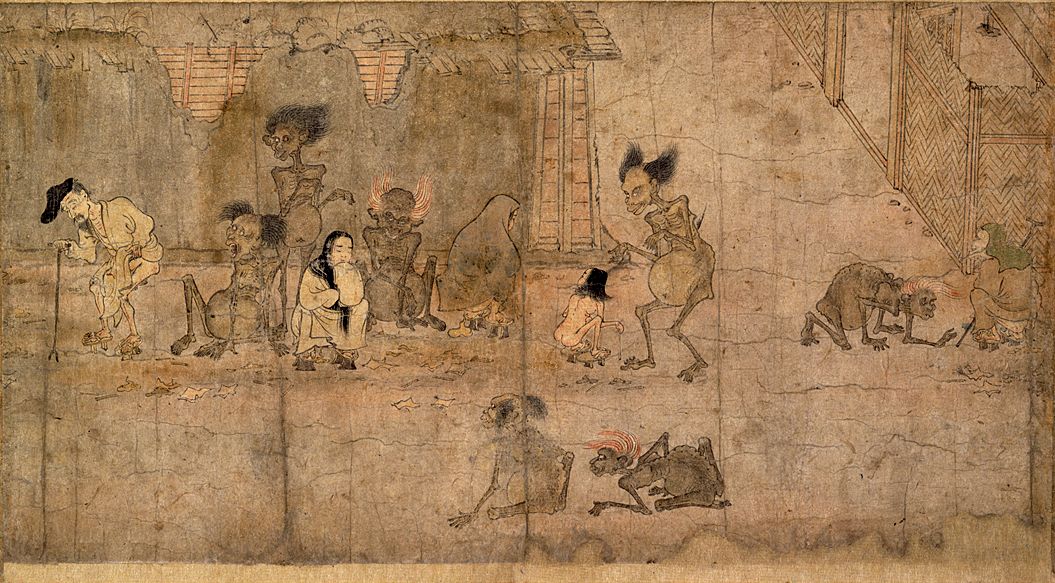
They stand at the periphery waiting, clinging. They passed away with strong attachments.
The REAL reason behind addictions and how to get over them
I don't know how it began. I was molested.
(Asangoham) April 26, 2024: Tibetan Vajrayana Buddhism includes within its teachings a very interesting concept, that of the "hungry ghost," known as yidags in Tibetan [preta in Sanskrit, peta in Pali].
Dr. Gabor Mate used this idea in his research
One possible form of hungry ghost can be a person who has died while still in the midst of intense craving, attachment, or an insatiable addiction.
Tibetan Buddhists believe that at death one sheds only the physical or gross form; the subtle and causal forms of the body remain [in a changing state of flux, just as they changed and were in flux during life].
This means that while one is now [temporarily] free of the gross or physical body, one is still in the grip of the subtle body, or mind, that was “made” during that and previous lifetimes.
The causal body will retain the seed of the addiction and carry it into the next life if it is not purified.
Thus, those who die in the grip of addiction or craving or attachment often remain in the physical plane as disembodied hungry ghosts.
The Wisdom of Trauma
[Dr. Gabor Mate, Canadian addiction medical specialist and star of Zeitgeist, contends that there are NO addictive substances or activities. Many people are indeed addicted and unable to stop; there is no doubt about that. Dr. Mate treats them daily and set up Canada's first compassionate care center to help them. But it turns out the real problem is an interaction of factors. IF substances and activities were "addictive," then everyone who partook would become addicted. This does not happen. Q: What then is the underlying cause?
When the Body Says No
A: Susceptibility brought on by childhood trauma. If a person who was abused takes a nonaddictive substance like alcohol, meth, fentanyl, MSG, sugar, heroin, crack, cocaine, or marijuana (which flood the brain with feelgood dopamine, endorphins, and neurotransmitters) then addiction quickly sets in. But it cannot be substance. It is that substance in that person. So as a society we abuse our children then condemn them for the easy-to-access coping mechanism they resort to to self-soothe. It's a double-bind, a Catch 22, a fully Belgium (HHGTTG) situation. Ghosts get trapped this way, and then they are trapped (in bondage), and then for a long time lost "in the realm of hungry ghosts" (Buddhism's peta loka). Knowing this, seeing this, one adheres to the Five Precepts, for one who preserves the Five Precepts is preserved by the Five Precepts. Otherwise, after the ghost realm, which is the beginning of the downfall (niraya), the great waste, one continues down to the hells, where there is no apparent way out. Good karma now will help a great deal then. So make merit (punya).]
Is Dr. Gabor Mate a secular Jewish Buddhist or a Buddhist Jew? (drgabormate.com)
.
I want what I want when I want it. I'm hungry.
That is, such beings are still gripped by insatiable addiction but now without the physical body that would give them any chance of satiating that addiction.
Those with the ability to perceive disembodied spirits can perceive hungry ghosts.
These people claim that in those places such as the “red light” districts of many cities where people gather to drink, have sex (engage in prostitution), or use intoxicants -- three of the most common pursuits of human addiction -- hungry ghosts can be seen to congregate, often in great numbers.
Addiction is complex.
It transcends mere substance or behavioral abuse.
Addiction is defined as a chronic and relapsing disorder.
It is characterized by compulsive seeking, continued use, and a lack of control.
This continues in the face of and despite severe adverse consequences.
The brain is dependent on neurochemicals.
Fundamentally, addiction involves changes in the brain's reward system.
Repeated exposure to addictive substances or behaviors leads to neuroadaptations.
This adaptation diminishes the brain's sensitivity to natural rewards (such as dopamine) and compels/drives one in the compulsive pursuit of the addictive stimulus.
In the digital age, behavioral addictions related to technology and social media have also begun to take hold. #addictions#hungryghosts#zen
DISCLAIMER 01: All ideas expressed on this channel are for entertainment and general information purposes only. There is no advice on what an individual should or should not do. Any response made by anyone after hearing this communication is their interpretation and is their responsibility. Ideas expressed by this channel should not be treated as a substitute for medical advice or professional help. If expert assistance or counselling is needed, the services of a competent professional should be sought.
It would be a "pause" except the IDF (genocidal Israeli militants) keep shooting Palestinians in the back for daring to return to their homes in northern Gaza before an actual "ceasefire" has been agreed to, not to mention sundry killing of Lebanese and anyone else stepping out of line, whether or not they know there is a line.
Local beachcombers are used to seeing dead animals: seagulls, fish, crabs, even the occasional whale. But they had never seen anything like this. Animal experts were brought in to identify it. They were stumped. It looked like part dog, part reptile, and part rodent -- with claws and the beak of a bird. This animal, whatever it was, became known as the "Montauk Monster" [after the real Montauk Monster that was brought through the use of a special reverse-technology chair in the Montauk Project in the secret government lab on the island]. But where did the Monster come from? There could be only one answer: Plum Island.
Plum Island is just a few miles from where the monster was found. Locals had heard rumors that this was a top-secret government [gain of function] facility that created bioweapons, engineered animal hybrids, and maybe even experimented on human beings. Sounds like a wild theory. But then another animal washed up on the beach. Again, it couldn't be identified. And then another animal. And then two more. In 2010, the rumors about Plum Island seemed to be true when something else was found on the beach. This time it wasn't a strange animal. It was a body, a human body, well, it was almost human.
Get 100 free blades with purchase of a Henson Shaving razor with code THEWHYFILES: hensonshaving.com/thewhyfiles. Make sure both the razor and blades are in cart for the code to take effect. Thanksm Henson Shaving, for sponsoring this video.
EXECUTIVE PRODUCERS: Gino Gentile Jennifer Gentile AJ Gentile Patreon Members. THANKS, MODS: jengen13 (Mrs. Why Files) Victoria Young Loolykins JohnnyBGood Hybrid Paul Rohrbaugh Mischief Kiam Timothy Weal Messor Synful Snowcrash RobinSparkles Original Jim The Why Files Theme Lyrics by @straightjacketspaceman9223
A few recent Brie Larson interviews have caught the attention of Marvel fans. People have asked if the cast doesn’t get along with her. Even as an audience member, it’s hard to sit through some of these interviews without cringing. What can we all learn from these gaffs and situations? And how can we prevent ourselves from falling into these specific behavior patterns that make people dislike a person without anyone intending it or even realizing it.
TIMESTAMPS
0:41 - Issue #1: Reading negative intent in ambiguous situations.
1:15 - Issue #2: Not realizing that sarcasm requires a “tell”
4:33 - Issue #3: Jumping on every opportunity to praise or call attention to yourself.
7:15 - Issue #4: Trying to win each moment of banter.
9:53 - Issue #5: Handling a compliment improperly.
A Page of Wisdom by motivational speaker Frank Miles (lafatfear@aol.com) presents: Thich Nhat Hanh, The Heart of the Buddha's Teaching (Broadway, 1999, pg. 24).
BUDDHIST MONK HORSE RIDER WINS GOLD: Japanese monk Kenki Sato wins gold medal at Asian Games in China as part of the “special life path” he is on (chakranews.com).
.
Buddhist meditation has two aspects -- shamatha and vipashyana.
We tend to stress the importance of vipashyana ("looking deeply") because it can bring us insight and liberate us from suffering and afflictions.
But the practice of shamatha ("stopping") is fundamental. If we cannot stop, we cannot have insight.
There is a story in Zen circles about a man and a horse. The horse is galloping quickly, and it appears that the man on the horse is going somewhere important.
Another man, standing alongside the road, shouts, "Where are you going?" and the first man replies, "I don't know! Ask the horse!"
This is also our story. We are riding a horse, we don't know where we are going, and we can't stop. The horse is our habit energy, pulling us along, and we are powerless...
We have to learn the art of stopping -- stopping our thinking, our habit energies, our forgetfulness, our strong emotions that rule us.
It's Black Friday. "What Would Jesus Buy?" follows Reverend Billy and the Stop Shopping Choir as they go on a cross-county mission to save the holidays from the Shopocalypse -- the end of mankind from consumerism, over-consumption, and the fires of eternal debt! The Shopocalypse is upon us... Who will be $aved?
Rev. Billy of the Church of Stop Shopping on Glenn Beck
(Freedomlost2007) The documentary "What Would Jesus Buy?" follows Rev. Billy and his gospel choir on their cross-country tour, preaching their message in such destinations as the Mall of America, Wal-mart headquarters, Starbucks, and Disneyland. "Democracy Now!" speaks to Rev. Billy and the film's producer Morgan Spurlock ("Super Size Me").
It might seem a total wonder that a smoker won't quit after hearing that puffing away is a leading cause of death, or that an obese person can't shed a few pounds after learning that lethal ailments loom for the overweight. But scientists have come up with a host of reasons why humans stick to bad habits, and they are zeroing in on what to do about it. Among the reasons:
Innate human defiance
Need for social acceptance
Inability to truly understand the nature of risk
Individualistic view of the world and the ability to rationalize unhealthy habits
Genetic predisposition to addiction
You'd think people were on a one-track mission to self-destruct rather than desiring immortality
"We have found that people aren't changing their behaviors," said Cindy Jardine of the University of Alberta. "But it's not because they haven't gotten the information that these are big risks." She added, "We tend to sort of live for now and into the limited future—not the long term."
Killer knowledge In a recent study, a group led by Jardine surveyed 1,200 people in Alberta, Canada in 1994 and again in 2005 about what they perceived to be risky behaviors. Many of the participants ranked lifestyle behaviors, such as smoking, drinking and sun tanning, as more dangerous than ozone depletion and chemical pollution.
In a related study that wrapped up this year, the scientists asked groups of indigenous Canadians why they ranked behaviors dangerous or not. For instance, when asked about drinking and driving, most participants mentioned that you could hurt yourself or somebody else. If people know cigarettes can kill them or drinking and driving could be lethal, logic suggests they might quit it. Yet even with this knowledge, Jardine said, people continue to undertake these lifestyle risks.
Everybody's doing it Jardine suggests several reasons for the contrary findings. For one, when a behavior is socially accepted or even considered desirable people tend to reconcile the fact that it's bad for them with the idea that "everybody's doing it," she said. "I know this is bad for me but in social circles this makes me more accepted," Jardine said of the common reasoning. "It ends up being something people rationalize one way or another. And it's often easier to rationalize it in favor of trying to fit into your social group."
Addiction in Your Genes Vulnerability to drug and alcohol abuse has been located to a particular gene. One way of making it okay to smoke like a chimney or eat like a pig is with individual experiences that support your action. For instance, you could say, "It hasn't hurt me yet," or, "My grandmother smoked all her life and lived to be 90."
In 2004, Jardine found that stress moved past cigarette smoking as the most dangerous habit. "Most of us wear our stress as a badge of honor these days," Jardine said. So rather than thinking about stress as causing physical damage to your body and perhaps hurting family relationships, "people often boast of their stress as a success."
Risky interpretations Typically the likelihood of contracting a disease or dying from a substance or activity is reported numerically as a percentage or ratio [see The Odds of Dying].
Ellen Peters of the University of Oregon has found that people who are better at processing numbers look at the same information differently than people not as number-minded, who tend to rely more on fear than actual hard evidence. Being afraid of cancer could drive their decisions on whether or not to smoke or the importance of treatment for particular cancers. It comes down to emotions, which Peters suggests act as guiding lights in choices.
That's one reason she thinks the "truth" campaign by the American Legacy Foundation and other anti-cigarette campaigns have been so effective. The truth ads show gruesome images such as a bleeding brain or inflamed heart with text stating cigarettes as the cause. One video ad shows a human-size rat walking up from a subway station and then collapsing on the sidewalk with a sign about how cigarettes contain rat poison.
The Truth Hurts ... and Helps The Canadian-based American Legacy Foundation's "truth" campaign relies on gruesome anti-smoking ads like this one of a giant, dying rat. Watch the Ad
A study by the American Legacy Foundation showed that 22 percent of the overall decline in youth smoking from 2000 to 2002 was attributable to their "truth" campaign.
challenge.exposaroonie.com
No bad behavior vaccine Social and physical environments also play large roles in fueling poor habits. For example, if you perceive that all of your friends are staying up all night, baking in the sun every day at the beach or taking multiple smoke breaks during work, this will affect whether you also take part in the activities. Couch potatoes might be glued to the TV by external factors more than a lack of desire to be healthy.
"We tell people they need to become physically active, but in certain neighborhoods if you get out and go for a walk you could be putting yourself in harms way from either traffic that's not well controlled or other kinds of things like violence in your neighborhood," said Andrea Gielen of Johns Hopkins University's Bloomberg School of Public Health.
Coming up with successful pro-health campaigns requires more research and multiple strategies, experts say. "There's no single strategy or single bullet. We're not going to be able to find a vaccine for healthy behavior," Gielen said. "We have to be more creative. We have to have different kinds of partners and work with many different folks."
All materials on this site are submitted by editors and readers. All images, unless otherwise noted, were taken from the Internet and are assumed to be in the public domain.
In the event that there is still a problem, issue, or error with copyrighted material, the break of the copyright is unintentional and noncommercial, and the material will be removed immediately upon presented proof.
Contact us by submitting a comment marked "private."
Do not follow this journal if you are under vinaya or parental restrictions. Secure protection by Sucuri.
Wisdom Quarterly: American Buddhist Journal is licensed under a Creative Commons Attribution-Noncommercial-Share Alike 3.0 United States License. Permissions beyond the scope of this license may be available at creativecommons.org/about/licenses.