Sati (Pali sati [1], Sanskrit स्मृति, smṛti), literally "memory" [2] or "retention" [3] [previously rendered "vigilance," "bare awareness," "wakefulness," "presence of mind," "presence," "to bear in mind"] is commonly translated as mindfulness, "to remember to observe" [4].
It is an essential part of Buddhist practice [occurring 14 times in the list of the 37 Requisites of Enlightenment].
It has the related meanings of calling to mind the wholesome Teachings (Dhamma) such as the Four Foundations of Mindfulness (Satipatthanas), the Five Faculties, the Five Powers, the Seven Factors of Enlightenment, the Noble Eightfold Path, and the attainment of insight [5].
Moreover, it means observing and remaining aware of mental and physical phenomena (dhammas), which is the actual practice of maintaining lucid heightened-awareness of these dhammas [6].
The bodily and mental phenomena one practices to remain aware/mindful of are these processes/"things." This is done in order to counter the arising of unwholesome states, the removal of unwholesome states [7][8], to develop wholesome states, and to sustain wholesome states to attainment of insight (vipassana).
It is the first factor of the Seven Factors of Enlightenment. "Right" or "correct" mindfulness (Pali sammā-sati, Sanskrit samyak-smṛti) is the seventh factor (limb or element) of the Noble Eightfold Path.
Definition
The Buddhist term translated into English as "mindfulness," "to remember to observe" [4], "to remember to remain observant," originates in the Pali term sati and in its Sanskrit counterpart smṛti.
According to Robert Sharf, the meaning of these terms has been the topic of extensive debate and discussion [8].
Ven. Analayo strives for an academic definition from the ancient texts.
Smṛti originally meant "to remember," "to recollect," "to bear in mind," as in the Vedic tradition of remembering [memorizing slokas of] sacred texts.
The Pali term sati also means "to remember" the phenomena being observed in Sattipatthana, that is literally "the fourfold setting up of mindfulness," as well more generally remember the Teachings of Tipitaka ("Three Baskets" or collections of the) texts.
In the "Discourse on the Four Foundations of Mindfulness" (Satipațțhāna Sutta), the term sati means "to maintain awareness of reality," where sense-perceptions are understood to be illusory and misleading so that the true nature of phenomena can be directly seen [8] and penetrated.
[What is their true nature? It is tilakkhana, marked by the Three Universal Characteristics of Existence, which are impermanent, disappointing, and impersonal, a lakkhana being a "mark" or "characteristic" of all phenomena, all dhammas, all "things."]
Sharf refers to the Questions of King Milinda (Milindapanha), King Menander I, which explains that the arising of sati calls to mind the wholesome phenomena (dhammas) such as the Four Foundations of Mindfulness...and the attainment of insight [5]. More
60 Minutes, Jan. 2025; Dhr. Seven, Amber Larson (eds.), Wikipedia Wiki edit
International Workers' Day observed on May 1st and is also called "May Day" but the two have different histories: May Day is a European festival of ancient origins marking the beginning of summer, usually celebrated on May 1, around halfway between the Northern Hemisphere's spring equinox and midsummer solstice [1, 2]
Festivities are also held the night before, known as May Eve. Traditions include:
gathering green branches and wildflowers ("bringing in the May") [3], which are used to decorate buildings and made into wreaths;
crowning a May Queen, sometimes with a male companion (to Jack in the Green) decked in greenery;
setting up a Maypole, May Tree, or May Bush, around which people dance and sing;
as well as parades and processions involving these [4].
Bonfires are also a major part of the festival in some regions.
The Buddha Smiles is a delightful gathering of Mari Gayatri Stein’s cartoons, or "Dharmatoons" as she calls them.
Cambodian novice caresses the Buddha's smile
Q: Most religious leaders don't, but the Buddha smiles? A: Yes, he is always depicted with a subtle smile, what one might describe as a gentle smirk if the connotation were not misleading. He is at ease, at peace, at rest, able to dip into the Fruits of Recluseship, namely, the bliss of the absorptions (jhanas, the eight attainments, right samādhi) at will and transcend even that supersensual happiness to touch the transcendent bliss of nirvana, the end of all unhappiness. Moreover, he smiles when he sees a noteworthy thing, of which his attendant monk, Ven. Ananda, will later inquire. The Buddha's smile acts as a signal in many sutras, an invitation to for Ananda to inquire what brought the smile about. It is unclear if the smile happened to the Buddha, as it does to us when something strikes us as funny, interesting, or curious or if the Buddha flashed it specifically to be asked what had struck him.
Buddhist psychology (Abhidhamma) describes the hasituppāda-citta, literally the "mind-moment (citta) or consciousness (viññāna) producing mirth (smile)."
The Buddha is full of happiness (sukha), having found and repeatedly tested and confirmed the escape from all misery (dukkha) here and now and hereafter, namely, access to the absorptions and nirvana-with-remainder at any moment and nirvana-without-remainder once the body passes.
The book follows a group of humans and non-humans as they seek their enlightenment, exposing their strengths and weaknesses (and ours as well) in the process.
The Buddha Smiles gently teaches the nature of Buddhist thought through cartoons on the Four Noble Truths, The Noble Eightfold Path, and the nature of the Five Hindrances along the path.
It is the first full-length book of Buddhist cartoons unless one counts Ioanna Salajan's Zen Comics, which came out in 1974 or 1982's Zen Comics II.
Comics communicate the Zen spirit perfectly. Laughter deflates pretension, and a good rap on the head sometimes transcends so-called logic (the hubris of rationality and reason). In the words of Zen, "Nothing is left for you but to laugh!"
(The Infographics Show) The founder of Apple Inc. may have revolutionized the way people communicate and connect with their screens, "smart" phones, laptops, and music devices, but Steve Jobs is not the hero [most people foolishly seemed to believe he was when he died and they were singing his praises, imagining he was entering some Buddhist heaven for all his good deeds on earth when it was obvious he was in cahoots with American intelligence agencies like the FBI, CIA, and NSA to sell users out and destroy the outdated concept of "privacy" for a new generation and incorporating a strategy of "planned obsolescence" into his sturdy devices that would physically outlast their functionality to make Apple a trillion dollar company] might think he is. Check out this epic video to learn the dark truth about Steve Jobs.
[And imagine a future where the same video is made about Apple co-founder Steve Wozniak, Google/Meta menace Mark Zuckerberg, Elon Musk, and child molesting Epstein Island fan Bill Gates, and other tech billionaires who sold us all out and their souls for riches and influence.]
Theranos, Elizabeth Holmes, and the Cult of Silicon Valley
Fraud female entrepreneur Elizabeth Holmes became a Silicon Valley celebrity after she dropped out of Stanford University at 19 to start a biotech company called Theranos (therapy+diagnosis). Reason sat down with John Carreyrou, the Wall Street Journal reporter who unmasked the medical fraud behind Holmes's growing empire. She is now facing serious charges, is ruined, and has set women in science and business back a few years.
By June 2016, Theranos founder Elizabeth Holmes was estimated to have a personal net worth of $4.5 billion. That has since dropped to virtually nothing. Her company was near bankruptcy until it received a $100 million investment from Fortress Investment Group in 2017. By 2018, the company was again close to going bankrupt.
(CNBC) Multi-billionaire Liz Holmes fights back on Mad Money
Her company?
Theranos is a privately held health technology company known for its false claims to have devised revolutionary blood tests using very tiny amounts of blood.
The company was lauded as a major challenger to existing companies before it was revealed that the company had lied about its core capabilities.
I'm an angel (Hughes)
Founded in 2003 by 19-year-old drop out Elizabeth Holmes, Theranos raised more than US $700 million from venture capitalists and private investors, resulting in a $9 billion valuation at its peak in 2013 and 2014.
Investors and the media hyped Theranos as a breakthrough in the large blood testing market, where the US diagnostic-lab industry posts annual sales of over $70 billion. Theranos claimed its technology was revolutionary for a number of reasons.
At the time, Theranos said its tests required only about 1/100 to 1/1,000 of the amount of blood that would ordinarily be needed and cost far less than existing tests.
Should women stick to fashion, Old Boys?
There was a turning point in October 2015, when investigative reporter John Carreyrou of The Wall Street Journal questioned the validity of its technology.
Since then, Theranos has faced a string of legal and commercial challenges from medical authorities, investors, the U.S. Securities and Exchange Commission, Centers for Medicare and Medicaid Services, state attorneys general, former business partners, patients, and others. More
Bad Blood author and WSJ reporter John Carreyrou: She's a fraud!
This column will change your life. How to tell whether you have a bullshit job: "Is the job you're doing, or applying for, one the world would be fine without?" (The Guardian)
My wage slave job has no point. Well, it has one point, as I found out one day at work.
.
Bullshit Jobs: A Theory review -- the myth of capitalist efficiency
The BS box tickers have taken over (Alamy)
Is your job one that makes the world a better place? If not, it is probably "bullshit," part of a system that is keeping us under control.
I had a bullshit job once. It involved answering the phone for an important man, except the phone didn’t ring for hours on end, so I spent the time guiltily converting my Ph.D. into a book.
I’ve also had several jobs that were not bullshit but were steadily bullshitized: interesting jobs in the media and academia that were increasingly taken up with filling out [bureaucratic] compliance forms and time allocation surveys.
I’ve also had a few sh*t jobs, but that’s something different. Toilets need to be cleaned. But to have a bullshit job is to know that if it were to disappear tomorrow, it would make no difference to the world: In fact, it might make the world a better place.
Tatted up butch cop giving out BS tickets
When I read [American anarchist London School of Economics Anthropology Professor] David Graeber’s essay "On the Phenomenon of Bullshit Jobs" in Strike! magazine in 2013, I felt somehow vindicated.
I had sat in the pub on many a Friday evening moaning to colleagues about data entry and inefficient meetings. But with the Martian gaze of the anthropologist, Graeber managed to articulate my plight in a way that made me feel part of some grand, absurdist outrage.
INTERVIEW: The Nature of Work and Paying for Time - author explains the bullshit jobs (iTunes) Anthropologist David Graeber talks about how over the years the concept of time has evolved to be used for control through hourly paid work ("wage slavery") leading to the proliferation of unnecessary jobs. He is known for his role in jump-starting the Occupy Wall Street Movement in 2011... LISTEN (KPFA, Berkeley)
I wasn’t alone. The essay went viral, receiving more than a million hits and being translated into a dozen languages.
“Guerrilla” activists even replaced hundreds of ads in London tube carriages [subway trains] with quotes from the essay, presumably in order to jolt commuters out of their apathetic stupor. As is the way in the world of reactive non-fiction publishing, a book followed.
The argument of both essay and book is this: In 1930, John Maynard Keynes predicted that technological advances would enable us to work a 15-hour week.
Yet, we seem to be busier than ever before. Those workers who actually do stuff are burdened with increasing workloads, while box-tickers and bean-counters multiply.
In an age that supremely prizes capitalist efficiency, the proliferation of pointless jobs is a puzzle.
Why are employers in the public and private sector alike behaving like the bureaucracies of the old Soviet Union, shelling out wages to workers they don’t seem to need?
Since bullshit jobs make no economic sense, Graeber argues, their function must be political. A population kept busy with make-work is less likely to revolt. More
Rebooting USA's Poor People's Campaign 50 years later
Send the poor to kill for the U$ Empire.
ALBUQUERQUE, New Mexico -
Thousands of anti-poverty activists have launched a campaign in recent
weeks modeled after the Reverend Dr. Martin Luther King Jr.'s Poor People's
Campaign of 1968. Like the push 50 years ago, advocates are struggling to
draw attention to those trying to survive through deep poverty from Appalachia to
the Mississippi Delta, from the American Southwest to California's Central Valley rural farm
country.
Come over here, you goddamned coon. Stop resisting my authority before I get the dogs.
Sign-carrying participants in the southern leg of the Poor People's
Campaign march through Atlanta. Thousands of anti-poverty activists have
launched a campaign in May 2018 modeled after Rev. Dr. King
Jr.'s Poor People's Campaign of 1968. Like the push 50 years ago,
advocates are drawing attention to those in deep
poverty around the USA.
Won't you do it for justice, folks? (MLK, Jr.)
The latest effort is led by the Rev. William Barber
of Goldsboro, North Carolina, and the Rev. Liz Theoharis of New York
City, who are encouraging activists in 40 states to take part in acts of
civil disobedience, teach-ins and demonstrations to force communities
to address poverty. They say poverty continues to be ignored and only a
"moral revival" can bring it to the nation's consciousness. More
Former Apple chief executive Steve Jobs holds original iPhone, one of
the biggest technological breakthroughs of modern times (Alessia
Pierdomenico/Reuters)
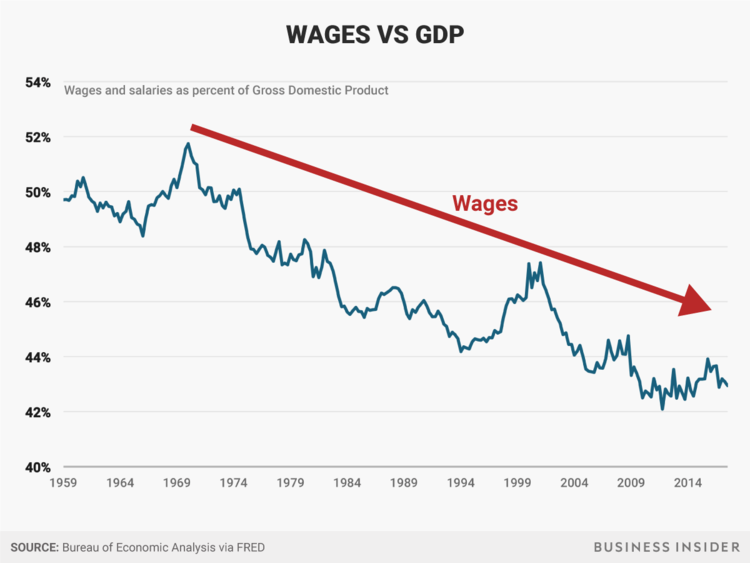
This chart shows every major technological innovation in the last 150 years — and how they have changed the way we WORK
Since 1760 productivity has increased almost 30 fold [3,000%].
That is largely down to tech innovations like electricity, phones, and Internet.
[How 99% of us work today is as "wage slaves" or peons with bosses who want more and more efficiency to give us fewer and fewer jobs.]
Barclays chronicled the world's rising productivity in its latest Equity Gilt Study.
LONDON, England - Humanity is always moving forward [except when it's moving backward or stagnating in place] with innovation after innovation improving planetary quality of life.
The last 150 years have seen the most remarkable advancement of technology in our recorded history [unless we look at ancient Buddhist, Vedic, and Sumerian texts that tell of previous golden ages and better technology due to beings from space and advancements developed here].
Electric lighting, cars, toxic plastic, the telephone, and television are all less than 150 years old, while newer innovations such as the Internet have spurred ever more rapid societal development.
Bitch slap workers like this, right on the face
Technological advances have boosted productivity by allowing workers to get more done in a day. This helps to increase output and boosts economic growth.
In its recent Equity Gilt Study, which is a massive annual report by Barclays chronicling the bank's thoughts on important topics in finance and economics, the bank focused heavily on new technologies and particularly on cryptocurrencies and artificial intelligence.More
Tesla says its factories are getting safer. These workers tell a different story (digg)
All materials on this site are submitted by editors and readers. All images, unless otherwise noted, were taken from the Internet and are assumed to be in the public domain.
In the event that there is still a problem, issue, or error with copyrighted material, the break of the copyright is unintentional and noncommercial, and the material will be removed immediately upon presented proof.
Contact us by submitting a comment marked "private."
Do not follow this journal if you are under vinaya or parental restrictions. Secure protection by Sucuri.
Wisdom Quarterly: American Buddhist Journal is licensed under a Creative Commons Attribution-Noncommercial-Share Alike 3.0 United States License. Permissions beyond the scope of this license may be available at creativecommons.org/about/licenses.