Showing posts with label Tricycle blog. Show all posts

Friday, August 16, 2019

Thai king honors Western monks (Tricycle)

Cara Dibdin (tricycle.org/trikedaily); Ellie Askew, Dhr. Seven (ed.), Wisdom Quarterly

Ajahn Chah feeds a wild forest deer.
Thailand’s King Vajiralongkorn (Rama X) recently invited four senior Western monks in the Thai Forest Tradition of Theravada Buddhism to receive royal titles in honor of their contribution to Buddhism in Thailand and around the world.

While the event was part of a long-standing tradition, it also marked a new development for Buddhism in the country.

Thai Forest monks historically have disregarded social status and authority systems, preferring to focus on meditation practices in remote forests and caves, as the Buddha and his first disciples once did.

Yet, despite its often-secluded practices, the Thai Forest Tradition [made famous by Ajahn Chah] has had a tremendous impact since its beginnings at the turn of the 20th century.

The school’s dedication to meditation, commitment to renunciation, and de-emphasis of ritual and ceremony held great appeal for Buddhists in the West, where disciples have established hundreds of Thai Forest Tradition monasteries.

In honor of the Western teachers’ contributions to the proliferation of Thai culture, the king invited the monks to receive the royal titles on July 28 as part of his birthday celebration. The invitees were:
  1. Ajahn Sumedho, the retired abbot of Amaravati Buddhist Monastery in southeastern England (Ven. Sumedho was unable to attend);
  2. Ajahn Amaro, the current abbot of Amaravati;
  3. Ajahn Jayasaro, an author and teacher who lives in a hermitage near Khao Yai Mountain, about two hours outside Bangkok; and
  4. Ajahn Pasanno, former abbot and guiding elder of Abhayagiri Buddhist Monastery in Redwood Valley, California.
To better understand the significance of this event, Tricycle spoke with Ajahn Pasanno about the title he received, Chao Khun, its history, and what it means for his tradition in Thailand and the West. More

Thursday, March 7, 2019

Buddhists oppress Muslims in Asia

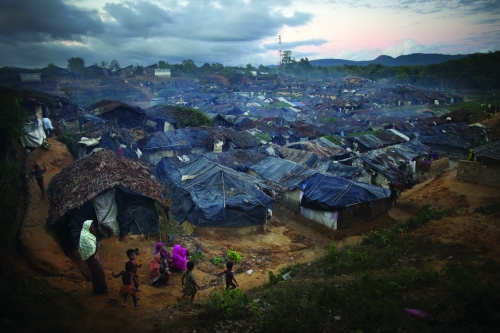
Thousands of unregistered Rohingya Muslim refugees from Burma are forced to reside next to the registered refugee camp at Kutupalong, Bangladesh (Jonathan Saruk/Getty images).

.
Buddhist-Muslim relations
Many predominantly Buddhist countries in lower Asia are also home to substantial populations of Muslims.

Likewise, a number of Muslim countries are home to Buddhist minorities. Majority-minority relations can be contentious, but add ethno-religious lines to the mix and things can easily degenerate from prejudicial policy-making to unbridled violence.

(Take Rakhine State in Burma, for example, where Buddhist violence against the Rohingya Muslims, which Tricycle covers in its most recent issue).

Despite what unbalanced histories and historical mythologies might indicate, relations between the two religions were NOT always so troubled.

Buddhism and Islam encountered one another on the Silk Road and enjoyed a relationship that for the most part was peaceful and involved a cultural exchange that played a part in transforming both religions into their current manifestations.

Such a history flies in the face of that of the common imagination, where a violent confrontation in which Muslims essentially terrorize the eminently serene, peace-loving Buddhists dominates.

[Islam displaced Buddhism in India as a force from without, while Hinduism ejected it from within, sending Buddhism into the world.]
 
Sri Lankan Theravada Buddhists off the tip of India (Mirror Times)

.
In recent decades, we’ve witnessed a very real reversal in which Buddhist-ruled governments engage in ethnic cleansing and attempt to relegate Islamic countrymen to permanent refugee status in their own country, as has been the case in Burma and Sri Lanka. 

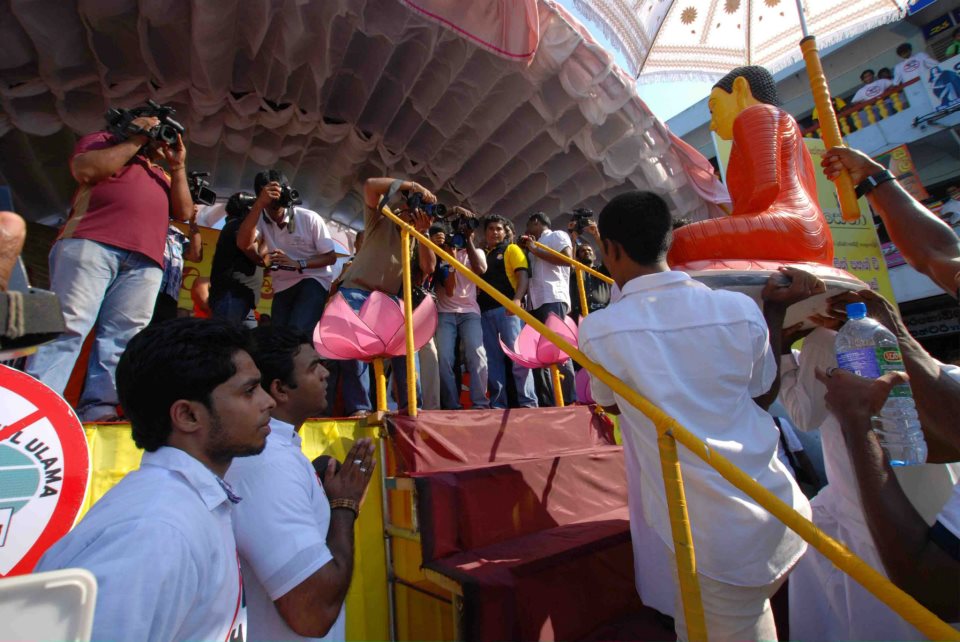
The Khaleej Times reported the largest anti-Muslim rally to date in Sri Lanka [in 2013].

Led by the Buddhist organization Bodu Bala Sena (BBS, “Buddhist Power Force”), members and supporters marched to petition for a ban on halal [Islamic "kosher"] food certification and the building of mosques [Muslim houses of worship] with funds from Middle-Eastern countries. 

The Khaleej Times quotes the BBS Secretary Ven. Galaboda Aththe Gnanasara Thero [a wayward and misguided patriotic Buddhist monk] on the militant ambitions of the Buddhist group:

“Hundreds of [Buddhist] monks are ready to fight….Our country is a Sinhalese [Sinhalese-speaking Buddhist] one and we are its unofficial police.”

Buddhist clergy-led social action has proven itself a powerful catalyst for social change in lower Asia. These days, favored reform unfortunately seems to run along the lines of racism and militant nationalism.
 
Buddha and Barbie ban
In more benign, and certainly more baffling news, Buddha statues have joined the likes of Barbie dolls and Simpsons figures under a countrywide ban in Iran.

[Fundamentalist] Iranian authorities have been seizing Buddha statues from shops in the capital of Tehran in order to stymie the ongoing “cultural invasion.”

While these sanctions generally focus on Western products, this might be “the first time that Iranian authorities are showing opposition to symbols from the East,” ABC News speculates.

Tibetan Catholicism
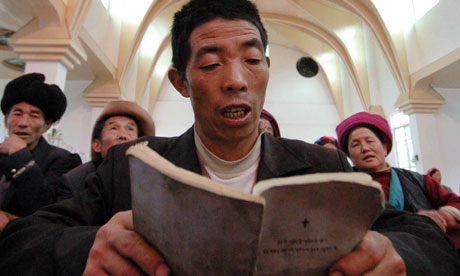
Tibetan Catholics pray at a church in the Tibet Autonomous Region. Most Christian missionaries in Tibet belong to nondenominational groups intent on mass conversion (Wang Changshan/Xinhua Press/Corbis).

In Tibet, a land where Buddhists and Muslims have coexisted peacefully since the 12th century (Tibetan Vajrayana Buddhists frequent the Muslim restaurants for their halal meat, generally regarded as the most flavorful), a new religious player has entered the scene:

Christianity and its [Catholic] missionaries. The Guardian reports an influx of evangelists pouring into Tibet [with Han Chinese government approval and support], where they are selectively tolerated by the traditionally anti-proselytizing Chinese establishment.

The Han Chinese government likely welcomes these new missionaries because they offer “a powerful counterforce to Tibetan Buddhism, with its electrifying political overtones.”

However, since Buddhism is so central to the cultural identity of Tibetans, they are notoriously tough sells in the spiritual marketplace. Source

Wednesday, July 30, 2008

Tricycle: Better Blogging

Tricycle: the Buddhist Review magazine cover (Summer 2006)

New location: blog.tricycle.com

This is the Editor's Blog with Wendy Johnson
Tricycle’s longtime contributor Wendy Johnson continues to pop up right and left. An article in Voice of America profiles her work at Green Gulch, while Wendy herself will be reading from her new book, Gardening at the Dragon’s Gate, at East West bookstore in Manhattan tonight at 7:45 pm (78 Fifth Ave., between 13th and 14th).

RECENT BLOG ENTRIES (July 30, 2008)
-->
India and Terror Posted by Philip Ryan in : General, Peace , add a comment
Terror attacks are becoming routine in India. Do they need a Department of Homeland Security?

-->
UN suckered by junta; ASEAN wakes up; Bush continues to hassle junta
Posted by Philip Ryan in : Burma
The UN has a great reputation for being careful with its money. Hope this doesn’t tarnish it: The UN has admitted losing about $10m (£5m) to the Burmese regime while delivering emergency aid to the country in the aftermath of Cyclone Nargis because of a distorted official exchange rate.

The UN’s senior humanitarian aid official said it had suffered the “significant” loss because the junta enforced an artificial exchange rate that was at least 15 per cent lower than the genuine rate. It has been alleged that the UN had been aware of the loss for weeks and had accepted it as the price of “doing business” with the regime.

Also is ASEAN getting serious about Burma?
Foreign ministers from member states of the Association of South East Asian Nations (ASEAN) meeting in Singapore expressed their “deep disappointment” with Burma’s continued detention of opposition leader Aung San Suu Kyi. They also called for the junta that for decades has ruled the nation with an iron grip to hold “meaningful dialogue” with opposition figures. ASEAN is a consensus-based organization that is loath to speak out on the internal affairs of its members. Given that human rights figured prominently in the meeting’s agenda and the political climate in Burma has deteriorated over the past year, the organization may have decided the time was right to speak out.
-
-
They also were encouraged by U.S. Secretary of State Condoleezza Rice, who credited ASEAN with growing influence in Rangoon. She said the group was instrumental in persuading the junta to reverse its initial obstruction of assistance and accept international aid after Cyclone Nargis killed at least 78,000 people along the Irrawaddy Delta in May. She urged the group to continue engaging Burma to push it toward democracy. Condi to the rescue. And Bush continues to pile on sanctions against Burma’s gem trade and overseas assets. Thank goodness he is showing more restraint than usual and hasn’t sent Rambo in yet.

-->
Monks in Korea Stick up for Disgraced Scientist Posted by Philip Ryan in : Science
But why?
South Korea’s Buddhist monks have urged the government to allow disgraced scientist Hwang Woo-suk to continue his stem cell research. “It is deplorable that research by Hwang Woo-suk and his team is suppressed unreasonably,” the monks said in a resolution. “The government should approve the research in order to save a greater soul.” The resolution came ahead of the Health Ministry’s decision Saturday over whether to approve Hwang’s request to restart his work. Hwang, once considered a national hero, has been on trial for alleged fraud and violation of bioethics laws after his team was found in January 2006 to have fabricated results to claim success in his study.

-->
Meditating Monks Ignore Earthquake Posted by Philip Ryan in : Meditation
An earthquake rocked L.A. yesterday, fortunately causing little damage. It managed to scare the usually unflappable Judge Judy, but a group of monks meditating at a Thai temple were unfazed.
A meditator was also shown to have special insight in problem-solving according to the New Yorker. Hat tip: the good folks at Thanissaro Bhikkhu’s Metta Forest Forest Monastery. And it seems someone is saying meditation can slow HIV. Most of this article is behind a free registration link.

-->
Colorado = Little Tibet Posted by Philip Ryan in : Dalai Lama, Tibet
The Dalai Lama, touring the U.S., apparently feels very at home in Aspen, Colorado.
It reminded him of the Tibetan home he fled as a child, he told the crowd. “Very beautiful,” he said. “Mountains all over the place.” More here on how Colorado become such a dharma hotspot.
Posted by Sarah Todd in : Books
Joan Halifax’s Being with Dying: Cultivating Compassion and Fearlessness in the Presence of Death is now available in hardcover. Joan’s Spring 2008 article for Tricycle, “The Lucky Dark,” addressed the topic of how best to prepare a gentle and meaningful death for our loved ones and for ourselves. It’s available for free here.

-->
Answers to your questions on Burma
Posted by Philip Ryan in : Burma
Gail Seneca of the Foundation for the People of Burma answers reader questions on Burma.

Other Tricycle-related links

ChatteringMind (Amy Cunningham)