
Showing posts with label yogis gone wild. Show all posts
Showing posts with label yogis gone wild. Show all posts
Friday, September 20, 2024


Friday, June 30, 2023
The dark and divine side of kundalini yoga
Asangoham, Sept. 26, 2022; Pat Macpherson, Dhr. Seven, Vanessa (eds.), Wisdom Quarterly
WARNING: This is neither the path the Buddha took nor the one he recommended. It does not lead to awakening or Buddhist enlightenment (bodhi and nirvana and the end of all further rebirth and suffering) but rather only to Vedic/Hindu samadhi (a wonderful experience often mistaken for final liberation or Buddhist moksha but far from it). This is also not Guru Nanak and Sikhism's dharma as taught in the West under the brand name Kundalini Yoga, a hazardous mishmash of Ashtanga Yoga limbs, fraudulent Yogi Bhajan inventions tailored to impress Westerners, and cultish nonsense not representative of the Sikh or Hindu religions. See the sex and money scandals of Yogi Bhajan and Guru Jagat as cautionary tales. This discussion of the Eightfold Path of Raja or Ashtanga Yoga within Hinduism, extending to esoteric Mahayana and Vajrayana Buddhist practices, as these schools are very influenced by Brahmanism and Vedic Hinduism.
The "dark" and "divine" side of kundalini yoga


Hence, yoga implies a spiritual union of the individual consciousness with the all-pervading, universal consciousness, or Brahman (Ultimate Reality behind all maya or "illusion"), according to the Upanishads.
In this way,
yoga is the empirical part of religion, says Gopi Krishna in his work, Kundalini: The Secret of
Yoga (3).
Of all the different yoga traditions and schools that developed in ancient Vedic times,
Kundalini Yoga [the Hindu not Sikh version] is considered to be the most powerful and therefore the most dangerous.
It is
part of the Shaiva Tantra system.
Kundalini is considered to be a form of sacred feminine
energy that lies dormant at the base of the human spine, called the muladhara, coiled like a serpent.


Swami Satyananda Saraswathi, a great master of kundalini yoga and author of
Kundalini Tantra says that although one may be generally aware of what yoga is, one requires some kind of awareness of what tantra is in order to appreciate the mysterious working of
kundalini yoga.
Tantra says that the range of mental experience can be broadened. With the help of the
senses, our mind can have an experience based on an object. There can be an experience
within the framework of time, space, and object. But there can also be an experience beyond
the framework of time, space, and object.
The second form of experience can happen when
the present mind expands beyond its given definitions and borders. When this experience
occurs, energy is released from oneself (Saraswati 6).
This concept is the tantric basis of kundalini yoga.
The dormant kundalini energy, when awakened, will rise in a spiraling motion up
through different energy nexus points in the body called chakras.
The literal meaning of chakra is
"circle" or "wheel," but in the context of kundalini tantra, it also connotes a vortex-like motion.
There are
many chakras in a human body, but the principal ones within the body are seven. And the highest
one, the seventh, is at the crown of the head.
The mind of a worldly person with base desires and passions moves in the muladhara
and svadhishthana chakras or energy centers situated near the anus and the reproductive organs respectively.
If one’s mind becomes purified, the mind rises to the manipura chakra, or the center
in the navel, and experiences some power and joy.
If the mind becomes more purified, it rises to the anahata chakra, or the center in the
heart, experiences bliss, and visualizes the effulgent form of the ishta devata or the "tutelary
deity."
When the mind is highly purified, when meditation and devotion become intense
and profound, the mind rises to visuddha chakra, or the center in the throat, and experiences
more and more powers and bliss.
Even when the mind has reached this center, there is a
possibility for it to come down to the lower centers.
- Voiceover: Surjit Singh
- Script: Shaiju Koottucheradil Chacko
- Editor: Medo
- Score: Epidemic Music
1. Halliday, Sandra Tan. Kundalini Yoga: Unlocking the Secrets to Radiant Beauty and
Health. Kundalini Research Institute, 2003.
2. Kason, Yvonne. Farther Shores: Exploring How Near-death, Kundalini and Mystical
Experiences Can Transform Ordinary Lives. Harper Collins, 1994.
3. Krishna, Gopal. Kundalini- The Secret of Yoga. F.I.N.D. Research Trust, 2000.
4. - --. Kundalini The Evolutionary Energy in Man. Stuart & Watkins, 1970.
5. Paulson, Genevieve L. Kundalini & the Chakras: Evolution in This Lifetime. Llewellyn
Publications, 2002.
6. Rele, Vasant G. The Mysterious Kundalini. D. B. Taraporevala Sons and Co., 1927.
7. Sannella, Lee. Kundalini Experience: Psychosis or Transcendence?
8. Saraswati, Swami Satyananta. Kundalini Tantra. Yoga Publications Trust, 2002.
9. Swami, Sivananda. Kundalini Yoga. Divine Life Society, 1994.
10. Grant, Kara-Leigh. The Hidden
Dangers of a Kundalini Awakening | UPLIFT
DISCLAIMER 01: All ideas expressed on this channel are for entertainment and general information purposes only. There is no advice on what an individual should or should not do. Any response made by anyone after hearing this communication is their interpretation and is his or her own responsibility. Ideas expressed by this channel should not be treated as a substitute for medical advice or professional help. If expert assistance or counselling is needed, the services of a competent professional should be sought.
DISCLAIMER 02: All materials in these videos are used for entertainment purposes and fall within the guidelines of fair use. No copyright infringement intended. If one is, or represents, the copyright owner of materials used in this video and has an issue with the use of said material, please send an email to doseofquotes02@gmail.com.
Copyright © 2022 Asangoham. All rights reserved.
Tuesday, June 6, 2023
When women get rejected (video)
Alpha Central, May 17, 2023; Sheldon S., Ashley Wells (eds.), Wisdom Quarterly
.jpg)
The best of when women get rejected

NOTE: These videos are not encouragement for viewers to harass these people. They are for entertainment purposes only. We do not condone any harassment or hate. Alpha Central makes these compilations solely and strictly for comedic and artistic purposes. No offense is intended towards any individual featured.
More videos:
When Women Get Rejected #23
• When Women Get Rejected #20
• 200 Times When Women Get REJECTED!
• 200 Times When Men STOP Simping For Women!
• When Women Get Rejected #16
• When Women Get Rejected #18
Attention content creators who have been featured and would like to be credited differently, for those with copyright issues, or who would like to be removed, please contact alphacentralTV@gmail.com, who will happily do that.
To submit clips, please email.
Friday, February 24, 2023
Why women flash breasts at Mardi Gras
Larissa Rzemienski (YourTango, 2/20/17); Ananda, Jen B., Dhr. Seven (eds.), Wisdom Quarterly


.
The truth about why women show their boobs at Mardi Gras
 |
| Throw beads, or don't look! |
Mardi Gras is a historical celebration that dates back thousands of years and was intended to be a Holy Week hedonistic celebration living it up on the day before 40 days of Lent (abstaining, sacrificing, giving up, letting go, and breaking bad habits).
 |
| Come, all ye sinners. Feel shame! Offend not the Lord. Pyre ashes, get your pyre ashes. |
 |
| The male of the species, living in big cities, has no shame. Monkey see, money do (Seinfeld). |
.
It's a time to fatten up before the now largely symbolic fasting. But the hedonism portrayed by the media is completely separate from the real purpose of the celebration.
Breast flashing is not considered to be a “real” tradition of Mardi Gras, except for mammals with cameras, but rather a phenomenon that surrounds the spring break mentality of the young people that hang out on Bourbon Street in New Orleans.
.
The festive parades throughout New Orleans and the South remain a more sacred old school religious celebration frequented by locals, while the wild celebrations occur only on Bourbon Street with thousands of tourists.
Why?
 |
| "Why?" is an interesting question. Have you considered the opposite question: "Why not?"? |
.
So why exchange beads for exposing body parts intended only for infants? Why DO women flash their breasts at Mardi Gras?
The act of bearing one’s breasts at Mardi Gras dates back to the 1970s, but it drastically increased from 1987 to 1991.
Many women attribute the flashing of their breasts to the mass consumption of alcohol [and other intoxicants].
They also report pleasure from violating the expected norms of society as a whole. One study found that 68 percent of men and 63 percent of women had at least 5 or 6 drinks per sitting while at Mardi Gras festivities.
About one-quarter of the men reported having at least 16 drinks per sitting. Whoa.
- Men love THESE kinds of boobs the most, says science
- The Southern Baptist Convention ousting female pastors shows the Christian right's radicalization
- Are they "attention wh**es"?
- Is it "monkey see, monkey do"?
- Is it low self-esteem needing a quick boost?
- Might it be that "we got caught up in the excitement"?
- "You and me, Baby, ain't nothing but mammals, so let's..." ("The Bad Touch" by Bloodhound Gang)
Casual sex
 |
| I'm cutting loose because it's Spring Break!! |
Perhaps we could compare the wild times at Mardi Gras to the activities that take place in Las Vegas. Clearly, there are some similarities between the two.
What happens on Bourbon St. does not necessarily stay on Bourbon St.
 |
| Max, we found them, we found them! |
One female flasher found out that video footage of her flashing her breasts showed up on a capitalist Girls Gone Wild video. No one asked her to sign a release.
She filed a court case after discovering that her images were on the cover of the DVD and X-rated footage of her within the video.
 |
| I love kids, not women's breasts. |
One can feel anonymous among a large half-naked crowd of strangers and, thus, be more prone to show the goods.
Some fall into the tourist trap
Another interesting fact is that many of the revelers are out of towners. Many of the partygoers tell interviewers that they are attending Mardi Gras to “escape” their daily lives.
They have the daily stresses of work or school and feel like they need to let off some steam by going to Mardi Gras and completely letting go of their inhibitions. It's a dopamine boost. More
Thursday, March 7, 2019
Buddhists oppress Muslims in Asia
Alex Caring-Lobel (Trike Daily, Buddha Buzz, ; Eds., Wisdom Quarterly
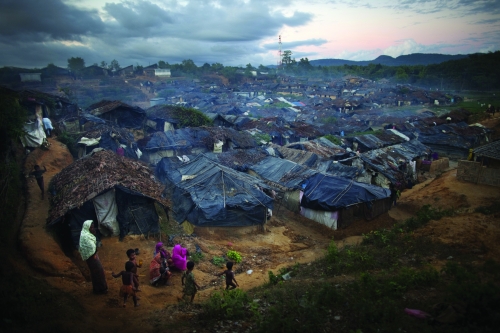 |
| Thousands of unregistered Rohingya Muslim refugees from Burma are forced to reside next to the registered refugee camp at Kutupalong, Bangladesh (Jonathan Saruk/Getty images). |
.
Buddhist-Muslim relations
Many predominantly Buddhist countries in lower Asia are also home to substantial populations of Muslims.
Likewise, a number of Muslim countries are home to Buddhist minorities. Majority-minority relations can be contentious, but add ethno-religious lines to the mix and things can easily degenerate from prejudicial policy-making to unbridled violence.
(Take Rakhine State in Burma, for example, where Buddhist violence against the Rohingya Muslims, which Tricycle covers in its most recent issue).
Despite what unbalanced histories and historical mythologies might indicate, relations between the two religions were NOT always so troubled.
Buddhism and Islam encountered one another on the Silk Road and enjoyed a relationship that for the most part was peaceful and involved a cultural exchange that played a part in transforming both religions into their current manifestations.
Such a history flies in the face of that of the common imagination, where a violent confrontation in which Muslims essentially terrorize the eminently serene, peace-loving Buddhists dominates.
[Islam displaced Buddhism in India as a force from without, while Hinduism ejected it from within, sending Buddhism into the world.]
[Islam displaced Buddhism in India as a force from without, while Hinduism ejected it from within, sending Buddhism into the world.]
 |
| Sri Lankan Theravada Buddhists off the tip of India (Mirror Times) |
.
In recent decades, we’ve witnessed a very real reversal in which Buddhist-ruled governments engage in ethnic cleansing and attempt to relegate Islamic countrymen to permanent refugee status in their own country, as has been the case in Burma and Sri Lanka.
The Khaleej Times reported the largest anti-Muslim rally to date in Sri Lanka [in 2013].
Led by the Buddhist organization Bodu Bala Sena (BBS, “Buddhist Power Force”), members and supporters marched to petition for a ban on halal [Islamic "kosher"] food certification and the building of mosques [Muslim houses of worship] with funds from Middle-Eastern countries.
The Khaleej Times quotes the BBS Secretary Ven. Galaboda Aththe Gnanasara Thero [a wayward and misguided patriotic Buddhist monk] on the militant ambitions of the Buddhist group:
“Hundreds of [Buddhist] monks are ready to fight….Our country is a Sinhalese [Sinhalese-speaking Buddhist] one and we are its unofficial police.”
Buddhist clergy-led social action has proven itself a powerful catalyst for social change in lower Asia. These days, favored reform unfortunately seems to run along the lines of racism and militant nationalism.
Buddha and Barbie ban
In more benign, and certainly more baffling news, Buddha statues have joined the likes of Barbie dolls and Simpsons figures under a countrywide ban in Iran.
[Fundamentalist] Iranian authorities have been seizing Buddha statues from shops in the capital of Tehran in order to stymie the ongoing “cultural invasion.”
While these sanctions generally focus on Western products, this might be “the first time that Iranian authorities are showing opposition to symbols from the East,” ABC News speculates.
Tibetan Catholicism
[Fundamentalist] Iranian authorities have been seizing Buddha statues from shops in the capital of Tehran in order to stymie the ongoing “cultural invasion.”
While these sanctions generally focus on Western products, this might be “the first time that Iranian authorities are showing opposition to symbols from the East,” ABC News speculates.
Tibetan Catholicism
 |
| Tibetan Catholics pray at a church in the Tibet Autonomous Region. Most Christian missionaries in Tibet belong to nondenominational groups intent on mass conversion (Wang Changshan/Xinhua Press/Corbis). |
In Tibet, a land where Buddhists and Muslims have coexisted peacefully since the 12th century (Tibetan Vajrayana Buddhists frequent the Muslim restaurants for their halal meat, generally regarded as the most flavorful), a new religious player has entered the scene:
Christianity and its [Catholic] missionaries. The Guardian reports an influx of evangelists pouring into Tibet [with Han Chinese government approval and support], where they are selectively tolerated by the traditionally anti-proselytizing Chinese establishment.
The Han Chinese government likely welcomes these new missionaries because they offer “a powerful counterforce to Tibetan Buddhism, with its electrifying political overtones.”
However, since Buddhism is so central to the cultural identity of Tibetans, they are notoriously tough sells in the spiritual marketplace. Source
Friday, March 10, 2017
Hindu yogis eat brains ("Believer"/Reza Aslan)
Reza Aslan (CNN.com); Breaking News Channel; Seth Auberon, Wisdom Quarterly

Our favorite Muslim, following the passing of Mohammed Ali, is Prof. Reza Aslan -- Christian scholar, author, and now TV host of "Believer" on CNN. Here he travels to India to meet the Aghori, crazed yogi ascetics or sadhus, with severe practices that apparently include eating rotted human flesh. A host should get right near the action, but maybe crossing the line shows why there's a line in the first place. Cannibalism? Eating brains from a corpse like a zombie? Hinduism would be mortified, but the Aghori are trying to show that nothing one takes in affects one's purity. Ritual contamination is a big thing among Hindus, particularly the standoffish Brahmins, so the Aghori are trying to show a different perspective.
Tuesday, January 24, 2017
Bad monks in a Buddhist country (video)
 |
| The inclusive rainbow Buddhist flag flies over a nation for virtue, meditation, wisdom. |
Thailand's Tainted Robes: Misbehaving Monks
 As scandals involving misbehaving Buddhist monks rock the Southeast Asian nation of tourist-friendly Thailand (possibly the most Buddhist country in the world), 101 East examines if the nation can save its moral character.
Why is this happening? Could it be that forcibly sending males into the monastery necessarily creates rebellion, discontent, and misbehavior?
Most of the misbehavior is due not to actual "monks" (bhikkhus) but to novices (samaneras) who temporarily ordain and so undertake fewer rules than fully ordination entails for a few days or months by Thai custom. A person's ordination is only as good as one's underlying motivation for undertaking the eight to 227 training rules of a Buddhist monastic.
Four of these 227 or more training rules (many of which are minor etiquette guidelines that number 1,000 or so) are so important that breaking them leads to immediate and irrevocable "defeat" (parajika). They are: killing, stealing, sex, falsely claiming spiritual attainments.
The whole purpose of the rules is to facilitate meditation and to preserve the Dharma as a living tradition in the world for as long as possible -- through study, teaching, and most of all intensive practice that ensures that at least some people (lay and monastic) gain the stages of enlightenment.
 |
| Wheel of the Dharma |
There is, of course, misbehavior higher up. Most novices are sincere and studious for the short time they are ordained. Some long time monks are the ones abusing the system set up by the Buddha for producing enlightened beings (arhats) in the world, which constitute the supreme field of merit for the world.
Some Buddhists, particularly adherents of the much larger latter-day Mahayana school, feel it is wrong to speak ill of the community. They invented an additional precept against it. One should hide the dirty laundry? We disagree because sunlight is the best disinfectant.
Dysfunctional communities, such as cults, need to keep secrets. If a community will not clean up its act in silence then saying something becomes necessary. If molestation were happening at home, would you keep silent? Most of us would. But silence makes it possible for it to keep going on. Speak up.
Dysfunctional communities, such as cults, need to keep secrets. If a community will not clean up its act in silence then saying something becomes necessary. If molestation were happening at home, would you keep silent? Most of us would. But silence makes it possible for it to keep going on. Speak up.
 |
| Two chedis (pagodas) near the summit of Doi Inthanon (Lester Mathias Andersson) |
 |
| Why is there Buddhism if no one seeks a path to enlightenment and nirvana? Altars, like this one in Thailand's Doi Inthanon, would be worthless (Charlie Owen/binbagger/flickr.com). |
 |
| Is Mara leering his hideous head again? |
There are rules -- monastic guidelines known as The Vinaya (Monastic Disciplinary Code) and Patimokkha (direct "Path to Liberation" rule recitation).
Unfortunately, most lay Buddhists have no idea what the rules are.
 And most monastics feel it is none of laypeople's business what goes on inside the monastic system. The rules lay out the enforcement of the rules, but they are not enforced. The guidelines are there, but no mechanism exists to see to it that they are carried out.
So instead of cleaning up its own act, unless some pressure comes from outside, the whole system could become corrupted to the point that we lose the third gem or guide of Buddhism, the Sangha (monastic community) like we lost most of the female monastic community and the noble community, both of which are currently on the rise again. The first gem, the Buddha, is no longer here.
The second and arguably the most important, the Dharma (the Teaching of the complete path to enlightenment) is on shaky ground as no one seems to know what it is. It is preserved in the ancient Theravada tradition as the bodhi-pakkhiya-dhamma or "37 Requisites of Enlightenment," which few know exists.
More from AJ's 101 East on
- YouTube - aje.io/101eastYouTube
- Facebook - facebook.com/101east
- Twitter - twitter.com/aj101east
- Instagram - instagram.com/aj101east
- Website - aljazeera.com/101east
Friday, June 19, 2015
International Day of Yoga, June 21 (video)
Ashley Wells, Dhr. Seven, Amber Larson, CC Liu, Wisdom Quarterly

(College Humor/Facebook) Typical American yoga class teachers will scare you to your core.
 |
| Yoga as an activity at the Wanderlust Festival, which travels around the U.S. |

International Yoga Day events in US
(Yoga21.org) HSS (Hindu Swayamsevak Sangh) is working with numerous organizations to organize events on International Yoga Day throughout the USA. HSS is constantly updating this LIST, so check back for events in your area or contact.
(Tato Salad) Ogden creates awkward situations in yoga studios throughout the San Fernando Valley, L.A. But don't worry, folks, he's in the teacher training program. Produced by James McFadden and Tyler McFadden. Directed by Greg Thanos. Starring Avi Rothman and Brittney Kara. Written by Avi Rothman. Special thanks to GardenOfYoga.com!
 |
| The ultimate goal of yoga is meditative concentration: strength, calm (poise), balance |
 |
| Sadhus or wandering yogis (usually abusers of sacramental ganja) at Ambubasi Festival with soccer ball, Kamakhya Temple, Gauhati, India June 21, 2014 (Anupam Nath/AP/Yahoo News) |
 |
| Sacred Science of Yoga: Knock it off! Do yoga pants draw unwanted attention? No, most wearers probably hunger for that attention. Here shoppers mug as they model undergarments at Lululemon then one commits assault or is it "just a joke"? It's ambiguous among the heteroflexible (yogapantsarchive.com). |
 |
| Yoga makes cover of Time |
Yoga has gone mainstream in the US. It is bigger here among lay practitioners than it is in India. The greatest yogis and yoginis may still haunt the Himalayan foothills. But the average practitioner of physical poses (asanas) now resides in the West.
Yoga is the Number One sport discussed on twitter. It is so big among college coeds and housewives that the men had to get on board en masse. Now everyone loves it. But what is "it"?
 |
| Patanjali's Yoga Sutras |
There are two yogas -- the stretch pants, sticky mats, and consumer-society fashions and something called Integral, Royal, or Eight-Limb Yoga (called Raja or Ashtanga). The eight limbs or angas are analogous to the Buddha's Noble Eightfold Path factors. They are not the same, but with the tremendous success of Buddhism in India and Central Asia, ancient Vedic practices were reformulated in more modern terms. Patanjali (author of Yoga Sutras) is credited with the formulation we now use. The factors in each list are ancient, even timeless/eternal, but how they are presented changes over the epochs and aeons.
NOBLE EIGHTFOLD PATH

2. Right intention (sankappa)
3. Right speech (vaca)
4. Right action (kammanta, karma)
5. Right livelihood (ajiva)
6. Right effort (vayama)
7. Right mindfulness (sati)
8. Right concentration (samadhi)
YOGA'S EIGHTFOLD PATH
- Yama – ethical restraints (what to abandon)
- Niyama – ethical observances (what to practice)
- Āsana – a posture that one can hold for a period of time, staying relaxed and steady (sthira-suka), comfortable and motionless
- Prāṇāyāma – conscious regulation and exercise of breath
- Pratyāhāra – mastery of sensory organs, withdrawal of the senses from external objects
- Dhāraṇā – concentration, introspective focus, one-pointedness of mind
- Dhyāna – successful meditation, absorption, unification of mind
- Samādhi – quiet states of complete absorption withdrawn from all external distractions of the world and the physical, complete blissful awareness of one's mind and liberated abiding, superconscious states.
 |
| Aum or Om symbol |
 |
| Downward Dog: modern US yoga class with guest teacher Maty Ezraty (lansingyoga.com) |
.
 |
| His and Hers: couples yoga (pinterest.com) |
"Modern" is relative as Buddhism is now at least 2,600 years old, and the Vedas reach back 5,000-10,000 years to the time of the Indus Valley Civilization (IVC). Other "Buddhisms" existed even before that -- because everything, like knowledge of the Dharma, is cyclical -- with the arising of previous fully enlightened teachers who discovered and established the timeless Teaching.
 |
| Human life is billions of years old. |
Just so, other non-Vedic shraman teachers have existed alongside the Vedas. This is evident in the history of Jainism, where a tirthankara or "ford finder" arises periodically. The Buddha spoke of previous lives (jatakas) as a Brahmin who memorized the Vedas, suggesting the antiquity of those sacred IVC scriptures. It is contested matter when previous buddhas lived, thousands of years ago or millions. The ancient Theravada tradition insists it was aeons ago and not any time in recent history. Life on this planet being cyclical has had modern humans and other humanoid life for millions of years, as Michael Cremo (mcremo.com) reveals in his studies of Forbidden Archeology.
- Int'l Yoga Day in USA (yoga21.org/upcoming-events)
- CHALK FESTIVAL 2015, Pasadena
- A little sexism goes a long way in a PC world
- PHOTOS: Female scientists mock sexist professor
- Greenpeace, Sierra Club, and other Environmentalists to protest Obama in Los Angeles (Palos Verdes) today (Jon Weiner/KPFK/The Nation Magazine)
- Why limit it to see-through yoga pants; why not tops, too?
- READ: How to Know God: The Yoga Aphorisms of Patanjali
 |
| Kalpas ("aeons") are the standard unit of measuring time in Buddhism and India. |
Wednesday, February 18, 2015
Why ashes on Ash Wednesday? (Catholic Lent)
Maya, Pat Macpherson, Dhr. Seven, Pfc. Sandoval, CC Liu, Wisdom Quarterly; PennLive.com
 |
| First it's Fat Tuesday then the feel bad rituals of American Catholicism (pennlive.com) |
 |
| God damn it, why do we do these thing in the Church like molest boys? (Southpark) |
.
 |
| Hi, I'm a sadhu. I smoke ganja, sacramentally. |
Q: The question today, suggested by an avid Wisdom Quarterly reader is, Why do Catholics rub ashes on their forehead today?
"Steal" might be a better word for it, although "beg" and "borrow" could also work. There is a great deal of Hinduism in Catholicism, but almost no Catholic knows it. Eastern philosophies -- Buddhism, Tibetan tantra, paganism, Sumerian, Egyptian traditions -- have all unwittingly contributed to Rome's great success. This universal (the meaning of the word "catholic") form of Christianity was originally a Roman "psy op," psychological operation/propaganda campaign to wrest power from religion and return it to the state.
 A: That's a good question. And it took us a long time to get to the bottom of this mystery. First, the Catholic Church -- the ruling body of the largest religion on Earth today -- gets to be so popular because it appropriated all of its traditions, pomp, circumstance, spectacle, and imperial behavior from other religions. [But first let's hear an "official" explanation.]
Ask a Catholic apologist: "Ash Wednesday"?
(PennLive) Chances are you spied someone with a black cross on their forehead on your way to work this morning - or even in your office or classroom. So what's going on? Today, Feb. 18th, is "Ash Wednesday." A brief primer:
What is Ash Wednesday?
Ash Wednesday is the first day of the Lenten season, a period of 40-some days focused on spiritual purification and repentance. It is a day of fasting for Catholic and Anglican churches. Ash Wednesday gets its name from the practice of the distribution of ashes upon the foreheads of Christians.
What do the black marks mean?
Those black marks are meant to be crosses, although as the day wears on they can look like black smudges. They are a mixture of ashes, Holy Water and, sometimes, olive oil.
The ashes come from the palms used in the previous year's Palm Sunday, the Sunday before Easter that marks Jesus's entrance into Jerusalem where he was met with palm branches by believers. It's especially significant, because Jesus was greeted in Jerusalem as a hero and the Messiah by the mob and he would eventually be put to death by the hands of the Romans at the insistence of those people. The ashes are meant to remind Christians about human mortality... More

A: That's a good question. And it took us a long time to get to the bottom of this mystery. First, the Catholic Church -- the ruling body of the largest religion on Earth today -- gets to be so popular because it appropriated all of its traditions, pomp, circumstance, spectacle, and imperial behavior from other religions. [But first let's hear an "official" explanation.]Ask a Catholic apologist: "Ash Wednesday"?
 |
| I'm Catholic, so you have to be, too! (PL) |
What is Ash Wednesday?
 |
| No molesting the kids today, 'kay guys? |
What do the black marks mean?
 |
| They do what they're told. I like that. |
The ashes come from the palms used in the previous year's Palm Sunday, the Sunday before Easter that marks Jesus's entrance into Jerusalem where he was met with palm branches by believers. It's especially significant, because Jesus was greeted in Jerusalem as a hero and the Messiah by the mob and he would eventually be put to death by the hands of the Romans at the insistence of those people. The ashes are meant to remind Christians about human mortality... More
- What is Lent?
- Why is everyone giving up stuff?
- Let's give our infant some weed from this bong
- Maybe molestation at church leads to it in schools
- Female teacher in New Jersey, mother of 2, molested six students at school, ages 14 and 15
 |
| We're here to torture and molest children in the name of mercy: an angry old German, former Hitler Youth, once ran the world's biggest corporation -- and maybe still pulls strings -- that's what's great about the universalist church of the Holy Roman Empire. |
.
 |
| Hindu Sadhus smoke so much weed/pot. |
One of the practices of Hindu sadhus or "holy men" was to rub themselves all over with pyre ashes to mindfully remember (recollect) death, along with all of the hygeinic advantages of using this free talcum powder like substance and skin protectant, which is also used as make up. Almost all sannyasis (spiritual wanderers) apply a tilak or forehead marking over their divine eye.
 |
| Why ashes when I can OM? |
Ask a priest, and he's likely to say something about Jesus or death, but the truth is he has no idea why they do most of the things they do up on stage during the mass. But travel to India and observe a Brahmin priest, ritual celebrant, or sadhu, and you are likely to be shocked by all of the Catholic Latin mass trappings -- incense, candles, hocus pocus, chanting in a dead language, bells, genuflecting, wafer distribution (prasad), holy water, ash application on participants' foreheads along with a big tilak on the person conducting the ceremony.
 |
| Sannyasi ponders life (Ashish Tamhane/flickr) |
Why would the Catholic Church beg, borrow, or steal all of the elements? Because experience and history shows they work. People love ritual, love spectacle, love communion (merging, union, yoga, connection with the divine). And that is why we in America and other Catholic countries (ever notice how many Catholics work over at FOX News?) do this strange thing without questioning it, and it probably has more than a little to do why people are leaving the Church and Christianity in general in search of something real.
 |
| We need more than the Church can offer; we need direct divine experiences (LU). |
Subscribe to:
Posts (Atom)





















































