Showing posts with label buddhist symbol. Show all posts

Friday, August 14, 2026

The real meaning of Yin and Yang ☯️

(Flowing Void) What does the ying and yang actually mean? (Taoist philosophy explained)

Yin-Yang is NOT about balance


Yin Yang is much deeper than thought | I Ching, Yin-Yang, trigrams, Chinese philosophy
Queen Mandarin(Queen Mandarin) Readers have probably seen these symbols in Chinese restaurants, kung fu movies, the Korean flag... But most people have no idea what they actually mean.

Today, let’s talk about the I Ching, not as magic, not as fortunetelling, but as one of humanity’s oldest attempts to understand change.
  • 00:00 Intro
  • 00:23 The idea of change: What and why?
  • 00:58 Yin and Yang, symbols and meanings
  • 02:51 The Four Stages
  • 03:12 The 8 trigrams, with examples
  • 06:44 The 64 hexagrams, with examples
  • 09:25 Magic? Fortunetelling?
#IChing #YinYang #ChineseCulture #AncientChina #Philosophy #Taoism #Yijing #ChineseLanguage #EastAsia #Symbolism

Whether learning Chinese for the first time or simply curious about the hidden stories in characters, this video will make viewers see Chinese in a whole new way. 👉 Remember to like 👍, comment 💬, and subscribe 🔔 for more fun explorations of Chinese characters. #IChing #YinYang #ChineseCulture Support my work via Paypal: paypal.me/JiayiWu83 Or via SUPER THANKS button under the video

Wednesday, March 1, 2023

The real meaning of yin and yang (video)

ReligionForBreakfast, Feb. 10, 2023; Pat Macpherson, CC Liu (eds.), Wisdom Quarterly

The real meaning of yin and yang
(ReligionForBreakfast) Let's explore the concept of yin and yang, the ancient Chinese philosophy that highlights the balance of opposing [complementary] forces in the universe.

Delve into the meaning of yin and yang, how they are represented in the famous Taijitu symbol, and their impact on health, relationships, and the natural world.

From the yin yang balance of light and dark, to hot and cold, and masculine and feminine, this is a comprehensive look at one of the most fundamental beliefs in Chinese philosophy -- that made it into Buddhism from Taoism.

Thanks to Wondrium for sponsoring today’s video. Signup for FREE trial. Patreon community: patreon.com/religionforbreakfast... One-time donations: paypal.me... Favorite religious studies books Amazon page: amazon.com/shop/religionfor...

Monday, August 29, 2022

"Chasing the Phallus," Bhutan (2022 doc)

Ananda (Dharma B Meditation), Ashley Wells, CC Liu, Seth Auberon (eds.), Wisdom Quarterly

Chasing the Phallus || Bhutan documentary
(Norter) March 21, 2022. Why would the people in the last Himalayan Buddhist kingdom, now turned over by the king to a people's democracy, still continue the old custom of venerating penises or Shiva's lingam? The male member is a potent symbol of fertility, but even allegedly celibate monastics get in on the worship. Do they masturbate? Do they take on tantrikas (female assistants in sexual tantric yoga)? Do they just imagine and obsess on what they now no longer use? Is it just symbolic for virile (viriya) power?


Why do some Buddhists worship penises and wear them as a charm on a necklace?
(The Ultimate Learning Tricks) June 19, 2019. The "God of Fertility" is a phallus in Buddhist Bhutan and Thailand.

COMMENTS:
  • (Don Karara) Shivling (Shiva's lingam or phallus symbol) is the same concept with a few variations.
  • Tashi Wangchuk(Tashi Wangchuk) I heard Lama Drukpa Kinley was kind of a rebel master who went against the rigid and set Vajrayana monastic establishment, in which the Buddha's teachings seemed to be inaccessible to lay people. He shocked everyone by these types of teaching or something like that.
  • (I.P. Freely) Are y'all serious? I can't imagine talking about my Willy in polite company or graffitiing it on my house or temple. This is wild, man.

Tuesday, August 16, 2016

The Buddhist SWASTIKA (卍 and 卐)

Amber Larson, Dhr. Seven, CC Liu, Wisdom Quarterly; ReligionFacts.com  (ANALYSIS)
In some Asian iconography, this auspicious symbol denotes "noble." (TBS)
Various swastikas, ancient and modern, pagan and Nazi (The Hebrew Cornerstone)

Swastikas are also found in ancient Greek culture, roots of the West (Minghui.org).
.
Maybe vandals were saying "all's well"?
In Buddhism, the swastika (Sanskrit svastika, "all is well") is a cross with four arms of equal length, with the ends of each arm bent at a right angle. Sometimes dots are added between each arm.
 
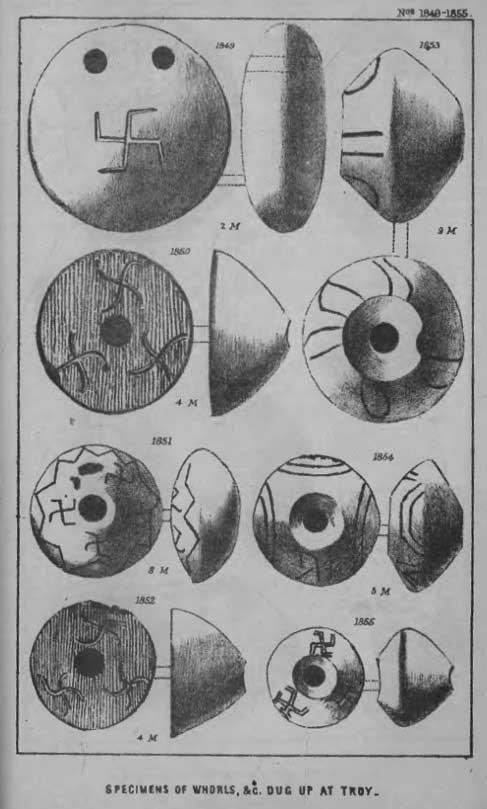
Common in India, the swastika is an ancient symbol that is in fact found worldwide. It can be seen in the art of the Egyptians, Romans, Greeks, Celts, Native Americans, and Persians as well as Buddhists, Hindus (based on Vedic Brahminism), and Jains.
 
https://ixquick-proxy.com/do/spg/show_picture.pl?l=english&rais=1&oiu=http%3A%2F%2Fpieceofmindblog.files.wordpress.com%2F2012%2F10%2F2_swastikas2.jpg&sp=b62da1a9c8549d9b3bde36d137cc4b0a
The swastika's Indian name comes the Sanskrit word svasti, which means "good fortune, luck, and well being."
 
In ancient Vedic Brahmanism and modern Hinduism, the right-hand (clockwise) swastika is a symbol of the sun and the god Vishnu, while the left-hand (counterclockwise) swastika represents Kali and magic.

The Buddhist swastika is almost always clockwise, while the swastika adopted by the Nazis (many of whom had occult interests) is counterclockwise. In Buddhism, the swastika signifies... More 
Swastikas of various kinds, including a Naziesque version (richardcassaro.com)
 
Why did the Nazis appropriate it?
Wisdom Quarterly (ANALYSIS)
Nazi corporate logo version
German Propaganda Minister Goebbels and other Nazis went to the mysterious East in search of occult artifacts, lore, and powers, including the legend of the "world ruler" (chakravartin), the thousand-spoke Wheel of Dharma that assists in ruling (possibly symbolic of a flying machine or vimana), and the arya ("noble") supermen or women or devas. So when a swastika is seen on an Asian statue, it is often to symbolize that the figure is spiritually enlightened/awakened. NOTE: The real world ruler likely resides in Agartha (Inner Earth, Aztlan, Shambhala, Shangri-La).

The Buddhist swastika vs. Nazi hakenkreuz (The Buddhist swastika/flickr.com)
Swastikas as temple symbols in Asia
Goebbels brought back a whole cloth legend of an all-powerful leader, like the figure of Maitreya ("Messiah"?), and Adolf Hitler was told to not be seen eating in public, it was said he was a vegetarian and in touch with higher spiritual powers and entities, and so on. That Nazism shares these superficial features with Buddhism is no accident; they were purposely misappropriated by Goebbels, Goering, and other top Nazis. The Theosophical Society led by Russian mystic Madame Blavatsky shared a lot of Eastern mysticism with the West.
 
Hey, you can't compare the State of Israel to Nazis visiting a holocaust on modern Palestinians in Palestine. It's verboten! Swastikas denounced at rally (cija.ca).

Tuesday, September 6, 2011

The Zen Zero (ensō)

Wisdom Quarterly edit of Ensō Wikipedia entry

Ensō is a Japanese word meaning "circle" and a concept strongly associated with Zen Buddhism. It is one of the most common subjects of Japanese calligraphy even though it is a symbol and not a character.

It symbolizes absolute enlightenment, strength, elegance, the universe, and the void. It can also symbolize the Japanese aesthetic itself. As an "expression of the moment" it is often considered a form of minimalist expressionist art.

In Zen Buddhist painting, ensō symbolizes a moment when the mind is free to simply let the body/spirit create. The brushed ink of the circle is usually done on rice paper or silk in one movement. But the great Bankei used two strokes sometimes. And there is no possibility of modification: It shows the expressive movement of the spirit at that time.

Zen Buddhists "believe that the character of the artist is fully exposed in how s/he draws an ensō. Only a person who is mentally and spiritually complete can draw a true ensō. Some artists will practice drawing it daily, as a kind of spiritual practice."[Ref. 1]

Some artists paint ensō with an opening in the circle, while others complete the circle. For the former, the opening may express various ideas -- for example that the ensō is not separate, but is part of something greater, or that imperfection is an essential and inherent aspect of existence. (See also the idea of broken symmetry).

The principle of controlling the balance of composition through asymmetry and irregularity is an important aspect of the Japanese aesthetic: Fukinsei (不均斉), the denial of perfection.

The ensō is also a sacred symbol in the Zen school of Buddhism. It is often used by Zen masters as a form of signature in their religious artwork. More on the philosophy see The Way of the Brush or Zen Calligraphy (Hitsuzendo).


Tuesday, July 27, 2010

Buddha Mania! (in home decoration)


(Los Angeles Times) In almost every room of Susan Cohen's Santa Monica house, there are Buddha statues: sitting, standing, reclining. Some are gray, others purple or pink. A 4-foot-tall copper-colored cast-resin Buddha head is propped up in the backyard pond, and a tiny ceramic figure gazes from the dashboard of her car.

Cohen isn't a Buddhist, and in 10 years of displaying symbols of the ancient religion, no one has asked if she is. She's just drawn to what the statues represent: serenity, wisdom, peace. "Who wouldn't want that in their home?" she asks. Very few, it seems. Buddhas are big. They're everywhere these days, more likely bought at the local mall or garden center than during an overseas vacation. The principal religious figure for an estimated 6% of the world's population now doubles as visual shorthand for soothing interior design to so many others -- an instant tranquilizer set on the console or hung above the mantel.

Buddha in home decor Buddha in home decor

Scott Thomas of Thomas-Somero Design in Hollywood says that whenever he hears the word "Zen" from clients, he automatically draws a Buddha into the design sketch -- much to their approval. Demand has even spread to the art market. In March, Christie's sold a 26-inch-tall wooden Buddha sculpture dating to the 12th century for about $14.4 million, setting a world auction record for traditional Japanese art. More>>

Buddha statues have meaning from head to toe
SIDDHARTHA GAUTAMA was a prince in India around 500 BC who set out to discover meaning in the [dukkha] he witnessed. Once he found enlightenment, he began to spread his philosophy. He became known as Buddha, a title, since given to others, that means "awakened one." Buddha statues have long conveyed the religion's teachings, according to Surya Das, a Buddhist lama trained in Tibet. "Encoded symbols in the statues were used in a preliterate, oral culture to pass on the messages"...

Tuesday, September 30, 2008

The Swastika "卍"

What is the real meaning of the Buddhist religious symbol known as the Swastika?

The swastika symbol can be found in archaeological sites all over the world including ancient Europe, Asia, America (among the indigenous Indians), and so on. These relics show that the swastika has a long history. In modern times, the swastika is most famous as the corporate logo for the Nazi party of Hitler's Germany. Before that, it had an exalted Indian history and played a role in many religions, not least of which was Buddhism and esoteric Hinduism.

The origin of the swastika is unknown -- representing the sun or a wheel even to the most ancient of cultures. But it is a famous and revered mark on the Buddha's body.

Generally, the swastika is a symbol meaning "good fortune." Most people seem to have forgotten that. The origin of swastika may be otherworldly. As a mark on the Buddha's body, it represents the Buddha's level and status in heaven. A Tathagata ("Perfected One") is represented with one swastika on the body, usually the chest. Other Buddhas imagined to be greater have more. Arhats and Bodhisattvas do not have any.

Pre-Buddhist symbol
Swastikas (facing in either direction) have been found in ancient Greece. While it is a Buddhist religious symbol, and Buddhism reached ancient Greece, not all swastikas are Buddhist. Ancient Vedic cultures (extending through modern day Pakistan, Afghanistan, and all the way through the ancient Greek world, came in contact with the West before then.

It is believed by some that in earlier times, before the Big Flood, people in Europe believed in the Buddha. And during the Big Flood, some ancient Greek people who lived to the south-west of Himalayas survived. They are the current light-skin Indians (Arya) called Brahmins, who seem to be descended from Persians and other pre-Indus Valley civilization conquerors. Originally, Brahmanism experienced many converts to the Buddha's teachings, which were inherited by the ancient Greeks.

They also inherited the sculpture methods. Therefore, many ancient Indian Buddha statues are distinctly Western (such as the Gandharan period pieces in many Western museums) in appearance. These sculptural techniques, along with various swastikas, spread from India to China with Buddhism. Thus, some Asian Buddha statues have deep eyes and straight noses (along with blue eyes, togas, jawlines, other facial features, and the physiques of Greek gods).

One of the main Buddha statues in Yun-gang Grotto, Shan-xi Province in China has an obviously Western face.

Shakyamuni Buddha began his dispensation about 500 B.C.E. Buddhism, in a narrow sense, only refers to the specific religion that grew up around this historical Buddha's teachings. But the Buddhism that spread to China in the 1st century to become one of the world's major religions and the dominant faith of most Chinese people was an amalgamation of Hinduism and Buddhism called Mahayana, a philosophical refinement of Shakyamuni's conventional teachings.

In a broader sense, Buddhism is not limited to referring only to Shakyamuni and his teachings. For example, Tibetan Tantra also believes in a Buddha but not Shakyamuni. In China, people regard Tibetan Tantra as a part of Buddhism. But Tantra (being a Hindu invention) was not created by Shakyamuni, and in some divisions of Tantra the followers did not know Shakyamuni at all.

Even within Chinese Buddhism, there are several Tathagatas and Bodhisattvas being worshiped. ("Tathagata" is the title of a Buddha like a job title). Shakyamuni is believed to have said that Tathagatas in the universe are as plentiful as the grains of sand in the Ganges river. Therefore, "Buddha" is a general word referring to a type of divine being in heaven. They assume an outward appearance blue hair [blue represents black in Hindu art] with curls, wrapped with long yellow cloth, with a swastika mark on the body.

The Nazi symbol
Hitler stole the swastika and used it for his own ends. Not only this ancient "Aryan" symbols, but the very mythology of Aryans comes from Buddhist teachings on the "noble" origins of Indian culture as having originated in the pre-Indus Valley civilization from the north (Persian, Iraqi, Middle Eastern, or otherworldly, it is not know. Not only this symbol and story but other esoteric ideas stemming largely from Theosophical teachings introduced to Western Europe by Madame Blavatsky were appropriated by Hitler and his advisers, who were very interested in astrology, mythology, and the occult. It has a much longer human history than the Nazi symbol. In Buddhism, the swastika is generally level and not painted black, whereas the Nazi symbol is tilted pointing upwards and is almost always black with a distinctive red and white background.