Showing posts with label sculpture. Show all posts

Wednesday, May 22, 2024

The Buddha's mother found in Thai jungle?

The Buddha’s mother, Queen Maya Gotami, in Buddhism (jendhamuni.com)
This bas relief found in Thai jungle may be Queen Maya holding sal tree branch
Thai: Buri Ram mushroom hunter makes enigmatic discovery (nationthailand.com)

Mysterious sculpture found in Thai jungle
The Buddha's biological mother Queen Maya
May 22, 2024: A search for mushrooms in a remote part of Thailand turned wondrous for a group of Theravada Buddhist villagers who stumbled upon a mysterious sculpture believed to be a depiction of the Buddha's mother, Queen Maya.

According to a local media report, the remarkable find occurred last week at the Dong Yai Wildlife Sanctuary in the province of Buriram, Thailand. It came to light by way of a social media post from Pramul Kongkratok, who was one of the mushroom hunters.

Close up of carving, possibly recent
"Went mushroom hunting and found this," he said of the strange sculpture (more of which can be seen here)/

"I've lived here for so long, but just learned we have this around here. It's a blessing."

Kongkratok's photos of the newly discovered and seemingly ancient artwork went viral on social media in Thailand (on the verge of the biggest holiday in Theravada Buddhism known as Vesak ("Buddhist X-mas") -- a day commemorating:
  1. the birth of Prince Siddhartha,
    Khmer art of Angkor area
  2. his great awakening, when he became "the Buddha,"
  3. and his passing into final nirvana
  • (all of which occurred on the same auspicious full moon day in the ancient Indian month of Vaiśākha).
  • [The art of the Khmer (present-day Cambodian) people is very similar to the art of the jungles of the Americas, as are their stone temples and exquisite bas relief art all over the walls of Angkor WatAngkor ThomSiem Reap, and new archeological sites constantly being discovered in the dense jungles of the massive former Buddhist-Hindu empire.]
 
Prince Siddhartha was raised by his adoptive aunt
Queen Pajapati Gotami, after Queen Maya passed.
This prompted the country's Royal Forest Department to dispatch experts to investigate the priceless archeological artifact.

Upon examining the sculpture, which is that of a woman with her arm stretched overhead [just as his mother, depicted as a salabhanjika, is seen in countless pieces of art in Indian as she gives birth to the future-Buddha, while standing, holding on to the branch of a sal tree].

Archeologist Chedha Tingsanchali was able to discern some clues as to the nature of the piece. Noting that the "eyebrows, lips, and other features" differed in their depiction from the artwork of the 6th to 11th century period known as Dvaravati, he posited that "the sculptor was someone who saw ancient art like ancient Indian art and imitated it.
    That said, the age of the piece largely remains uncertain beyond it not being particularly ancient and how it wound up in the remote jungle is also a mystery.

    Frescoes at Sigiriya (Lion's Rock), Sri Lanka
    One potential creator for the sculpture, put forward by villagers in the area, is a Buddhist monk who lived in the general area decades ago.

    As for who the piece is meant to depict, the prevailing theory at this time is that the woman is Buddha's mother Sri Maha Maya.

    As one might imagine, experts in Thailand are keen to study the newfound artwork further in the hopes of developing definitive answers to the questions surrounding the discovery and ultimately determining what, if any, historical value it might have. More
    Original story
    The topless ladies ofSigiriya are also a mystery
    (NationThailand.com, May 14, 2024) Thai mushroom hunters in Buri Ram (near the Thai border with Cambodia) may have come upon an engraving of great historical significance. But an art history professor says otherwise. Pramul Kongkratok, a villager who lives near Khao Krachiao Mountain in Buri Ram’s Non Din Daeng district, posted an image on social media recently, which quickly went viral. It showed an ancient engraving of a woman with an arm held above her head. The photo was captioned: “Went mushroom hunting and found this....” More

    Maya statue found in the Americas, in the jungles
    of Honduras, a marvel of Central America.
    • Tim Binnall, Coast to Coast, Mysterious Sculpture Found in Thai Jungle, May 22, 2024; Dhr. Seven, Pfc. Sandoval, Seth Auberon (eds.), Wisdom Quarterly

    Friday, September 22, 2023

    Million-and-a-half dollar Buddha stolen in LA

    Vivian Chow, Jacqueline Sarkissian, 9/22/23; CC Liu, Sheldon S. (eds.), Wisdom Quarterly

    $1.5 million ancient Buddha statue stolen from Los Angeles art gallery
    Budai: Kano Koi Hotei, Edo Period
    (KTLA) Security cameras captured the moment an ancient Buddha statue worth US $1,500,000.00 was stolen from a Los Angeles art gallery.

    The bronze sculpture was stolen on Sept. 18 from the Barakat Gallery on La Cienega Blvd. in Beverly Grove, Los Angeles, around 3:45 am, officials said.

    Weighing 250 pounds, the artifact dates back to Japan’s Edo Period (1603-1867), according to gallery owners. It was believed to have been commissioned for the centerpiece of a temple.

    “I prize it so much,” said Fayez Barakat, the gallery's owner. “I had it in the backyard of my home and when I moved into this gallery, I put it in the backyard of the gallery for everybody to admire and enjoy.”

    Security video shows the thief pulling up to the gallery in a moving truck. The driver steps out, breaks open a driveway gate, enters the gallery, and uses a dolly to move the statue into the truck.

    The entire heist took around 25 minutes, the owner said. “This gentleman came and, I think, strapped a rope or a chain around that piece and pulled it to his rental van and put it in the back,” Barakat said.

    Barakat said he acquired the statue more than 55 years ago and that there is no other piece in the world quite like it.

    “We have 200 objects back there, but this is our prize piece,” said Paul Henderson, the gallery’s director. “I don’t think there’s another like it on the market anywhere. It’s four feet tall, it’s hollow cast bronze, and it’s a stunning piece.

    “It’s really aesthetically arresting, and it’s shocking to see something like this go missing.” Barakat believes the theft was premeditated due to the sculpture’s prominent display in the gallery’s outdoor space.

    There were hundreds of other valuable items that could’ve been stolen as well, but only the Buddha statue was targeted. He believes the thief seemed to have their heart set on this specific artifact.  More

    Sunday, May 13, 2012

    The mystery of Buddha's missing head

    Zhang Zixuan (China Daily, May 11, 2012)
    The Akshobhya Buddha's head, on the eastern wall of the Four Gates Pagoda's center pillar, was stolen on the night of March 7, 1997.

    "It was the most exquisite and beautiful head among the four," says Liu Jiwen, director of the Cultural Heritage Preservation Center of the Four Gates Pagoda.

    In 1999, the case was cracked, but the Buddha head was still missing. The head eventually appeared at an overseas auction and was bought by disciples of Taiwan's Buddhist master Sheng Yin (1930-2009).

    It was given to the Buddhist NGO Dharma Drum Mountain Foundation, which was founded by the master, and exhibited at the foundation's Museum of Buddhist History and Culture in Taipei.

    In July 2002, Liu and archaeologist Liu Fengjun went to Taiwan and identified the origin of the head. On Dec 17, 2002, Master Sheng Yin escorted the head in person to give it back to the Four Gates Pagoda.

    "The head is back, but there are still mysteries about these Buddha statues," says Wang Feng, deputy director of the center...."It may damage the statues. Also, the pagoda was intended to keep the Buddhist relics, not the statues," Liu continues.

    "But, on the other hand, to move such big stone statues into the pagoda was quite a challenge. We still cannot figure out how it was done." More

    Thursday, December 24, 2009

    Towards Personal Transcendence

    Sculpture exhibition approaches Buddhist truths
    (Bangkok Post/Outlook, Dec. 24, 2009) Buddhism has been the inspiration for many Thai artists, oftentimes with uninspired results. Far from serving as a cornucopia for their creativity, these practitioners frequently reduce the religion's icons to the level of kitsch as they repetitively reproduce its symbology, usually in gaudy gold [such as the sculpture shown here of an enlightened elder monk, not from this exhibit, covered in gold leaf].

    On the other hand, there are some artists who incorporate these ancient emblems into their work with a degree of originality. Vichoke Mukdamanee is one such artist and his latest show at The National Gallery titled "The Inspiration from Dharma" effectively breathes new life into the metaphysical representations from antiquity. More>>

    Wednesday, April 1, 2009

    Nefertiti: Hidden Face Beneath


    Bust of Egypt's legendary beauty Queen Nefertiti in Berlin's Old Museum. German researchers have uncovered her second, hidden face (AFP/DDP/File/Oliver Lang).

    Was Buddha's beauty constructed?

    Marks of a Great Man in Buddhism

    Famous Buddhist Beauty


    BERLIN – Researchers in Germany have used a modern medical procedure to uncover a secret within one of ancient Egypt's most treasured artworks — the bust of Nefertiti has two faces. A team led by Dr. Alexander Huppertz, director of the Imaging Science Institute at Berlin's Charite hospital and medical school, discovered a detailed stone carving that differs from the external stucco face when they performed a computed tomography, or CT, scan on the bust. More>>


    Undated photo composite released 3/31/09 by the Radiological Society of North America. Researchers in Germany have used a CT scan to uncover a secret inside one of ancient Egypt's most treasured artworks — the bust of Nefertiti has two faces.

    The differences between the faces, though slight — creases at the corners of the mouth, a bump on the nose of the stone version underneath — suggest to Dr. Alexander Huppertz a makeover. Huppertz, director of the Imaging Science Institute at Berlin's Charite hospital and medical school, believes someone expressly ordered the adjustments (the makeover) between stone and stucco. This would have been done when royal sculptors immortalized the wife of Pharaoh Akhenaten 3,300 years ago (AP/Radiological Society of North America).

    Tuesday, September 30, 2008

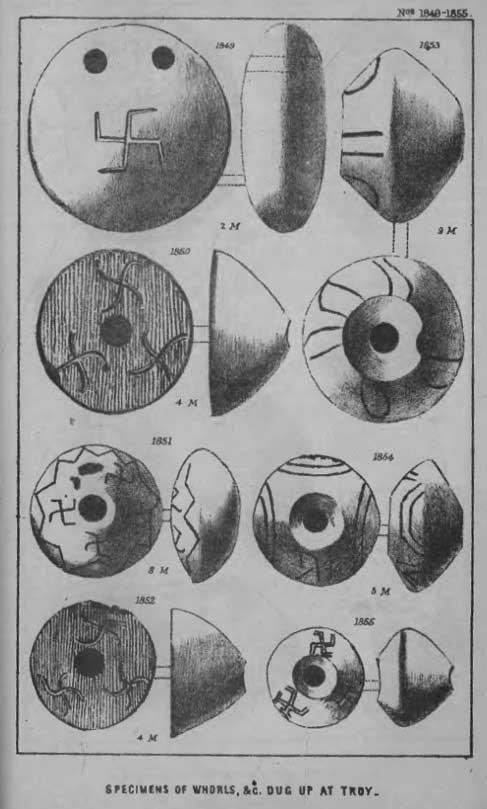
    The Swastika "卍"

    What is the real meaning of the Buddhist religious symbol known as the Swastika?

    The swastika symbol can be found in archaeological sites all over the world including ancient Europe, Asia, America (among the indigenous Indians), and so on. These relics show that the swastika has a long history. In modern times, the swastika is most famous as the corporate logo for the Nazi party of Hitler's Germany. Before that, it had an exalted Indian history and played a role in many religions, not least of which was Buddhism and esoteric Hinduism.

    The origin of the swastika is unknown -- representing the sun or a wheel even to the most ancient of cultures. But it is a famous and revered mark on the Buddha's body.

    Generally, the swastika is a symbol meaning "good fortune." Most people seem to have forgotten that. The origin of swastika may be otherworldly. As a mark on the Buddha's body, it represents the Buddha's level and status in heaven. A Tathagata ("Perfected One") is represented with one swastika on the body, usually the chest. Other Buddhas imagined to be greater have more. Arhats and Bodhisattvas do not have any.

    Pre-Buddhist symbol
    Swastikas (facing in either direction) have been found in ancient Greece. While it is a Buddhist religious symbol, and Buddhism reached ancient Greece, not all swastikas are Buddhist. Ancient Vedic cultures (extending through modern day Pakistan, Afghanistan, and all the way through the ancient Greek world, came in contact with the West before then.

    It is believed by some that in earlier times, before the Big Flood, people in Europe believed in the Buddha. And during the Big Flood, some ancient Greek people who lived to the south-west of Himalayas survived. They are the current light-skin Indians (Arya) called Brahmins, who seem to be descended from Persians and other pre-Indus Valley civilization conquerors. Originally, Brahmanism experienced many converts to the Buddha's teachings, which were inherited by the ancient Greeks.

    They also inherited the sculpture methods. Therefore, many ancient Indian Buddha statues are distinctly Western (such as the Gandharan period pieces in many Western museums) in appearance. These sculptural techniques, along with various swastikas, spread from India to China with Buddhism. Thus, some Asian Buddha statues have deep eyes and straight noses (along with blue eyes, togas, jawlines, other facial features, and the physiques of Greek gods).

    One of the main Buddha statues in Yun-gang Grotto, Shan-xi Province in China has an obviously Western face.

    Shakyamuni Buddha began his dispensation about 500 B.C.E. Buddhism, in a narrow sense, only refers to the specific religion that grew up around this historical Buddha's teachings. But the Buddhism that spread to China in the 1st century to become one of the world's major religions and the dominant faith of most Chinese people was an amalgamation of Hinduism and Buddhism called Mahayana, a philosophical refinement of Shakyamuni's conventional teachings.

    In a broader sense, Buddhism is not limited to referring only to Shakyamuni and his teachings. For example, Tibetan Tantra also believes in a Buddha but not Shakyamuni. In China, people regard Tibetan Tantra as a part of Buddhism. But Tantra (being a Hindu invention) was not created by Shakyamuni, and in some divisions of Tantra the followers did not know Shakyamuni at all.

    Even within Chinese Buddhism, there are several Tathagatas and Bodhisattvas being worshiped. ("Tathagata" is the title of a Buddha like a job title). Shakyamuni is believed to have said that Tathagatas in the universe are as plentiful as the grains of sand in the Ganges river. Therefore, "Buddha" is a general word referring to a type of divine being in heaven. They assume an outward appearance blue hair [blue represents black in Hindu art] with curls, wrapped with long yellow cloth, with a swastika mark on the body.

    The Nazi symbol
    Hitler stole the swastika and used it for his own ends. Not only this ancient "Aryan" symbols, but the very mythology of Aryans comes from Buddhist teachings on the "noble" origins of Indian culture as having originated in the pre-Indus Valley civilization from the north (Persian, Iraqi, Middle Eastern, or otherworldly, it is not know. Not only this symbol and story but other esoteric ideas stemming largely from Theosophical teachings introduced to Western Europe by Madame Blavatsky were appropriated by Hitler and his advisers, who were very interested in astrology, mythology, and the occult. It has a much longer human history than the Nazi symbol. In Buddhism, the swastika is generally level and not painted black, whereas the Nazi symbol is tilted pointing upwards and is almost always black with a distinctive red and white background.