Showing posts with label art gallery. Show all posts

Friday, September 22, 2023

Million-and-a-half dollar Buddha stolen in LA

Vivian Chow, Jacqueline Sarkissian, 9/22/23; CC Liu, Sheldon S. (eds.), Wisdom Quarterly

$1.5 million ancient Buddha statue stolen from Los Angeles art gallery
Budai: Kano Koi Hotei, Edo Period
(KTLA) Security cameras captured the moment an ancient Buddha statue worth US $1,500,000.00 was stolen from a Los Angeles art gallery.

The bronze sculpture was stolen on Sept. 18 from the Barakat Gallery on La Cienega Blvd. in Beverly Grove, Los Angeles, around 3:45 am, officials said.

Weighing 250 pounds, the artifact dates back to Japan’s Edo Period (1603-1867), according to gallery owners. It was believed to have been commissioned for the centerpiece of a temple.

“I prize it so much,” said Fayez Barakat, the gallery's owner. “I had it in the backyard of my home and when I moved into this gallery, I put it in the backyard of the gallery for everybody to admire and enjoy.”

Security video shows the thief pulling up to the gallery in a moving truck. The driver steps out, breaks open a driveway gate, enters the gallery, and uses a dolly to move the statue into the truck.

The entire heist took around 25 minutes, the owner said. “This gentleman came and, I think, strapped a rope or a chain around that piece and pulled it to his rental van and put it in the back,” Barakat said.

Barakat said he acquired the statue more than 55 years ago and that there is no other piece in the world quite like it.

“We have 200 objects back there, but this is our prize piece,” said Paul Henderson, the gallery’s director. “I don’t think there’s another like it on the market anywhere. It’s four feet tall, it’s hollow cast bronze, and it’s a stunning piece.

“It’s really aesthetically arresting, and it’s shocking to see something like this go missing.” Barakat believes the theft was premeditated due to the sculpture’s prominent display in the gallery’s outdoor space.

There were hundreds of other valuable items that could’ve been stolen as well, but only the Buddha statue was targeted. He believes the thief seemed to have their heart set on this specific artifact.  More

Sunday, November 3, 2019

Los Angeles Art Show 2019 (video)

Mario Vasquez, 1/28/19; Crystal Quintero, CC Liu, Seth Auberon (eds.), Wisdom Quarterly
This is the most creative city on earth because it includes Hollywood and is in California.

Los Angeles Art Show 2019 @laartshow #laartshow #artfair

Friday, August 16, 2019

False Flags, Spying, Pizza (David Dees)

Artist David Dees (ddees.com); Pfc. Sandoval, Seth Auberon, Ashley Wells, Wisdom Quarterly


PizzaGate: elite pedophile rings
A false flag is a deceptive operation done under the flag of the other side. It's like Spy vs. Spy. If White Spy does something that makes it appear that Black Spy did it, then uses that incident as a pretext to retaliate, we have a false flag on our hands. And anyone who calls it out will be demonetized on YouTube and censored on social media. Whistleblowing will not be tolerated.

The collage art of ddees.com says it all, from psyops to propagandistic PR campaigns on mainstream (fake) news.

Sheeple: 6 companies control 96% of media
Noam Chomsky spelled it out in his book describing how our police state government rules, not as an all-out dictatorship, but as a PR-loving oligarchy manufacturing consent. We are the rule, and we consent to all that happens? Yes, and if we don't, then the government gets heavy-handed. It's how we treat other governments, as when John Perkins described being an Economic Hit Man. When the hitman can't get the job done, the U.S. government says, "It's time to send in the jackals."


Monday, December 17, 2018

Early Buddhist photo art exhibit until Dec. 23

HsiLai.org; Dhr. Seven, Ananda M. (Dharma Meditation Initiative), Wisdom Quarterly


Prince Siddhartha Gautama
The Hsi Lai Temple art gallery houses a rich collection of Buddhist artifacts from around the world, along with Chinese art and temporary displays -- such as the current photography exhibit of Buddhist art from Northwestern India and modern Pakistan, an area once known as Gandhara, where the earliest and most famous images of the historical Buddha, Prince Siddhartha Gautama, come from. In these he appears as a Central Asian king with Western and Eastern features, often wearing a toga in the ancient Greek style of Bactria in old "Shakya Land" (modern Afghanistan according to Dr. Ranajit Pal), mistakenly thought of as Kapilavastu, one of its seasonal capitals, Sogdia, and Indo-Sakastan. Saka=Shakya. Exhibition ends Sunday, 12/23/18. More

    Friday, October 19, 2018

    The Myth of the Tortured Artist (video)

    The Art Assignment, October 2018; Dhr. Seven, Ashley Wells (eds.), Wisdom Quarterly

    The Myth of the Tortured Artist
    Are artists really more tortured than the rest of us? Let's consider this myth and the studies that assess whether there might be a link between creativity and mental illness.

    Artists really are A-holes. Their art is still good, probably because of it.

    If anyone needs or wants help with mental or substance use disorders, contact SAMHSA’s National Helpline: (800) 662-HELP (4357): FREE, confidential, 24/7, 365-day-a-year treatment referral and information service: samhsa.gov
    • Special thanks to our Grandmasters of the Arts Vincent Apa and Indianapolis Homes Realty and all patrons, especially Bronze Bond, Patrick Hanna, M12 Studio, Jane Quale, and Constance Urist. To support this channel, visit: patreon.com/artassignment.

    Friday, August 31, 2018

    Art as Meditation: Norton Simon (Sept. 6-7)

    Ananda M. (Dharma Meditation Initiative), Eliza Darcey, Dhr. Seven, Wisdom Quarterly


    Goddess Tara (nortonsimon.org)
    Thursday, Sept. 6, 7:00-8:30 PM: Art as meditation? Buddhism has produced some of the world's most enjoyable art.

    Tibetan lamas create sand mandalas and wipe them away. Nepalese artisans pound out gorgeous golden statues and sell them to tourists. Thai craftspeople carve only to see their work drenched in rain.

    Americans can use mixed media to focus on the Buddha as the Light of the East. The first human depictions of the Buddha were from the merging of East and West in Ancient Greek Afghanistan called Gandhara and Bactria.

    Before we visit Pasadena's Norton Simon Museum of Art  (Sept. 7th), we'll meditate on the Buddha through art. Artist and former child-Buddhist nun Darcey will guide us. Basic materials provided. Or bring your media. FREE RSVP

    Buddhist Art Night at the Norton Simon
    First art was made in Gandhara.
    Friday, Sept. 7, 6:00-9:00 PM: First Fridays at the Norton Simon (nortonsimon.org) are free. Join us for an enchanting evening exploring the Norton Simon Museum of Art’s world-class Buddhist collection from India and Southeast Asia. Take an artful meditation tour. Learn tips on meditation in a drop-in session in the Asian Sculpture Garden. Enjoy the galleries (where the best of Western art is on exhibit). Stop by the theater to see works come to life. Enjoy the flavors of India with special treats available at the outdoor Garden Café next to the lotus pond. FREE RSVP
     
    Dharma Meditation Initiative: DMI, PasaDharma, Dharma Punx, Disclosure, UCLA

    Friday, August 10, 2018

    A Night in Focus: India (Norton Simon, Sep. 29)

    NortonSimon.org (Events & Programs); Crystal Quintero, CC Liu, Wisdom Quarterly

    Art student examines Vishnu statue (NS)
    Join us at the Norton Simon Museum of [Buddhist] Art for an enchanting evening exploring the museum’s Indian art collection.

    Take an artful meditation tour of select works in the collection or learn tips on meditation in a drop-in session in the Asian Sculpture Garden. 

    Avalokita, Shakyamuni, Maitreya
    Enjoy the sounds of the tabla, tanpura, and flute in the galleries, or stop by the museum's theater to see works come to life as dancers recreate the poses seen in sculptures from India.

    Families can create a drum inspired by the rhythmic movements in the sculptures. Challenge a friend to a game of chess (a game invented by Buddhist monastics in Asia) in the galleries and garden.

    Enjoy the many flavors of India with special treats available for purchase in the Garden Café.
    • A Night in Focus: India
    • Saturday, September 29
    • 5:00–7:30 pm
    • Free with admission
    Limited free parking is available at the Museum; view public transportation options here. Questions? Email events@nortonsimon.org.

    Monday, June 18, 2018

    Beyonce and Jay-Z sing in the Lourve (video)

    Queen B, JZ; Washington Post; TBS; Bela, Crystal Quintero, S.Auberon (eds.), Wisdom Quarterly


    (Washington Post, June 18, 2018) What is the meaning behind five pieces of art seen in the new Beyoncé and Jay-Z video dropped while they, The Carters, are on tour? Their joint video, “Apeshit,” was shot in the Louvre [loov] Museum in Paris. From the Mona Lisa to an Egyptian Sphinx, here is the meaning behind five of the art pieces seen in the video. More
     

    Friday, September 22, 2017

    What is Latin American Art? (PST: LA/LA)

    (laweekly.com 9/12/17, , ); PacificStandardTime.org; edited and expanded by Crystal Quintero, Dhr. Seven, Xochitl, Ashley Wells, Wisdom Quarterly
    This will be the most important showcase of Latin American art in the US in a decade.
    Emigdio Vasquez's El Proletariado de Aztlán (detail), 1979, acrylic on plaster, 8’ x 40’ (Chapman University Art Collections/Jessica Bocinski/pacificstandardtime.org/laweekly.com)
    .
    What is Latin American Art? Finding answers at Pacific Standard Time: LA/LA

    Joaquin Torres-Garcia
    The year was 1935. Fascism was on the rise throughout Europe, but the art world was preoccupied with  petty infighting between its abstract and figurative camps. And Joaquín Torres-García had had enough. 

    That year the multifaceted artist left France to return to his native Uruguay, eager to quash misguided essentialist European delusions of ethnic, cultural, and artistic purity by writing a manifesto that initiated a new philosophy he called the "School of the South."

    He announced that his movement's guiding cardinal direction would be south rather than north, articulating a new way of thinking about Latin American art and the world.

    Ken Gonzales-Day:  Exploring Identity and the Construction of Race
     
    Kahlo as Campbell's soup can
    To further illustrate his point, he irreverently flipped a map of South America on its head.
     
    Torres-García's simple ink drawing, called América Invertida ("American Inverted"), captured the spirit of other iconic Latin American artists.

    They, too, had returned home from places like New York and Paris to forge an artistic identity in a newfound pride in their cultural and aesthetic heritage. They would become the pillars of Latin American art.

    Danny ["Machete" Trejo] mural by Levi Ponce, Van Nuys Bl., Pacoima (Skirball Cultural Center's Gonzales-Day exhibition, "Surface Tension: Murals, Signs and Mark-Making in LA")
     
    I love Frida Kahlo this much. She's a goddess.
    Torres-García challenged U.S. and European dominance over Latin America.

    He proposed creating a uniquely Latin American perspective and aesthetic that honored the region's indigenous roots while drawing connections between pre-Columbian art [this land before the arrival of the genocidal colonial rapist Columbus and the Conquistadors] and European modernism.

    Refusing to grant privilege to Western traditions, he proclaimed, "There should be no north for us. From now on, the elongated tip of South America will point insistently to the south, our north."
     
    I'm the real Frida, Mexican artist, ex of Diego Rivera
    Eighty-two years later, as the world rocks on its political and moral poles once again [due to Trump and his Republocrat backers], Los Angeles shifts its attention to a dazzlingly expansive and interconnected series of exhibitions.

    These exhibits by Latin American artists are the latest and largest iteration of The Getty Museum's PST initiative. Over the course of several months, at institutions from Santa Barbara to San Diego, Pacific Standard Time: LA/LA features art and artists from across Latin America.

    They illuminate the region's historical legacies, from pre-Columbian [500+ years before the present] to contemporary, across all mediums and disciplines.

    "Hi, neighbor" (by Vincent Ramos)
    The scheduled shows, performances, and other events present the possibility for adventure, but they also pose an impossible-to-answer question: What is Latin American art? Better yet, What constitutes Latin America?
    • [WQ's proposed answer: All of the places that used to speak Nahuatl or a dialect of the Uto-Aztecan language that were then forced to speak only Spanish by the imperial invading colonial overlords.]
    The idea of Latin America, according to renowned Argentine semiotician Walter Mignolo, is an outdated project of nation-building that belonged to 19th-century Europe that homogenizes as it subdivides the Americas.
     
    Visualizing Language: Oaxaca in L.A., Los Angeles Central Library (oaxaca.lfla.org)
    When we got to Ellis Island... Wait. We didn't cross the border. The border crossed us.

    .
    Aztec eagle and serpent motif
    PST: LA/LA attempts to break up homogenizing notions of what Latin American art is and who Latin American artists are.

    "One thing I've found after all these years, when you're looking at a whole hemisphere, there is no way to sum it up. There are many things that join us, but there are so many stories to tell. It's vast," says Director of the Vincent Price Art Museum Pilar Tompkins-Rivas.
     
    Tompkins-Rivas, who was part of the brain trust that conceived of PST, acknowledges that mounting such a massive venture was daunting but it felt necessary in Los Angeles. More


    Detail of first figure ((left side) in El Proletariado de Aztlan by Emigdio Vasquez
    It's an enormous mural on the side of a SoCal building, "The Proletariat of Aztlan"

    Saturday, September 16, 2017

    Chicano Power at The Autry: "La Raza"

    TheAutry.org; Crystal Quintero, Pfc. Sandoval, Dhr. Seven, Daisy (eds.), Wisdom Quarterly

     
    NEW EXHIBIT: LA RAZA
    (September 16, 2017-February 10, 2019)
    "Chicano Power" graffiti on the wall
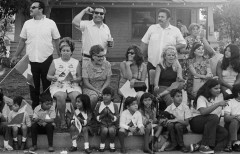
    The Autry Museum in Griffith Park La Raza, the influential bilingual newspaper published in Los Angeles from 1967-1977, provided a voice to the Chicano Rights Movement.

    La Raza engaged photographers not only as journalists but also as artists and activists to capture the definitive moments, key players, and signs and symbols of Chicano activism.

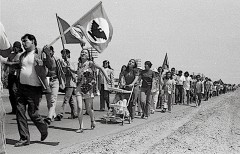
    Cesar Chavez, United Farm Workers (W)
    The archive of nearly 25,000 images created by these photographers, now housed at the Chicano Studies Research Center at UCLA, provides the foundation for an exhibition exploring photography’s role in articulating the social and political concerns of the Chicano Movement during a pivotal time in the art and history of the United States.

    LA RAZA will be the most sustained examination to date of both the photography and the alternative press of the Chicano Movement, positioning photography not only as an artistic medium but also as a powerful tool of social activism.
     
    Pacific Standard Time: LA/LA is now at The Autry in Griffith Park, part of LA RAZA
    .
    LA RAZA is part of Pacific Standard Time: LA/LA, a far-reaching and ambitious exploration of Latin American and Latino art in dialogue with Los Angeles, taking place from September 2017 through January 2018 at more than 70 cultural institutions across Southern California.

    Pacific Standard Time is an initiative of The Getty. The presenting sponsor is Bank of America. For more information, visit the Pacific Standard Time website.
    "We are all immigrants" [so don't call us immigrants, and no person is illegal] (SCPR)
    .
    In Spanish (en espanol)
    Zoot Suits: Cops take Chicanos to court, 1945
    La Raza, el periódico bilingüe de gran influencia publicado en Los Ángeles de 1967 a 1977, dio voz al Movimiento Chicano que luchaba por los derechos de los chicanos y chicanas de esa época. Los fotógrafos que participaron en La Raza no solo trabajaron como periodistas, pero también como artistas y activistas... More
     
    Related to this exhibition
    Dolores [Huerta]: Rebel. Chicana. Activist. Feminist. Mother (fandango.com)