Showing posts with label Budai. Show all posts

Thursday, July 10, 2025

Mindfulness of Eating (meditation)

This is regular eating, mindless and full of craving (for dopamine). How is it done mindfully?

I don't want to look fat (muffin topping) in a bikini at the pool party (collegepill.com)


Budai, the Fat Happy Bodhisattva
What is the FAT founder of world's third largest religion (when the 1 billion uncounted Buddhists in communist, and therefore officially atheist, Buddhists are counted) in the world going to teach us about being fit? The fact is the popular depiction of "Fat Happy Buddha" is not the historical Buddha Shakyamuni (born Prince Siddhartha Gautama) but rather a monk (now elevated to bodhisattva) named Budai (also Putai, Hotei), a Chinese monk with a big sack of candy for children, a luck-bringing jolly fellow very reminiscent of the West's Santa Claus.


Fat on a slippery wet diving board
ABOUT: Dr. Jon Kabat-Zinn, PhD, is professor of medicine emeritus at the University of Massachusetts Medical School and the founder and director of its renowned Mindfulness-Based Stress Reduction (MBSR) Clinic. His clinic was featured in 1993 in the public television series Healing and the Mind with Bill Moyers. Jon Kabat-Zinn is the author of 15 books, in print in over 45 languages. These include Full Catastrophe Living; Wherever You Go, There You Are; Coming to Our Senses; and Mindfulness for Beginners.

Tuesday, December 24, 2024

Why is Santa Buddha (Budai) so fat?


Hotei/Budai is not Buddhist but Shinto
"The Legend of Hotei, the Laughing Buddha" (holymtn.com) edited by Wisdom Quarterly

Hotei (Budai) is a Shinto god
Japanese Hotei (known in Chinese as Budai) is one of the Shichi Fukujin, or "Seven Shinto-Gods of Luck." He is the "god of happiness, laughter, and the wisdom of contentment" and the patron of the weak and of children, fortunetellers, and bartenders.
  • The term "Shinto" derives from the combination of two Chinese characters -- shin (神), which means "spirit" (kami, supernatural entities, possibly heavenly ETs coming to this dimension) or "god," and (道, tao), which means "way," "road," or "path" [45]. Shintō (神道) is therefore "the Way of the Gods" (or Spirits, the shapeshifting kami at the center of the priestly religion). It was a term already used in the I-Ching or Book of Changes, referring to the divine order of nature [46]. Around the time of the spread of Buddhism in the Han Dynasty (206 BCE–220 CE), the term was used to distinguish indigenous Chinese religions (shamanic or magic-based traditions) from the new imported religion. Ge Hong used it in his Baopuzi as a synonym for Taoism [47]. Shinto is animistic and polytheistic with priests who deal with the unruly shapeshifting monsters/gods known as the kami. The Chinese term 神道 (MC zyin daw) was originally adopted into Japanese as Jindō [48]; this was possibly first used as a Buddhist term to refer to non-Buddhist deities [49] or spirits. More
Budai points at the Moon
Hotei is distinguished by his [fat] body, which is of generous proportions with a round belly exposed beneath loose robes. This big jelly belly is a symbol of happiness, luck, and generosity.

On his back he carries a huge linen sack, containing candy, precious things, and gifts of good fortune, including children.

He also holds an uchiwa, a flat fan of Chinese origin used by ancient chieftains as an emblem of authority and wish granting.

Hotei may sit in an old cart drawn by boys, as the Wagon Priest, and can be compared with the Buddhistic Mi-lo-Fo.

Chinese backstory
I am the big Friendly One. Here's some candy!
In Chinese Buddhism he is known as Budai, the "Loving or Friendly One." He was a wandering Chan Buddhist monk who lived in the 9th century.

At his death between the years of 901 and 903, he recited a poem that revealed to the world that he was in fact the Bodhisattva Maitreya in disguise.

Maitreya, Chinese Mahayana Buddhists believe, is the Future Buddha, who will return to the world and bring innumerable individuals to realization (bodhi) and salvation (nirvana).

This concept of hope for all those who suffer, combined with Budai’s pleasing (always kind and smiling) human features, made him a most popular Buddhist deity (deva).

Good Luck Budai honored in Thailand
It was not until the 16th century that he was canonized as the sixteenth and last Chinese Bodhisattva.

According to Chinese legend he carried a sack of candy to give to children. He is sometimes worshiped as a god of good luck and prosperity.

He is always represented as very stout (fat), with breasts and upper abdomen exposed to view. His face has a widely grinning, joyful, or laughing expression, so he is also known loosely as "the Laughing Buddha" even though he is NOT a buddha.
  • [EDITOR'S NOTE: Even "Maitreya Buddha" is actually not yet a buddha as his name would suggest but rather a bodhisattva, that is, "a being striving to become a supreme buddha" (samma sam buddha) in the future.]
He stands in the first hall of Buddhist monasteries. Because of his constant good nature, he has become the symbol of philosophical contentment. Source
The Laughing Buddha Story | Joy of Enlightenment | Zen Buddhism

(Narrative Dreamscape) This short Zen story follows the tale of Hotei (Budai, Putai), a Chinese Buddhist monk who attains "enlightenment" [satori or kensho, an epiphany or spiritual realization] after hearing a child's laughter. He then wanders the land being called the "Laughing Buddha" [Bodhisattva], spreading joy and showing that enlightenment [a realization] can be found by embracing the humor and impermanence of life. This lighthearted and inspirational Zen tale reminds us not to take life too seriously but to greet each moment with childlike joy and presence. Let this [Fat Happy] Laughing Buddha story bring a smile to the face and warmth to the heart.

#zenstory #lifelessons #laughingbuddha #laughingmonk #laughingbuddha

Monday, September 23, 2024

Funky Buddha's Oktoberfest? Alcohol

Hey, where your tutu is, Desi? - Hey, where's your llama, Dolly? - AH HA HA HA!
.
Budai brand beer?
Imagine a place so crass that it exploits the Buddha's image to promote beer and hard liquor, drunkenness and carelessness, negligence and unskillful karma. Let's call the place "Buddha Bar." No, that's taken. Let's call it Funky Buddha. Open it on the dangling participle of the country (Sandy Schlong Beach, Florida).

Let's invite the Dalai Lama, who says he's all about laughing it up, and tell him to bring his freaky friends like the ghost of Archbishop Desmond Tutu. We can hold a skimpy BBC (Buddha Bikini Contest) with a large purse and a slow reveal that begins with the wet tee-shirt phase.

Yo yo yo, how we feeling out there tonight!?
DJ Buddhahed can spin the turntables with EDM and hip-hop beats pleasing to all. Fight through protesters and picketers to get in there and, BAM, we've got ourselves a party. Well, no need for imagination because a company called Funky Buddha beat us to it: funkybuddha.com with BuddhaFest MarZen

Alan Watts, Zen monks stole swigs of saké on Cloud Mountain, while their whereabouts were unknown? No, that was Taoists. And it wasn't saki, the water of life, but ambrosia.
SUTRA: To Sujata (Sigalovada)

Doesn't booze make the writer?
(DN 16) Thus I have heard. One time, the Buddha was staying on Vulture's Peak (Mount Gṛdhrakūṭa in Rājagṛha), Rajgir. He was accompanied by a large assembly of 1,250 monastics.

It was then that the Buddha (the Blessed One, the Bhagavān) put on his outer robe and took his bowl into the city for alms. At the time, there was a prominent man’s son named Sujata in Rajgir. Early in the morning, he went out of the city to go for a walk in the park. He bathed, wetting his entire body. He then bowed in all the directions: east, west, south, north, above, and below.

The Buddha saw Sujata getting wet [as a mark of respect] then bowing in the directions. Seeing this, the Buddha went over to Sujata and asked: “Why did you leave the city in the early morning to go to a park, wet your entire body, and bow in the directions?”

Sujata explained to the Buddha, “My father’s death is imminent, and he gave me this instruction: ‘When you go to bow, you should first bow to the east, south, west, north, above, and below.’ I dare not neglect to carry out my father’s instruction, so after I’ve bathed, I first saluted while facing east then bowed to the east. I do this for all the cardinal directions -- south, west, north, above, and below.”

The Buddha then told Sujata, “These 'directions' are only names. We, too, have this practice, but we do not bow to the directions to pay respect to them in this noble teaching [enlightening Dharma].”

Sujata then said to the Buddha, “Please, Blessed One, it would be good if one were to explain the way it is done in the noble Teaching!”

The Buddha said, “Listen closely, listen closely! Consider it well, for I will explain this.”

Sujata replied, “Very well. I am glad to hear it.”

DUI with loaded gun and salsa: Welcome to TX
The Buddha taught: “Suppose one knows of four unskillful actions, and the grounds for their being unskillful, so one avoids them and is able to know the six actions that squander wealth.

“That is to say, Sujata, one abandons four unskillful actions and pays homage to the six directions. It will be good for the present life, and one will obtain good results in later lives.

“It will be the source for this in the present life and later lives. In the present life, one is commended by the wise and gains this one worldly reward: When the body breaks up and life ends, one will be reborn in a good place.

“Sujata, you should know, those four bad actions are: 1. killing, 2. stealing, 3. sexual misconduct, and 4. false speech. These are the four bad actions.

“What are the four grounds for these bad actions? They are: 1. desire, 2. anger, 3. fear, and 4. delusion.

“If one does unskillful actions on these four grounds, then one will decline.”

After saying this, the Buddha restated it in verse:

“Desire, anger, fear, delusion:
Those who harbor these four
See their reputation dwindle away
As the waning moon does day by day.”

The Buddha further told Sujata, “If one avoids these unskillful actions on these four grounds, then one will improve.”

The Buddha then restated this in verse:

“One who avoids unskillful actions
Done out of desire, anger, fear, or delusion
Will see improvement day by day
As the waxing moon steady gains.”

What happened to all our money, Brian? - This.
“The Buddha further told Sujata, “The six actions that squander wealth are:
  1. indulging in alcohol
  2. gambling
  3. self-indulgence
  4. getting carried away at musical performances
  5. associating with bad friends and
  6. idleness.
“These are the six acts that squander wealth.

“Sujata, suppose one understands these four actions, avoids these unskillful actions done on these four grounds, and knows the six actions that squander wealth.

“Doing this, Sujata, one can abandon these four grounds and make offerings to the six directions. It will be good for the present life and good in later lives. It will be the source for this in the present life and in later lives. In the present, one will be praised by the wise and gain this one worldly reward: When one's body breaks up and life ends, one will be reborn in a good place.

Defects of drinking
Go on. I'm listening. I only imbibe to drink the pain away. You got a better way?
.
Wine, women, and song! Why stop now?
“Sujata, know that drinking alcohol has six defects: 1. loss of wealth, 2. becoming ill, 3. fighting, 4. circulation of a bad reputation, 5. sudden outbursts of anger, and 6. a daily loss in wisdom. Sujata, if they drink alcohol, their family and property with decrease day by day. ...

Then Sujata exclaimed: “...The Buddha is a Wayfarer (Tathāgata), Luminary (Arhat), and a Supremely Awakened One, so he is able to reveal to the world clear instructions. Now, I go for guidance to the Buddha, go for guidance to the Dharma, and go for guidance to the Saṅgha.

How will I ever be able to stop?
“Blessed One, please permit me to become a lay follower in the true Teaching! Starting today, I will avoid killing, stealing, sexual misconduct, lying, and drinking alcohol for the rest of my life.”

Having heard what the Buddha taught, Sujata rejoiced and approved of it.

Tuesday, April 23, 2024

Pink full moon Buddhist lunar observance

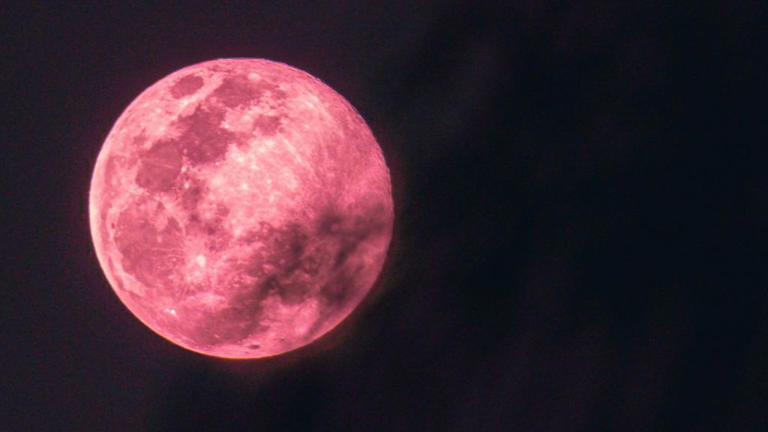
A pink full moon in the dark night sky (© InspireMore via msn.com)
.
Let’s keep our eyes on the skies tonight. We don’t want to miss the pink full moon.

According to The Old Farmer’s Almanac, we’ll be able to get the perfect view around 7:49 pm ET. That’s when “peak illumination” occurs.

As full moon peeks above the horizon, it’ll be at its brightest and most vibrant to our eyes.

Where should we go in order to get the best experience during the pink full moon? The Old Farmer’s Almanac suggests heading somewhere with a generous view of the open sky. Find a place where the horizon isn’t obscured by tall buildings or trees.

What’s in a name?

Although the pink full moon will certainly be a beautiful sight, it unfortunately isn’t actually as colorful as it sounds. It will have a rich amber tone at first, but it will fade to the usual silvery white as it rises into the night sky.

One might be wondering why it’s called a "pink moon" if it doesn’t look pink. USA Today reminds us that many of the full moon names we use today come from much older Native American traditions. These names were usually connected to what was happening in nature that month.

What to know about Tuesday night's pink moon? April happened to be the time of year when Phlox subulata, also called creeping phlox or moss phlox, started to bloom. These rosy-hued blossoms were also sometimes called “moss pink,” which is how the pink full moon earned its title.

In February, we watched the “snow moon” ascend into the sky. Last month brought the “worm moon,” whose slightly less appealing name comes from the appearance of worms in nature during early spring.
According to Space.com, next month will bring us the “flower moon.” May's full moon is so named for the many blooms we’ll see during this phase of spring.
Ready to get a good look at the pink full moon tonight? Find a prime viewing spot and keep all eyes peeled at 7:49 pm ET. Find the source of this story’s featured image here. The post Don’t Miss The Pink Full Moon Tonight! Best Times To Watch & More appeared first on InspireMore. Follow on MSN.

In Brief: The Lunar Observance Day
Bhikkhu Bodhi (trans.), Saṁkhitt-ūposatha-Sutta, Aṅguttara Nikāya, "The Book of the Eights" (AN 8.41); edited by Dhr. Seven and Crystal Q., Wisdom Quarterly

If Budai were a buddha, would he fast?
Thus have I heard. On one occasion the Blessed One (the Buddha) was dwelling at Sāvatthī in Jeta’s Grove in the millionaires (Anāthapiṇḍika)’s Park. There the Blessed One addressed the meditators:

“Meditators!”

“Venerable sir!” they replied. The Blessed One said: “Meditators, observed complete in eight factors, the lunar observance (uposatha) is of great fruit and benefit, extraordinarily brilliant and pervasive. And how is it observed complete in eight factors so that it is of great fruit and benefit, extraordinarily brilliant and pervasive?

(1) “Here [within this Doctrine and Discipline], meditators, a noble disciple reflects: ‘As long as they live the fully enlightened (arahants) abandon and abstain from the destruction of life; with the rod and weapon laid aside, conscientious and kindly, they dwell compassionate toward all living beings. Today, for this night and day I, too, shall abandon and abstain from the destruction of life; with the rod and weapon laid aside, conscientious and kindly I, too, shall dwell compassionate toward all living beings. I will imitate the fully enlightened in this respect and observe the fasting day.’ This is the first factor it possesses.

(2) “‘As long as they live the arahants abandon and abstain from taking what is not given; they take only what is given, expect only what is given, and dwell honestly without thoughts of theft. Today, for this night and day, I too shall abandon and abstain from taking what is not given; I shall accept only what is given, expect only what is given, and dwell honestly without thoughts of theft. I shall imitate the fully enlightened in this respect and observe this fasting day.’ This is the second factor it possesses.

(3) “‘As long as they live the fully enlightened abandon sexual activity and observe celibacy, living apart, abstaining from sexual intercourse, the common person’s practice. Today, for this night and day I, too, shall abandon sexual activity and observe celibacy, living apart, abstaining from sexual intercourse, the common person’s practice. I will imitate them in this respect and observe.’ This is the third factor it possesses.

(4) “‘As long as they live they abandon and abstain from false speech; they speak truth, adhere to truth; they are trustworthy and reliable, not deceivers of the world. Today, for this night and day I, too, shall abandon and abstain from false speech; I shall speak truth, adhere to truth; I shall be trustworthy and reliable, not a deceiver of the world. I will imitate them in this respect and observe.’ This is the fourth factor it possesses.

(5) “‘As long as they live they abandon and abstain from liquor, wine, and intoxicants, the basis for heedlessness. Today, for this night and day I, too, will abandon and abstain from liquor, wine, and intoxicants, the basis for heedlessness. I will imitate them in this respect and observe.’ This is the fifth factor it possesses.

(6) “‘As long as they live they eat once a day, abstaining from eating at night and from food outside the proper time. Today, for this night and day I, too, will eat once a day, abstaining from eating at night and from food outside the proper time. I will imitate them in this respect and observe.’ This is the sixth factor it possesses.

(7) “‘As long as they live they abstain from dancing, singing, instrumental music, and unsuitable shows, and from adorning and beautifying themselves by wearing garlands and applying scents and creams. Today, for this night and day I, too, shall abstain from dancing, singing, instrumental music, and unsuitable shows, and from adorning and beautifying myself by wearing garlands and applying scents and creams. I will imitate them in this respect and observe.’ This is the seventh factor it possesses.

(Dylan Sauerwein/Unsplash/InspireMore)
(8) “‘As long as they live they abandon and abstain from the use of high and luxurious beds; they lie down on a low resting place, either a small bed or a straw mat. Today, for this night and day I, too, will abandon and abstain from the use of high and luxurious beds; I will lie down on a low resting place, either a small bed or a straw mat. I will imitate them in this respect and observe this fasting day.’ This is the eighth factor it possesses.

“It is in this way, meditators, that the fasting day is observed complete in eight factors, so that it is of great fruit and benefit, extraordinarily brilliant and pervasive.”
  • Bianca Wooden, InspireMore via MSN.com, April 23, 2024; Bhikkhu Bodhi (suttacentral.org); Dhr. Seven, Crystal Q., Seth Auberon (eds.), Wisdom Quarterly

Sunday, December 24, 2023

Reason for the Season: Xmas before Christ

These customs are mirrored in Asia with Budai Bodhisattva (a rotund Buddhist monk) the "fat happy Buddha" giving small gifts or candy from a sack he carries around in his jolliness.

Christmas before Christ: Yule and other Northern European traditions
(Fortress of Lugh) Let's take a look at Slavic, Baltic, Celtic, and Germanic Yuletide (Christmastime) traditions and their similarities and origins, with a special focus on Yule, as well as the nature of Santa Claus [the magic mushroom shaman of the Sami, the Native Swedes, distributing the Amanita muscaria harvest distributed among villagers living in yurts and with chimneys being the door/entrance where the shaman would come in, give out the mushrooms which needed to be dried and so were put in stocking and hung over the fire to dehydrate].

To support the channel and get extra content, discussion, requests, and so on: fortressoflugh PayPal donations (greatly appreciated): paypal.com/donate...
  • Fortress of Lugh, 12/15/21: Pat Macpherson, Amber Larson, Dhr. Seven (eds.), Wisdom Quarterly

Wednesday, November 1, 2023

100 Years of Jokes (Reader’s Digest)

100 Funniest Jokes of All Time | Reader's Digest (rd.com); Eds., Wisdom Quarterly
"Make me one with everything," oh ho ho! Now I get it. After explain to me, now I get. Pizza!
.
Man, Lisa was really onto something.
Humor has certainly evolved over the years, yet many jokes manage to withstand the test of time.

To commemorate the 100th anniversary of Reader’s Digest, the RD team of humor-loving editors combed the archives to come up with this collection of the 100 best jokes published in the magazine since 1922.

["Two Flappers walk into a room. It’s the Roaring Twenties! So one growls and the other does the Bees Knees dance." Is it funny? Things were different back then. Who hasn't seen that Leo DiCaprio F. Scott Fitzgerald movie, The Great Gatsby?]


Woo-hoo! - Hang Ten on that board, Budai!
In fact, RD couldn’t stop itself, so readers will actually find more than 100. If a century’s worth of humor isn’t enough, there’s even more to explore in Reader’s Digest — whether tastes lean toward
And if anyone is looking for that special someone to share favorite jokes with, RD’s collection of funny pickup lines might come in handy.

Get Reader’s Digest’s Read Up newsletter for humor, cleaning, travel, tech, and fun facts all week long. More

Friday, September 22, 2023

Million-and-a-half dollar Buddha stolen in LA

Vivian Chow, Jacqueline Sarkissian, 9/22/23; CC Liu, Sheldon S. (eds.), Wisdom Quarterly

$1.5 million ancient Buddha statue stolen from Los Angeles art gallery
Budai: Kano Koi Hotei, Edo Period
(KTLA) Security cameras captured the moment an ancient Buddha statue worth US $1,500,000.00 was stolen from a Los Angeles art gallery.

The bronze sculpture was stolen on Sept. 18 from the Barakat Gallery on La Cienega Blvd. in Beverly Grove, Los Angeles, around 3:45 am, officials said.

Weighing 250 pounds, the artifact dates back to Japan’s Edo Period (1603-1867), according to gallery owners. It was believed to have been commissioned for the centerpiece of a temple.

“I prize it so much,” said Fayez Barakat, the gallery's owner. “I had it in the backyard of my home and when I moved into this gallery, I put it in the backyard of the gallery for everybody to admire and enjoy.”

Security video shows the thief pulling up to the gallery in a moving truck. The driver steps out, breaks open a driveway gate, enters the gallery, and uses a dolly to move the statue into the truck.

The entire heist took around 25 minutes, the owner said. “This gentleman came and, I think, strapped a rope or a chain around that piece and pulled it to his rental van and put it in the back,” Barakat said.

Barakat said he acquired the statue more than 55 years ago and that there is no other piece in the world quite like it.

“We have 200 objects back there, but this is our prize piece,” said Paul Henderson, the gallery’s director. “I don’t think there’s another like it on the market anywhere. It’s four feet tall, it’s hollow cast bronze, and it’s a stunning piece.

“It’s really aesthetically arresting, and it’s shocking to see something like this go missing.” Barakat believes the theft was premeditated due to the sculpture’s prominent display in the gallery’s outdoor space.

There were hundreds of other valuable items that could’ve been stolen as well, but only the Buddha statue was targeted. He believes the thief seemed to have their heart set on this specific artifact.  More

Monday, September 12, 2022

Jewish Buddhist LOVE: Zen (Shinzen Young)

Shinzen Young (YouTube); CC Liu, Pat Macpherson, Ananda (DBM) (eds.), Wisdom Quarterly

After Enlightenment? Love deeply and act effectively - Shinzen Young
What do these ten pictures represent?
(Shinzen Videos) Los Angeles JuBu Shinzen Young weaves stories of the famous Ox Herding pictures and various impressive bodhisattvas ("beings bent on supreme enlightenment") -- including a Holocaust survivor and Buddhist activist, and a "marathon monk" he has known and been influenced by, to get to the true point of this Buddhist practice.
I'm a Jewish Buddhist (JuBu).
Go to shinzen.org for more information on Shinzen Young and his teachings -- including meditation retreats, blog, speaking engagements, and writings.

Home Practice Program includes live monthly phone teachings. Life Practice Program includes live 45 minutes of Shinzen Young guiding practitioners to help their lives. 

Core Free Introduction to Unified Mindfulness recorded and edited by Stephanie Nashstrategicmindfulness.net youtube.com
This is a re-posting of a video that was added on 7/7/17, which had over 400 views in less than 20 hours, but a slight edit had to be made, and this repost is the new video.