Showing posts with label missing monks of Lhasa. Show all posts

Thursday, February 20, 2025

Day in the Life of a Tibetan monk


Tibetan prayer flags in the Himalayan breeze
Hey, what's the difference, Buddhism is Buddhism, right? No. The differences are so vast that they make one form or school nearly unrecognizable from another. There are at least three or four Buddhisms, but many more when culture is factored in. This website is partial to "orthodox" Early Buddhism, the many forms of Theravada (particularly Burmese, Sinhalese, and Thai).

But there's no denying the extreme value of the "reformed" Mahayana schools, with their mix of Hinduism, Taoism, and indigenous shamanism. One should parse what is missionary Buddhism from what practices and beliefs were present before Buddhism arrived and not confuse the Dharma (the Buddha's Teaching) with many other beliefs. The bathwater was not thrown out just because the baby arrived. There are throughlines for all forms of Buddhism no matter how far afield they travel.

Note that Theravada ("Teaching of the Elders") only represents 10% of the Buddhist experience in the world, whereas Mahayana ("Great Vehicle") is a big tent with many disparate members that would not really go together but do because everyone accepts the mainstream by default and some even prefer it.

What's the difference? Would YOU prefer a Buddhism centered on Amitabha, a "Cosmic Buddha" of Infinite Light, or a Queen of Heaven who is the Goddess of Compassion Virg Yin Guanyin -- or a lackluster tradition about an actual historical human guy named Siddhartha Gautama who mostly refuses to do magic and prefers the "miracle of instruction" over the other more flashy miracles?

We think the answer is clear. But people on this planet, by and large, will stick with whatever they were born with. Right, Catholic readers? Lol. We were Catholic, we were Christian, we were Jewish, we were atheists, we love (animistic) shamanism, and now we fancy ourselves lapsed agnostics (like Monty Python said).

So one way the Dhamma (Pali) came to be practiced was the post-Brahmin version that went north. Technically, it is a Mahayana school, but it is actually Himalayan Vajrayana (as distinct from the related Mongolian, Russian, and Siberian versions), where -yana means "vehicle." Let us take a peek at a lama's life in a form of Buddhism so influenced by Bon shamanism that it is all about ritual, black magic, and a whole lot of Hinduism by another name.

(One may ask how Tibetan Vajrayana survived and came to be so widely known. The CIA and the American Empire, at odds with the Chinese Empire, had a lot to do with that). Which Buddhism is the "right" Buddhism? Viva la difference.

Tibetan Monk: A Day in the Life of a Tibetan Buddhist Monk | Tibet Travel
Tibet Travel (Tibet Vista) What is the daily life of a Tibetan monk or lama? This is one of the most intriguing aspects when we talk about the Tibetan plateau, now a quarter of China's total territory. Learn more at tibettravel.org.

This video lets us have a glimpse of what a monk’s daily life is like in Tibet, which is shown as we followed a head monk, who lives in the Jhoden Monastery, about three hours driving east of the Tibetan (formerly imperial) capital Lhasa.

Follow-up on monk's daily life: The Daily Life of a Monk (2): Gift

He leads a fairly peaceful and simple life. His daily schedule consists of morning Buddha offering (puja), meditation (bhavana), praying for the peace and a good harvest for the villages around his monastery, and night chanting (paritta).

Buddhist monastics are living a happy and simple, but it’s not easy. They need to keep pursuing their Buddhist practices, studies, and praying for the blessings of the Goddess of Mercy Kannon (Kwan Yin, Guanyin, Avalokita).

From the early morning to the late night, see how he will enjoy the day. Hoping all will enjoy the video and let us know what you think. 

Subscribe to channel: bit.ly/2UzibQD. Website: tibettravel.org. Social media: tibettravel.org/tibetan-c.... Facebook/tibettravelorg. IG: tibettravelorg #tibet #monk #tibetanmonk #monastery #dailylife #lhasa
  • Tibet Travel (Tibet Vista), July 22, 2020; Dhr. Seven, Ananda (Dharma Buddhist Meditation), Amber Larson (eds.), Wisdom Quarterly

Thursday, September 19, 2013

Gateway to Tibet: World's highest airport

Wisdom Quarterly; AP Beijing; TheGuardian.com, Sept. 17, 2013
Potala Palace, Lhasa, Himalayas, the heart of Vajrayana Buddhism and Tibetan culture
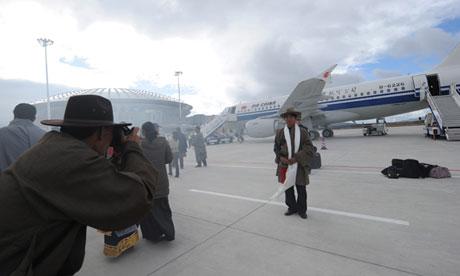
Daocheng Yading airport
Tibetans taking pictures at Daocheng Yading, part of China's plan to stabilize area (EPA).
  
Tibetan protest in Washington, D.C.
Daocheng Yading airport, 14,472ft (4,400 meters) above sea level, opens as China aims to boost tourism and clamp down on dissent. 
 
China has begun flight operations at the world's highest civilian airport in an effort to boost tourism and tighten political control over the country's restive west.
 
At such an elevation, Daocheng Yading Airport replaces the previous highest, Bangda Airport in the Tibetan Autonomous Region, which sits at 4,334 meters.
 
The (Han) People's Army of China
The region is a Gateway to Tibet, one that Beijing has sought to promote for tourism as a way of dampening dissent among the native Tibetan Buddhist population and stabilizing the area through economic development.
 
Beijing has peppered the region with little-used airports and spent $3.68bn (£2.3bn) building the world's highest rail line over permafrost to Tibet's capital, Lhasa.
 
State media said flights from Daocheng Yading Airport, which began on Monday, will slash travel time from Daocheng Yading to Sichuan's provincial capital of Chengdu from two days by bus to just 65 minutes. Other routes are due to begin by the end of the month. More

Monday, May 28, 2012

Self-immolations continue in Tibet (video)

() A rash of self-immolations by Tibetans. Chinese troops streaming into the eastern part of the Tibetan Plateau. Host Yul Kwon speaks with Prof. Robert Barnett of Colombia Univ. about unrest in Tibet and China's provocation and reaction.
  • Image: A monk reacts as he participates in a debate as part of Tibetan New Year celebrations at a temple in Langmusixiangm (Reuters/Carlos Barria).
(Global Post, May 28, 2012) Two Tibetan Buddhist monks have set themselves on fire in Lhasa [Tibet's capital], the first reported self-immolations in the capital of China's Tibet Autonomous Region.
  
US-based broadcaster Radio Free Asia said in a statement that the monks set themselves on fire on Sunday outside the Jokhang temple, a renowned center for Buddhist pilgrimage in Lhasa.
  • Jampa Yeshi runs engulfed in flames to protest Pres. Hu Jintao in New Delhi March 26, 2012 (STR/AFP/Getty Images)
The temple has been under heavy security since deadly riots broke out in 2008. The self-immolators were believed to be among Tibetan youths gathered to protest against Chinese rule outside the temple.
  
They were taken away by authorities within minutes of setting themselves on fire, according to RFA, and had reportedly died. "The security forces arrived immediately and put out the fire and all the tourists in the area were cordoned off from the site," a witness told the broadcaster.
  
"Within 15 minutes, the area was cleaned and not a trace of the incident was left." Radio Free Asia quoted a source as saying the situation in Lhasa was now "very tense" and the city was filled with police and paramilitary forces. More
  

() Tibet, a three-part documentary series charting the long overland
journey from Shanghai, China through Lhasa, Tibet to Kathmandu, Nepal.
 
 What are the Tibetans complaining about?
(, Dec. 2011)
  
What could be so bad that self-immolation starts looking like a good idea? Purportedly this is leaked footage of a crackdown by Chinese "security" forces in Tibet. It indicates that the level of repression against ethnic Tibetans is much more serious than generally acknowledged by the international community.
  
Video posted on the exile Tibetan Web site TibetOnline.tv showed a raid by a Chinese SWAT team comprised of about 100 People's Armed Police (PAP) officers on what is believed to be Unit 2 of Dode Village, near Sera Monastery northeast of Lhasa.
 
The quality footage, which is believed to have been shot in 2008, displays an unprecedented show of force by Chinese authorities using special weapons and tactics (SWAT) teams, accompanied by trained dogs and an armored vehicle. They assume an attack formation and aim assault rifles at sleeping villagers. In all, four confused-looking men and one elderly woman are taken away. Each is forced to stare into the camera and provide details to the cameraman, who is presumably a PAP.
 
Unlike previous unrest, such as the 1989 riots in Lhasa or the March 2008 incident, during which nervous and sometimes vengeful PAP officers were confronted with an emergency, the troops in this video are not responding to any immediate threat.
 
This video was taken offline and has since emerged on YouTube. The material follows the release on the citizens' journalism Boxun Web site of eight photographs showing Tibetan prisoners being paraded by a large contingent of armed police in China's Sichuan Province, from 2008 or later.
 
The two releases have led analysts to conclude that someone in China, perhaps within the security apparatus, is leaking information to show the true scale of the repression in Tibet and neighboring areas in China.
 
Reacting to the video, Dawa Tsering, chairman of the Tibet Religious Foundation of the Dalai Lama -- the de facto representative of the exiled government in Taiwan -- said that the way Chinese treat Tibetans shows them to be a conquered and colonized people.
 
"Any Tibetan with a heart will never forget this humiliation. We will not forget how arrogant the Chinese are and the humiliation we went through," he said. "We will remember this for generations to come, and this memory will constantly remind us of what we should do."
 
Former Regional Tibetan Youth Congress Taiwan President Tashi Tsering said he was not surprised by what Chinese police officers did to Tibetans. "That's how the Chinese Communist Party has always treated Tibetans," Tashi said via telephone. 
  
"The Chinese always claim they respect human rights, but what they do is different from what they say. Taiwanese should know this and be very careful when dealing with China." He called on the international community to launch a probe into human rights violations by China in Tibet.

Monday, March 21, 2011

Tibetans voting; Self-immolation protest


(WQ) The child novice (not monk) who set himself on fire protesting China's invasion and five decades of occupation and commemorating the third anniversary of the Tibetan riots was cremated on Saturday as the world continued to roil in turmoil. Suicide under any pretext is not advocated by Buddhism. But a Mahayana text may inadvertently cause people to imagine it a heroic act.

Toronto Tibetans vote for new gov't
CBC News (March 21, 2011)
Tibetan Buddhist monks and exiles are voting during the final round to choose the next exile Tibetan prime minister as well as the members of the Tibetan parliament-in-exile in Dharmsala, India. More than 1,000 Canadian-Tibetans took to the polls on yesterday in Toronto's west end to vote for a new government in exile, a move that comes only weeks after the Dalai Lama announced he is stepping down as political leader. The 76-year-old Nobel Peace laureate has said he will continue to be the Tibetan Buddhist spiritual leader but wants a new political leader to take up the Tibetans' cause. More>>

Cremation for Tibetan protester
PTI/MSN, (March 19, 2011)
BEIJING, China - A 16-year-old Tibetan Buddhist monk, who died after setting himself on fire in China during an anti-government protest coinciding with the third anniversary of the Lhasa riots, was cremated today.

Rigzin Phuntsog, a [novice following Ten Precepts, the first of which is not to kill and if one does, one immediately takes oneself out of the Buddhist monastic Order] at Kirti Monastery, set himself on fire in Aba Tibetan-Qiang Autonomous Prefecture in southwest Sichuan Province was cremated in accordance with Tibetan rituals, the official Xinhua news agency reported.

Rigzin Phuntsog was rushed to a nearby hospital after setting himself on fire. However, a group of monks from Kirti Monastery forcibly took him out and hid him inside the monastery, the report quoted officials as saying. The monks finally allowed Rigzin Phuntsog's mother to take him to hospital again, after long hours of negotiations.

The [novice, since one needs to be 20-years-old to receive full ordination as a Buddhist "monk"] died on early Thursday, the officials said."The hospital tried its best. Five or six doctors gave him emergency treatments. But it was too late since the treatment was delayed for 11 hours," the report quoted monk's father... More>>

Wednesday, March 24, 2010

Two Earthquakes jolt Tibet

Two earthquakes jolt Tibet
LHASA, Tibet - Two earthquakes measuring 5.7 and 5.5 on the Richter scale jolted the Tibetan Autonomous Region in southwest China today. The first 5.7-magnitude quake struck at around 10:06 a.m. (local time) and the second 5.5-magnitude hit 38 minutes later, both in northern Tibet’s Nyainrong County, Nagqu Prefecture. No reports of casualties or damage were immediately available. More>>

VIDEO: Two earthquakes jolt Tibet (CCTV) - Tibet Jolted By 2 Moderate Earthquakes (RTT News) - Tibet jolted by two earthquakes (Times of India) - Phayul - Global Times

Friday, July 18, 2008

Tibetans protest in Nepal; torch reaches Lhasa


Tibetans protest in Kathmandu, Nepal as Olympic torch relay reaches Lhasa, Tibet.
By Gopal Sharma
(6/21/08)
KATHMANDU (Reuters) - Hundreds of Tibetans protested outside a Chinese consular office in Nepal on Saturday, with many condemning the passage of the Olympic torch through Tibet.

"The torch relay through Lhasa is to show that Tibet is under the control of China," said Tashi Lama, 32, in Kathmandu. "If China feels that the relay of the torch through Tibet will receive support from the Tibetan people then they are wrong."

The torch procession arrived on Saturday at the Potala Palace, the traditional seat of the Dalai Lama, the head of Tibetan Buddhism.

In Kathmandu, police said they detained about 400 protesters. Many scuffled with the police before being pushed into vans. Around 20,000 exiled Tibetans live in Nepal. There have been protests nearly every day in Kathmandu since violence roiled Tibet in March.

Nepal considers Tibet to be a part of China, a key aid donor and trade partner, and does not allow any anti-Beijing activities.

Sunday, July 6, 2008

Update: Where Are the Monks of Lhasa?

July 6, 2008
-
A few days ago a Canadian journalist reported on the strange absence of Buddhist monks from the streets of Lhasa, Tibet. Now Jane McCartney of the Times of London reports that few monks remain in Lhasa's three main monasteries, Drepung, Sera and Ganden.
-
Each monastery had several hundred monks in residence before the March demonstrations, and now they are nearly empty.
-
McCartney says dozens, if not hundreds, of monks have been detained by Chinese authorities because of their suspected role in violent protests that rocked Lhasa last March before spreading to other parts of Tibet. This did not account for the empty halls of the monasteries, however.
-
Now Tibetan sources say more than 1,000 additional monks have been imprisoned or placed in detention camps. McCartney says the "detained monks are all young ethnic Tibetans from surrounding regions who had made their way to Lhasa, their spiritual capital, to study and pray in the most prestigious spiritual centres on the Roof of the World."
-
The monks were arrested because they had not registered as formal residents of the administrative region. Their families have been told they will be released after the Olympic Games are concluded. You can see recent images of Sera Monastery and its few remaining monks in Buddhism Under Guard, a photo gallery.
-
Elsewhere -- in today's New York Times, Daniel Slotnik describes a new documentary about Palden Gyatso, a Tibetan Buddhist monk who was imprisoned and brutally tortured for refusing to denounce His Holiness the Dalai Lama.
-
By Barbara O'Brien (About.com's Guide to Buddhism)
-
PHOTOS: Police officers stand on duty in front of the Norbulingka, the former summer residence of the Dalai Lama, on June 21, 2008 in Lhasa, Tibet. Chinese policemen march past the Potala Palace after the ending ceremony for the 2008 Beijing Olympic Games torch relay on June 21, 2008 in Lhasa, Tibet.