
Showing posts with label lotus. Show all posts
Showing posts with label lotus. Show all posts
Wednesday, May 20, 2026


Tuesday, April 29, 2025
Budding Lotus in the West: Feminists

Budding Lotus in the West: Buddhism from an Immigrant's Feminist Perspective

"A refreshingly frank, critical, yet ultimately loving analysis of Buddhism, challenging interpretations shaped by patriarchal views.
"This well-researched page-turner references early Buddhist texts to explore today's hot-button issues, such as abortion, gun rights, LGBTQIA+ identity, and gender equality. [Tran] weaves deeply personal experiences throughout with notable vulnerability and humor, making this book equally compelling as a memoir." — Lion's Roar
 |
| Budding Lotus in the West (p.1) |
Budding Lotus in the West follows her journey and unveils the complexities of Buddhist teachings woven into American fabric. With raw authenticity, Trần combines personal narratives, scholarly insights, and critical analysis to share her experiences with Buddhism and provide a fundamental understanding of key Buddhist concepts and traditions.
Examining the interplay between ancient wisdom and contemporary challenges, she invites spiritual seekers and curious minds to relate these principles to their own lived realities.
 |
| Budding Lotus in the West (p.1) |
How can Buddhist practitioners more skillfully navigate romance in their sangha (spiritual community)? Whether one is a longtime Buddhist practitioner or just beginning to explore the practice, Budding Lotus in the West offers wisdom, inspiration, and a path toward an evolving, authentic, and inclusive spirituality in the modern world. More

ABOUT THE AUTHOR.
 |
| Seattle 🌸 Cherry Blossom Sangha |
Now residing in Seattle, she cofounded the Cherry Blossom Sangha, a mindfulness community dedicated to fostering inner serenity, mutual understanding, and universal compassion.
 |
| AmeEx |
Her book, Budding Lotus in the West, reflects these experiences, focusing on gender equality and social change. She is also a devoted patron of Tu Viện Giác Hải, a monastery in Khánh Hòa founded by her great-uncle, Venerable Thích Viên Giác.
 |
| Where's the Cherry Blossom Sangha? Map |
- Budding Lotus in the West: Buddhism from an Immigrant's Feminist Perspective | Goodreads
- Cherry Blossom Sangha: Northwest Dharma Association
- Cherry Blossom Sangha - Wake Up International
- Cherry Blossom Sangha | Seattle WA | Facebook
- Wake Up Seattle 🌸 | Third Mindfulness Training: True Love
- Miss World Vietnam 2023
- Nhi Yến Đỗ Trần (amazon.com, Oct. 1, 2024); Bio (goodreads.com); CC Liu, Amber Larson, Dhr. Seven (eds.), Wisdom Quarterly
Tuesday, April 8, 2025
'The White Lotus' a Buddhist review
 |
| SPOILER ALERT * SPOILER ALERT * SPOILER ALERT * SPOILER ALERT |
The White Lotus: A Buddhist Review
 |
| Theravada Buddhism is the overwhelmingly dominant religion in laidback Thailand |

The review continues
(Hardcore Zen) Roshi Brad Warner: The Ocean of Consciousness
PayPal: hardcorezen.info/donate Patreon: patreon.com/user?u=4874189. Write Brad Warner at bw@hardcorezen.info. Book: Letters to a Dead Friend About Zen audiobook: audible.com/pd/Letters-to... Other audiobooks: audible.com/search?keywor... Blog: hardcorezen.info
The White Lotus | Season 3

ABOUT: Max is the culture-defining entertainment service for every mood. With a variety of genres that include favorite series and movies from iconic brands and treasured franchises, it delivers irresistible stories every time. From reuniting with life-long favorites to uncovering new ones not discovered yet, there's something for every moment, every feeling, every you of all the yous because there are so many yous, don'tcha think? It’s all here. Iconic series, award-winning movies, fresh originals, and family favorites featuring the worlds of Harry Potter, the DC Universe, and HBO. Discover the best entertainment for every mood.
#WarnerBrosDiscovery #streamonmax https://streamonm.ax/3vgR69B https://streamonm.ax/4a83GYO Follow Max on YouTube: https://streamonm.ax/YouTube, Instagram: https://streamonm.ax/Instagram, TikTok: https://streamonm.ax/TikTok, Twitter: https://streamonm.ax/Twitter, Facebook: https://streamonm.ax/Facebook
- Brad Warner, Hardcore Zen, April 8, 2025; Mike White's The White Lotus (HBO, Max)' MsMojo; Eds., Wisdom Quarterly
Monday, March 24, 2025
Trump's war plans, Jon Stewart (TDS)
Team Trump accidentally texts war plans, Donald throws fit over portrait and G in White Lotus

Comedy from MikeMacRae.com when VP JD Vance calls in to TJDS
Jon Stewart on which speech is free and which will cost you in Trump’s America | The Daily Show

- Jon Stewart, The Daily Show; Jimmy Kimmel Live; The Jimmy Dore Show (TJDS); Pfc. Sandoval, Sheldon S., Ashley Wells (eds.), Wisdom Quarterly
Monday, September 30, 2024
The Heart Sutra: Emptiness, an example
The Heart Sutra: Post canonical Buddhist discourse on the profound nature of reality
(Wisdom Tellers) Sept. 27, 2024: This video explores one of Buddhism’s most profound teachings — emptiness (the impersonal nature of all things). The heart in the Heart Sutra is the heart of wisdom. Discover the essence of emptiness, wisdom, and the path to enlightenment as taught in this timeless Mahayana text, chanted the world over with few penetrating its meaning.
#HeartSutra #BuddhasWisdom #MahayanaBuddhism #Emptiness #Shunyata #Enlightenment #Prajnaparamita #BuddhistTeachings #Avalokiteshvara #SpiritualWisdom
An example to explain emptiness
 |
| What is this phenomenon? Interaction of factors |
Constituents.
What does not exist?
Anything apart from those core constituents; there is no separate existence.
All is one?
Perhaps, but what is being said is that a thing is not anything (or is no thing) apart from its constituents (mere supporting causes and conditions).
Can you please give me an example? That sounds crazy.
Yes. Go get a candleflame or envision a real candleflame burning. Now ask, Does it exist?
Of course it exists. Why wouldn't it exist?
Where is it?
It's right here, right here in front of me. Don't you envision it, too?
Yes, but what I see right here is wax, wick, oxygen, heat, and a complex process of combustion. I do not find a candle "flame" itself.
Well, all of that is the candleflame, isn't it?
Is it? There are just those five, so where is the "flame"?
What do you mean, "Where is it?" It's right here!
But here are just five things. And the "flame" is the functional integration of these five. It is not a separate thing at all. It's only an illusion arising from the interdependence of these five. When these five are exhausted or fall away, the illusion of the candle "flame" is no more. It ceases.
What ceases? The flame?
No, the illusion. When it ceases one might ask, Where did it go? Did it go up, down, sideways, north, south, inside, outside?
No, none of those apply, do they? It simply went out, out of existence. It was annihilated. Having been born and created when the candle was lit, it died and ceased to exist.
No. It never was. The illusion fell away. It, not having been, could not cease to be. There were those five, which are not the candle "flame," and now they are no more, their functional integration having ceased.
So that's it?
Oh no, it's much more personal. If this can be said of a candleflame and other things (like constituent parts), what if one were to say it of me, myself, and I?
That's madness!
Madness it may be, but it's true. What is "I" but an illusion arising from five things clung to as "self"?
What five?
Form, feeling, perception, mental formations, and consciousness.
The self has those.
No, those very things are the self, and there's no separate existence for the self apart from them, because they are the changing constituents of self. They cling to the illusion that there is a "self."
The self clings?
No, there is no self. They (the constituents) cling. Just as feelings themselves feel, and consciousness itself is conscious, so an illusion called "self" arises and is clung to, fearing that it might die and be annihilated, wishing that it could be born and last forever.
Okay.
If they are always changing, what can be said about a "permanent" self that endures from moment to moment or life to life or even enduring unchanged through one life?
It's an illusion?
Yes, it's an illusion. ALL things are empty (and illusory) in this way. Moreover, if the mind/heart can know-and-see this in a flash of clarity and insight, one can be free of clinging, free of rebirth, free of all suffering.
That's what Mahayana Buddhism believes?
No, Mahayana doesn't know what it means. That is to say, most Mahayanists do not know what it says. They imagine it means all sorts of other things, unconsciously clinging to thoughts of a self that will be eternalized and free and everlasting and luminous, all sorts of things held over from the Vedic Brahmanical and Hindu way of seeing things.
What is Mahayana?
Let's ask Asangoham to explain that.
- Wisdom Tellers (Video 1), 9/27/24; CC Liu, Dhr. Seven, Amber Larson, Bhante (eds.), Wisdom Quarterly
Saturday, September 28, 2024
Rinpoche, is karma predestined (fate)?
Is karma predestined (fate) or is it the result of freewill? ‒ Dzongsar Khyentse Rinpoche

What is Tantric Buddhism? Is it compatible with Western culture today? ‒ Dzongsar Khyentse Rinpoche
(Perfect Teacher) 上師言教 Feb. 10, 2024: #tantric #deconstruct #westernculture Buddha's Vision | New Zealand | Nov. 15, 2023: Question: What is Tantric Buddhism? Is it compatible with Western culture today? (with Chinese subtitles) #Westernculture #tantric #deconstruct
Jain-ism, Buddh-ism, Hindu-ism, there's no such thing. Abrahamic
religions (the British and West) think this way and imposed it on India
Friday, September 6, 2024
Zen refuge: Huntington Botanical Garden

 |
| Asian garden pavilion sits on a lily pond with lotus flowers as tall pines, bamboos, and plum blossoms surround it: The lovely Lotus Pavilion (Martha Benedict/The Huntington/LAist.com) |
Huntington Botanical Gardens in a new light
 |
| The Tao or "way" of Zen is [easy]. |
The Huntington Library, Art Museum, and Botanical Gardens is opening evening access to its Twilight Garden Strolls hours during the summer months so more people can enjoy the gardens in cooler temperatures. Previously, only members could get tickets to the special program.
Why the Huntington is extending hours: “Opening in the evening allows us to welcome more visitors who can enjoy green spaces and see our gardens in quite literally a different light,” said Director of Membership and Visitor Services at the Huntington Kristin Voss.
The program has been such a success for members that the Huntington is now expanding ticket access to the general public.
 |
| The cultivation of stillness, silence, absorption |
- [EDITOR SEVEN: What is "Zen"? In English it means "flow state," "effortless creativity," "artless artfulness," "unpremeditated spontaneity," "calm," "ease," but in Japanese it comes from the Chinese Chan (channa), which is an attempt to pronounce the Pali jhana (from the Sanskrit dhyana), all of which mean "meditative absorption." If meditation in English means flapping our wings to get in the air, efforting to alight off a branch in a tree on a cliff, in Buddhist terms it is the bhavana or "cultivation" of the subsequent effortless soaring. Just let go of the branch.
We make an effort (dharana) to let go, allow, let it be, accept what is, breathe being aware only of that breathing, which keeps us in the present moment, not reacting to whatever arises but merely observing, not falling into the habit of escaping to the past and dragging it into the present, not leaping into the habit of escaping into the future and dragging it into the present, staying only here and now mindful (present with) of the present, watching, and remaining watchful.
What if? - Don't do that to yourself. Be here now
It is the nonabandoning of the moment, the nondistraction from the object, the following this very moment into calm presence, unification of mind, stillness, coherence, which are ways of saying samadhi. First there was the subject (me) and the object (what was observed). Then, for a moment, they were one; that is, there was no distinction. They merged, one absorbing into the other. It was so Zen.]
Thinking is not the way. Let go. See. Allow.


.
What’s different about the gardens in the evening hours: With the shift in temperatures and lighting, the gardens take on different sights, smells, and sounds.
One can see the campus during the “golden” or “magic” hour -- a favorite time for photographers when the sun is just about to set and casts an ethereal quality on plants and flowers.
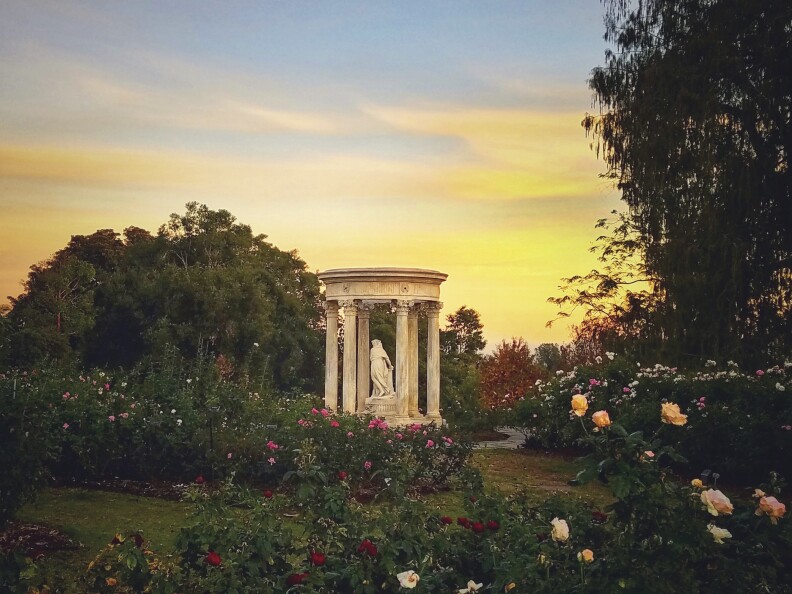 |
| Rose Garden Tempietto, Huntington Botanical Gardens (The Huntington) |
“The Desert Garden is one of my favorites,” said Voss. “There's something really lovely about the unusual shapes and colors matched with the warm tones of sunset during summer.”
How to take a tour after hours: This year, the Huntington has added Twilight Garden Estate Tours, a docent-led walk through many of the gardens and looks at some of the historic architectural features, on campus.
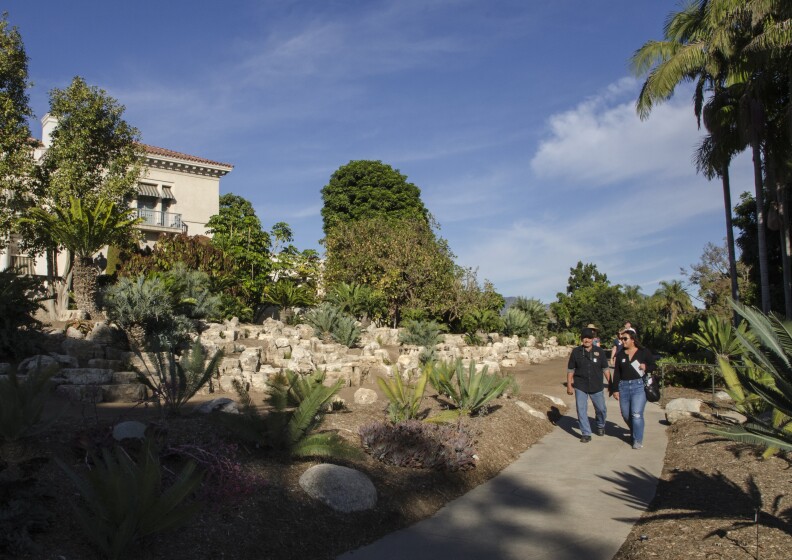 |
| Docent leads Twilight Garden Estate Tour at Huntington Botanical Gardens (The Huntington) |
.
When and how to attend: There are three Twilight Garden Strolls left scheduled for the summer, but they will return. Hours are 4:30-8:00 pm. Reserve tickets ONLINE for $20.00. Tickets to the Estate Tours cost an additional $25.00. More: LAist.com
 |
| Wise quote and Zen comic art by Roshi Brad Warner, Angel City Zen, Los Angeles (WQ) |
- Julia Paskin/LAist.com, July 21, 2024; CC Liu, Ashley Wells (eds.), Dhr. Seven (explanation of Zen), Wisdom Quarterly
Friday, September 30, 2022
The Buddha holds up a flower (Zen)
Roshi Bodhin Kjolhede | Zen Bow | Spring 2019, Vol. XLI, No. 1 via Rochester Zen Center (RZC.org); Seth Auberon, CC Liu, Dhr. Seven (eds.), Wisdom Quarterly


 |
| Philip Kapleau Roshi (hvzc.org) |
Two reasons come to mind. First, by publicly presenting those who had just seen into their nature, he hoped to boost others’ faith that they, too, could break through. Second, now that those who had glimpsed their True Self were “outed,” they would feel a greater responsibility to live up to that Self in their daily lives.
However well these strategies may have worked at Hosshin-ji, for an American Sangha I would expect them to do more harm than good. They would too likely reinforce the delusion that there is something to be “attained” in Zen. On the contrary, if awakening gives us anything, it’s the realization that from the very beginning all beings are endowed with the same originally enlightened nature....
THE BUDDHA HOLDS UP A FLOWER
Koan commentary
 |
| Art in the Rochester Zen Center (rzc.org) |
At this all were silent. Venerable Great Kashyapa (Maha Kassapa) alone broke into a smile. The World-Honored One said, “I have the all-pervading Eye of the True Dharma, the Secret Heart of Incomparable Nirvana, the True Aspect of Formless Form. It does not rely on letters and is transmitted outside the sutras. I now hand it on to Maha Kashyapa.”
The Commentary
 |
| You don't get it like I do (Demystifying Reality). |
Or again, if Kashyapa had not smiled, how could he have been entrusted with it? If you say that the True Dharma can be handed on, the golden-faced old man with his loud voice deceived the simple villagers. If you say it can’t be transmitted, why did the Buddha say he had handed it on to Kashyapa?
The Verse
Holding up a flower
The snake shows its tail.
Kashyapa smiles,
And people and devas are confounded.
About Maha Kashyapa: “Kashyapa” is the short form of Mahakashyapa. The prefix “Maha” means “great” or “large,” and here it is an honorific. With this incident of him on Vulture's Peak smiling in response to the Buddha holding up a flower, he became the first patriarch of Zen.
For the scant biographical information available on Mahakashyapa, let’s turn to The Transmission of Light (Denkoroku in Japanese), a collection of koans compiled by the Japanese Zen Master Keizan, the Dharma Heir of Dogen.
This text purports to be Zen’s ancestral line, presented in stories — enlightenment accounts — of each of the 52 or so earliest masters. It says that Kashyapa was born in an Indian Brahmin family, and his name in Sanskrit means "drinker of light."
When he was born, supposedly a golden light filled the room and went into his mouth; hence the name. We’re also told that his complexion was golden.
As a monk he was renowned for his ascetic self-discipline and moral strictness, and these qualities enabled him to assume the leadership of the Sangha after the passing of the Buddha.
It was Kashyapa who convened the First Buddhist Council in order to counteract tendencies toward a less strict lifestyle within the Sangha. He had differences of opinion with Ananda, the Buddha’s attendant, but in the end authorized Ananda as his Dharma Heir in Zen’s ancestral line.

IN THE CHINESE TEMPLES and in [the Rochester Zen Center] Buddha Hall in Rochester, the figure of Mahakashyapa stands on the Buddha’s right and Ananda on the Buddha’s left. Iconographically, Mahakashyapa is often identified by his cracked and wrinkled face, meant to show his age and his asceticism.
When Kashyapa met the Buddha, the latter said, “Welcome, mendicant” [Ehi bhikkhu or "Come, monastic"] — so by that time, apparently, Kashyapa was already wearing the patchwork robe of a monk. [The saying makes someone a monk ordained by the Buddha, so one would not need to be wearing a robe yet.]
The Denkoroku says that “Kashyapa had practiced austerities and never wasted any time.” Remember that the Buddha himself began his journey to enlightenment by first spending six years practicing severe austerities, but then gave them up when he realized they would not lead to enlightenment.
The Buddha then warned that self-punishment [penance, severe asceticism] was not the way, but Kashyapa stuck to his ways, drawing the disapproval of others in the Sangha:
“Only seeing the ugly emaciation of his body and the wretchedness of his clothing, everyone doubted Kashyapa.” Still, we’re told, “every time the Buddha was going to give a talk in someplace or other, he shared his seat with Kashyapa, who thenceforth was the senior member of the community.” More
Thursday, September 29, 2022
The Buddha holds up a flower and smiles
CC Liu, Seth Auberon (eds.), Wikipedia edit Mahākāśyapa smiles at the lotus flower

One of the Buddha's Great Disciples, Maha Kassapa (Mahākāśyapa) smiles at a lotus flower the Buddha shows instead of delivering a Dharma talk.
Chan and Zen purport to lead their adherents to insights akin to that mentioned by the Buddha in the [apocryphal] "Flower Sermon" (Chinese 拈華微笑, Pinyin Nianhua weixiao, literally, "Holding up a flower and smiling subtly") given on Vulture's Peak, Rajagriha (India), in which the Teacher held up a white flower and just admired it in his hand, without speaking.
 |
| The Buddha shows Maha Kassapa a lotus in an apocryphal Mahayana sutra (Hishida Shunso) |

.
 |
| This monk gets it. He understands. |
In East Asia, there is a Chan and Zen tradition, first recounted in the The Jingde Record of the Transmission of the Lamp (Chinese 景德傳燈錄, Pinyin Tiansheng Guangdeng-lu), which is a 1036 genealogical record about Chan Buddhism.
According to this tradition, Venerable Mahākāśyapa once received a direct "transmission" from the historical Siddhartha Gautama Buddha.
 |
| Artist Hishida Shunsō |
All the disciples just looked on without knowing how to react, but only Ven. Mahākāśyapa smiled faintly, and the Buddha picked him as one who truly understood him and was worthy to be the one receiving a special "mind-to-mind transmission" (Pinyin yixin chuanxin).
Thursday, July 7, 2022
FREE Lotus Festival, Echo Park, LA (July 9-10)
Los Angeles Parks Foundation (laparksfoundation.org); Saul, CC Liu (ed.), Wisdom Quarterly
The Lotus Festival celebrates Asian Pacific cultures with two days of FREE attractions and entertainment in scenic Echo Lake Park, near downtown LA.
 |
| 2022 Lotus Festival in Echo Park, Los Angeles Parks Foundation (laparksfoundation.org) |
.
 |
| The lotus is a Buddhist symbol of rising above |
The festivities take place in July when the great flower is in bloom. The weekend kicks off with an opening ceremony, continuing with live music, a film screening, cultural performances and more. More:
laparks.org/lotusfestival
Originally built in the 1860s as a reservoir for drinking water, today Echo Park Lake is a Los Angeles icon that functions primarily as a detention basin in the city's storm drain system, while providing recreational benefits and wildlife habitat. But it also plays host to community events, such as the annual Lotus Festival. More
Thursday, February 15, 2018
"Becoming Who I Was": Tibetan Saint Padma
Global Post (PRI.org, Feb. 15, 2018); Dhr. Seven, Ananda M., CC Liu, Wisdom Quarterly


Reincarnating as an "enlightened" being isn’t easy, especially when you’re 6-years-old


- TRAILER: "Becoming Who I Was"
- BuddhistDoor.net: Buddhist documentary Becoming Who I Was picked up for U.S. distribution after premier in Berlin
- Who was the REAL Saint Valentine?
 |
| South Korea's "PENIS PARK" draws an Olympic crowd (Reuters, Feb. 14, 2018) |


Subscribe to:
Posts (Atom)

























































