
(Natasha Yehenara) How did Buddhism reach China? Buddhism in China, Greco-Buddhism, the Buddha (Scythian Prince Siddhartha Gautama) was from Gandhara (Central Asia), modern Afghanistan (likely Buddhas of Bamiyan, Mes Aynak, and Kabul as one of the three seasonal capitals all collectively referred to as Kapilavastu). See Dr. Ranajit Pal: Non-Jonesian Indology and Alexander #academia #Buddhism #historyfacts #Gandhara #GrecoBuddhism #ChineseCulture
Showing posts with label Buddhist Councils. Show all posts
Showing posts with label Buddhist Councils. Show all posts
Friday, May 1, 2026


Friday, July 4, 2025
Sunday, April 14, 2024
The "Coachella Sutra" (The Hill Festival)

 |
| This'll is the best weekend of our lives, right? |
Getting high, one can distract and delude oneself that one is being "spiritual," or that one's friends are on the right track and on the verge of a breakthrough in insight or understanding. But continued asinine behavior when they return to the suburbs and the big city proves that was just a "pipe dream," of the sort for which Alice in Wonderland was famous.
One parties, one explores hedonism with great zeal, one claims to be a "seeker," an atheist or agnostic, but something eats away at one, and it can't just be what parents and society inculcated.
Humans have an innate drive to make sense of things: Who am I? What am I? What is my purpose? WTF is the meaning of it all? Inquiring minds want to know.
 |
| Another year, another giant West Coast Woodstock festival |
As members of The Empire, we have a far better chance of figuring things out than the victims of our American imperialism and its hegemony. It, therefore, behooves us to speak out, to protest, to speak truth to power, to stand up for the powerless, to point out our own U.S. hypocrisy and not just comfort ourselves at others' expense. That reminds us to say, the emperor has no clothes. He's totally naked and no one has said anything about it. The nominal left (our side) is little better than the nominal right (their side). We prefer Purple in the Red vs. Blue, Bloods vs. Crips Battle that is our sorry excuse for a political system. We oppose the wars of our endless war economy. ("Fight war, not wars.")
 |
| What d'you like most? The beat, the beat, the beat |
We're on a quest. Who else was on an ancient quest? Two friends who became the Buddha's chief male disciples foremost in wisdom and psychic powers, respectively. This "sutra," more a portion of their life stories than a discourse, speaks of what happened when two young guys and all their friends went to ancient multiday music festival to see performers, enjoy art, meet new people, date, eat, and above all be entertained!
Nevertheless, what in the Avici does Coachella have to do with Buddhism?
 |
| What if we could go back to the Hill Festival? |
I came to the royal city of Rajgir, thinking this ancient citadel more important than world-famous "Enlightenment Grove" (Bodh Gaya, Bihar) because so many things had happened here. Not the least of which, this is the site of Vulture's Peak and Pipphali Cave and even the Squirrel's Feeding Ground at Bamboo Grove (Veluvana). It's unclear that this is the exact location of the squirrels, but there is a large pond (tank).
I stayed at a monastery run by an Asian Buddhist monk (Japanese, Korean, it's unclear), who seemed devoid of any spiritual motivations and was just running a hostel in the pre-season. It was nice except for the noise. What was that noise? Day and night, I could not sleep. Finally, upset and wanting to get to the bottom of it, I set out in the direction of the racket. Imagine my surprise that the 24-hour disturbance was The Hill Festival!
It still happens. I was offered a couch, but I recoiled. Who would waste time on such worldly distractions in the most spiritual place on the face of the planet? There really are seven big hills ringing this ancient capital on the Gangetic plains.

 |
| View of Vulture's Peak, looking away from Rajgir's city gates |
 |
| Vulture's peak platform looking at Isigili Hill |
There's a gondola to a peak where a Japanese Buddhist temple sits. This was off season, so there were no crowds. But one could see where the crowds must be. There's another Japanese temple with "Zen" drawings of the great disciples down in the valley by the river (which has leeches).
 |
| Sacred Buddhist pilgrimage sites in Rajgir, India |
 |
| Jainism's Mahavira naked and set in stone |
Showing up at the Hill Festival is not so different than taking a trip to Coachella, which was originally billed as a "Woodstock" for California.
 |
| Mara is a god of sensuality, a reckless Tempter. |
Coachella is seductive. Coachella is an ordeal. Coachella is a vacuum that often sucks: walking around on lawns (polo grounds) and dirt in the heat, dust blowing, a mad crush all around the stage, a dusty, sweaty, unruly mosh pit and, worst of all, an early curfew. It's an expensive disappointment, but the people-watching and all the circus tents with different shows going on, providing little darkness for midday EDM in the desert. It's a mixed bag, and it's overkill.
That time at the ancient art and music festival
Hellmuth Hecker and Ven. Nyanaponika Thera, edited and updated by Wisdom Quarterly
 |
| Those old legends and folk comedies will make great fodder for art festival entertainments. |
.
 |
| Great Disciples of the Buddha: Their Lives |
Their places within their rich and privileged families were different. Kolita was an only child, but Upatissa had three brothers and three sisters.
For both, their friendship meant so much that it filled their daily lives. It filled it to such an extent that as young males, they had little interest in girls compared to other boys. They were not quite free from the indulgences of their youthful age and its lightheartedness.
Each led a group of friends with whom they undertook many kinds of sport and play in high spirits.
 |
| Lifestyles of the rich and famous Brahmins |
It was similar with Francis of Assisi (the future San Francisco): He, too, had been the leader of a group of playboys, and like him, both friends, too, had been enamored by the intoxications of youth, health and life.
.jpg) |
| "Buddhism" was created in a cave: First Council |
In Rajagaha (now Rajgir, India, a royal city encircled by seven hills where "Buddhism" was born with the First Council), the capital of the ancient Kingdom of Magadha, there was a great festival with popular entertainments and amusements called "the Hill Festival."
Partying for days at the Hill Festival


.
 |
| Dance like there's no tomorrow because one day... |
They enjoyed the entertainments so much, they returned for a second day. They were keen to watch the dramatic performances, a mixture of folk comedies and great legends. However, attend as much as they did, the heightening of their mood that they expected failed to come.
 |
| Kolita (Ven. Maha Moggallana) had very dark skin |
Suffering insomnia, Kolita thought: "What's the use of all this for us? Is any of this really worthwhile? What benefit does it give? After a few years, these glamorous performers will be old, frail, and feeble; they will leave the stage of life and carry on their wanderings through samsara existence after existence, driven by their cravings. It's the same with us. These actors cannot help themselves to solve the problem of existence. How, then, can they help us? We're just wasting our time here instead of working out our spiritual liberation!"
Upatissa also had a restless night, and similar thoughts occurred to him. He reflected on how the ancient legends and myths dramatized in these performances actually concerned the reality of rebirth. The jokes and frolicking that overlay the ideas in the plays pretended that there was only this present life one needed be concerned with. Was this not an artificial suppression and habitual repression of the truth with vain illusions?
When, on the morning of the third day, they got to the festival, Kolita asked his friend Upatissa, "What's the matter with you? You are not as merry as you have been. What depresses you?"
His friend Upatissa replied, "Tell me, what is the use to us of all these pleasures of eye and ear? It is absolutely useless and worthless! I would rather seek a way to escape from the devastating law of impermanence, a way to find liberation from the fleeting illusions of life that are alluringly and haunting and just leave us empty. That is what went through my mind and made me think.
 |
| Hey, c'mon, why don't you enjoy the party? |
Kolita replied: "I have felt the same as you. Why should we stay any longer in this vanity show? We ought to seek a way to real freedom!"
When Upatissa heard his friend had the same wish, he happily exclaimed: "That is a good thought that came to us independent from one another! We've wasted our lives and time long enough with all these unprofitable things. But if one earnestly seeks a teaching of freedom, one has to give up one's home and possessions and go forth into the left-home life as a seeker, free of worldly and sensual bonds, rising above them like a feathered bird."
- What got into them as they grew disillusioned and dispassionate towards these frivolous sensual pursuits? A "sense of urgency" called samvega
The two friends decided to adopt the life of yogis and wandering ascetics who at that time, like now, wander in large numbers along the roads of Asia in search of a spiritual teacher, a guru or guide, who can show them the path to freedom.
When they announced their decision to their friends, the other young men were so impressed that most of them joined in this spiritual quest. All of them gave up home life, removed the sacred Brahmin's thread, cut their hair and beard and put on the pale earth-colored garments of religious wanderers. Discarding all distinguishing marks and privileges of their caste, they entered the classless society of ascetics. More: The Life of Maha-Moggallana
From birth to attainment of enlightenment
 |
| Ven. Sariputta became "foremost in wisdom" |
The story begins at two ancient Brahmin villages in Magadha, near Rajagaha, where Upatissa and Kolita were born. Before the Buddha appeared in the world, a wealthy Brahmin lady named Sari, living in Upatissa Village [1] conceived. On the same day, in Kolita Village, another rich Brahmin lady named Moggalli did, too.
The two families were connected, friends with one another for seven generations. From the first day of their pregnancies, the families gave due care to the mothers-to-be. After ten [lunar] months, the women gave birth to boys on the very same day.
On the name-giving day, Sari's son (Sari-putta or -putra meaning "Sari's son") received the name Upatissa, as he was a son of the foremost family of the village. For the same reason, Moggalli's son (Moggallana) was named Kolita.
When the boys grew up, they were educated and mastered their lessons. Each had a large following of Brahmin youths. And when they went to a park or to the river for sports and recreation, Upatissa used to be carried their on fancy palanquins (vehicles), whereas Kolita arrived on horse-drawn carriages.
One day Rajagaha was having its annual Hilltop Festival [an ancient version of the Coachella Festival]. Entrance was arranged for the youths who sat together with all their friends.
When there was something funny, they laughed. When the spectacles were exciting, they became excited. They liked it so much that they paid the fees for extra shows.
In this way they enjoyed the festival for a second day. But by the third day, their understanding was awakened, and they could no longer laugh nor get very excited. They didn't feel inclined to pay for extra shows as they had at the beginning of the festival.
 |
| They will be my chief male disciples. |
With such thoughts in mind, they took their seats at the festival. Then Kolita said to Upatissa: "How are you doing, friend Upatissa? You seem not as happy and joyous as on previous days. Your mood seems discontented. What's on your mind?"
"Friend Kolita, to look at these things here is of no benefit at all. Watching this is utterly worthless! I ought to seek a doctrine of deliverance for myself. That, Kolita, is what I was thinking seated here. But you, Kolita, seem to be discontented, too."
Kolita replied: "It is just as you have said. I feel the same way."
When he heard that his friend had the same inclination, Upatissa said: "That was a good thought of ours. For those who seek a teaching for their spiritual liberation, there is only one thing to do: leave home and become wandering ascetics. But under whom shall we live the ascetic life?" More: The Life of Sariputta (accesstoinsight.org)
%20wiki,%20sadao,%20thailand.jpg) |
| How the Buddha awakened beautiful Khema |
It would be a while before they met the Buddha. They all went and ordained under the Yogi Sañjaya, who taught them all he could. They were not satisfied with his doctrine or dhamma. They scoured the countryside, each promising the other that if he found a real enlightened teacher, he would tell the other. The story of how the Buddha's two extremely beautiful chief female disciples, Ven. Khema and Ven. Uppalavanna, is equally interesting. It was no accident that these four were chosen to help the Buddha awaken a great many hearers.
- WatchMojo.com; Hellmuth Hecker on Kolita (Ven. Maha-Moggallana) and Ven. Nyanaponika Thera (German born Siegmund Feniger) on Upatissa (Ven. Sariputta), Great Disciples of the Buddha: Their Lives, Their Works, Their Legacy (The Teachings of the Buddha) edited by Bhikhu Bodhi, via accesstoinsight.org introduced and assembled by Dhr. Seven and Amber Larson (eds.), Wisdom Quarterly
Monday, October 27, 2014
West pulling in, and out of, Afghanistan
Amber Larson, Dhr. Seven, Ashley Wells, CC Liu, Laila Re, Wisdom Quarterly; Ian Thomson (theguardian.com, Feb. 2, 2014); WilliamDalrymple.uk.com; Cemml.ColoState.edu
 |
| American edition of The Return of a King: The Battle for Afghanistan, 1839-42, author William Dalrymple (R), at Asia Society, New York, Feb. 2012. (Suzanna Finley/Asia Society) |
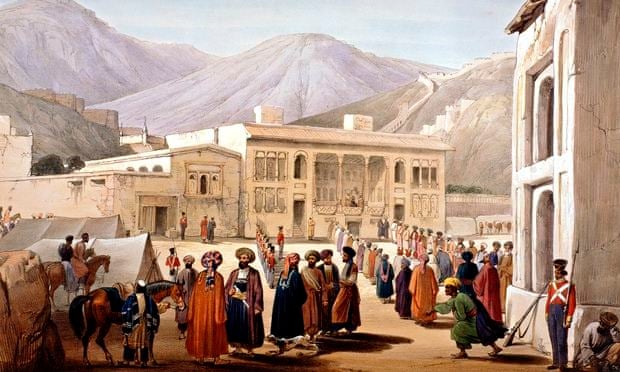 |
| Shah Shoja, puppet of the British, holds a durbar in Kabul, during the First Anglo-Afghan War (Print Collector/Getty Images/TheGuardian.com) |
.
The Return of a King (Afghanistan)
 |
| Author in Pasadena (levantinecenter.org) |
William Dalrymple's colorful history of the first British campaign in Afghanistan draws effective parallels with recent events.
[For example, the U.S. Military-Industrial Complex continues its exploits with no end in sight: the U.S. is not leaving, Pres. Karzai is, and the newly selected puppet, Pres. Ashraf Ghani (CIA-groomed and U.S.-educated economist and World Bank official missing from Afghanistan for the past 24 years, quite like Emir Shah Shujah Durrani, the British puppet installed when this entire imperial charade played out more than two centuries ago, who is currently in China cutting new business deals, likely offering to sell off Mes Aynak -- the world's most fascinating Buddhist archeological site -- as a strip mining location for even less than originally promised), has invited us to stay indefinitely, because that's how well the CIA does its job, even as the British "officially" depart this past weekend in sickly echoes of the past].
Kenneth Williams, with his nasal, camp-cockney inflections, made a very good Khasi of Kalabar in "Carry On Up the Khyber." The film, shot in 1968 in north Wales, satirized British imperial ambitions in Afghanistan and the Kingdom of Kabul (now Pakistan). Sir Sidney Ruff-Diamond and his posh cor blimey cohorts find themselves out of their depth amid tribal bloodletting and jihadi mayhem. Qur'anic [Koranic] ideals of mercy are not shown the 3rd Foot and Mouth Regiment as they move up the Khyber [Pass].
 |
| Early Buddhist art: birth of the Buddha, aka Prince Siddhartha Gautama (studyblue.com) |
William Dalrymple's history of Britain's ill-fated 1839-1842 occupation of Afghanistan has elements of "Carry On." British army deserters, spies, and drunken archaeologists rub shoulders with "hookah-smoking, pyjama-wearing" East India [Company] traders and their "dashing Rajput" warlord associates. For all the Boy's Own tone, however, Return of the King is a serious work of history.
 |
| Shakyaland = Indo-Scythia (CC) |
According to Dalrymple, the Afghans regarded their deliverance from the British in 1842 as "their Trafalgar, Waterloo, and Battle of Britain rolled into one" [examples of triumphant British battles].
The invasion, intended to thwart perceived Russian tsarist designs on the region [the Russian Empire and later USSR had extended across North Asia and down Central Asia and just needed Afghanistan to make it to the sea, surround Iran, and complete their domination of the region], was achieved without difficulty; the problem, as with subsequent invasions of Afghanistan, was getting out.
The occupying British troops encountered hostility as they went about publicly drinking and whoring [in a Muslim land where those things are usually done in secret]. The "king" of the book's title -- Shah Shuja -- was a British appointment and gratifyingly pliable [another pawn being made rich by selling out his people and being friendly to the West].
 However, his ties with the infidel [Judeo-Christian] British make him unpopular; violence erupts in Kabul [now the Afghan capital] as anti-Shuja protesters take up arms.
Throughout, Dalrymple draws "clear and relevant parallels" (as he calls them) with Afghanistan today.
In American eyes, all of Afghanistan was a target after the twin towers assault [a pretext used to launch a pre-planned war on, invasion, and indefinite occupation of Afghanistan, the toughest foreign land it has tried to rule since bombing three other Buddhist countries into submission: Vietnam, Laos, and Cambodia]: there could be no innocent people in a "guilty" nation [guilty of letting Emmanuel Goldstein/Osama bin Laden live in its caves].
 |
| Buddhism spread out from Afghanistan, India |
The US forces had intended to "liberate" Kabul from the Taliban, but Pentagon intransigence was no defense against Muslim fanaticism. In neighboring Pakistan, the Taliban created [by the CIA and OSI, Pakistan's own intelligence agency, out of Pakistani prisoners radicalized in prison and released early, deported to Afghanistan, and told to make jihad against the West, Afghans, and Buddhist history to serve as a pretext for sending in overwhelming US military force and a permanent presence, created] a climate of fear (an important weapon in their fanatic armory) and tempted young men into a useless martyr's death.
In swift-paced prose, Dalrymple chronicles Britain's first Afghan war (as it came to be known) through British, Afghan, and Russian eyes.
In swift-paced prose, Dalrymple chronicles Britain's first Afghan war (as it came to be known) through British, Afghan, and Russian eyes.
Tsar Nicolas I, it turns out, had no designs at all on Afghanistan. The British takeover, based on "doctored intelligence about a virtually non-existent threat," was begun for no wise purpose.
But it left a trail of carnage and muddled strategy in its wake. "Fakir, off!" as a character says in the "Carry On" movie. Source
 |
| Afghan Maitreya, Gandhara (AA) |
The years 200 BC to
100 AD in the Afghanistan region was a fitful and confusing period,
riven with internal conflict fed by waves of outside invasion from
Central Asian nomads [just as the Shakya clan had been centuries earlier] and the Parthian warriors from present-day Iran ["Ariyan"-land].
The result: an ever-shifting military, political, linguistic, and
cultural landscape, with multiple overlapping powers. No single tribe [clan, gotta],
dynasty, or cultural influence could hold sway beyond their immediate
neighborhood.
No less than five separate kingdoms, empires, military dynasties, and tribes battled and jostled with one another during this 300-year period to establish a buffer state or homeland in this rugged, remote region. These five overlapping powers and tribes were:
No less than five separate kingdoms, empires, military dynasties, and tribes battled and jostled with one another during this 300-year period to establish a buffer state or homeland in this rugged, remote region. These five overlapping powers and tribes were:
- The Parthian Empire
- The Indo-Greek Kingdom
- The Indo-Parthian Kingdom
- The Yuezhi Invasion and
- Indo-Scythian Rule; which was supplanted and pushed aside by The Kushan Empire. More
Azam Ahmed (irishtimes.com, Monday, Oct. 27, 2014)
 |
| Marine listening to music before invading forces withdraw from Camp Bastion, Helmand province, this weekend. The last US Marines and British combat troops have "officially" ended operations. Unofficial combat roles will continue indefinitely (Omar Sobhani/IrishTimes). |
.
Combat operations in the province of Helmand officially ended yesterday for US marines and British troops stationed there, bringing an end to a decade-long struggle to keep a major Taliban stronghold and the [Afghan] region’s vast opium production in check [or actually in highly profitable production].
Officials commemorated the handover during ceremonies at Camp Leatherneck for the Marines and Camp Bastion for the British forces, conjoined bases that made up the coalition headquarters for the region.
The Afghan Army’s 215th Corps will assume full control of the [combined] camps, a 6,500-acre parcel of desert scrubland in southwest Afghanistan -- and with it responsibility for securing one of the most violent provinces in the country.
Explaining "Afghan Buddhism"
QUESTION: "Why does Wisdom Quarterly say there's an "Afghan Buddhism" when surely all of Afghanistan is Muslim, radical Islamists, and maybe Sufi or some Pashtun tradition?
ANSWER: Good question! We speak of Afghanistan's Buddhist past, as a citadel of the Dharma at Bamiyan (where the CIA/Taliban blew up the world's biggest Buddha statues, the likely site of the original Kapilavastu, the seasonal Scythian capital of the Shakya clan and their republic or janapada, "foothold of the clan") and Mes Aynak ("Little Copper Well," the unexcavated and incompletely logged site of the world's most massive Buddhist temple/town complex, which is at least one square mile of archeological treasures threatened with destruction for the sake of Chinese mining interests) and other archeological sites both found (i.e., "Golden Hill" or Tillya Tepe) and yet to be discovered.
Afghan (not Indian or Nepalese) Treasures
The Bimaran urn is a small gold reliquary (gold and gemstone-studded container within a larger soapstone casket) for the Buddha's sacred relics that was found inside. Stupa No.2 at BIMARAN, near Jalalabad, eastern Afghanistan. When it was found by archaeologist Charles Masson during his work in Afghanistan between 1833 and 1838, the casket contained coins of the Indo-Scythian King Azes II.
But recent research by Senior indicates Azes II never existed (R.C. Senior, "The Final Nail in the Coffin of Azes II," Journal of the Oriental Numismatic Society 197, 2008, pp. 25-27) and archeological finds attributed to his reign should probably be reassigned to King Azes I. The container also had coins sometimes dated to a slightly earlier date of 50 CE, based on a redeposition theory, and sometimes much later (2nd century CE), based on artistic assumptions. It is currently in the collections of the British Museum.
The Buddhist past of Iran is completely obscured, overtaken by official Muslims, remnant Zoroastrians (one or both of which were aligned with the Titans, the Asuras, rather than the Shining Ones, the Devas, of Buddhist, Hindu, and Jain cosmology/mythology), and blended in with mystical Sufism.
One thing is sure, having asked one, the Hazaris are proud of their spiritual heritage and archeological history -- much as most U.S. citizens are proud of our Native American roots, relations, and lore. We're proud enough to protect it with anti-vandalism laws, UNESCO World Heritage and/or similar certifications, making ancient sites popular tourist attraction, like the whole of Sedona and the Grand Canyon, the National Forests and Parks, but not enough to preserve the life and active culture of those same peoples.
If anyone should wish to learn about the impossible history of faraway Afghanistan and the massively influential "Afghan Buddhism," here are just four recent links. Wisdom Quarterly: American Buddhist Journal is one of the few sites in the world to constantly pursue lines of inquiry where past politicians, historians, and archeologists put up apparent roadblocks so that the truth would never come out.
We would like to acknowledge and thank the maverick historical research and documentation of
A Scythian tribe
The Buddha was born an Afghan as it were. (There was no "Afghanistan" then but the land in Central Asia, adjacent to kingdoms one could anachronistically lump together as "India," which would not come into existence as a unified country, holding, or empire until at the earliest the life of Asoka, a brutal emperor who converted to Buddhism and united everyone. Dr. Pal suggests he was not an Indian raja (king, ruler) but from farther west like the Buddha himself). The Buddha and his extended family were foreigners in Varanasi (Benares, Kasi), Bihar (Vihar, Bodh Gaya), and Magadha (Rajgir, King Bimbisara's capital on the Gangetic plain), where Buddhism first took hold along with the territory held by his family clan.
Explaining "Afghan Buddhism"
Here are four articles that give a taste of the obscured history of Buddhism outside of any place that could be called "India." The the first images of the Buddha in human form came from Gandhara, which is now Afghanistan/Pakistan is also significant. The people of that culture were not dominated by Brahmanism, the influential religion of the Brahmins of "India" at the time of the Buddha or the stunning spiritual diversity along the Indus and Ganges rivers.
ANSWER: Good question! We speak of Afghanistan's Buddhist past, as a citadel of the Dharma at Bamiyan (where the CIA/Taliban blew up the world's biggest Buddha statues, the likely site of the original Kapilavastu, the seasonal Scythian capital of the Shakya clan and their republic or janapada, "foothold of the clan") and Mes Aynak ("Little Copper Well," the unexcavated and incompletely logged site of the world's most massive Buddhist temple/town complex, which is at least one square mile of archeological treasures threatened with destruction for the sake of Chinese mining interests) and other archeological sites both found (i.e., "Golden Hill" or Tillya Tepe) and yet to be discovered.
..........
 |
| The Buddha's urn, Bimaran casket (W/BM) |
But recent research by Senior indicates Azes II never existed (R.C. Senior, "The Final Nail in the Coffin of Azes II," Journal of the Oriental Numismatic Society 197, 2008, pp. 25-27) and archeological finds attributed to his reign should probably be reassigned to King Azes I. The container also had coins sometimes dated to a slightly earlier date of 50 CE, based on a redeposition theory, and sometimes much later (2nd century CE), based on artistic assumptions. It is currently in the collections of the British Museum.
...........
 |
| Priceless Afghan Buddhist cultural treasures cataloged by the U.S. Dept. of War/DOD (CC) |
The Buddhist past of Iran is completely obscured, overtaken by official Muslims, remnant Zoroastrians (one or both of which were aligned with the Titans, the Asuras, rather than the Shining Ones, the Devas, of Buddhist, Hindu, and Jain cosmology/mythology), and blended in with mystical Sufism.
One thing is sure, having asked one, the Hazaris are proud of their spiritual heritage and archeological history -- much as most U.S. citizens are proud of our Native American roots, relations, and lore. We're proud enough to protect it with anti-vandalism laws, UNESCO World Heritage and/or similar certifications, making ancient sites popular tourist attraction, like the whole of Sedona and the Grand Canyon, the National Forests and Parks, but not enough to preserve the life and active culture of those same peoples.
If anyone should wish to learn about the impossible history of faraway Afghanistan and the massively influential "Afghan Buddhism," here are just four recent links. Wisdom Quarterly: American Buddhist Journal is one of the few sites in the world to constantly pursue lines of inquiry where past politicians, historians, and archeologists put up apparent roadblocks so that the truth would never come out.
We would like to acknowledge and thank the maverick historical research and documentation of
- Dr. Ranajit Pal (ranajitpal.com),
- Prof. Brent E. Huffman,
- Ven. Karunananda Thero, Ph.D. (BodhiMission.com) whose degree is in Indian archeology,
- American Afghan experts Fitzgerald and Gould (invisiblehistory.com),
- Hendon M. Harris (ChineseDiscoverAmerica.com),
- G.P. Malalasekera (Dictionary of Pali Proper Names),
- the Buddhist Publication Society (BPS.lk, the second wave of Western scholars that included Bhikkhu Bodhi, Ven. Nyanaponika, Ven. Nyanatiloka, and Maurice O'Connell Walshe)
- the Pali Text Society, the first wave of European "Orientalists" who translated the ancient texts into English.
A Scythian tribe
 |
| Wondrous Buddhist treasures of Afghanistan, Indo-Scythia, Gandhara, Central Asia |
 |
| Indo-Scythian coin designs |
Explaining "Afghan Buddhism"
Here are four articles that give a taste of the obscured history of Buddhism outside of any place that could be called "India." The the first images of the Buddha in human form came from Gandhara, which is now Afghanistan/Pakistan is also significant. The people of that culture were not dominated by Brahmanism, the influential religion of the Brahmins of "India" at the time of the Buddha or the stunning spiritual diversity along the Indus and Ganges rivers.
Wisdom Quarterly reader Urizen sets the gears in motion into the most details:
But "Who Were the Shakyans?" Who was the family Prince Siddhartha left on a spiritual quest that took him east, where he became the Buddha?
It's very hard for average American in the US to understand what Afghanistan was and how) important it has been to history. American researchers Fitzgerald and Gould (InvisibleHistory.com by tells the amazing history since the British left, along with the writing of Return of the King's William Dalrymple. It is very amazing and we only know about it because of the never ending wars led by the west against it. It's so amazing what happened to the land when the Greeks came:
Prof. Brent E. Huffman (often covered by Wisdom Quarterly) is keenly interested in saving Mes Aynak or at least documenting its significance before it is razed by the Chinese with the blessing of the current Afghan regime installed by Western democracy backed by war and the threat of more war.
Saturday, April 14, 2012
The Origins of the Pali Canon
Pali Canon Online; Dharmachari Seven, Wisdom Quarterly
 Countless devas, devis, brahmas (extraterrestrial divinities), wanderers (shramans), brahmins, monks, nuns, and lay followers came to the Buddha for guidance. As a universal teacher, he welcomed and helped them all.
"Then without approving or disapproving, those words and expressions should be carefully noted and compared with the discourses and reviewed in the light of the disciplinary code. If they, on such comparison and review, are found not to conform to the discourses or the discipline, the conclusion must be:
"'Assuredly this is not the word of the Buddha; it has been wrongly understood by this monastic, and the matter is to be rejected.' But where on such comparison and review they are found to conform with the discourses or the discipline, the conclusion must be:
"'Assuredly this is the word of the Buddha; it has been rightly understood by this monastic'" (DN 16, The Buddha's Last Days, Mahāparinibbāna Sutta).
The authentic teachings of Gotama (Sanskrit, Gautama) the Buddha have been preserved, handed down, and are to be found in the Three Divisions of the Dharma (literally, "three baskets," ti = three + piṭaka = collections of scriptures). All of the Buddha's teachings, when they were originally written down on ola palm leaves, were stored in one of three baskets according to subject matter.
 The Buddha had many prominent female disciples in an apparently smaller separate but equal Bhikkhuni Order that monks later subordinated by the institution of eight additional rules (garudhammas) for women. It has been claimed that the Buddha instituted these additional rules as a condition for female ordination -- an assertion contradicted by textual evidence that modern Theravada monks either do not know or choose to ignore to keep women out. It seems these sexist rules were a later fabrication. The issue is extremely important because based on these rules some assert that no woman can now legitimately gain the higher ordination in Theravada Buddhism to be a full nun and instead at best can only hope to be a ten precept holder living as a monastic without the rights and privileges full ordination would confer. For the Dharma to survive and prosper in modern times, particularly in the West, women are absolutely needed. Anyone who stands against them based on specious, fabricated, and unvetted "rules" harms the Dharma and limits how long it will survive to help everyone. Therefore, it is an issue of the utmost importance for monks interested in preserving the tradition as well as Buddhist women in the world today.
In this way the Buddha's words were preserved accurately and were in due course passed down in the oral tradition of the day from teacher to pupil. Some of the monastics who heard the Buddha teach in person (savakas or "hearers") were arhats -- "noble ones" free of passion, ill-will, and delusion. They were therefore capable of perfectly retaining the Buddha's words. So they ensured the Buddha's teachings would be preserved faithfully for posterity.
Even those devoted monastics who had not yet attained full enlightenment but had reached the three preliminary stages and had powerful, retentive memories could also call to mind word for word what the Buddha had taught and so were worthy custodians of the Doctrine.
 There were almost always monastic companions as well as lay disciples present when the Buddha taught. Most of his teachings were to ordinary people. But since monks took it upon themselves to memorize and recite those delivered them -- not the ones delivered to the nuns or exclusively to lay people -- it now seems as if all of the sutras began, "O, monks..." This makes it seem as if the Buddha was only addressing them when he taught, or that this was the case the majority of the time. But we know that he taught almost daily, and most of the settings and circumstances are to ordinary people. This is to the detriment of women today, but it is also to the detriment of lay people and therefore Buddhism in general even as monks experience it. The most famous and significant sutra for lay people is the Sigalovada Sutta, the Advice to Laypeople," which is cobbled together imperfectly from more than one discourse. Where are those other discourses now? The monks did not retain them. With the loss of the Nuns' Order, the sutras addressed to them that they memorized and recited apparently disappeared as well. All that remains is what the monks considered important to retain, which is generally advantageous to them.
One such monastic was Ānanda, the Buddha's chosen attendant and constant companion during the last 25 years of his life. Ānanda was kind, intelligent, and gifted with a remarkable ability to remember all that he heard. Indeed, in order to accept the position, it was his express wish that the Buddha always relate to him discourses originally delivered in his absence. Although he was not yet enlightened, he deliberately committed to memory word for word all of the Buddha's sutras.
As a teacher the Buddha exhorted his monk, nun, and lay followers. The combined efforts of these gifted and devoted followers made it possible for the Doctrine and Discipline as taught by the Buddha to be preserved in its authentic state.
The Pāli threefold division of the Dharma and its allied literature exists as a result of the Buddha's discovery of the noble and liberating path of the pure Dharma. This path enables all who follow it to lead a peaceful and increasingly happy life.
Indeed, in this day and age we are fortunate to have the authentic teachings of the Buddha preserved for this and future generations through the conscientious and concerted efforts of his disciples down through the ages.
The Buddha said to his disciples that when he was no longer among them, it was essential that the Saṅgha (monastic community) should come together for the purpose of collectively reciting the Dharma, according to formal oral tradition, precisely as he had taught it.
 Buddhaghosa was the greatest ancient Buddhist compiler and commentator, author of both The Path of Purification (Vissudhimagga) and The Path of Freedom (Vimuttimagga), texts important in both Theravada and Mahayana Buddhism.
To comply with this instruction the first elders (theras, senior monastics) duly convened a council and systematically organized all of the Buddha's discourses and monastic rules then faithfully recited them word for word in concert.
The teachings contained in the threefold division (Tipitaka) is also known as the "Doctrine of the Elders" (Theravāda). These discourses number several hundred and have always been recited word for word ever since the First Buddhist Council was convened. Subsequently, more councils have been called for a number of reasons, and at every one of them the entire body of the Buddha's teaching has always been recited by the Saṅgha participants together word for word.
They are so designated because of the precedent set at the First Dharma Council, when all the Teachings were recited first by an elder, either Upali in the case of monastic rules or Ananda for other material, of the Saṅgha then chanted once again in chorus by all of the monastics -- for a long time exclusively monks -- attending the assembly.The recitation was judged to have been authentic when and only when it had been unanimously approved as accurate by all of the members of the council. What follows is a brief history of the six councils.
The Six Buddhist Councils
More

Countless devas, devis, brahmas (extraterrestrial divinities), wanderers (shramans), brahmins, monks, nuns, and lay followers came to the Buddha for guidance. As a universal teacher, he welcomed and helped them all."Suppose a monastic were to say, 'Friends, I heard and received this from the venerable one's own lips: This is the Dhamma, this is the Discipline, this is the Master's Teaching.' In that case, monastics, you should neither approve nor disapprove of those words.
"'Assuredly this is not the word of the Buddha; it has been wrongly understood by this monastic, and the matter is to be rejected.' But where on such comparison and review they are found to conform with the discourses or the discipline, the conclusion must be:
"'Assuredly this is the word of the Buddha; it has been rightly understood by this monastic'" (DN 16, The Buddha's Last Days, Mahāparinibbāna Sutta).
The authentic teachings of Gotama (Sanskrit, Gautama) the Buddha have been preserved, handed down, and are to be found in the Three Divisions of the Dharma (literally, "three baskets," ti = three + piṭaka = collections of scriptures). All of the Buddha's teachings, when they were originally written down on ola palm leaves, were stored in one of three baskets according to subject matter.
 The Buddha had many prominent female disciples in an apparently smaller separate but equal Bhikkhuni Order that monks later subordinated by the institution of eight additional rules (garudhammas) for women. It has been claimed that the Buddha instituted these additional rules as a condition for female ordination -- an assertion contradicted by textual evidence that modern Theravada monks either do not know or choose to ignore to keep women out. It seems these sexist rules were a later fabrication. The issue is extremely important because based on these rules some assert that no woman can now legitimately gain the higher ordination in Theravada Buddhism to be a full nun and instead at best can only hope to be a ten precept holder living as a monastic without the rights and privileges full ordination would confer. For the Dharma to survive and prosper in modern times, particularly in the West, women are absolutely needed. Anyone who stands against them based on specious, fabricated, and unvetted "rules" harms the Dharma and limits how long it will survive to help everyone. Therefore, it is an issue of the utmost importance for monks interested in preserving the tradition as well as Buddhist women in the world today.
- The first part is known as the Vinaya Piṭaka containing all of the rules which the Buddha laid down for monks and nuns (and novices).
- The second part is called the Suttaṅta Piṭaka containing the discourses.
- The third part is known as the Abhidhamma Piṭaka containing the psychological [as well as the particle physics] and ethical teachings of the Buddha.
In this way the Buddha's words were preserved accurately and were in due course passed down in the oral tradition of the day from teacher to pupil. Some of the monastics who heard the Buddha teach in person (savakas or "hearers") were arhats -- "noble ones" free of passion, ill-will, and delusion. They were therefore capable of perfectly retaining the Buddha's words. So they ensured the Buddha's teachings would be preserved faithfully for posterity.
Even those devoted monastics who had not yet attained full enlightenment but had reached the three preliminary stages and had powerful, retentive memories could also call to mind word for word what the Buddha had taught and so were worthy custodians of the Doctrine.
 There were almost always monastic companions as well as lay disciples present when the Buddha taught. Most of his teachings were to ordinary people. But since monks took it upon themselves to memorize and recite those delivered them -- not the ones delivered to the nuns or exclusively to lay people -- it now seems as if all of the sutras began, "O, monks..." This makes it seem as if the Buddha was only addressing them when he taught, or that this was the case the majority of the time. But we know that he taught almost daily, and most of the settings and circumstances are to ordinary people. This is to the detriment of women today, but it is also to the detriment of lay people and therefore Buddhism in general even as monks experience it. The most famous and significant sutra for lay people is the Sigalovada Sutta, the Advice to Laypeople," which is cobbled together imperfectly from more than one discourse. Where are those other discourses now? The monks did not retain them. With the loss of the Nuns' Order, the sutras addressed to them that they memorized and recited apparently disappeared as well. All that remains is what the monks considered important to retain, which is generally advantageous to them.
One such monastic was Ānanda, the Buddha's chosen attendant and constant companion during the last 25 years of his life. Ānanda was kind, intelligent, and gifted with a remarkable ability to remember all that he heard. Indeed, in order to accept the position, it was his express wish that the Buddha always relate to him discourses originally delivered in his absence. Although he was not yet enlightened, he deliberately committed to memory word for word all of the Buddha's sutras.
As a teacher the Buddha exhorted his monk, nun, and lay followers. The combined efforts of these gifted and devoted followers made it possible for the Doctrine and Discipline as taught by the Buddha to be preserved in its authentic state.
The Pāli threefold division of the Dharma and its allied literature exists as a result of the Buddha's discovery of the noble and liberating path of the pure Dharma. This path enables all who follow it to lead a peaceful and increasingly happy life.
Indeed, in this day and age we are fortunate to have the authentic teachings of the Buddha preserved for this and future generations through the conscientious and concerted efforts of his disciples down through the ages.
The Buddha said to his disciples that when he was no longer among them, it was essential that the Saṅgha (monastic community) should come together for the purpose of collectively reciting the Dharma, according to formal oral tradition, precisely as he had taught it.
 Buddhaghosa was the greatest ancient Buddhist compiler and commentator, author of both The Path of Purification (Vissudhimagga) and The Path of Freedom (Vimuttimagga), texts important in both Theravada and Mahayana Buddhism.
To comply with this instruction the first elders (theras, senior monastics) duly convened a council and systematically organized all of the Buddha's discourses and monastic rules then faithfully recited them word for word in concert.
The teachings contained in the threefold division (Tipitaka) is also known as the "Doctrine of the Elders" (Theravāda). These discourses number several hundred and have always been recited word for word ever since the First Buddhist Council was convened. Subsequently, more councils have been called for a number of reasons, and at every one of them the entire body of the Buddha's teaching has always been recited by the Saṅgha participants together word for word.
- That is, the oral tradition has continued in spite of writing because it is a more faithful form of keeping the Dharma from declining. Why? Words on a page can be altered, but no one can hope to simultaneously altered the memories of many thousands of seasoned monastics all at once. Therefore, change in the words is very slow and takes place only after deliberate debate and consideration. Councils define and settle issues that arise in the living body of the Buddhist community.
They are so designated because of the precedent set at the First Dharma Council, when all the Teachings were recited first by an elder, either Upali in the case of monastic rules or Ananda for other material, of the Saṅgha then chanted once again in chorus by all of the monastics -- for a long time exclusively monks -- attending the assembly.The recitation was judged to have been authentic when and only when it had been unanimously approved as accurate by all of the members of the council. What follows is a brief history of the six councils.
- Why was the First Council convened? It is said that Maha Kassapa called the first gathering of elder monastics in response to unskillful comments uttered by Subaddha, an unwise older man who ordained late in life and was disgruntled at there being so many rules: What all of those comments were is not certain. But according to Culavagga in Vinaya Pitaka, Maha Kassapa overheard Subaddha saying to the other monks who had just heard of the Buddha's attainment of final nirvana: “Friends…since the Buddha is dead, now there is no one to tell us what to do and what not to do. So we can do whatever we want.”
More
- Buddhist Councils (Sangayana) according to the Mahavamsa
- Extra rules for Theravada Buddhist nuns?
- VIDEO: The Buddhist nuns of California

One of the Buddha's greatest disciples is an American scholar-monk alive today. Born on the East Coast, educated on the West Coast, and a long time resident of Sri Lanka as editor of the Buddhist Publication Society, Bhikkhu Bodhi, like his eminent teachers (particularly Ananda Maitreya and Nyanaponika Thera). He has done more to preserve and promote the Pali Canon -- as editor, translator, interpreter, commentator, co-author, and promoter (organizer of ghost translators) -- than anyone alive. He is our longstanding teacher and an inspiration to this publication. Almost every Buddhist alive is familiar with his work even if the name does not sound familiar because of his translation. They have become the standards in English:


Venerable Bhikkhu Bodhi
Rev. Danny Fischer (elephantjournal.com)
Though many know him well as the Pali scholar responsible for prodigious English translations of huge pieces of the Tripitaka, Ven. Bhikkhu Bodhi has also emerged in the last few years as one of the globe’s most important and industrious Engaged Buddhist leaders. Born Jeffrey Block in Brooklyn in 1944, he was ordained in the Theravada Buddhist tradition of Sri Lanka at age 28. In 1984, he succeeded the great Ven. Nyanaponika Thera as editor of the Buddhist Publication Society. By 1988, he was named president of the organization. He would hold these positions until 2002, when he returned to the United States. More
Rev. Danny Fischer (elephantjournal.com)
Though many know him well as the Pali scholar responsible for prodigious English translations of huge pieces of the Tripitaka, Ven. Bhikkhu Bodhi has also emerged in the last few years as one of the globe’s most important and industrious Engaged Buddhist leaders. Born Jeffrey Block in Brooklyn in 1944, he was ordained in the Theravada Buddhist tradition of Sri Lanka at age 28. In 1984, he succeeded the great Ven. Nyanaponika Thera as editor of the Buddhist Publication Society. By 1988, he was named president of the organization. He would hold these positions until 2002, when he returned to the United States. More
Subscribe to:
Posts (Atom)

























































