Showing posts with label Kalmyks. Show all posts

Tuesday, January 21, 2025

Eli in Buddhist Russia, RU Machu Picchu


Traveling in Eastern Europe's only indigenously Buddhist republic...on a camel
The camels of formerly Buddhist Central Asia
(Eli from RussiaREPUBLIC OF KALMYKIA. Four hundred years ago the descendants of Mongolian Oirats (Kalmyks) migrated to Europe. They created the Kalmyk Khanate, which lasted from 1635 to 1779, in the south of the European portion of Russia's massive territory. Today they form the majority in Kalmykia, located on the Kalmyk Steppe, on the western shore of the Caspian Sea. They are the only traditionally Buddhist people located in Europe, and they herd and ride Bactrian camels. This place, cold as it feels with the windchill, has burning water springs.

Time codes
  • Elista, capital of Russian Buddhist Kalmykia
    00:00 Welcome to the only Buddhist republic in Europe!
  • 01:20 A day starts with Kalmyk/Mongolian salty tea
  • 03:15 Let's find the Mongols!
  • 05:10 Meeting the Bactrian camels
  • 07:00 Being a guest in a Mongol yurt
  • 09:50 Exploring Kalmyk steppes
  • 12:20 Throat singing
  • 14:15 A natural wonder in the steppe
  • 15:28 Heading North!
Let's go to the Buddhist temple

Southernmost republic of Russia | Makhachkala, abandoned villages, Khabib's, Machu Picchu

(Eli from Russia) Redheaded correspondent travels the length of a nation so big, it might as well be many countries called Europe 2.0Dagestan is named the "hidden gem of the Caucasus in Russia." It is also the most multinational republic in the country. Let's discover its beautiful mountain villages, canyons (deeper than the Grand Canyon, USA), and get to know the local traditions.

Time codes
  • Russian redheads blend in well in Soviet Union
    0:00 Welcome to Dagestan!
  • 1:36 Local cuisine and payment for breaking the dishes
  • 3:30 Dagestan - hidden gem of the Caucasus
  • 4:17 Makhachkala's beaches
  • 6:50 Crazy drivers?
  • 9:40 Natural beauties. The Sulak Canyon
  • 11:02 Khabib's restaurant
  • 12:56 Russian Machu Picchu - abandoned village of Gamsutl in the mountains
  • 18:09 Sary-Kum sand dune near the capital
  • 19:19 Why do Dagestanis love this region?
📌Videos from Chechnya: • The real life in Grozny | Is Chechnya...
- Real life in Grozny. Is the Chechen Republic of Russia safe for traveling? • The Chechen wedding isn't what you'd... - Visiting the Chechen wedding | Code of honor, traditions, and life of the Chechens

📌elinabakunova.com/russianclub: Russian Speaking Club where participants can practice the Russian language. Join at any level ;)

🔸What can be found on this channel? 👉🏻 Explanations of Russian culture and facts about Russia that are not found on Google 👉🏻interviews with people on the streets talking about controversial topics 👉🏻opportunities for education for international students learning Russian 👉🏻travel vlogs from the Big Country 📍

More videos: • Life in a provincial Russian town in... - Life in a provincial Russian town in the Urals | Perm • Russian culture | Habits you should a... - Russian culture | Habits you should adopt in Russia • Slavic languages | Are they similar a... - Slavic languages | Are they similar and can you learn all of them?

📸 elibakunova - on Instagram sharing more content about Russia, its cultures, traveling through, and daily life 🤍 elifromrussia - for those who feel like supporting this channel through Patreon
  • Adopted WQ Russian Correspondent Eli Bakunova ("Eli from Russia"), YouTube, Jan. 20, 2024, Nov. 26, 2021; Amber Larson and Dhr. Seven (eds.), Wisdom Quarterly

Friday, May 26, 2023

Buddhism in Russia (PHOTOS)

John Snelling (amazon.com); Dhr. Seven, Amber Larson (eds.), Wisdom Quarterly
Close up of the largest depiction of the Buddha in Russia: Buryatia (buddhistdoor.net)

It's hard to imagine how big it is on the mountainside among the Russian pines.

Moscow's "Red Square" is like a fairytale Nutcracker church-and-castle of a capital.
The Buddhistic Temple in beautiful St. Petersburg, a Russian Vajrayana Buddhist datsan

Small Buddhist pavilions around the Elista Buddhist Temple in Kalmykia

Buddhism in Russia: The Story of Agvan Dorzhiev: Lhasa's Emissary to the Tsar
Buddhism in Russia: Lhasa's Emissary to Tsar
There is Buddhism in Russia, Ukraine, Siberia, Kalmykia (Europe), Buryatia, Afghanistan and the other formerly-Buddhist stans of Central Asia below Ukraine (formerly in the USSR/the Tsar's Empire) -- and there has been for a long time. Lenin's mother was from Kalmykia, the only indigenously Buddhist part of Europe.

It is mostly of the Mongolian Vajrayana or Tibetan/Himalayan tradition, as also found in Nepal and Bhutan.

There are datsans (Buddhist university-monasteries like Rinchin Datsan from the Tibetan Gelukpa school) all over the hinterlands of North Asia.

Russian Buddhism and anti-Putin FEMEN
This paperback from January 1993 by author John Snelling (now with a foreword by Stephen Batchelor) has earned 4.8 out of 5 stars (with 4 ratings). It is available in various formats and editions.

It is a fascinating story of political and religious intrigue. Buddhism in Russia tells the story of Agvan Dorziev, a Mongolian Buddhist lama.

He was instrumental in the founding of Buddhism in Russia. It includes an update of the status of Buddhism in Russia since glasnost with photos.

Russians are stunning beauties (like Maria Sharapova) on par with Scandinavian neighbors
Russian Buddhism is very old, like the datsan or Buddhist university of Ivolga Monastery
Russian Buddhism in the great Elista Temple of Kalmykia, now part of Europe.

There are European Buddhists? Yes. Young Buddhists Convention, Berlin (Hannah Prinzler)
.
Didn't Communist Dictator Stalin destroy Russian Buddhism?
I hate those FEMEN troublemakers.
Stalin desired a "cultural revolution"[357], entailing both creation of a culture for the "masses" and wider dissemination of previously elite culture [358]. He oversaw a proliferation of schools, newspapers, and libraries, as well as advancement of literacy, science, and numeracy [359], but... The government's anti-religious campaign was re-intensified [363], with increased funding given to the League of Militant Atheists [355], so Buddhist monks, Christian priests, and Muslim imams faced persecution [351]. Many religious buildings were demolished, most notably Moscow's Cathedral of Christ the Savior, destroyed in 1931 to make way for the (never completed) Palace of the Soviets [364]. Religion retained an influence over much of the Russian population; in the 1937 census, 57% of respondents were willing to admit to being religious, indicating that the number was actually higher even after communist abuses. More

When Wisdom Quarterly visited, officially "atheist" and communist Russia was nevertheless full of Eastern Orthodox Christianity, like Moscow's Red Square, and the monastic catacombs, where a long tradition of ancient [sort of Coptic] Christianity was still being practiced, with the government banning the export of icons or depictions of a Black African Jesus and famous disciples.
Unveiling massive Russian Buddha

Sunday, April 9, 2023

The old Buddhists of Europe (video)

DW, 7/12/19; Namepedia, 5/5/15; Jen Bradford, Dhr. Seven (eds.), Wisdom Quarterly

Kalmykia is Europe's only Buddhist region
(Pal in China) May 19, 2022. Kalmykia is located in Eastern Europe in Southwest Russia. The Kalmyk nomads, a Mongol subgroup, came here about 400 years ago. They brought their Tibetan Buddhist tradition with them from East Asia. The republic was dissolved in 1943 under the reign of Russian dictator Stalin, spiritual leaders were persecuted, and Buddhist temples were destroyed. The entire Kalmyk people were deported to Siberia and only allowed to return to the region after the end of Stalinism. Since the fall of the Soviet Union in 1990, Buddhism has flourished again in Kalmykia. There are now Buddhist temples, pagodas, and religious statues, especially in the capital city of Elista.

Kalmykia: Europe's only Buddhist region | Europe to the Maxx

(DW Euromaxx) ELISTA - Welcome to Europe's only Buddhist Region, Kalmykia. Some 160,000 Buddhists live here. Kalmykia is an autonomous republic of the Russian Federation, located between the Caucasus and the Caspian Sea. For the series "Europe to The Maxx," Euromaxx reporter Hendrik Welling has made his way to the south-easternmost part of Europe. Join him on his tour to see the highest statue of Buddha in Europe, to hear the sound of overtone singing, and to learn more about the rich culture of this special place in Europe.
The grand Buddhist temple in Elista, Kalmykia, is full of European devotees.
.
What the Buddha taught is True!
There is a place at the edge of Europe, by the Caspian Sea, just before the Ural Mountains, where one can find the only Buddhist people with roots in this old continent called Europe.

The Kalmyk people
Kalmyks have been living there since the XVIIth century, after a long journey from Mongolian Djungaria, a land in Far East Siberia.

Buddhist pavilions under a bright blue sky made out of wood with ceramic roof arcing inward.
.
Kalmyk girl dressed in Russian fashion
Like all other people who have undergone an extensive journey looking for a new home, they tried to go back.

They have been chased around the steppes a few times: Kalmyks have been subjected to contrasting cultural influences and have emerged as quite original themselves.
  • PHOTO: Kalmyk girl, wearing a red dress decorated with white lace and a head bonnet, typical of the Russian fashion of that time.
Map showing where the Kalmyk region is situated in the Ural Mountains
.
From their shamanic roots, to the Tibetan [Vajrayana] Buddhism they practice, to the pressure of living under a Russian bureaucracy, to the surprise that this was once the chess capital of Europe, Kalmyk culture has felt it all.

Kalmykia is the most Eastern of European realms and the most Western of Asian cultures, uniting such strong contrasts in everyday life and reflecting its history even in names. More

Thursday, April 6, 2023

Awkwardly Zen Zooms (4/7)

Ananda (Dharma Buddhist Meditation), Seven, Jen, Pfc. Sandoval (eds.), Wisdom Quarterly; Awkwardly Z., Ari, Amber, Valorie Lewis, Sophia (Zen Zoom - Friday)
A safe place for your spiritual path - Be awkwardly you! (Awkwardly Zen | Meetup Pro)


Organizer Ari (Awkwardly Zen)
Join Awkwardly Zen for one of its Awkwardly Zen Zooms. It's an open forum where it's safe to speak openly about our spiritual journeys.

No questions are weird. No story is judged. Speak freely and support others as they wander down their path. Like Vegas, all discussions on these Zen Zooms stay on these Zen Zooms.
  • Opinions of guests are not necessarily the opinion of Awkwardly Zen. Also, we are not doctors, so we do not diagnose, cure, or recommend medical treatments.
  • One may hear about techniques that have worked for other people, but they are not intended to replace proper medical care. Always bear in mind the maxim, "You do you, Boo."
Ari on Zoom from on high in Denver, Colorado
This is a FREE event that takes place every Friday. If another time works better, please check the Meetup page to find more available times.

ZEN ZOOMS has 16 locations across the world that meet regularly to spread love and light (Awkwardly Zen).
Awkwardly Zen is a worldwide endeavor with 16 locations so far, and it's growing.
.
[*Except for NSA, NSC, CIA
, cell phone company which collects data and "gives" it to police and quasi-government alphabet agencies to skirt the law against their direct collection. The AI is watching. It's not spying; it's just domestic surveillance and the deployment of photographic comparison technology or analogous collateral obfuscatory euphemisms. That's right, go back to sleep. Your phone is spying on everything you do anyway and you're too addicted to put it down, so don't try to start complaining about it now (lol).]

Sunday, January 29, 2023

It's cold in Buddhist Siberia: Yakutia (video)

Kiun B, YouTube, Jan. 21, 2023; Amber Larson and Dhr. Seven (eds.), Wisdom Quarterly

Living alone in the wild Siberian forest for 20 years (-71°C, -96°F) Yakutia
(Kiun BSAKHA REPUBLIC, Siberia - There's Buddhist Kalmykia, and there's Yakutia. This is a story of Samuil. For the past 20 years, Samuil has chosen to live far away from civilization, together with bears and wolves, in one of the harshest environments on Earth.
Website: kiunb.com shares some personal stories of Yakutia 🥶. To buy local handmade crafts from Yakutia, order here: kiunb.com/shop📩 For business inquiries: pr.kiunb@gmail.com 😇 Support on: patreon.com/kiunb 📸 Follow on Instagram: instagram.com/kiun.b 💙 Thanks for watching. Subscribe for next videos.

Wednesday, February 17, 2016

Kalmykia (Europe): Monk's White Path (video)

Amber Larson and Dhr. Seven, Wisdom Quarterly; RT (Russia Today); NuMeditationMusic 


Buddha behind "Shamans of Siberia" (RT)
Kalmykia is a steppe region in the south of European Russia and the only European Buddhist republic. An international Buddhist festival is going to take place in a temple in the Kalmykia's capital, Elista

Scythian Buddha, Gandhara
Russian-Buddhist monks are preparing a sand mandala. It is a palace that may serve as a temporary abode for an enlightened deity. Colored marble sand is applied to the canvas through a cone-shaped tube. Follow the monks' white path on RT.

Buddhism and shamanism also thrive in Buryatia, now a colony of the Russian Empire.

The USSR tried to colonize formerly Buddhist Afghanistan below North Asia (Siberia, next to Alaska). This great frontier region, where the Buddha was born, is called Central Asia (ancient Scythia and Greco-Buddhist Bactria), the "middle country" of Eurasians between Europe from Asia.

(IH) Who were the Shakyians/Sakas? They were Scythians.

From Sakha to Magada (r-sport.ru)
Can it be a coincidence that the Scythian Prince Siddhartha (who became the Buddha) traveled east from the Republic of Shakya Land (Bamiyan, Mes Aynak, Kabul, Tepe Nereng, Afghanistan, literally, the territorial foothold of the Sakha Clan led by the Buddha's father, Tribal Chief Suddhodana, who would have headed a kind of loya jirga (see Wm. Dalrymple) as is still done today in Central Asia) to the Kingdom of Magadha (now a state in northern India) -- and the North Asian Buddhist-shamanic regions echo their names as the Sakha Republic and just to the east, the Magadan Oblast?

"Kalmykia: The Monk's White Path" (special program presented by RT)
.
Everyone is, of course, misdirected to think it was Nepal (due to deception by the early British historian Jones, as pointed out by Dr. Ranajit Pal). We do not suggest that the Buddha was from Ukraine or North Asia but that the nomadic Buddhists there named their land after the familiar places to the south in Central Asia and India on both sides of Gandhara.


(NuMeditationMusic) Two hours of hypnotic shamanic meditation music
featuring Tuvan throat-singing for chakra cleansing and mystical journeying.

Tuesday, February 16, 2016

Shamans of Alaska and Kamchatka (video)

Amber Larson, Dhr. Seven, CC Liu, Wisdom Quarterly; Isuma.tv; Awakened Indigo

Shakyamuni (Central Asian shraman from Scythia/Indo-Sakastan, modern Afghanistan) thangka with enthroned Vajrayana Buddhist/Bon lamas, Tibet (Earth-Spirit/flickr.com)
Dancing shaman holding a traditional trance-inducing drum (Hamid Sardar-Afkani)
Scene from "The Journals of Knud Rasmussen" (isuma.tv, a website dedicated to indigenous media from around the world with over 2,600 videos in more than 46 languages).
Kalmyk Buddhism: "Shaman Reality: The Other Side" (Christophe Carlier/flickr.com)

(RT) Smoking Beauties: Kamchatka, Land of Stone TorchesEigunichvan National Folklore Ensemble of Kamchatka performing at Festival du Houblon, Haguenau, France, August 18th, 2015.

Shaman masks (oakleafcontracts.com)
Eigunichvan was created by Svetlana and Serguei Beliaeva Kutynkavav. The women wear dresses with Manchu accents sewn into the skin. Through dance the youth reconnect with their history, imitating nature, celebrating life: a bear attack, whale hunt, childbirth, the beauty of the tundra, love, particularly the "gaga" dance, the sacred bird that plunges into the sea and comes back to land. These dances are like prayers expressed in symbolic codes. Dancers are dressed in coats and reindeer skins with traditional "torbosa" shoes made of sealskin. They change with the rhythm of the drums.

Animist Tanya Tagaq: Nanook of the North
Sometimes accompanied by an accordion to build a bridge between tradition and modernity. Perched on the edges of the North Pole, the Koryak communicate with unseen spirits through dance and music. Meanwhile, the sacred reindeer tirelessly seek out lichen and moss under the snow. On earth human life is difficult, but with the help of shaman guides, faithful humans are able to continue their long journey over the snow.

The shaman, like a "Bear-Man" (Almas/Sasquatch) merges with the natural world (HSA).
We cannot live here, exist here. We can only live and coexist with reindeer. The shaman-led Mongolian Duhalar people depend on reindeer like Sami of Sweden (Hamid Sardar-Afkhami)
Ayahuasca is a medicine, not a drug of abuse.
A day-long workshop at Claremont College in Southern California addressing the Jung Society of the greater LA area, was an unusual setting to instruct and enchant a group "with a rich inner life" that was not necessarily psychedelic. McKenna stretched to accommodate Jungian fans. McKenna's plant psychology scenarios meander through symbols dear to Jungians including Jung's theory regarding UFOs. Do UFOs originate as psychic projections from our own minds? Also explored are the mysteries of time, nature of language, techniques of ecstasy developed in non-Western societies to navigate invisible worlds, and the role of hallucinogenic plants. McKenna is the author of Food of the Gods, Archaic Revival, and the 9-CD set True Hallucinations, an underground classic (Sound Photosynthesis).

Wednesday, December 9, 2015

A History of Buddhism in Russia

Dr. Andrey Terentyev, St. Petersburg (BuddhistDoor.net), trans. by Tom Dykstra, Buddhist Door Global, 11-23-13, VEHICLES; Amber Larson, Dhr. Seven (eds.), Wisdom Quarterly
Kalmykia is the only indigenously Buddhist country in Europe, next to Caspian Sea.

European Buddhist temple in the Republic of Kalmykia, Europe (kalmykia.eu).

A History of Buddhism in Russia: Return to Saint Petersburg
The Dalai Lama visits.
With the start of perestroika, which heralded the reforms that ended the Soviet Union, Buddhism's renaissance and growth throughout the country began in earnest.

In 1988 and 1989, the first Buddhist communities were registered in Tuva, Kalmykia, and Leningrad.

In 1991 for the first time, the 14th Dalai Lama openly visited Moscow and Buddhist regions of the country, giving a powerful impulse to the Buddhist renaissance. His earlier visits of 1979 and 1981 were not advertised by the press.

Today more than 200 Buddhist communities are active in Russian territory.

Saint-Petersburg Temple being returned to Buddhists in 1990. From Andrey Terentyev.
St. Petersburg temple returned in 1990 (A.T.)
Besides the Tibetan Buddhism native to the Kalmyks, Buryats, and Tuvans, other branches of the Dharma are now flourishing as well: Theravada, Korean Seon, and the Japanese tradition of the Lotus Sutra.

The Tibetan tradition [Vajrayana] itself is not limited, as it was in the pre-war period, to a monopoly of the Gelug school.

By the end of the twentieth century in Russia all of the other Tibetan schools had appeared: Nyingma, Kag'iu, Sakya, and Dzogchen as taught by Namkhai Norbu Rinpoche (born 1938), which unites Buddhist and Bon [pre-Buddhist Tibetan shamanism] versions of this doctrine.
 
Tilopa reborn as Telo Rinpoche
The majority of Buddhist communities are united by a centralized organization: the old TsDUB, which was renamed The Buddhist Traditional Sangha of Russia in 1996.

Besides the Buryat communities, several organizations from the European part of the Russian Federation joined this organization.
 
Since 1991 the Union of Buddhists of Kalmykia has been active there, led by Telo Rinpoche -- that is, a lama [reborn] from the great Indian yogi Tilopa (who is currently the only rinpoche native of the Russian Federation).

Lama Chokyi Nyima Rinpoche in Moscow. From Andrey Terentyev.
Lama Chokyi Nyima Rinpoche, Moscow (A.T.)
In all three Buddhist republics the renaissance of Buddhism is seen as a sign of the strength of indigenous national non-Russiafied culture and accordingly is supported by the state.

According to the 1997 Russian Federation law on religion, "On Freedom of Conscience and Religious Associations," Buddhism is counted as one of the four "traditional religions of the Russian Federation" other than Orthodox Christianity. (Judaism and Islam are the other two).

Before 1990 the Buddhists of Russia generally had no opportunities to publish their own literature. Since 1991 the first Buddhist books began to be published, as well as a number of Buddhist journals, including:
  • Buddhism (just two issues have appeared)
  • Narthang Bulletin (renamed Buddhism of Russia in 1995)
  • Garuda
  • Mir Kag'iu (now Buddhism.ru), and others.
By 2003 approximately 50 Buddhist Internet sites were functioning; nowadays, there are many more.

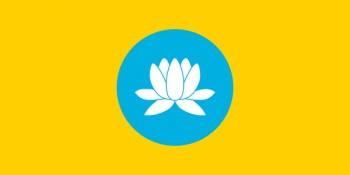
Flag of the Republic of Kalmykia. From Wikipedia.
The lotus flag of Kalmykia, the only indigenously Buddhist country in Europe.
   
Coat of arms of the Republic of Kalmykia. From Wikipedia.
Kalmykia coat of arms, Europe
The problem of Buddhist education, however, has yet to be resolved. Although in Buryatia and Kalmykia institutions of higher Buddhist education have been established, they do not have enough financial resources or teaching staff.

Resurrection of the standard twenty-year course of studies of Tibetan Buddhist education remains far in the future, and the country still suffers a severe lack of educated Buddhist clergy.

The situation will not change until the Kalmyk, Buryat, and Tuvan youths who have traveled to India to study in Tibetan monasteries return. (As a result of the Chinese takeover of Tibet in 1959, there was a mass exodus of Buddhist monks, and many of them established new monasteries in India).
 
In the meantime, in all the traditional Buddhist regions, and also in Moscow and Petersburg, the Dharma is taught primarily by Tibetan monks, some of whom live in Russia on a permanent basis, while others come especially for the purpose of preaching and conferring empowerments.
 
EDITOR’S NOTE
(Buddhistdoor.net)
The poignant story of Russia’s Buddhist nomad traditions, its spiritual republics, is ongoing. It is a living tale that is far from extinguished.

Despite the imperialism of the Russian Empire and cultural persecution by the [former] Soviet Union, Russia’s Buddhist communities have endured and kept their unique place within its borders.

This can be seen most obviously in the Republic of Kalmykia, which has been registered as an autonomous republic within the USSR and its successor, the Russian Federation, since 1958.

The editorial staff would like to thank Dr. Terentyev for his contribution and hope that this series can help to further awareness of Russia’s unique Buddhist inheritance.
REFERENCES
Bakaeva, E. Buddizm v Kalmykii. Elista, 1994
Gerasimova, K. M., et al. Lamaism v Buriatii XVIII-nachala XX v. Novosibirsk, 1983
Mongush, M. Istoriia buddizma v Tuve. Novosibirsk, 2001
Journal Buddizm Rossii (Buddhism of Russia) Nos.1-44. 1992-2012
Snelling, John. Buddhism in Russia: The Story of Agvan Dorzhiev, Lhasa's Emissary to the Tsar, Shaftesbury, Dorset, 1994
Terentyev, A. Buddizm v Rossii. Dialogos, Moscow, 1998-99. Pp. 517-541
Terentyev, A. Tibetan Buddhism in Russia. The Tibet Journal, XXI:3 (Autumn 1996):60-70
Terentyev, A. Buddhism (Greater Encyclopaedia of Russia). Vol. 1: Moscow. 2004. Pp. 239-242