Bohemian Grove is a private campground covering 2,700 acres (1,100 ha) in Monte Rio, Marin County, Northern California.
It is the site of many bizarre rituals related to the occult, capitalism, initiation of the rich, influential politicians, businessmen, and other movers and shakers behind the scenes who control the USA. There are other such gatherings, like the Bilderbergers who get more attention. But so far as anyone can tell, The Bohemian Grove is still operating covertly.
Founded in 1878, it is owned by a rich, private "gentlemen's club" called the Bohemian Club. Each year in mid-July, the Bohemian Grove hosts an annual gathering lasting more than two weeks, attended by invited members and guests from politics, business, and the arts [1, 2]. More
There is a good life, that of a nomadic hippie -- free as the wind (no savings), enjoying free love, doing whatever one wishes whenever one wishes, feeling good, dropping chemical-assistance anytime (haunted by addiction). That may have been true in the 1960s and 1970s; it is less true now. There's a superficially similar but much better life, that of wandering ascetics like the Buddha, Mahavira, and others in the sramana movement. What is the difference? Underlying motive. Both may be spiritual seekers, but only one is likely to make any progress. Why? Vice and drugs make one possible, whereas the other relies on virtue and restraint.
The word śramaṇa is pronounced /shra-ma-na/ like the English word shaman, a wandering aiming for spiritual development through simplicity, voluntary poverty (relinquishing everything), and often penances or austerities in the misguided attempt to subdue "sin" and evil and develop virtue and self-restraint. Of the many schools and teachers at the time of the Buddha that rebelled against the devotional functions of temple priests (brahmanas), only three seem to have survived to today, Buddhism, Jainism, and wandering yogi sadhus.
Trash recipes
Assortment of dumpster diving finds (wiki)
If one is going to eat "trash," and we do not recommend it, put drugs and drug paraphernalia away, put down the phone, tell pimp or madame you will call them later, and dive into a dumpster, preferably in a group with someone holding a flashlight. Panhandling is a better option, as is eating things growing naturally from trees as well as wild edible plants from the park or other public places. There are always also charitable organizations offering food. But all those sources having failed (and people will usually give food even if they refuse to give change), pick clean greens. Avoid all meat and dairy. Give everything the sniff test. Keep any food found in cool place, which should be easy in SF because it's usually cold at night. Boil over burning dumpster fire or one of those hobo oil barrels. Do not boil a shoe or old boot as that provides no nutrition and is likely to have toxic industrial products, plastics, dyes, and dioxin. Ask a John or Jane to cook or to offer food. Stand by the exit of a restaurant and ask for leavings before customers trash them. Seek public social services. Get a side job at a restaurant that doesn't mind employees eating extras. Finally, pretend you're in lockup, jail, or prison and consider all the jailhouse delicacies crafty and creative inmates dream up. By the addition of crumbled potato chips (which are full of deadly acrylamides in the best of circumstances) seems to make anything palatable. Avoid sugar (particularly high fructose corn syrup) and glutens (wheat, barley, rye, oats, and buckwheat, all of which have very harmful plant lichens that destroy the gut lining and lead to deficiencies, according to Dr. Joel Wallach).
A better way to be a nomad: wandering asceticism
The śramaṇas [a] are people who labor, toil, or exert themselves for some higher or religious [spiritual] purpose [1, 2], a "seeker, or ascetic, one who performs acts of austerity [tapas]" [3, 4, 5, 6].
Looking down on UC Berkeley and SF
The śramaṇa tradition includes primarily Jainism [7], Buddhism [8], and others such as the Ājīvika [9, 10].
The śramaṇa religions became popular in the circles of alms-gathering mendicants from greater Magadha (the adopted home of the Buddha) that led to the development of spiritual practices [11], as well as the popular concepts in all major Indian religions such as saṃsāra (the endless cycle of rebirth and suffering) and moksha (liberation from that cycle) [12, Note 1].
SF is very liberal and full of compassion
The Śramaṇic traditions have a diverse range of beliefs, ranging from accepting or denying the concept of an eternal soul, fatalism (that all things are preordained) to free will, idealization of extreme asceticism (penance) to that of family life, renunciation, strict ahimsa (non-violence), and vegetarianism to permissibility of violence and meat-eating [13, 14]. More
Los Angeles’s collapsing streets: a city in crisis as the homeless take over block by block
(Discovery Globe - Life Documentary) Aug. 2, 2025: HOA KỲ. In this urgent street documentary, let's explore the reality behind the headlines as Los Angeles homeless communities grow larger, block by block.
Glittering Hollywood: The Home of Dreams
Once known for ambition, sunshine, and opportunity, L.A. (aka Tinsel Town) is now recognized as a city in crisis, where LA's collapsing streets reflect deeper problems beneath the surface.
What was once temporary has become "structural" (systemic, a permanent problem)—an unfolding homeless crisis USA in one of America’s most iconic cities.
Captured throughout LA at night, this footage reveals a hidden world shaped by urban decay, growing encampments, and the visible homeless takeover of sidewalks, parks, and business zones.
With each passing week, more areas fall into block by block takeover, changing how the city looks, feels, and functions.
As poverty in LA surges and public service systems strain, the reality of LA's decline becomes harder to ignore. The rise of LA's tent cities in every direction—from Skid Row to Venice Beach—signals a long-brewing social collapse of California now erupting in plain sight.
These changes aren’t isolated; they form part of the broader seedy side of America, where prosperity and suffering share the same streets.
The crime in LA increases alongside the growing instability. As emergency services struggle to respond, parts of the city are left with little protection or support. In many places, urban decay LA defines the new normal, where infrastructure breaks down and basic needs go unmet.
Through real interviews and firsthand footage, we trace how the LA homeless population adapts, survives, and expands amid the chaos.
This street documentary does not seek blame—but rather seeks understanding. From the fall of LA's collapsing streets to the expanding takeover, the footage examines how long-standing economic gaps, housing shortages, and social fragmentation have fueled the homeless crisis now overtaking the West Coast’s largest metro area.
By highlighting the interconnected issues of poverty in LA (and California's second city, San Francisco), the social collapse of California, and the USA's decline, this documentary invites reflection on what the future holds—not only for LA, but for urban centers on the edge.
The images of LA at night tell a deeper story—one of resilience, desperation, and the urgent need for systemic response.
📌 Please note: Thumbnails are crafted to capture attention and spark curiosity. They are designed creatively and may not always represent the video’s full content. We appreciate understanding and hope viewers enjoy what we’ve put together. This video is intended to provide insights for educational and informational purposes only. The content draws from a variety of sources—news articles, forums, social media posts, and public commentary—and aims to present a range of perspectives. While we make every effort to ensure reliability, this is not an official or definitive source. We encourage viewers to cross-check facts, explore multiple viewpoints, and remain thoughtful and discerning when engaging with online content.
📌 This video does not aim to attack or judge any person, group, or country. Instead, our goal is to foster meaningful reflection and learn from the complexities of real-world events. #homeless #homelesscrisis #homelessness #losangeles #california
Evening twilight over Berkeley, California (Alfred Georg Sonsalla/Getty Images)
.
Beloved city has neighborhoods and Cal (UC)
What is the healthiest city in the U.S. to live in? Niche.com did its annual analysis, and a California destination came out on top.
Berkeley, California, was named the healthiest city in the USA by niche.com. The Northern California Alameda County city (just across the bay from overpriced San Francisco) enjoys an average of 256 sunny days each year and a mild Mediterranean climate, allowing residents to spend ample time outdoors.
The strangest thing about attending UC Berkeley is that no one here calls it "Berkeley." Everyone refers to it as "Cal" (or Cal Berkeley) because "Berkeley" (so often misspelled as Berkley) refers to the city, which is also sometimes called the "Republic of Berserkley" and F everywhere else because this is the best place to go to college, the greatest public university in the world since Nalanda and Timbuktu closed, rivaling the great private universities of the nation. (Wisdom Quarterly: American Buddhist Journal likely exists because Berkeley exists and, strange and counterintuitive as it may seem to outsiders, half-baked L.A. is more spiritual than Berkeley or S.F. probably because it needs to be, with so many people desperately searching for meaning in the throat chakra of the planet (thanks in large part to Hollywood film, music, radio, and TV industries). That surprised us, thinking we were going to the Shangri-La of the state where everyone would be spiritual, where the Sixties would still be alive, where San Francisco was just a BART ride away to visit Golden Gate Park and join a love in, be in, or free concert, slipping over to Haight Ashbury, but it's always so cold, and Berkeley mostly empties out for the summer when the tourists come and classes are not in session. There is KPFA.org (the founding Pacifica station even older than KPFK.org in LA, where Alan Watts got his start and where he lives on, respectively). There are so many protests on campus and in Berkeley that there is a nationwide media blackout about it. One rarely hears about all that is going on there, and every week something IS going on there. It's a nearly daily occurrence the mainstream media keeps quiet, ignores, and suppresses so that the radicalism doesn't spread as quickly to other campuses across the nation. It is the most progressive of the big schools.
In this famous scene (and song) Ben, "The Graduate" (played by a young Dustin Hoffman), is driving his red convertible to Berkeley, which is funny because he's headed the wrong direction, but that never stopped Hollywood (who needed to show him with the top down, which wouldn't look as good on the lower level that runs toward Berkeley. He's from Los Angeles and going to UC Berkeley in Berkeley to see about a girl, Elaine, which is odd because she's the daughter of Mrs. Robinson, the older married woman he's been having an affair with all summer. Had it not been for a roommate at Cal, I would never have known to see such an important film all about the wonders of legendary California.
Each year, Niche.com reveals the healthiest places in the nation, based on "a comprehensive assessment of the general health levels among residents in an area." The company considers key indicators of personal health, including smoking and excessive alcohol consumption, rates of obesity, and people's access and proximity to health care facilities, including gyms, doctors, and mental health practitioners.
And this year, Niche.com named Berkeley, California, the healthiest city in the U.S.
The Alameda County city is less than half an hour from San Francisco [depending on traffic on the Bay Bridge, it would only take 15 minutes to go between the two] and boasts 256 sunny days per year [but is nearly always cooler than one would think, just like San Francisco is chilly and foggy] and a mild Mediterranean climate.
Residents don't have to travel far to enjoy time in nature and stay active. Why? — Berkeley has over 50 parks with sports facilities, trails, and playgrounds. [There's a secret swimming lake behind the campus, up the mountain on Grizzly Trail.] Additionally, places like Muir Woods National Monument, Yosemite National Park, and Pinnacles National Park offer even more options for outdoor recreation.
In fact, the city was named the No. 1 Healthiest Place to Live in America and the No. 1 Healthiest City, really driving home the point that this is indeed a healthy place.
Berkeley also snagged an A+ rating for its schools, A+ for nightlife, and an A+ for outdoor activities, which surely helps to keep its population in tip-top shape.
The only categories it falls short in are housing, where it scored a C-, crime and safety, which also nabbed it a C-, and the cost of living, where it scored a low D+. And these grades are well reflected in the local reviews. More
Jack Kornfield, Amazon, 2001; Amber Larson and Dhr. Seven (eds.), Wisdom Quarterly
Buddhism for Beginners by Dr. Jack Kornfield is an Audible audiobook, an original recording Bay Area psychologist and successful Buddhist meditator Kornfield.
Dr. Kornfield is founder of Spirit Rock Meditation Center in Marin County, California (next to San Francisco), who also narrates.
This Sounds True publication has 4.5 stars out of 5 with 15 ratings. It was created specifically to address the questions and needs of first-time students. (It is offered FREE with Audible trial).
Here is Buddhism's vast spiritual legacy (in the early Theravada back-to-basics tradition of the Teachings or Dhamma of the historical Buddha, Siddhattha Gotama or Sakyamuni) presented by one of America's leading meditation teachers. More + audio sample
New trainees Teresa Romano, Alisa Dennis, and Gullu Singh receive blessings for the 5th Spirit Rock’s Teacher Training from Buddhist teachers Beth Sternlieb and Christiane Wolf (InsightLA.org).
Emily Horn, Celeste Young, Lisa Kring, Paloma Cain, and Vincent Horn [Buddhist Geeks] at InsightLA’s Teacher Authorization Ceremony (InsightLA.org).
.
InsightLA teachers earn Theravada authorization; others graduate from Spirit Rock’s Retreat Teacher Training Program
From Insight LA in Santa Monica comes the announcement that five of the meditation center’s teachers have become “recognized, honored, and formally authorized in the Theravada lineage.”
On Saturday May 13th, Paloma Cain, Celeste Young, Lisa Kring, Emily Horn, and Vincent Horn were formally authorized in the Theravada Buddhist lineage. Presiding over the ceremony was InsightLA’s founding teacher Trudy Goodman and her husband and InsightLA Board Member Jack Kornfield (spiritrock.org).
Kornfield represents the Theravada lineage that he handed down to Goodman years before. Together, they now pass the Dharma on to another five InsightLA teachers in this formal Teacher Authorization Ceremony.
Famous friend Ram Dass looks on as Jack Kornfield and Trudy Goodman marry (LR via SR).
Each teacher lit a small candle from the big candle on the altar and shared their teaching aspirations with the community. It was a beautiful celebration of light, love, and the blessings that cascade down the generations of teachers all the way back to the historical Buddha, Siddhartha Gautama.
Also on this day, Goodman formally recognized the graduation of three InsightLA teachers from Spirit Rock’s Retreat Teacher Training Program: Emily Horn, Beth Sternlieb, and Christiane Wolf.
They offered their encouragement and appreciation to the new trainees: Teresa Romano, Alisa Dennis, and Gullu Singh.
InsightLA is happy that the next Spirit Rock training is designed to expand the presence of teachers of color in both centers. They are proud of their graduates and trainees.Source
Wes Nisker, Anne Cushman, John Martin, Julie Wester, Tempel Smith, Erin Selover, Andrea Fella, Oren Jay Sofer, Donald Rothberg, Dana DePalma, JoAnna Hardy, Larry Yang, Anushka Fernandopulle. Phillip Moffit, Sharda Rogell, Pamela Weiss, Sally Armstrong, Heather Sundberg, John Travis (Emeritus), Kittisaro, Anna Douglas, Eugene Cash, Erin Treat, Will Kabat-Zinn, Howard Cohn, Debra Chamberlin-Taylor, James Baraz. Matthew Brensilver, Michelle Latvala, Nikki Mirghafori, Mark Coleman, Thanissara, Nisha Shah (spiritrock.org).
"When one thought ends, right before the next thought begins, there is a tiny gap called 'now.' Over time we learn to expand that gap."
The Monday Night Meditation Group is now in its 33rd year and serves as an introduction to the practices of awareness and compassion that are the heart of Theravada Buddhist teachings.
The sit is appropriate for beginning and experienced students alike. New to Spirit Rock? Join the weekly Community Welcome Program at no charge. Fee on Monday nights: $15-30 (sliding scale).
Is it funny (autoerotic asphyxiation)? Is it heavy (depression)? Sex or suicide? The loss of comedic genius, hyper-kinetic former coke-fiend and alcohol abuser Robin "Mork" Williams comes as a shock to us all. He was a funny stand up, an over-the-top Oscar-winning actor, and all around Hollywood icon. The coroner does not say he was "fully clothed" but leaves it at that, which sound erotic. But what if it was suicide?
The Great Unmentionable
(Nadeem Mayhar/flickr.com)
It is sometimes said that DEATH today has replaced SEX as "The Great Unmentionable." And certainly it is, for most people, an uncomfortable subject which they do not care to think much about.
Yet, if there is one thing that is certain in life it is that we shall all die, sooner or later. There was once a creed that declared: "Millions Now Living Will Never Die," and it had great appeal -- but all those who first heard it proclaimed are now dead. [The great appeal of New Testament Christianity is the promise of "eternal life," one of the three things living being crave and suffer over.]
So we all have to face death, whether we like it or not. And we all know it, however we may try to forget the fact. Let us, then, at least for a while, stop trying to forget it and look death straight in the face....
Death-Wish
Though there is a strong fear of death, there is, strangely enough, also a desire for it.
[In Buddhism "craving" (tanha) refers to three things -- sensual desire, for continued being, and for annihilation, all of which lead to frustration and disappointment.]
Psychoanalysis has much to say about this, though it is perhaps not very illuminating. But the fact remains that many people show suicidal tendencies, or even actually commit suicide, whatever be the explanation.
The Buddha in fact included this "death-wish" as the third of three kinds of craving: besides desire for sense-pleasures, we find in the formula of the second of the Four Noble Truths the desire for becoming (bhava-tanha) and the desire for cessation (vibhava-tanha).
Why annihilation? Since life is -- by its very nature -- frustrating, we can never get it on our own terms; therefore, there is an urge to quit the whole thing. The fallacy, of course, lies in the fact that one will not just get off the carousel so easily. Why? Death by suicide, like any other death, is followed immediately by rebirth in some plane of existence or other -- quite possibly in one worse than this one.
The traditional Christian view is that suicide is a "mortal sin" -- with the implication that it would be a case of "out of the frying-pan and into the fire."
Some psychoanalysts speak -- ignorantly -- of the "Nirvana-principle" in connection with the death-wish. But what we are here dealing with is not in fact the urge for true liberation, but merely an escapist-reaction to disappointment, frustration, and suffering of all kinds.
Disappointment
Sign or cry, but death is no escape.
[What is this "suffering" (dukkha) Buddhism speaks so much of? The Buddha defined it as: "Now this, meditators, is the ennobling truth of suffering: Birth is suffering, aging is suffering, DEATH is suffering; sorrow, lamentation (crying), pain (illness), grief, and despair (losing hope) are suffering; coming into contact with the unloved is suffering; separation from the loved is suffering; not getting what we want is suffering. In brief, the Five Aggregatesthat are clung to are suffering."]
Only if by insight more profound than that of the Freudians, this revulsion is followed by complete equanimity can it be turned towards the supramundane, which is the goal (nirvana) of Buddhism. This will not happen spontaneously.
It should be noted that the "death-wish" here referred to is associated in Buddhism with the "heresy of annihilationism" already mentioned.
Robin Williams reaching out to his wife in hell with appreciation and regret in this clip from 1998's modern version of Dante's Inferno, "What Dreams May Come"
[This is the belief that death brings annihilation, the wrong view of scientists and materialists that there is nothing further at death by the demise of the physical body. This is a pernicious view that leads to much suffering here and hereafter, but by holding to the wrong view that there will be no hereafter, people who hold this view do not worry about the consequences. BEFORE they die, they are sure to realize that there is more to come. Of course, by then it's really late to do or think anything about it other than regret. This is why the Buddha taught the Four Noble Truths and showed the path to making an end of ALL suffering, which does not happen with simple death. Some may rejoice that we do not die, but we do in a sense because this personality, this ego, this name, body, karmic result, these relations, these abilities are all hurtling toward destruction; it will not survive. Something will but not I, me, and mine. Death is certain, and rebirth is worse as it insures that there is more suffering and disappointment to come, sometimes much worse depending on the karma, our deeds of body-speech-and-mind, we make now.]
In a somewhat aggressive form it can even serve to mask repressed fear of death. This would seem to explain the vehemence with which people like Dr. Ernest Jones assert the desirability of their anti-survivalist views. By way of curiosity, it may be mentioned that a distinguished biologist has gone on record as declaring that whether or not we believe in survival is entirely determined by our genes, which is pushing determinism pretty far. More
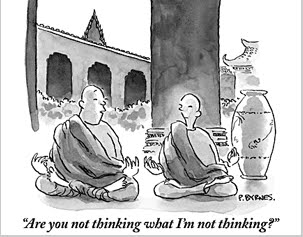
Meditation and koan resolution is by insight not discursive thinking (cartoonbank.com).
Don’t “Piss Away Your Power” Text by Marc Lesser (care2.com, Green Living, comments) “Living our life deeply and with happiness, having time to care for our loved ones -- this is another kind of success, another kind of power, and it is much more important” (Thich Nhat Hanh).
When I was in my early 20s and a young Zen student living at the San Francisco Zen Center’s Green Gulch Farm in Marin County, an older woman teacher of mine looked me in the eyes and said, “Marc, you have a way of pissing away your power.”
Zafu girl (juniper.typepad.com)
I didn’t know what to make of this. I was stunned at her directness. And I was puzzled. Was this a criticism or a compliment? I felt bad, wondering why and how I was not embracing and utilizing my power. At the same time I felt encouraged because I had no idea I had any power to piss away!
I thought: Where and what is the power that she sees in me that I don’t see? I suspected that this statement was intended as a gift, one human being looking at another, seeing and expressing what [s/he] believes is possible in the other person, not measuring and comparing but acknowledging an intrinsic positive quality.
Successful meditation manifests as nondistraction (one-pointedness) of attention. That needs gentle nonjudgment and contented persistence.
Perhaps at its most basic, offering what she said was a compliment but one couched in language that said ominously, “Don’t squander that gift.” This statement has been a puzzle, a “koan” for me ever since.
A koan in Zen Buddhism is a story that is used to deepen understanding, to transform the way in which we experience our selves and the world, generally by cutting through habits, patterns, and conventional views and attitudes. A koan doesn’t necessarily have an answer but... More>>
Spirit Rock's serene exterior and Jack Kornfield lecturing within (SF Examiner). Spirit Rock's many Buddhas welcome, amuse, and in a sense adorn the 410 acre meditation retreat facility located 30 miles north of San Francisco in rural Marin County, California. View Slideshow
Spirit Rock is not a New Age center per se. Located in San Francisco’s Bay Area (in the Marin County city of Woodacre), Spirit Rock is home to Theravada Buddhists. They are not Zen, Tibetan, or Mahayana Buddhists, as they emphasized. They are Theravada, as is one of their founding members, the American Buddhist teacher and popular author Jack Kornfield.
Many find Spirit Rock a refreshing, spiritual place to visit or to participate in a meditation retreat. This county, southern Marin in particular, is not much for Christian worship, or so says an older study on religious practices in Marin. This tidbit indicates the general religious interest of the Bay Area. One librarian at the Tiburon library says most spiritual and religious books in their library are "New Age." Christian reading isn’t of interest. Jack Kornfield is particularly popular.
Jack Kornfield and one of his many psychology-infused books on Buddhism.
The publisher of After the Laundry, the Laundry (Random House) says: "Enlightenment does exist." Internationally renowned author and meditation master Jack Kornfield assures us. “Unbounded freedom and joy, oneness with the divine...these experiences are more common than you know, and not far away. "But even after achieving such realization — after the ecstasy — we are faced with the day-to-day task of translating that freedom into our imperfect lives. We are faced with the laundry.
"Drawing on the experiences and insights of leaders and practitioners within the Buddhist, Christian, Jewish, Hindu, and Sufi traditions, this book offers a uniquely intimate and honest understanding of how the modern spiritual journey unfolds — and how we can prepare our hearts for awakening.”
According to a Marin Independent Journal article, “His books have been translated into 20 languages and sold more than a million copies." Kornfield's books include:
A Path with Heart
After the Ecstasy, the Laundry
Teachings of the Buddha
Seeking the Heart of Wisdom
Living Dharma
A Still Forest Pool
Stories of the Spirit, Stories of the Heart
Buddha's Little Instruction Book
The Art of Forgiveness, Lovingkindness and Peace
His most recent book is A Wise Heart: A Guide to the Universal Teachings of Buddhist Psychology (or The Wise Heart, which Bantam published in hardcover in April, 2008 and newly released in paperback). This is a short excerpt:
“When we learn to rest in awareness, there’s both caring and a silence. There is listening for what’s the next thing to do and awareness of all that’s happening, a big space and a connected feeling of love. When there is enough space, our whole being can both apprehend the situation and be at ease. We see the dance of life, we dance beautifully, yet we’re not caught in it. In any situation, we can open up, relax, and return to the sky-like nature of consciousness.”
Significantly, many teachers at Spirit Rock emphasize the feminine. For instance, Debra Chamberlin Taylor, writes in their August 2009 Spirit Rock News: I don’t know if there is any other Buddhist center that has a statue of Prajna Paramita [an anthropomorphism, literally the "Perfection of Wisdom"] sitting as an equal beside the Buddha on their main altar. The image of the "Mother of All Buddhas’ clearly communicates Spirit Rock’s intention to honor the feminine.
Some people might ask, "What’s the point? It doesn’t matter because enlightenment has no gender." This is true, but for many people, especially women, seeing the image is significant both consciously and unconsciously. It’s a reminder that females, as well as males, can fully awaken.
The same Spirit Rock News article contains “The Sacred Feminine: Restoring Balance in Challenging Times (Interviews by Walt Opie, Communications Coordinator)” by a yoga instructor who is a novelist (Enlightenment for Idiots) who writes:
Again, it is not an issue of men versus women because I’ve experienced many male teachers who also emphasize these dimensions of practice. But when I’m sitting yoga on a retreat that’s oriented towards the Sacred Feminine, I’m aware of an explicit intention to value the interpersonal aspect of practice; the intimate aspect of practice; the qualities of unwinding and opening rather than dominating and controlling. It’s an approach that emphasizes allowing and being, rather than doing and becoming. More>>
All materials on this site are submitted by editors and readers. All images, unless otherwise noted, were taken from the Internet and are assumed to be in the public domain.
In the event that there is still a problem, issue, or error with copyrighted material, the break of the copyright is unintentional and noncommercial, and the material will be removed immediately upon presented proof.
Contact us by submitting a comment marked "private."
Do not follow this journal if you are under vinaya or parental restrictions. Secure protection by Sucuri.
Wisdom Quarterly: American Buddhist Journal is licensed under a Creative Commons Attribution-Noncommercial-Share Alike 3.0 United States License. Permissions beyond the scope of this license may be available at creativecommons.org/about/licenses.